Blog

  • Charlecote House – Billiards Room (Painting of George Lucy)

    Charlecote House – Billiards Room (Painting of George Lucy)

    20250426_124032

    This painting is located in the billiards room of Charlecote House and it’s of George Lucy (1714-1786) who was also known as the Bachelor Squire. The painting is by Pompeo Girolamo Batoni (1708 – 1787) and it’s that which I’m most interested in here as George had a long and complex life that is far beyond any short blog post. Batoni became famous for painting members of the British aristocracy, and indeed many others, who were visiting Italy as part of the Grand Tour. George Lucy himself noted:

    “I have shown my face and person to the celebrated Pompeo Battoni, to take the likeness thereof. These painters are great men, and must be flattered for ‘tis the custom here, not to think themselves obliged to you for employing them, but that they oblige you by being employed.”

    George Lucy arrived in Naples in 1756 and soon realised that he didn’t quite look the part and he promptly asked for his clothes to be shipped from Charlecote to Italy. I’m not sure how you would go about doing that, as UPS weren’t quite fully formed at that point, but it didn’t do much good as the vessel they were on was promptly intercepted by Moorish pirates and his fineries ended up in Algiers. It was in 1758 that he moved onto Rome, with what I assume was a new wardrobe he had acquired out there, as he was clearly in no rush on this Grand Tour, and it was then that he commissioned Batoni to paint him. This was a considerable honour, the artist didn’t speed paint and he was careful what work he took on.

    Lucy paid 40 guineas for this artwork which was completed after he had left Rome and so it was shipped back, fortunately not being intercepted by pirates on this occasion. He looks very on-trend in the painting, he’s wearing fancy and fine clothes, he looks elegant and he looks very travelled. Batoni was often said to have inspired Thomas Gainsborough and on Lucy’s return he also had a painting commissioned by the British artist. The phrase Bachelor Squire was polite, he was known by others as the “wild bachelor”, obsessed with travel, society and food. I make no comment. Lucy found the process a bit of a faff, he had to sit on three occasions for Batoni and he wrote to his housekeeper at Charlecote that “he would not undertake to do me in less time”.

    Batoni’s paintings are scattered everywhere today, but this one of George Lucy hasn’t gone anywhere far since it was installed in Charlecote in the late 1750s. Along with the entire house, it was given to the National Trust in 1946.

  • 1911 Census – Spends My Money

    1911 Census – Spends My Money

    Credit for this one to Family Tree Magazine, but they noted that on this 1911 census form that the occupation of the housewife has been listed as “spends my money”. George Henry Mousell, a transport clerk, lived at 17 Clifford Gardens in Kensal Rise, London, and goodness knows if his wife, Lucy Mousell, ever saw this. [I originally posted this in November 2020, but have reposted it to fix the broken image link].

  • Charlecote House – Billiards Room (Colonel Sir Henry Fairfax-Lucy)

    Charlecote House – Billiards Room (Colonel Sir Henry Fairfax-Lucy)

    20250426_123946

    This artwork is located in the billiards room at Charlecote House and is a painting of Colonel Sir Henry Fairfax-Lucy (1870-1944). The date of the artwork is unknown, but the artist was Alfred Edward Borthwick (1871-1955) and he has painted Fairfax-Lucy wearing the uniform of the Royal Company of Archers.

    As some background, he was born Henry William Fairfax on 25 September 1870 in Leamington Spa, Warwickshire and he was the eldest son of Sir William George Herbert Taylor Ramsay-Fairfax, 2nd Baronet, whose family seat was Maxton in Roxburghshire, Scotland. His education followed the conventional path for his class, attending Eton College and it was evident that he would go on to do great things. Upon the death of his father on 19 January 1902, he succeeded to the baronetcy, becoming the 3rd Baronet Ramsay-Fairfax-Lucy (the ‘Lucy’ having been added previously into what was becoming a ridiculously long name if I’m being honest, although I’d likely take a double barrelled name if I got a country house from the arrangement). Alongside the title, he inherited the family estate of Maxton and at this time has embarked on quite a successful military career. He also managed to become a chartered accountant, which doesn’t feel like an obvious fit alongside a military career and numerous political responsibilities, but I suppose that someone has to do it.

    As for the link with this property. On 26 July 1892, Sir Henry (then Henry William Ramsay-Fairfax) married Ada Christina Lucy (1866-1943). Ada was the eldest daughter and, crucially, the heiress of Henry Spencer Lucy of Charlecote Park. Her father had died in 1890, and Ada inherited the historic Charlecote estate. This marriage thus brought Charlecote Park, with its centuries of Lucy family history, into the sphere of the Ramsay-Fairfax family. Despite the historical significance and grandeur of Charlecote Park, Sir Henry reportedly preferred to live in Scotland, presumably at his ancestral estate of Maxton. Nevertheless, he remained involved in the parish life of Charlecote. During the Second World War, he offered his services in an advisory capacity to Winston Churchill, though this offer was apparently not taken up which I imagine Sir Henry felt was sub-optimal.

    I was interested in Henry (if I might call him that) as this was the last real period when the property was run as a country house. Following his death in August 1944, the baronetcy and the associated estates, including the financially strained Charlecote, passed to his eldest son, Sir Henry Montgomerie Cameron-Ramsay-Fairfax-Lucy (1896-1965), who became the 4th Baronet. It seems that there are numerous factors here including the more obvious death duties which would have been substantial. However, his interest in his Scottish estate did mean that there had been a lack of investment at Charlecote and it wasn’t in the best state of repair, another factor as to why it was all given to the National Trust in 1946. The decision was also clearly being made much earlier, as the Stratford-upon-Avon Herald reported on 1 June 1945 that the property was likely being given to the Trust, so discussions about this seem to have begun shortly after the Colonel’s death.

    So, as a painting, this feels important as Henry was a pivotal figure. I can’t imagine that he could have saved Charlecote in terms of keeping it as a family house, and the National Trust deal did mean that the family could continue to live in one wing of the property permanently anyway. His life was certainly an interesting one, even if he didn’t get to work for Winston Churchill…..

  • Food from Every Stall on Norwich Market (2025 Edition) – Week 9 and Jacket Spuds & More

    Food from Every Stall on Norwich Market (2025 Edition) – Week 9 and Jacket Spuds & More

    20250502_131700

    This week’s attempt to eat at every food stall at Norwich Market is Jacket Spuds & More, which we visited last time we embarked on this same project in 2023. Incidentally, for anyone thinking that we’ve done three visits this week, we have as I’ve been away which has disrupted our dining schedule no end. Since we made our last visit, jacket potatoes have undergone something of a revolution in this country and that’s to a large part down to social media. Operating from his van in Tamworth, Spudman has become something of a viral sensation and he’s been able to build up a large regular trade on the back of that. Following this have been numerous other retailers trying similar things and even Subway got into the action when they started to sell jacket potatoes in a trial that was launched a couple of months ago. I’m not sure whether that trend has impacted this stall on Norwich market, but I’m impressed at how many toppings that they offer here.

    20250502_131802

    The service from the two team members was friendly and I think that they thought I was nervous in ordering, when I was just faffing about deciding what to have. There is a wide variety of choices including jacket potatoes, sandwiches, toasties, breakfasts and omelettes. The reason for my delay is I was debating having something different to a jacket potato, but I decided in the end to stick with that as I’m sometimes not very adventurous. It was clear how to order (unlike last time when we got muddled up) and the whole service was efficient and helpful, with the team members checking if we wanted a drink or anything else with the food. The stall accepts card and cash, with the prices having gone up around £1 an item over the last two years.

    20250502_132611

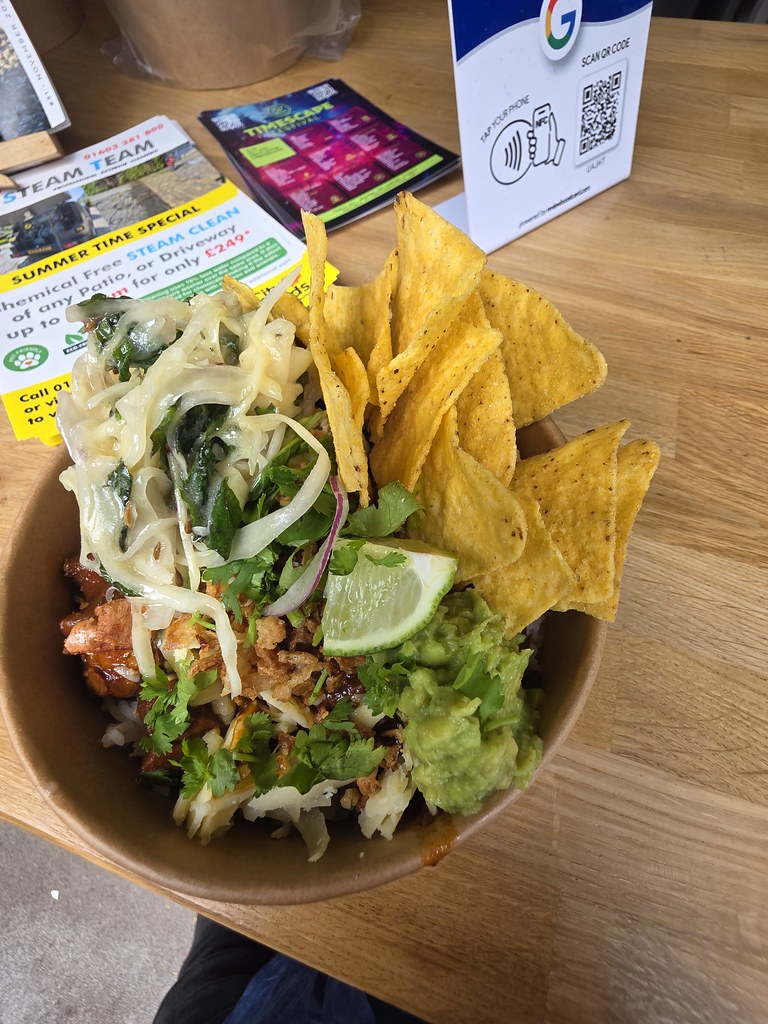
    I opted for the jacket potato with chicken curry and no butter, which was £6. That heap of black pepper on the top is me and not them, I’ve made that look worse presented than when it was handed to me. I’m not usually one to opt for a jacket potato when dining out (pizzas make quite an appearance though), but this whole arrangement did surprise and delight me. The jacket of the potato was crispy, the inside retained some firmness but was cooked through and the chicken curry was plentiful and actually had some reasonable sized pieces of chicken in it. There was sufficient curry sauce for the amount of potato, with the portion size in general feeling generous.

    IMG-20250502-WA0003

    After standing about taking photos from odd angles, James started to eat the beef chilli jacket potato with extra cheese added that he’d ordered and he noted:

    “During a recent midday peregrination through Norwich, serendipity led me to partake of a rather exemplary tubercule en chemise. This was no quotidian spud, but a specimen of discernible, superlative provenance, its preparation evincing considerable culinary adroitness: the integument crisped to perfection, the interior exquisitely fluffy, and the whole presented with commendable aesthetic fastidiousness at an eminently suitable thermal point. Crowning this farinaceous marvel was a generous impartation of piquant bovine concoction – a beef chilli of satisfying depth – further embellished by a liberal cascade of molten caseous adornment. The resultant gustatory experience, an agreeable amalgamation of textures and flavours, represented remarkably judicious expenditure considering the modest pecuniary outlay. One departed thoroughly gratified by this unexpectedly sophisticated rendition of humble fare, acknowledging the substantial contentment derived from its consumption.”

    In short, he liked it, even though he managed to spill some on his trousers, nearly choke halfway through and have chats with about ten people he knew. Talk about a social butterfly.

    All told, I thought that this was a really decent visit that was really most lovely. The service was polite, the potato and the topping had a depth of flavour, there were a range of textures and it felt like value for money.

  • Charlecote House – Billiards Room

    Charlecote House – Billiards Room

    20250426_124443

    I can’t imagine that I’ll ever need to live in a large house, not least as it would be expensive to heat, complex to maintain and I would fill it with books. But, if I did, I’d have a snooker table in it. Putting that thought to one side, this room is located on the ground floor of Charlecote House and is part of the original Tudor house and was part of a suite of three rooms and it might have been a bedroom. It was later changed into a dining room but was remodelled under the guidance of Mary Elizabeth Lucy to become a billiards room in the 1850s and the Elizabethan style ceiling was installed here at the same time.

    These billiards rooms were the on-trend thing to have in country houses in the late nineteenth century, a place for gentlemen to retire after dinner to smoke, drink port and play billiards (this was before the time of snooker being commonplace).

    20250426_123823

    The room guide told me that when the National Trust acquired the house they got rid of the original snooker table, which had some considerable heritage, as they didn’t intend to put it on display when they laid the room out as a dining room. When they decided later on that they did want to put one on display they then couldn’t get back the one they’d flogged off which all feels a bit sub-optimal. The replacement table has the annoying attribute that there are two baulk lines slightly out of alignment. The room guide also said that the National Trust believe that the lighting set-up above the table is original, that apparently went into storage but they were able to recover it (there’s a pun there about re-covering a billiards table, but I won’t labour that point).

    20250426_123907

    The rules of billiards are on the wall and they certainly go into some detail here. Anyway, this was one of my favourite rooms in the property and I’ll just have to console myself that I won’t ever own a snooker table, but maybe a bar billiards table one day….

  • Ridgeway – Day 4 (Walking)

    Ridgeway – Day 4 (Walking)

    [I originally posted this in June 2018, but am reposting it to fix the broken image links]

    Some more photos from day four of our walking expedition.

    20180614_110634

    20180614_144922

    20180614_122843

    20180614_101555

    20180614_101617

    20180614_100746

    20180614_103859

    20180614_150816

    20180614_133612

    20180614_101610

    20180614_175647

    20180614_140453

    20180614_101901

    20180614_092655

    20180614_100731

  • Ridgeway – Day 4 (Summary)

    Ridgeway – Day 4 (Summary)

    [I originally posted this in June 2018, but have reposted it to fix a broken image link]

    DISTANCE WALKED: 21.9 miles

    BRAVEST PERSON: No award. So, the award goes automatically to the bravest person on day three, which was Julian.

    QUOTE OF THE DAY: “I have a fetish for shower caps” – Bev  “Sorry about her” – Julian  “Can I just say, you have very nice eyelashes” – Bev  “Test it and see how hard it is” – Bev  “It’s still a bit fluffy” – Susanna  “I thought you were Ian Botham” – random member of the public about Dave  “Can you put a finger in?” – Susanna   “She always presses her treasures between her buttocks” – Susanna


    Well, that was another long day. We set off early and I’m writing this at 00.23, primarily because I’ve been kept chatting in the bar. It’s a hard business this walking… I also know I’m behind with photos, but they will be added this week!

    Anyway, I had breakfast at the Miller of Mansfield in Goring and I had a rather lovely selection of yoghurts and a bacon sandwich. I had a good night’s sleep and was ready at 09:15, which was the agreed time. Susanna however faffed about and so we didn’t actually meet until 09.30, although no-one complained. Other than Bev.

    The walk in the morning was leisurely and I reassured everyone how well they were doing. We look a relaxed pace and started to eat through the miles, which made me full of confidence. We reached the only church where the Ridgeway actually crossed their churchyard and we thought we’d go in.

    So, at the church I had a go at getting through the door, but as I’m a slight idiot, I couldn’t get through. So Bev, Steve, Dave and Susanna had a go, and at that stage we realised that it was locked. As I’m British, I thought that was the end of the matter, even though there were interesting medieval wall paintings inside. But Susanna was having none of it, she bravely phoned up the number on the board and a very kind man went to open the church up.

    We spent some time looking around the church and it was a delight, the photos of that will come in due course. We all enjoyed that little slice of history and we continued on our walk, all confident because I reassured everyone how well we were doing.

    We had a very leisurely lunch, plonking ourselves on the path itself on a little grassy knoll. Bev enjoyed her sausage whilst we all decided who would play us in a film. Bev managed to come up with a load of offensive suggestions for everyone, but I agreed with Susanna that Marlon Brandon could have played me, but only in his very younger days.

    After our long lunch of nearly an hour we ploughed on, really enjoying the rather more interesting terrain that we’ve had in recent days. It was less exposed today and we had much more walking through trees and by the river, and that change made things much easier on my feet.

    I haven’t mentioned my feet yet today, the very feet that nearly fell off yesterday. Fortunately, they held up well today and I didn’t encounter any real problems. Everyone had tired feet that were quite sore, but that’s different from broken feet.

    We stopped a church in Nuffield as they advertised outside that they had tea and coffee available, now that the village’s pub was shut. It was a lovely church, although the quality of the coffee was questionable, but I was really impressed that the church opened itself up. This was very much the Christian spirit and Bev rewarded them with a large donation. She probably thought it was some form of religious indulgence to forgive her sins, but nonetheless everyone appreciated the stop.

    The stop in the church was also interesting as a couple came in who were in charge of the floral displays. They gave us some information that was particularly intriguing, including telling us that David Frost was buried in the churchyard, and we went to look at their graves.

    At this point, a little problem appeared on the horizon. Everyone thought that we were around two hours away from the end of the walk, about five or six miles. I looked at my map, and to my confusion, we were only half-way. I had seriously under-estimated where the hotel was, and although that’s good news for tomorrow as the distance is shorter, it was very bad news for today.

    So, given this dreadful news, I sidled out of the church to have a panic outside. I took the opinion that a trouble shared is a trouble doubled, so I told Steve who was calm, cool and collected. This is why he’s the group’s official driver, as he doesn’t buckle under pressure.

    I don’t think it’s sexist to admit that I told the men first about the situation. We all agreed that we would rush the next few miles and then come clean. I say we, but I take responsibility for my little miscalculation. Anyway, we rushed through several miles and no-one complained. Other than Bev obviously, who came running at the front. She thought she was making a subtle point about the speed, but I can read her like a book.

    We continued on and I told the ladies in the group what I had done, but only when we had ninety minutes left. Maggie walked off during the explanation, but I think that was because she was distracted with her feet rather than being angry at my little mistake. Bev went loopy, but I have her wrapped around my little finger, so I wasn’t too bothered.

    The last ninety minutes weren’t the easiest, as everyone was tired and had hurting feet. Reaching the hotel was particularly exciting, as it had been a long day and the afternoon was hard work. The rooms were clean though and I got my free drinks vouchers for Accor status.

    We had dinner and I was very impressed, my sausages and mash were lovely, although I replaced the mash for chips. Lots of gravy and everyone enjoyed their meal. Well, other than Bev, who complained about the croutons.

    I thought we’d be having an early night at 21.00, but no such luck, the chat went on until the early hours of the following morning. I will probably regret that tomorrow, but such is life. There was a lot of gossip and a lot of chat about people who we know. We also talked about the people we miss, and there are some who would have really added to this week. But that’s the great thing about Hike Norfolk, we’re welcoming and we miss some of our members.

    So, that’s pretty much it for today. We all had fun, but it was a difficult day that was full of challenges. Well, one challenge really, the bloody long way that we had to go. The distance tomorrow is a little lower, and I hope that we can sail through without too many problems. My foot will need some repair, but hopefully that can be managed and I can be as brave tomorrow as I was today.

    Just one full day and one half day now left, the end is in sight!

  • Ridgeway – Day 4 (St. Mary, North Stoke)

    Ridgeway – Day 4 (St. Mary, North Stoke)

    [I originally posted this in June 2018, but have reposted it to fix some broken image links]

    20180614_111006

    The thirteenth century church of St. Mary in North Stoke is the only churchyard which the Ridgeway actually crosses, so we thought that it would be rather pleasant to go inside. We were delighted to see on approaching the door that it was open.

    20180614_110907

    After I had failed to open the door, Steve and Dave decide that they’ll use their wit and initiative to enter. It soon transpires that the church is unfortunately locked, despite the open sign on the door. This doesn’t stop Susanna, she finds a phone number on the church noticeboard and calls the church warden, a pleasant man who comes rushing over to open the building. His efforts were much appreciated, as the interior of the church meant that a stop here was certainly worthwhile.

    20180614_112220

    Susanna enjoying the beautiful interior of the church, with the nave dating to a slightly later period to the chancel.

    20180614_112126

    20180614_112402

    The font dates to the early English period, probably thirteenth or fourteenth century, although the cover appears to be much later.

    20180614_111846

    20180614_112117

    20180614_112022

    20180614_112107

    One of the earliest of burials in the church, which is located in the chancel. The chancel itself dates from around the early thirteenth century, and this grave appears to be contemporary to that date or just after.

    20180614_111850

    This path is the official route of the Ridgeway, which cuts across the churchyard.

    20180614_112254

    20180614_112009

    Some of the wall paintings, which are relatively very well preserved. They date to the fourteenth century and one includes the killing of Thomas Becket in the late twelfth century.

    20180614_111808

    I hadn’t heard of her at the time, and I didn’t take a photo of the grave, but Dame Clara Butt is buried in the churchyard. Susanna knew of her and was particularly excited at the news.

    20180614_113019

    20180614_111835

    This lychgate dates to 1923 and uses some of the oak from the old Goring bridge which had been constructed in 1837.

  • Charlecote House – St. Leonard’s Church (Christina Cameron-Lucy)

    Charlecote House – St. Leonard’s Church (Christina Cameron-Lucy)

    20250426_144453

    I’m rather more interested in the graves and memorials of the less wealthy, such as William Malins, but it’s hard to entirely ignore the wealthy and this is the memorial located in St. Leonard’s Church at Charlecote commemorating Christina Cameron-Lucy (1845-1919). Born Christina Campbell, she married Henry Spencer Lucy (1830-1890) at St. George’s Church in Hanover Square in London in 1865, so there’s some considerable decadence there. In 1898, she decided to take the surname of Cameron-Lucy to bring the two families together in her name. There’s a disconnect here as Henry is buried at Charlecote, but circumstances meant that at this stage Christina decided to let the entire property out.

    Christina is buried in the Cameron of Callart Mausoleum, which has fallen into a state of slight disrepair, although bits of it have been repaired relatively recently. Indeed, her memorial at Charlecote refers to her as Christina Cameron Campbell of Callart, this link was important to her. Christina and Henry had four children, Ada Christina Lucy (1866-1943), who married Sir Henry Ramsay-Fairfax (later Fairfax-Lucy), Constance Linda Lucy (1867-1955) who married John Secker, Sybil Mary Lucy (1868-1886) and Joyce Alianore Lucy (1871 – 1948), unmarried.

    There’s a story somewhere here about why Christina decided not to be buried with her husband, I assume it’s because she felt a greater affinity to her Scottish roots although I wonder what Henry would have made of that.

  • Charlecote House – St. Leonard’s Church (William Malins)

    Charlecote House – St. Leonard’s Church (William Malins)

    20250426_145414

    This grave is located outside St. Leonard’s Church at Charlecote as I’m rather engaged, or as much as anyone can be, with burials at what are effectively country house churches.

    William Malins was born in 1781, the son of William Malins and Elizabeth Malins, and he married Catherine Smith in the church on 18 July 1820, although this would have been in the medieval building that was demolished and rebuilt after his death. He lived long enough to appear on the first census in 1841, which noted that he was 60, his wife was 55 and he had a son George Malins, aged 20, and a daughter Emma Malins, aged 17. The census also noted that he was a farmer and this would fit, as his family had owned a farm at Ettington, which is in the neighbouring village to Charlecote. William died on 29 August 1843 and was buried on 2 September 1843.

    There’s an interesting question which underlies this which is whether William Malins would have had any social interactions with the owners of Charlecote Park, namely George Lucy and Mary Elizabeth Lucy at the time. It was likely that Malins was a tenant farmer, as that was the most common set-up in this period, paying rent to the Lucy family and perhaps (but not necessarily) having something of a long tenure. Although I like to imagine that William would have popped down to Charlecote House to have his lunch, it doesn’t seem entirely likely, although perhaps he was in the same fox hunting brigade. William is buried outside of the church, whereas the Lucy family had their own chapel inside, so I’m imagining that in life, as in death, they were kept close but still separate.