Blog

  • Dictionary of the Vulgar Tongue – Day Thirty-Six

    Dictionary of the Vulgar Tongue – Day Thirty-Six

    The Dictionary of the Vulgar Tongue was first published at the end of the eighteenth century, and given that the Coronavirus crisis is giving too much time to read books, I thought I’d pick a daily word from it until I got bored…..

    Bouncer

    The dictionary defines this as “a large man or woman”, which is interesting insomuch as that using the word bouncer as a slang for door staff is thought to originate from a novel by Horatio Alger called The Young Outlaw. I was hoping that instead the word evolved from inns and pubs using large men to ensure order at their establishments, but unfortunately I can’t find any evidence of that…..

  • Florence – Museo Galileo (Organum Mathematicum)

    Florence – Museo Galileo (Organum Mathematicum)

    This is an Italian Organum Mathematicum from the late seventeenth or early eighteenth century. I didn’t have a clue what this meant, but again, the museum’s web-site has the answer, it’s effectively a portable encyclopaedia.

    The museum describes more elegantly than I could:

    “The inside of the chest is divided into nine compartments, one for each of the following subjects: Arithmetic, Geometry, Art of fortifications, Chronology, Horography, Astronomy, Astrology, Steganography, and Music. Each compartment contains twenty-four small rods ending in a coloured triangular tip. On each of the nine series of twenty-four small rods are inscribed definitions and information on the corresponding subject. At least one rod in each of the nine compartments has a black tip and constitutes the application table, which gives the rule for proper use. To multiply 74 x 8, for example, one removes the black-tipped rod from the Arithmetic compartment and places it next to the rods carrying the numbers 7 and 4 at the top. The eighth line on the black-tipped rod gives the desired product.”

    I think it’s delightful, Wikipedia notes just how important they were:

    “Kircher adopted some of the ideas in the Organum from preexisting inventions like Napier’s bones, almanacs, and his own Arca Musarithmica. Like other calculating devices of the period, the Organum prefigures modern computing technology. Yet, due to its general lack of adoption, it remains an interesting but obscure footnote in the history of information technology.”

    Nathan and Richard would definitely one.

  • Florence – Museo Galileo (Box for Mathematical Instruments)

    Florence – Museo Galileo (Box for Mathematical Instruments)

    This is one of those excellent museums which gives some brief information about the object on a panel nearby, whilst adding more details on-line for those who want to find out more. So, the description by the object simply said that this was an eighteenth-century box for storing mathematical instruments. On-line, there’s lots more information about what’s inside the box:

    “The inside contains a drawer and three shelves carrying the instruments, some of which are missing. There are now several proportional compasses, reduction compasses and dividers; polymetric compasses (i.e., capable of multiple measurements); a plumb level; a few squares including a double square; a radio latino; several rulers; a quadrant; a surveying compass; a trigonometer, and a cylindrical weight tapering to a point and fitted with a ring.”

    I don’t really have that many mathematical instruments to store, but if I did, I’d like it in a grand red book-like box like this. Incidentally, I had to look up what a radio latino was, apparently it’s “a measuring instrument used in surveying and military engineering starting in the 16th century”.

  • Florence – Museo Galileo (Polyhedral Dial)

    Florence – Museo Galileo (Polyhedral Dial)

    Thank goodness for signage, as I didn’t have a clue what this was, but apparently, it’s a polyhedral dial from the seventeenth century. It’s a sundial, which allows the user to see the time in a number of different ways. Initially I thought that it was wooden, but it’s made from stone and the figures are painted on. Only one of the gnomons remains (it’s on the rear side, so not visible in the photo), which are the little things which stick out to cast the shadow (I’m not sure that’s the most technical explanation).

    The museum have a better photo at https://catalogue.museogalileo.it/gallery/PolyhedralDialInv2495.html.

  • Panxworth – All Saints Church

    Panxworth – All Saints Church

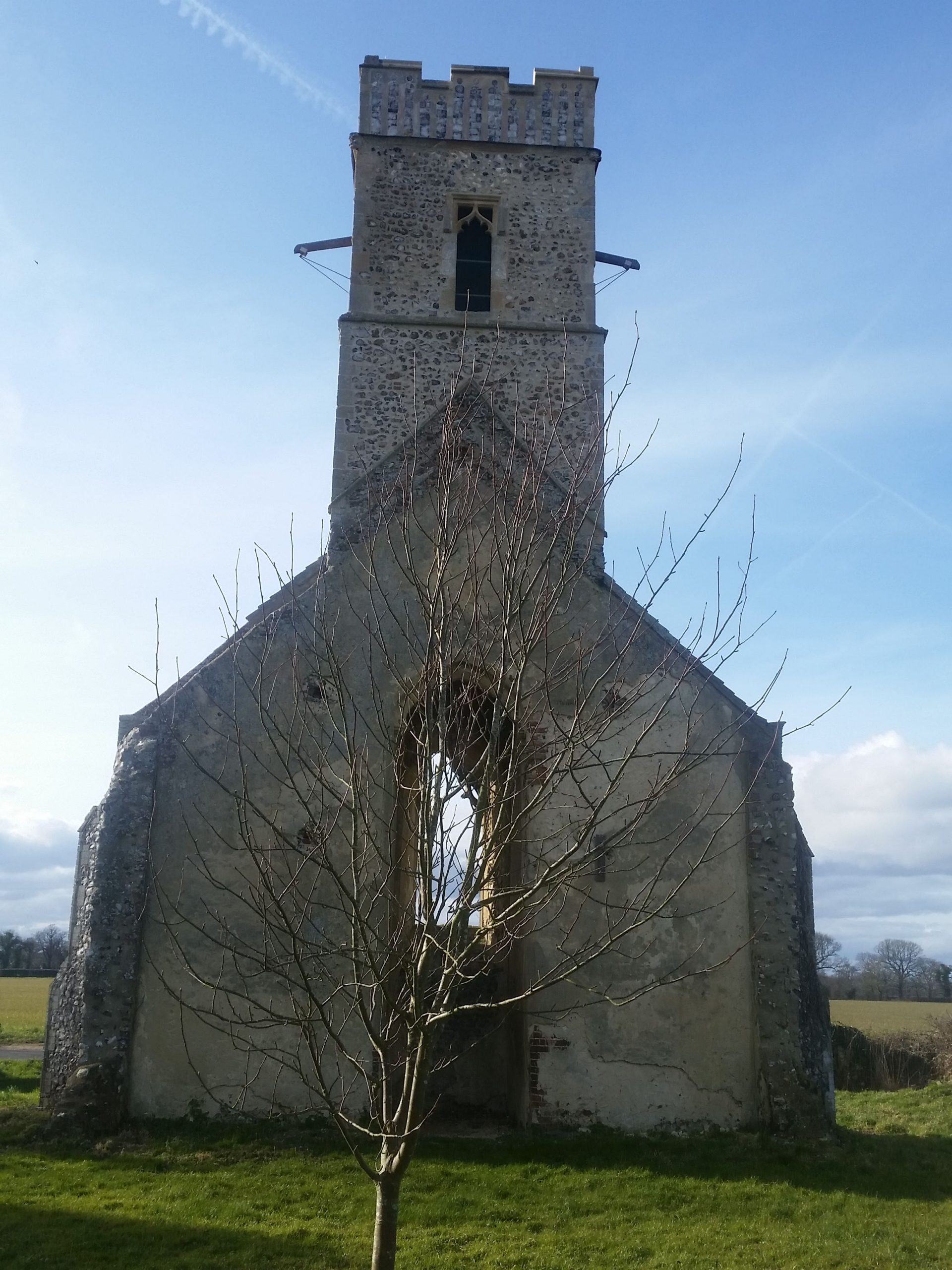
    This is one of my favourite churches in Norfolk, or at least, what’s left of it.

    The church was originally built in the fourteenth century, but as can be seen from this 1826 map, at this stage the church was in ruins (it’s located on the map just after the word ruins, at the little cross). It’s notable that there’s nothing else around there in terms of residential properties, the community had literally moved on. It’s not known when the church fell into ruins, but it was probably around the sixteenth century, which would coincide with depopulation in the area.

    However, the Victorians in a surge of confidence about church-going spent a fair sum of money on bringing the building back into use. An article in the Norfolk Chronicle in September 1845 noted that £500 was needed to complete the project and the local landowners made a donation, and there were events held including a “fancy fair”. At the fair there were “drawings on the tables of the intended design, with the building in the style of the fourteenth century, with a nave and chancel”.

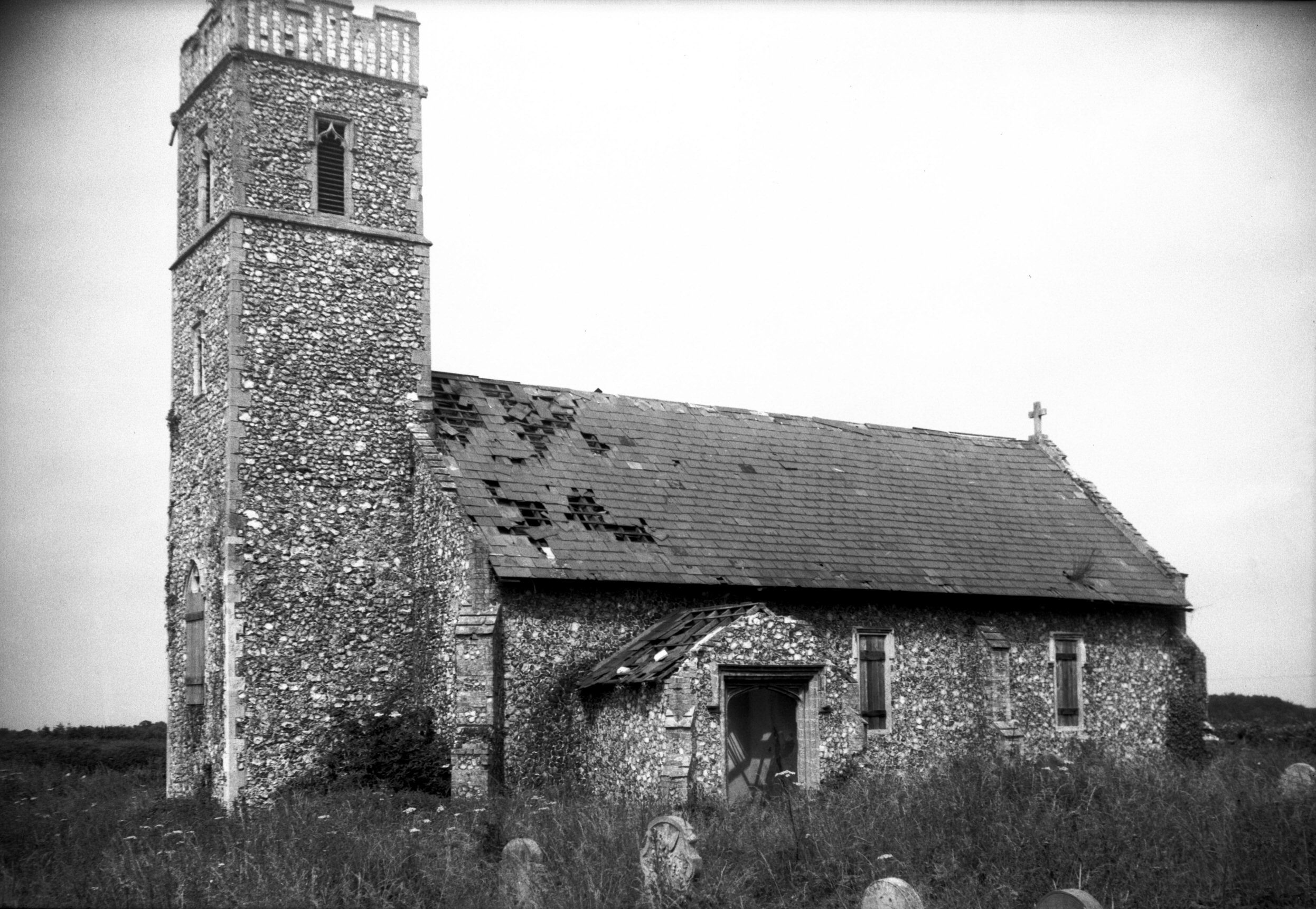
    The project (there’s a plan from 1846 here) was overseen by James Weston and he didn’t really do much work to the tower itself, just tidying the structure up and adding a new nave. This plan worked for a while, with the church remaining in use until 1959 and it was finally declared as redundant in 1976. As usual, the wonderful George Plunkett has a photo of the church as it looked in the 1970s.

    Rather than repair the nave, which by the 1980s was becoming in need of some attention, they knocked it down, which wasn’t a huge historical loss as it was a Victorian structure anyway. So, in 1981, the nave and the south porch were taken down. As if that wasn’t enough for the church, a lightning strike hit the tower in 2005, which required more repair work.

    A damaged window frame, but this looks original from the fourteenth century (the frame, not the damage).

    Inside the church tower.

    The churchyard, where the graves are still tended.

    And there’s the tower, standing somewhat adrift in the landscape. Over recent years there have been rumours that the site has been used for Satanic worship and for a while the site was closed off. Fortunately, the structure is now accessible again for visiting and I think it still looks elegant. I do though still feel sorry for those Victorian donors, who contributed money to make it an operating church once again, but instead it’s come to this.

  • Dictionary of the Vulgar Tongue – Day Thirty-Five

    Dictionary of the Vulgar Tongue – Day Thirty-Five

    The Dictionary of the Vulgar Tongue was first published at the end of the eighteenth century, and given that the Coronavirus crisis is giving too much time to read books, I thought I’d pick a daily word from it until I got bored…..

    Book-Keeper

    I really like the definition of this term, not anything about accountants, but “one who never returns borrowed books”. As a side issue, there’s a small debate about why book-keeper is hyphenated, with a few people suggesting that in this case it would really be bookskeeper, which is a clunky term, hence why a hyphen developed. This interested me, and going back to the late seventeenth century, the word is usually spelt book-keeper. There must be a whole field of study about the evolution of the hyphen, which I suspect is more intriguing than it might at first sound. I do need to get out more…..

  • Florence – Uffizi Gallery (Parade Hat)

    Florence – Uffizi Gallery (Parade Hat)

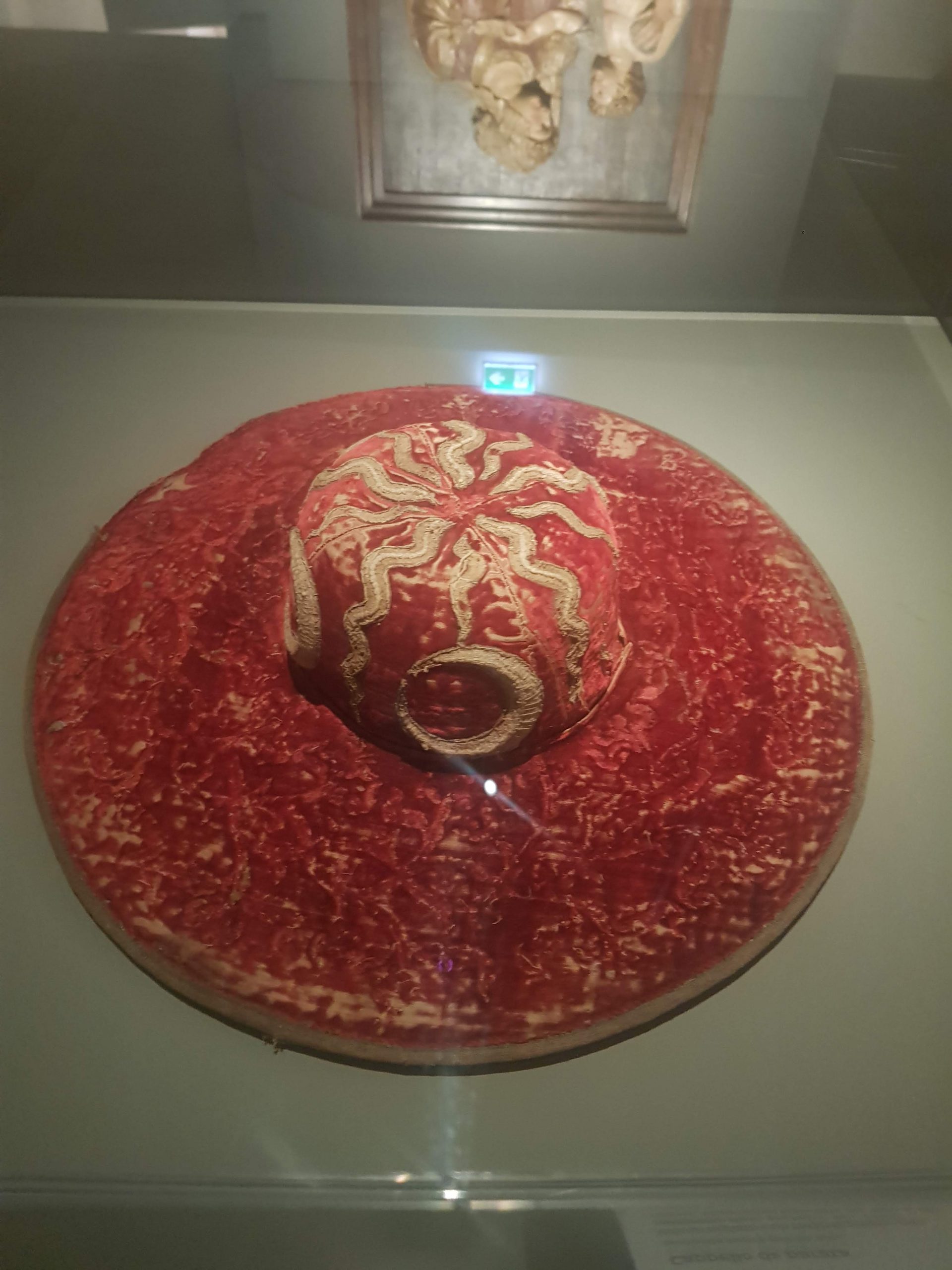
    This parade hat dates from the second half of the fifteenth century, which makes it a fascinating exhibit for any museum. Of course, this being the Uffizi, their collections are exemplary and not only has this item been preserved, but it’s thought that it might have belonged to Pope Pius II or Pope Pius III (he’s the Pope who was in the position for just 26 days). It’s made from velvet, with silk and gold braid, so a very elegant piece.

  • Norwich – St John the Baptist’s Church, Timberhill (James Tillott)

    Norwich – St John the Baptist’s Church, Timberhill (James Tillott)

    Further to my post about St. John the Baptist’s Church at Timberhill, this is one of the graves which is located within the building.

    I liked this tombstone, it’s so very eighteenth century and it’s in a reasonable state of repair. The tomb holds the graves of James Tillott (1715-1763) and his wife, Elizabeth Tillott (1714-1783), with James apparently being “a good husband, a humane master and a sincere friend”. The church’s records for both of these burials have survived, so it’s known that James was buried on Tuesday 28 June 1763 and Elizabeth was buried on Monday 16 June 1783, both three days after they died.

    Tallow chandlers usually made and sold candles out of animal fat that were used in homes, whilst wax chandlers usually made and sold candles out of beeswax that were used in churches and grander residential properties.

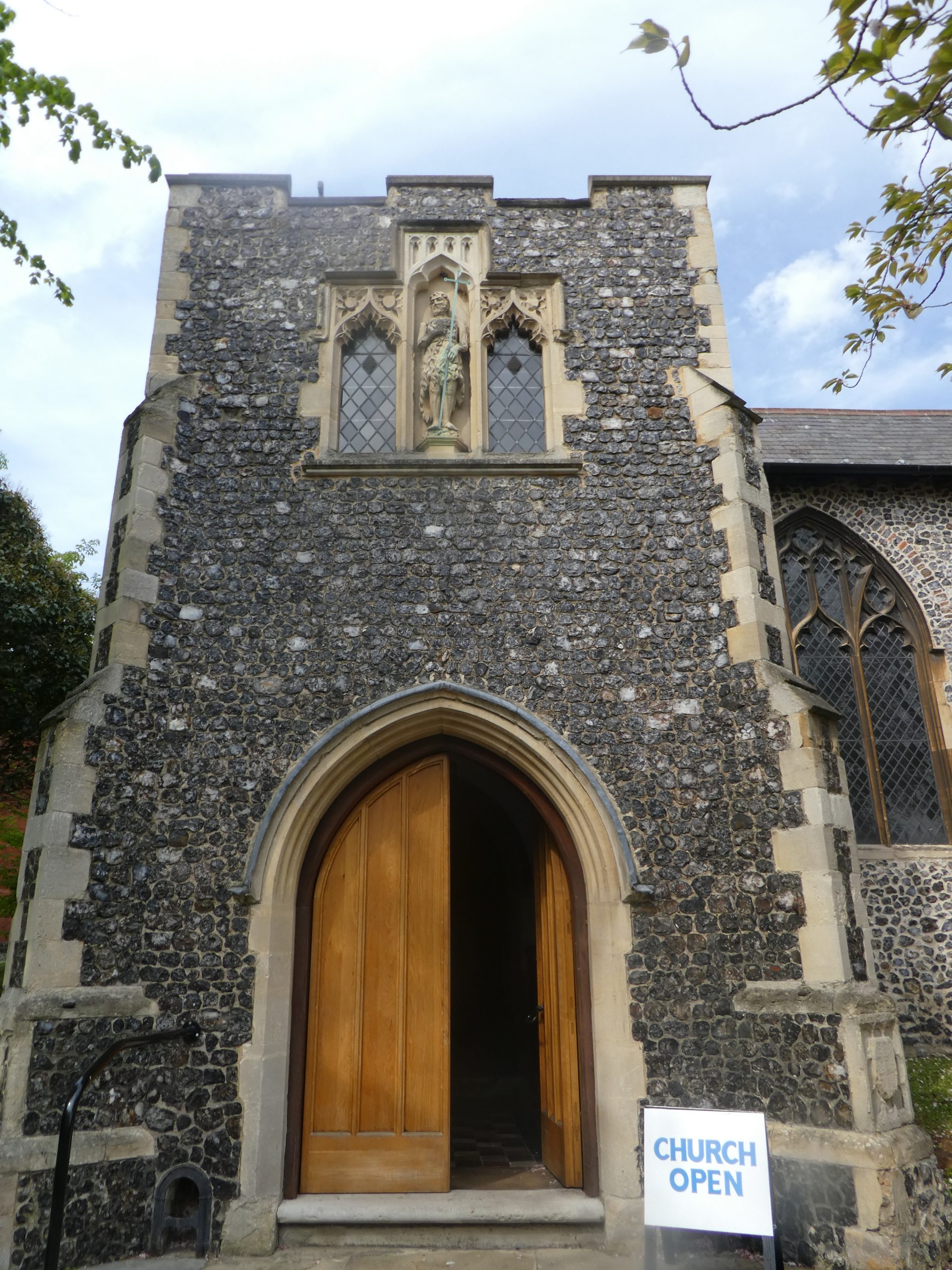
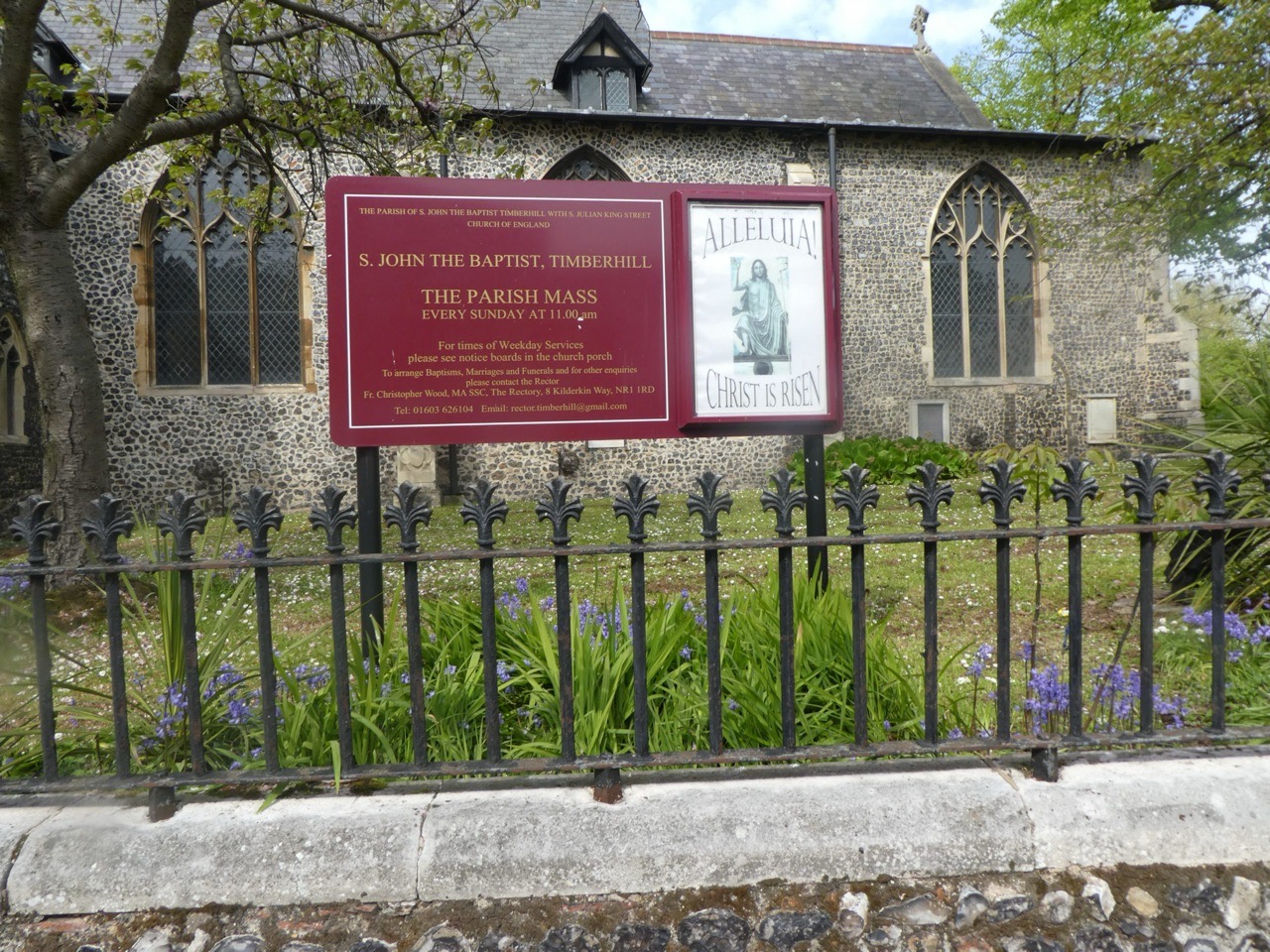
  • Norwich – St John the Baptist’s Church, Timberhill

    Norwich – St John the Baptist’s Church, Timberhill

    This church is the main Anglican church of the Catholic tradition in Norwich and the building dates to the eleventh century. It was perhaps constructed shortly after the building of Norwich Castle, which had forced some urban replanning.

    The tower fell down in 1784, which wasn’t ideal, but a shortened version was added in 1877. The church had been through some troubled times before the tower fell down, being stripped of its icons in the sixteenth century and then not being looked after structually. They also flogged off the church bells to help pay for the repair of the building, which I suppose makes sense given they didn’t have a tower to put them in.

    There are two different design styles, between the nave and the two aisles.

    Until 1828, the church had a thatched roof, which must have made for quite a sight. The more modern roof is a little less exciting, but the building is now at least in a good state of repair. Those little windows on the roof were also added in the nineteenth century, I’m not sure I like them, it reminds me of a house conversion.

    One of the few churches in Norwich which has replaced its railings, which were removed during the Second World War.

    The font, which dates to the eighteenth century, primarily as the one before got a bit broken when the tower collapsed. The rather large font cover is more modern, designed by John Howard and installed here in 1929.

    I bet this was the Victorians, so often careless with their placement of new church furniture. Although, interestingly, Father Ram, the controversial vicar in the late nineteenth century was determined to restore the building to how it looked in the medieval period, which included removing the George box pews.

    This stained glass window is from 1910, painted by Martin Travers.

    Looking towards the altar. I hadn’t expected to go in this church when I walked by a few years ago, hence why I only had my phone and that at the time didn’t exactly produce quality photos. I’ll go back after this virus is over to take better ones.

    The rood beam with its three figures, introduced by Father Ram, with some opposition to his High Church reforms. Unfortunately, the historic rood screen was removed at the same time.

     

  • Dictionary of the Vulgar Tongue – Day Thirty-Four

    Dictionary of the Vulgar Tongue – Day Thirty-Four

    The Dictionary of the Vulgar Tongue was first published at the end of the eighteenth century, and given that the Coronavirus crisis is giving too much time to read books, I thought I’d pick a daily word from it until I got bored…..

    Bones

    One of the shortest definitions provided by the dictionary so far, simply saying “dice”. The reason for the word is just as simple, as for most of human history, dice were made from animal bone. There were always alternatives such as wood, metal, antlers, stone and no doubt many more materials, but bone was likely from where it started. Dice have for centuries also been loaded, and there’s another phrase from this book on that (in about 40 days), with weights hidden inside the dice to fool the unsuspecting. I’m still impressed that King Henry VIII lost the bells of St. Paul’s Church whilst throwing his bone dice, not an ideal situation for him….