Blog

  • Wymondham – Wymondham Abbey (Thomas Betts)

    Wymondham – Wymondham Abbey (Thomas Betts)

    This gravestone caught my eye as it probably doesn’t have long left, the back is heavily eroded and there’s now a hole at the top.

    Surprisingly, the front of the gravestone is still partly readable. I think it’s the Thomas Betts who died on 28 June 1861 and was buried here on 4 July 1861. The probate records suggest that he didn’t die a wealthy man, with only minimal assets. Assuming this is the correct Thomas Betts, which I think is, he lived on Damgate Street with his family and so he would have looked out onto Wymondham Abbey.

    The 1861 census was taken a few months before he died, when he lived with his wife Mary Ann and his children, Thomas, Sarah Ann, Harriet and Rosa. He worked as a carrier in the town, as did his son of the same name. Betts sadly died at the age of 43. At least, for the moment, his gravestone remains readable and in the churchyard of the beautiful Wymondham Abbey.

  • Dictionary of the Vulgar Tongue – Day 128

    Dictionary of the Vulgar Tongue – Day 128

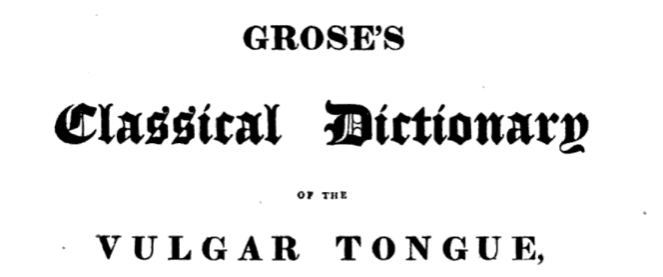
    The Dictionary of the Vulgar Tongue was first published at the end of the eighteenth century, and given that the current health crisis is giving too much time to read books, I thought I’d pick a daily word from it until I got bored….

    Freeholder

    The dictionary says “he whose wife accompanies him to the alehouse”. I’m not sure that I can add much here, although there’s something that reminds me of the Andy Capp cartoon series. I have no idea about the logic behind this word, unless it means that it’s something done by the wealthy, or freehold land-owners.

  • Wymondham – Wymondham Abbey

    Wymondham – Wymondham Abbey

    Wymondham Abbey sits almost a little adrift in the local landscape, a former Benedictine monastery which is still in use as a church. It’s imposing and impressive with its two towers and a more recent modernisation is the latest part of the building’s evolution. Work started on the building at the beginning of the twelfth century and the first main section of the monastery was completed by 1130.

    There are interpretation boards around the site that are sensibly placed and have plenty of useful information on them.

    This is the west tower which stands 42 metres high, although it was initially intended to be even higher before the money ran out. It was also where William Kett, brother of Robert who led a rebellion in 1549, was hanged from.

    The west window was added in the 1450s and this turned out to be a bit of a mistake as the tower was at risk of falling down. So, they put a new central pillar through the middle of the window to help to support the structure. Not the most elegant perhaps, but it works.

    This is what is left of the Monks’ Tower, or the east tower, which was built in 1380 to replace the earlier Norman tower that was falling down. Although this is now the end of the church, it previously went back further and this central area is where the choir stalls were once located. The monastery had been used by the town and the monks, so when the Dissolution of the Monasteries came it was decided to take down the monks’ church and leave the rest of the main building. The structure started to fall into some disrepair after this, but Queen Elizabeth I came by in 1573 and she pledged money to help fix the problems.

    This is the entrance to the chapter house of the monastery and the cloisters would have sat behind this. The complex was large, and although it has been re-landscaped the area hasn’t been built on. The church’s interior isn’t currently open given the national situation, but hopefully it’ll be back to its normal opening hours again soon.

  • Wymondham – White Hart

    Wymondham – White Hart

    I’ve never been to the White Hart in Wymondham before, but it has a grand frontage and was once the town’s main coaching inn.

    Within the building, the heritage of its time as a coaching inn is evident, I hadn’t expected such impressive interiors. The building was constructed in the early seventeenth century, likely after the fire which devastated much of the town in 1616. Originally, the above wall was the back of the wooden structure, but it was expanded backwards in the eighteenth century and that’s when the frontage was redone.

    The White Hart has been a licensed premises for four centuries or so, but for reasons that must have made sense to someone, it was renamed to the Heart of Wymondham for a few years. Irrelevant as my view is, that’s an awful name for such a historic pub and bizarre to make it sound like a cross between a nightclub and a radio station. Fortunately, the pub has been renamed back to the White Hart and normality has resumed.

    There were people in this room, so I didn’t take a photo inside, but this is the pub’s Masonic Hall from when there was a lodge held here. That’s another impressive interior though, this is a quite glorious pub in terms of its history. But, going back a little to my visit. I noted other reviews of how good the pub’s one-way system was, although I was entirely confused where I was supposed to go to order. It seems the answer is that you hover near the bar, but I suspect there’s table service when it’s busier. It only occurred to me after leaving that the pub isn’t operating track and trace, or at least, I wasn’t asked. Sometimes systems have to be idiot-proof as otherwise I get confused by them.

    The staff member was friendly and helpful though, there was a welcoming atmosphere about the pub. It has new owners and from what I heard from others there’s a focus on the food which is being served here, and they certainly have a delightful environment for diners. The beer selection wasn’t marvellous, just Doom Bar and I don’t think any craft beer, but it was well-kept and these are challenging times in terms of customer numbers. The food menu does that strange thing of offering a separate option for senior citizens without mentioning whether it’s also available for those just with smaller appetites. Not that having a smaller appetite much impacts on me, but I’ve heard so many people over the years want to order from such menus but not feeling they’d be allowed to.

    Another interior as I sat inside, primarily as I wasn’t entirely sure if they had any seats outside and I didn’t want to get caught up in the pub’s one-way system. Although I like indoors to be fair, there are fewer wasps and bees. Looking back at historic newspapers, there have been hundreds of different meetings held here over the centuries, this was once a pub that was very much at the centre of the community and the new owners seem keen to restore that ethos. The pub’s web-site makes nearly nothing of the building’s history, which is a moderate shame, although I wonder whether that’s a limitation of EI’s (Enterprise Inns) technology.

    Anyway, it’s marvellous that this pub is still trading, so much heritage packed into this building and a relaxed, friendly and calm environment. If the number of real ales or craft beers were increased with some more exotic options, this would very likely be a pub that should be listed in the Good Beer Guide.

  • Google Photos – Photo Location Archive

    Google Photos – Photo Location Archive

    Putting to one side the situation about Google knowing far too much about me, I like this new feature on Google Photos showing where I’ve taken photos over the last few years. It’s not entirely accurate (and for reasons I’m unsure it has entirely taken out my visits to Russia) as I used a camera rather than my phone for many photos, but it’s a good indication……

    Anyway, I digress.

  • Great Yarmouth – Docwra’s Chip Stall

    Great Yarmouth – Docwra’s Chip Stall

    I’m not sure what the best strategy is in terms of choosing between the various chip stalls at Great Yarmouth market. I decided on the practical solution of going under the covered section of the market to try and avoid any seagull related attacks. The owner of this stall, Norma Docwra, said in the local press a couple of years ago that the seagulls were becoming an increasing problem and she’s not wrong. There was one seagull who hopped along at one stage, but I followed that advice of staring at it, and it merrily hopped off. Rarely do wild animals or birds do what I expect, so this pleased me. Anyway, I digress.

    There’s a plethora of chip coverings at the stall, including curry sauce, chicken gravy, onion gravy, cheese, BBQ sauce, beans, mayo, burger sauce, spicy chilli sauce, sweet chilli sauce and chilli con care. Or, if those don’t appeal, there are sachets of tomato ketchup and brown sauce for 10p each.

    I went for topless chips, just adulterated in a positive way (I’m not sure that’s a thing) with salt and vinegar. I’m not one for large portions of chips, so went for the £1.20 option which proved to be entirely sufficient. Ignoring the toppings options, I like stalls where there’s just one product for sale, it makes things much easier.

    The chips were fine, not greasy, sufficiently plentiful for the money, hot and at the appropriate hot temperature. I’m not really a chip expert, so I don’t know what they were cooked in. There were two staff members, the younger one was happy and bubbly (the other one was the owner and she was serving another customer, so she might have been just as happy and bubbly but I wasn’t paying attention) so there was a friendly feel to the whole arrangement.

    All rather lovely and excellent value at £1.20. Based on this, and for comparison purposes, I might start a little research survey of other Great Yarmouth food options at the market.

  • Dictionary of the Vulgar Tongue – Day 127

    Dictionary of the Vulgar Tongue – Day 127

    The Dictionary of the Vulgar Tongue was first published at the end of the eighteenth century, and given that the current health crisis is giving too much time to read books, I thought I’d pick a daily word from it until I got bored….

    Fousil

    The dictionary defines this as “the name of a public house, where the Eccentrics assemble in May’s Buildings, St. Martin’s Lane”. This entry seems relatively bizarre to me, leading to more questions than answers.

    Somewhat pleasingly, the Eccentrics still exist as the Eccentric Club and this was originally founded in 1781, subsequently being refounded in 1858, 1890 and 2008. They now have premises at Stratford Place in London, but they were at May’s Buildings from the late eighteenth century into the early nineteenth century. They had at this time around 40,000 members, including some of the most influential people in the country.

    Unfortunately, I can’t find out anything about the Fousil public house, that seems to have been otherwise lost to history.

  • Oświęcim – Auschwitz-Birkenau Concentration Camp (Execution of Rudolf Hoess)

    Oświęcim – Auschwitz-Birkenau Concentration Camp (Execution of Rudolf Hoess)

    From May 1940 until January 1945, other than for a short period in early 1944 when he was in Berlin, Rudolf Hoess was the camp commandant at Auschwitz-Birkenau. He managed to evade capture after the end of the Second World War, but British forces eventually caught up with him, arresting him in his new role as a farm-worker. The trial was under the control of the new Polish government and it began on 11 March 1947. Hoess was found guilty on 2 April 1947 and after some deliberation, it was decided that he should die at Auschwitz on 14 April 1947.

    This is the location where Hoess was hanged for his crimes against humanity. The execution was photographed, but the public was mostly limited from watching, following the grisly scenes in Poznan when Arthur Greise was executed when it turned into almost a day out for families.

    Copyright Auschwitz Museum

    Hoess being escorted to the gallows. Before he died, the Polish authorities had encouraged him to write his memoirs, to ensure that his story was told. Before his death, Hoess had sought the presence of a priest, which was allowed and Hoess was the last person to be killed at Auschwitz-Birkenau.


  • Oświęcim – Auschwitz-Birkenau Concentration Camp (Railroad Car)

    Oświęcim – Auschwitz-Birkenau Concentration Camp (Railroad Car)

    This railroad car has been placed at the ramp at Birkenau concentration camp where victims were hounded off trains to face the selection process, where most were sent immediately to their deaths. Over 120,000 of these cars were produced in Germany between 1919 and 1925, designed to transport freight around the country. Thousands of them were ultimately used to transport victims as part of the Nazi’s final solution plan, each initially intended to hold 50 people but there were frequently over 150 in this small space.

    The railroad car here was restored with funding from Sir Frank Lowy, the former chairman of the Westfield shopping centre company. His father, Hugo Lowy, was beaten to death here on the ramp when he refused to leave his Jewish prayer shawl on the train. Frank Lowy only found out about this over forty years on and he said about his father:

    “Actually, in a way, in all my sadness, I felt very proud: that my father was able to make such a sacrifice of his life for his principles. I finally found out what happened to him. I used to dream about him, but after I discovered it, I didn’t dream anymore. You know, it was kind of a closure. In my dreams about my father, he bent over me and I didn’t know if he was really there or not. I dreamed about him many, many times. The dreams have not returned. So it must have been some kind of closure.”

    The railroad car may not have been one which actually transported prisoners, but is an authentic one from the period. What is known though is that Hugo Lowy died at around the spot where the railroad car is now placed. A tribute not just to him, but to all those who died here.

  • Oświęcim – Auschwitz-Birkenau Concentration Camp (Room of Shoes)

    Oświęcim – Auschwitz-Birkenau Concentration Camp (Room of Shoes)

    Much has already been written about this room at Auschwitz-Birkenau, the shoes that were taken from victims when they arrived at the concentration camp. There are around 25,000 pairs of shoes here, this would be about the number of shoes taken every day or two at the camp, to give this some sense of perspective. The leather smell from the shoes is also evident when visitors walk into the room as the shoes very slowly decay.

    United States Holocaust Memorial Museum, courtesy of Yad Vashem (Public Domain)

    This photo was taken at Auschwitz in May 1944, when the female prisoners were given the task of sorting the shoes that had been taken from mostly Hungarian Jews.