Blog

  • Dictionary of the Vulgar Tongue – Day 236

    Dictionary of the Vulgar Tongue – Day 236

    The Dictionary of the Vulgar Tongue was first published at the end of the eighteenth century, and given that the current health crisis is giving too much time to read books, I thought I’d pick a daily word from it until I got bored….

    Open Arse

    This perhaps less than classy phrase is defined by Grose as “a medlar”, which is a small tree. It has fruit which are a little similar to apples, but they must be picked and left to, well, go a bit off before eating them. This is perhaps less interesting than the fact that the word to describe this tree’s appearance dates back over 1,000 years and was originally ‘openaers’ or ‘openears’, with ‘ears’ being another word for arse. I find it a little bizarre that this phrase has this kind of etymological heritage, although it wouldn’t have been seen as offensive in the past as some might find it today.

  • The Magic of British Gas…..

    The Magic of British Gas…..

    This is another one of my irrelevant posts, which seem to be no less frequent recently  🙂

    In late 2019, British Gas tried to get me to change to their “best value” fixed tariff rate, but I ignored their e-mails and letters as the price was more expensive than the flexible rate. It came to pass that if I had switched to their best value tariff, it would have cost me £25 more this year. I had wondered why they were so keen to get me to switch, although it makes sense now.

    And, this is today’s little treat of an e-mail:

    “Our cheapest like-for-like tariff is only an estimated £171.24.”

    Then telling me that if I don’t sign up for this tariff soon I could end up paying £153.23 for the year. Hmmm. There is a big auto-switch button on the e-mail to click, which is located at the top, with these figures shoved at the base of the e-mail. Now, British Gas will claim that their more expensive rate is guaranteed to stay the same to allow me to forward plan, but that expensive rate also locks me in and there’s a charge of £30 to leave. I can leave their flexible rate at any time and without charge.

    This is really sharp practice IMO, stating that the cheapest rate is available by just clicking a button, hoping people don’t scroll down. Although I’m more concerned currently that my electricity bill has soared to over £10 per month, that’s a by-product of not travelling as much  :/

  • Norwich – Earlham Cemetery (Frank Samuel Tann)

    Norwich – Earlham Cemetery (Frank Samuel Tann)

    This is the grave of Frank Samuel Tann, located in the older military burials area of Earlham Cemetery. These graves offer some very different sorts of military stories to those who died in the First World War, and there was no conscription in the nineteenth century so everyone in the army is there by some form of choice.

    Frank was born in 1875, the son of Ransome Bransby Tann and Hannah Tann (nee Sayer), who had married at St. Peter Hungate Church in Norwich on 6 April 1874. The couple lived at Philadelphia Lane in Norwich, a street which is still there, but the Victorian housing has all long since gone.

    For reasons that I don’t understand, Frank was living with his grandparents (on his mother’s side) at the 1881 census, Henry Sayer and Hannah Sayer. Henry worked as a shoemaker and the family lived at Gildengate Street in Norwich. He was still living with them at the time of the 1891 census, although they had by now moved to Middle Street and Frank was also working as a shoemaker, like his grandfather.

    At the age of 19 years (and 9 months), the excitement of working as a shoemaker (specifically he was working as a clicker in the shoe trade) in Norwich had perhaps worn off. He had been serving in the Norfolk Artillery Militia and decided that he would sign up for the army, agreeing to serve for at least 12 years. He attested for military service on 29 August 1894 (and he was given the service number 4058) and his medical revealed that he was 5’7″ in height, weighed 9.5 stone, had brown hair and was a member of the Church of England.

    Frank’s war records remain, so it’s possible to say where he was stationed, although not unfortunately the exact area of any particular country. He was at his home base with the 1st Norfolk Regiment, which was at the Britannia Barracks in Norwich which had been constructed between 1885 and 1887, from 29 August 1894 until 9 November 1894. He then went to India from 10 November 1897 until 25 February 1904, before returning home between 26 February 1904 and 14 January 1905. His final overseas posting was in South Africa from 15 January 1905 until 16 February 1907, then coming back to the Britannia Barracks. I do wonder what these soldiers thought about these places they were sent, it must have felt very exotic.

    His military records also give details of his promotions, he started as a private in the army, then was promoted to a lance corporal on 27 April 1896, although returned to being a private on 10 November 1896. He was made a lance corporal again on 11 September 1897, then a corporal on 18 September 1899, a lance sergeant on 1 December 1901 and then a sergeant on 6 July 1903. He served in the army for a total of 15 years and 134 days, as he died in Norwich on 9 January 1910 at the age of just 35, the cause of death being given as a malignant tumour.

    On 14 September 1908, Frank had married Ellen Ethel in Brentwood and they lived at 2 King Street in Norwich. The witnesses at their wedding were Frederick Marshall and Alfred Hyatt, with Ellen Ethel later working as a nurse and she lived until 1956.

    Frank was buried at the military section of cemetery and the authorities must have thought that they would have enough space for many more decades, unaware of what was ahead just a few years later with the First World War. His gravestone is a good quality one, although some of the lettering is coming off, something which the CWGC repair for the graves in their care. A life sadly cut short far too early and I do wonder what Frank thought about his over seven years in India.

  • Norwich – Earlham Cemetery (Daniel George Hatton)

    Norwich – Earlham Cemetery (Daniel George Hatton)

    This is the grave of Daniel George Hatton, located in the old military cemetery at Earlham Cemetery. He is remembered by a gravestone which was placed here by his family, pre-dating those that were provided by the CWGC. Daniel was born in 1894, the son of Daniel and Emma Hatton. Daniel (the older) had been born on 10 January 1872 and Emma on 21 May 1875, with Daniel working as a shoe finisher.

    At the 1901 census, the family were living at 11 Greyhound Opening in Heigham, a property which has since been demolished. There was Daniel, his parents, and his new-born little brother, John William Hatton. By the time of the 1911 census, Daniel was using his middle name of George, with the family living at 29 Greyhound Opening, another property since demolished. Daniel George’s uncle was also with the family at the time of the census, another John Hatton. The younger Daniel was working as a boot maker and the older Daniel as a boot finisher. As an aside on this, it can only be wondered what people like Daniel would have done as a job in today’s economy, the choice of options that they had back in the early twentieth century was far more limited and many in Norwich worked in the shoe industry.

    At some point after 1911, the family moved to nearby 53 Midland Street, yet another property since demolished. Daniel’s war records seem to have been lost, but he joined the 4th Norfolk Regiment in 1914 (with service number 3659), although I don’t know if he saw any service overseas.

    Daniel died on 17 June 1915, at the age of just 21 after he was killed whilst travelling from London Liverpool Street to Norwich by train. The inquest found that “death was due to injuries to the head from a blow described as a terrific nature. The line had been examined, but no marks found on the bridges or signalposts.” The coroner said that this was “a mystery”, but noted that his service colleagues he was travelling with were entirely free of blame. After having to endure the inquest in Bishop’s Stortford to their son’s death, the family paid for his nice gravestone and I can sort of picture them standing there saying their final goodbyes.

    Daniel’s parents were still living at 53 Midland Street at the time of the 1939 register, so they saw the start of the Second World War and perhaps wondered whether they lost their son in vain. Emma died on 1941 and I can’t find when Daniel senior died. As for John William Hatton, Daniel’s little brother, he was living with his wife Gracie at 5 Lound Road at the time of the 1939 register, dying in 1989. It must have been difficult for John, he lived for 74 years without his younger brother, having lost him when he was aged just 14.

    There’s something sad about all war deaths, but for Daniel (or George, his 1911 census and one of his service records call him that) the three houses he lived in have been demolished, his war records are seemingly lost in the fire and the coroner never worked out how he died.

  • British Airways – G-BNLY and G-BYGC

    British Airways – G-BNLY and G-BYGC

    [not my photo, supplied from British Airways]
    Some good news about the 747s, I’ve pinched the below text from a press release that BA have just sent out. It’s nice to know that these aircraft have been saved, although I’m not sure if the one at Dunsfold will just be used as a part of a film set. I’m not actually sure what eCube are doing with theirs either, since they are usually a dismantler of aircraft (and G-CIVD caught fire last week). If I had a large amount of land, I’d quite fancy a 747 to be parked up on it. But, fortunately, I don’t have a large amount of land and I’m not sure what I’d do with my aircraft anyway.

    “The aircraft, registrations G-BNLY and G-BYGC, are this month due to depart from British Airways’ engineering base in Cardiff, where they will be waved off by the British Airways engineers who for many years have proudly maintained the 747 fleet. The pair were among several aircraft painted in heritage liveries to mark the airline’s centenary last year.

    Adorned in the iconic Landor livery, used between 1984 and 1997, G-BNLY has been given a new lease of life as a permanent exhibit at Dunsfold Aerodrome in Surrey. It will join its sister 747, G-CIVW, which was retired in late October and features the current Chatham Dockyard livery.

    G-BYGC, painted in the BOAC ‘Gold Speedbird’ livery used between 1963 and 1974, will make the short journey from Cardiff Airport to the Bro Tathan business park in the Vale of Glamorgan. It will be maintained as a heritage piece by aviation specialists eCube Solutions to showcase the pre-eminent contribution British Airways’ 747 fleet made to UK aviation.”

  • Dictionary of the Vulgar Tongue – Day 235

    Dictionary of the Vulgar Tongue – Day 235

    The Dictionary of the Vulgar Tongue was first published at the end of the eighteenth century, and given that the current health crisis is giving too much time to read books, I thought I’d pick a daily word from it until I got bored….

    Oil of Stirrup

    The definition of this phrase is more sinister than it might initially appear, with Grose noting that it’s “a dose the cobler gives his wife whenever she is obstropulous”. The word ‘cobler’ is just another, now archaic, spelling of cobbler, or a shoemaker, hence the stirrup reference as that was one of their tools. The word ‘obstreperous’ is lovely in itself, but it means unruly or difficult. So, effectively, this is another phrase for wife beating, although it seems to have come into usage only briefly during the late eighteenth century and had pretty much disappeared again by the early nineteenth century.

  • London – Kensington and Chelsea (Borough of) – EasyGroup

    London – Kensington and Chelsea (Borough of) – EasyGroup

    And another random post….

    The branding from easyGroup is nearly always quite vibrant and they haven’t held back at their London offices in Kensington. I like that their branding is so recognisable, quite an achievement. As an irrelevant aside, I try and avoid anything from easyGroup since they started getting involved with practices such as those mentioned at https://www.pinsentmasons.com/out-law/news/hard-cheese-for-stelios-in-easypizza-case. But each to their own….

  • London – Kensington and Chelsea (Borough of) – National Army Museum (Earl Haig Fund Poppy Badge)

    London – Kensington and Chelsea (Borough of) – National Army Museum (Earl Haig Fund Poppy Badge)

    This is my photo of the Earl Haig fund poppy which is on display at the National Army Museum.

    This image (courtesy of NAM) is much clearer though. The poppy was made at a factory in Edinburgh and the operations there were set up Earl Haig’s wife, as few of the poppies produced in London were getting to Scotland. The factory was opened in March 1926 and initially employed just two people, but this increased to over 100 within just a few years.

    The poppy in the collections of the National Army Museum dates to around 1930, at a time when poppies were made out of different materials which were charged at different prices. It wasn’t until 1954 that only the paper poppy was produced, with no fixed price but offered instead by donation.

    And one thing I never knew until today, the Scottish poppy has four petals, whereas those produced in the Richmond factory in London have two petals. Which goes to show how unobservant I am…..

  • Norwich – Earlham Cemetery (Marsham Elvin Wrench)

    Norwich – Earlham Cemetery (Marsham Elvin Wrench)

    This is the war grave of Private Marsham Elwin Wrench, located in the older military cemetery within Earlham Cemetery. Unfortunately, the age of this soldier are wrong, he died at the age of 48 and not 42. Marsham was born in Kensington on 13 November 1872, the son of Marsham and Margaret Wrench.

    At the 1881 census, the family lived at 43 Monteith Road in Bow where the older Marsham was working as a general dealer. Marsham the younger was the only boy in the family, living with his older sister Susan and his younger sisters Mary, Alice and Maud. As an aside, Martha Elizabeth Land lived in this house during the Second World War and she was one of 173 people killed at Bethnal Green underground station when people fell down the stairs and died in the crush that ensued.

    At the 1891 census, Marsham was 18 years old and he had decided to join the army, where he was listed as being a gunner living at the Woolwich Barracks. He doesn’t appear in the 1901 census, so was likely serving somewhere else in the army. He had by this time got married, hence his move to Norwich, although he had been widowed by the time of the First World War. Fortunately, the war records have survived, which means there’s a story of his expeditions around the world.

    Marsham joined the army in Woolwich on 11 December 1886 at the age of just 14, with his trade being listed as a musician. He signed up for the Royal Artillery, agreed to serve for 12 years and was happy to be vaccinated. He was just 4’6″ tall, weighed 5.8 stone, had brown hair and declared himself as a member of the Church of England.

    Marsham was disabled with haemoptysis in June 1911 in Karachi in what was then India, but is now in Pakistan. He was moved to a hospital in Bombay before returning to England. He rejoined the army reserve on 20 August 1914 as part of the Norfolk Regiment, briefly going to serve in France. On 11 November 1914, a medical report though declared that he was unfit for service, his usual weight of 12 stone 5 lbs had fallen to 9 stone 10 lbs and he had a frequent cough.

    Marsham died on 20 April 1920, and by nature of him having a war grave, he would have died of injuries incurred in the war, although I’m not sure what they were or where he went.

  • London – Southwark (Borough of) – The Rockingham Arms

    London – Southwark (Borough of) – The Rockingham Arms

    I’ll add now that this visit was from some weeks ago, they’re not open during the second lockdown. I’m working through old photos since I can’t currently go to pubs….

    This is an image from Google Streetview of the front of the Rockingham Arms (taking its name from another pub which had been in the area), the JD Wetherspoon pub in Elephant and Castle, London. It’s not the most glamorous of buildings, it’s in the 1960s Metro Central Heights building, the former home of the Department of Health and Social Security. It was another little design error, the Government were very pleased with their new building, but it soon fell out of favour and it suffered from sick building syndrome. The civil servants moved to a lovely new building in Whitehall and this structure was repurposed to be used for residential flats.

    Anyway, back to what it is now, a JD Wetherspoon pub. Punk IPA, always cheaper than Brewdog charge in their own pubs, I find that this a very drinkable beer. It might be one of Brewdog’s more generic beers, but it’s still nicely citrusy and with some depth of flavour to it.

    And the chicken jalfrezi from Curry Club, which is very rarely a disappointment and wasn’t here either. Served quickly, at a hot temperature and by a staff member who was perfectly polite, it’s hard to find anything to complain about here.

    The pub interior is perhaps a bit bland, but it feels like a safe environment and I’ve never experienced any problems in the times that I’ve visited here. It lacks the atmosphere of some of the more historic buildings that Wetherspoons operate and the open plan of this pub does make it all feel a bit generic. The toilets, which are located downstairs in the basement, could do with a little bit of a refurbishment as well.

    The reviews for the pub aren’t great, but I think that’s more because some customers are keen to complain and the ones who are happy don’t tend to post. There was a 1-star review as the barman didn’t serve a customer who was on the phone, with the customer noting “I told him that it doesn’t matter that I’m at the phone as far as I order properly”. I suspect a fair few bar staff would have agreed with the pub here.

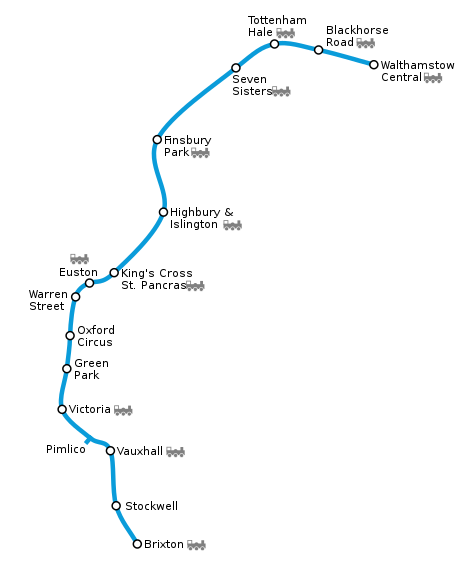
    Anyway, all perfectly acceptable, keenly priced and just a short walk away from the London Underground.