Blog

  • Munich – Klinglwirt

    Munich – Klinglwirt

    20250821_192908

    We veered to the Au-Haidhausen district of Munich in the evening of our relatively short stay as there looked to be some rather more on-trend options in this area, not least some decent beer options. This restaurant, Klinglwirt, is very focused on organic and sustainability, with the online reviews being positive to match that. We walked to the restaurant, but it’s located a short distance away from the Rosenheimer Platz underground station.

    20250821_180705

    There was a friendly welcome, as well as a relaxed and inviting atmosphere in the restaurant. It was relatively busy, but they were able to seat us without a reservation. The prices were a little towards the higher end of the scale, but the standards were evidently high. There was a bustling element to the restaurant, but it was never noisy and the child at the neighbouring table watching his mobile phone helpfully had it on silent.

    20250821_183241

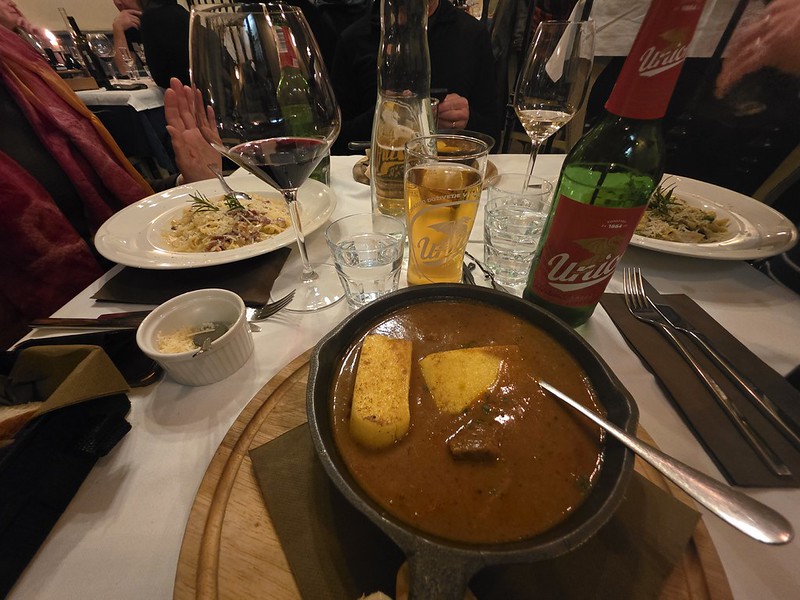
    I went for the sausages and mash, which cost around £16, so slightly pricey but the quality of the meat was high and the mustard wasn’t too harsh in its flavour. The portion size was a little better than the photo suggests, but I could have done with a little more. The sausages actually had a meaty profile rather than spice and bulking agent, with the restaurant being proud to advertise that their pork comes from the organic Herrmannsdorfer Farms. The actual real highlight of this dish was, perhaps not entirely predictably to me, the sauerkraut which was punchy and even slightly decadent.

    The beer is the Franziskaner Kellerbier from Spaten-Franziskaner-Löwenbräu-Gruppe which isn’t my usual style of choice, but it had a pleasant depth of taste. It was a clean tasting drink, which was a little sweet with slight tastes of toffee, a generally well rounded beer.

    20250821_183244

    Richard spent more, as one might expect, getting a charcuterie type board which he was pleased with.

    20250821_190353

    He’s abandoned his diet now in the name of research and is ordering desserts all over the place.

    20250821_190527

    I don’t usually do desserts, but the apple strudel option was too tempting to resist. The vanilla custard added positively to the arrangement, with the pastry being light but tasty with not sogginess ruining the dish.

    All told, this was a positive visit and the strongest element really was the welcome and comfortable nature of the venue. It’s not always guaranteed, but they accepted cards here, although Richard had taken out cash just in case. The food and drink all met my expectations, with an evident depth of flavour and taste. It might not be the cheapest option in the neighbourhood, but the quality of the food was high and I’d recommend the venue to others.

  • Munich – BrewsLi (Der Biermacher)

    Munich – BrewsLi (Der Biermacher)

    20250821_210844

    If I’m being entirely honest, there’s a lot of generic beer served across Munich in the same way as dull lagers are served in many UK pubs. Manacled by the outdated Reinheitsgebot, which is a Bavarian innovation, the boundaries of beer are far more limited than in nearby countries such as Poland and macro breweries pump out endless litres of uninspiring beer.

    20250821_195643

    20250821_195646

    But there is yet hope, from a growing number of interesting, innovative and excellent craft breweries.

    20250821_210828

    20250821_210824

    Some of the brewing equipment on-site and thank goodness for ventures such as this, which is listed on Untappd. Table service is offered, which felt a little unusual for a set-up like this with a blackboard behind the bar, but the team members were knowledgeable, helpful and engaging. This felt a place where the staff actually cared about the product and were keen to talk and converse about it.

    20250821_201058

    The interior is functional and clean, but this is all about the beer. Richard couldn’t find anything that tempted him, so he had some wine related thing that I ignored.

    20250821_201238

    I went for a tasting board to try as many of the brewery’s beers as I could.

    (i) Bru-Bliss. This is a light, fluffy, hoppy and smooth IPA with a touch of citrus.

    (ii) Os’s Hoptimus Prime. This had flavours of mango and orange, being light and nicely rounded.

    (iii) Royal Drunkness. Creamy, sweet, taste of coffee and liquorice.

    (iv) Quake Crusher. Fluffy, with flavours of grapefruit, stone fruit and perhaps a bit of hedge.

    (v) PH-1 and this was my 6,000th Untappd check-in. Nicely sour, lots of orange and just the right amount of tartness.

    (vi) Sky Krush. Hoppy, hides its 7.5% ABV and suitably juicy.

    And, in my view, these beers completely outclassed the generic offerings at Hofbräuhaus which is an ideal location to see Munich’s past. The focus here is on flavour, quality and depth of taste, not just beer designed to be poured in litre quantities and drunk quickly. The number of these venues is increasing across Germany, but I wish they’d increase in number just a little quicker. I was suitably surprised and delighted, this is definitely a venue that I’d recommend.

  • London – Alex Dilling at Hotel Café Royal (2 Star Michelin Restaurant)

    London – Alex Dilling at Hotel Café Royal (2 Star Michelin Restaurant)

    20250828_183002

    Richard does some very sensible things sometimes, like going to a charity auction, having too much to drink and then bidding on a five course tasting menu with champagne at a two star Michelin restaurant. So that’s why I was here. I haven’t yet won the lottery.

    20250828_203826

    The restaurant is located on the first floor of the Hotel Café Royal, one of Oscar Wilde’s favourite restaurants.

    20250828_203600

    Overlooking the hotel reception where rooms start from £700 per night. I had booked the £38 Travelodge at ExCel though, I know my place. Richard compromised and was at the Novotel ExCel at nearly £100 a night, but he has aspirations of grandeur.

    20250828_203858

    It’s all quite decadent. I think that would go without saying though.

    20250828_183348

    We were seated at a table overlooking Regent Street, it was like sitting in a calm and suitably chilled observatory looking out onto a hectic street.

    20250828_183734

    The champagne, which was Bollinger and which tasted like every other champagne to me, but I don’t claim expertise here. I didn’t expect otherwise, but I wasn’t surprised and delighted at the beer list, so I stuck to the free sparkling water, but Richard splashed out £120 on the wine pairing and spent the evening beaming like he had purchased a stake in a vineyard. I would have gone for a craft beer pairing, but although this is becoming more common, it’s still not treated in the way that wine is.

    20250828_183823

    The menu for the evening which was swept away soon after, but not before I took this photo of it.

    20250828_185134

    I think that they expected diners to have one roll each, but Richard had three, so I did the same. And then asked for another one later on, so that was four delicious rolls. The chorizo one, which is the fluffy puff pastry roll on the left, was really quite glorious and bakery certainly isn’t just a side show here.

    20250828_184151

    The amuse bouche.

    20250828_185338

    This is the aged Kaluga caviar. I’m not sure I understand the mystique of caviar, this was clearly a rather decent one with a creamy and buttery flavour, but I don’t understand why it has the luxury tag attached to it other than its rarity. But, hippo is quite rare, and they wouldn’t serve that. Anyway hippo matters aside, the sweetcorn retained some bite and the prawns added some texture to the arrangement.

    20250828_190854

    This is the John Dory with brown crab and lovage, which proved to be my favourite dish of the evening. I like John Dory, it’s light but flavoursome, delicate and easy to bully, but it was the crab on the side that I thought was the decadent and rich tasting element to this dish. The presentation was rather fine as well, with a range of tastes and textures running through it.

    20250828_194520

    A little mango based palate cleanser. Richard was struggling to keep up with his wines, as he had one per course. I was busy keeping up with my rolls.

    20250828_192237

    This is the quail with courgette, anchovy and Parmesan, also being Richard’s favourite dish of the evening. I don’t get to eat quail very often, it’s not something Greggs pop in their selection of bakes very often, but it was gamey in flavour and also tender. The anchovy packed a salt punch through the dish, with the ingredients all complementing each other to give a real depth of flavour, with the Parmesan giving it that suitable umami feel.

    20250828_195225

    The presentation here is quite special, with the meringue at the base being punchy and the sorbet being smooth and sweet.

    20250828_195959

    20250828_200003

    20250828_200006

    A final trio closed proceedings, my favourite being a little praline number with a whisper of gold and a pleasing roasted-nut finish.

    The atmosphere in the restaurant was inviting and comfortable, with a quite modern selection of music playing which I hadn’t anticipated. But, the aim appears to be to have a welcoming and informal dining experience, rather than a stuffy and unnecessarily upmarket one. There’s not much point in having a beautiful restaurant if no-one is comfortable in it though, so I felt that the design elements were all appropriate and in keeping with their aspirations. There was always a touch of theatre in the presentation of the food and plating elements at the table, but that never became intrusive. The restaurant was quieter earlier on, but got steadily busier so it was nearly full by the time that we left.

    Overall, this was a rather lovely decadent experience, with the service being impeccable throughout. We were never rushed, but the pace of the dine was constant and appropriate, although it of course felt that it was over too soon. The quality of the food was as expected high and Richard was beyond excited about his wines, with the servers busily clearing crumbs off the table from my excessive consumption of rolls. I thought a lot of the dishes were quite understated and I reference that in a positive way, there was a competence rather than a desire to surprise by being quirky. The only problem Richard has now is that he’s decided this is the way he needs to live, so I expect to see him at all manner of Michelin restaurants over the coming few months….

  • Fakenham – Edward VII Coronation Lamp-post

    Fakenham – Edward VII Coronation Lamp-post

    [I originally posted this in August 2018, but have reposted it to fix the broken image links]

    20180803_134635

    This lamp-post, which was funded by public subscription, was erected in 1902 to mark the coronation of King Edward VII as the country’s new Monarch.

    20180803_134643

    The coronation date for the King was originally set to be held on 26 June 1902, but King Edward got an abscess and it had to be delayed. I can imagine the irritation that this caused to the people of Fakenham, who then had to go and buy a second plaque. All was well though for the second date, and the Coronation went ahead on 9 August 1902.

    20180803_134646

    This panel notes the creation of the Royal Manor of Fakenham, linking the town to the Royal Family.

  • Fakenham – War Memorial

    Fakenham – War Memorial

    [I originally posted this in August 2018, but have reposted it to fix the broken image links]

    20180803_134013

    The town’s war memorial was unveiled in August 1921 to mark those who had died during the First World War.

    20180803_133957

    There are 96 names of those who died during the First World War, 27 names for the Second World War, 2 names of those who died during the Korean War and 1 name from the Iraq War in 1954. There’s a full list of those who died at http://www.roll-of-honour.com/Norfolk/Fakenham.html with five names having been added later (two from World War Two and those who died during the Korean and Iraq conflicts). Details of these five men are listed at http://www.edp24.co.uk/news/the-heroic-tales-behind-the-new-names-on-fakenham-war-memorial-1-2963865.

    20180803_134007

    It’s a nicely presented war memorial and it’s centrally located in Fakenham.

  • Munich – Hofbräuhaus Brewery

    Munich – Hofbräuhaus Brewery

    20250821_154546

    I’m not really that engaged with the bierhaus type concept where it’s all about quantity of alcohol rather than a focus on quality beer. The shared tables, music and lack of beer that inspires me doesn’t bode entirely well. However, I was pleased that we did pop into this brewery to see what went on.

    20250821_154617

    On a Thursday afternoon it was busy, very busy. It’s hard to argue with that level of popularity, even if your heart belongs to little taprooms down side streets.

    20250821_154633

    The place can seat over 3,500 people and we struggled to find a table space.

    20250821_154720

    Hofbräu München began in 1589 when Duke Wilhelm V set up a court brewery at the Alter Hof to supply his household with brown beer. The first brewmaster was Heimeran Pongratz, and within a few years the new brewhouse had become a fixed part of Munich’s court economy. Under Wilhelm’s son, Maximilian I, the focus shifted to wheat beer and in 1602 he secured a princely monopoly over Weissbier across Bavaria and expanded production so rapidly that, in 1607, the wheat brewery was moved to a new site at the Platzl while the brown-beer operation continued at the old court. Opening sales to Munich innkeepers in 1610 turned Hofbräu from a court supplier into a business with a city-wide market and they became an important part of the local economy.

    20250821_154941

    The drinks menu with the ‘exciting’ beers that are available, with the prices not being unreasonable.

    Back to the history though…. In 1614 the brewmaster Elias Pichler introduced a strong Ainpöckisch-style beer that became Hofbräu Maibock, the city’s archetypal spring bock. During the Thirty Years’ War the beer acquired legend as when the Swedes occupied Munich in 1632 they accepted, alongside a cash tribute, a consignment of Hofbräu beer, much of it Maibock, and left the city largely unscathed. As for the beer, it obviously complies with the Reinheitsgebot, which I consider as something bad, but the brewery inevitably view it as something good. After the Bavarian kingdom was proclaimed in 1806 it was known as the Royal Hofbräuhaus and in 1808 the brown-beer plant also moved to the Platzl complex to gain space. In 1828 King Ludwig I formally allowed hospitality on the premises, creating the beer hall tradition visitors know today and in 1852 ownership passed from the crown to the Bavarian state, where it remains as the State-owned Hofbräuhaus in Munich. Industrial growth in the late nineteenth century pushed brewing out of the cramped city-centre buildings and between 1894 and 1896 Hofbräu built a modern brewery on Innere Wiener Straße in Haidhausen, and in 1896 the architect Max Littmann refitted the Platzl as a purpose-built tavern.

    There was a more sinister period for the building in the inter-war period as on 24 February 1920, Hitler unveiled the Nazi Party’s 25-point programme at a meeting attended by around 2,000 people. He returned to the venue on numerous occasions to make speeches and it’s where he made the “Warum sind wir Antisemiten” speech where he started to define who the enemies of the state were (mainly Jews) which was to underpin what came next. This entirely sub-optimal piece of history came to an end of sorts when the beer hall was largely destroyed by bombing in 1944, although it was then reconstructed after the war, with the grand Festival Hall reopening for Munich’s 800th anniversary in 1958. Production stayed in Haidhausen until a major fire in the malthouse and offices on 6 April 1987 forced an accelerated move to a new, purpose-built plant at Munich-Riem. The Riem brewery was inaugurated in November 1988 and remains Hofbräu’s production site today.

    20250821_155126

    The pretzels are sold by people who walk around and these can only be purchased with cash. This tasted of a decent quality, it’s something that works well with beer.

    20250821_155203

    There is lockable storage for 616 steins which are used by locals, some of these are over 100 years old.

    20250821_163643

    The area where customers can wash their stein, all very handy and this was used by some locals when we were there.

    20250821_163110

    I evidently sat at an appropriate location, although this obviously wasn’t me involved with such vandalism. In terms of seating, we walked around a couple of times before finding an empty table. It is appropriate and allowable to ask others to join their table, or at least the other end of it, but I’m too British for that. If we had gone in an evening, I suspect we would have had to be much more sociable if we wanted somewhere to sit. One advantage in sitting at the side was that I couldn’t hear the live music, which isn’t a complaint about the quality as I’m sure it was excellent, but I can’t be doing with all this raucous fun.

    20250821_163617

    The glasses, which unlike the one served to me were generally clean.

    20250821_160530

    Service was routine and equally brusque to everyone, which is almost comforting. Card payments are accepted with a hint of theatrical reluctance, you’re marched to a terminal and treated to a convoluted process that lasts just long enough to question your life choices. But, I can forgive this, they’re serving a large number of people who speak any number of languages and it’s fast-paced, I understand they’re not going to spend time building up a rapport with customers. We didn’t have to wait too long to be served, although it took nearly ten minutes for the beers to actually arrive.

    As for the Dunkel, it was sweet and malty, but it was generic, served in a dirty glass with lipstick marks and it was quite a basic beer lacking any depth of flavour or taste. Ultimately, they’re not going to change the taste of this beer as it’s long standing, so this all becomes a matter of mass production whilst the quality of other beers overtakes them. I did try some of the wheat beer that Richard ordered and that was better and tasted refreshing, but it still seemed quite basic and generic.

    Overall, this is a tourist attraction and it’s evidently doing very well at that as it’s busy and clearly professionally managed to be able to serve this much food and drink to customers. If coming with a group, I think that works better with the whole theme and I’m sure that a pleasant evening would be had with traditional German beer and drink, but I was underwhelmed by the bland beer to be honest. However, I’m glad to have experienced an authentic Munich bierhaus although there’s part of me just a little sad that the small breweries in the city are producing some amazing beers but they have to compete with this mass production facility.

  • Dachau – Dachau Concentration Camp (Crematorium)

    Dachau – Dachau Concentration Camp (Crematorium)

    20250821_101736

    The crematorium at Dachau was first constructed in 1940, but a larger facility was built next door between 1942 and 1943 as the first building proved to be inadequate in size in just months. Before 1940, when prisoners died, the SS sent ashes to families, buried bodies near the camp or transported them to Munich’s Ostfriedhof for cremation. It would be wrong to suggest that there was respect for the living or the dead at Dachau, but there were greater efforts made during the early years of the camp’s operation.

    Screenshot_20250827_082848_Photos

    A plan of the new crematorium.

    20250821_102334

    This is the 1940 building, which isn’t included on the above plan of the site. It remained in use until 1943 and it’s thought that around 11,000 prisoners were cremated here.

    20250821_102259

    The old gallows stand outside, these were placed here in 1942, but killings would have taken place in numerous areas around the camp. Often prisoners were hanged as a warning to others, so they would have taken place on the main parade ground of the camp.

    20250821_101803

    The ovens in the new crematorium where the dead were cremated. There was no fuel in the last few months of the camp’s operation, so they had to use nearby burial facilities or rather more ad hoc solutions instead. The Americans kept this section of the site when they liberated the camp in 1945, ensuring that it was documented and left intact.

    20250821_102017

    The shower room with fake shower heads. This is just a little confusing, the museum makes clear that there’s no evidence these were used for the mass killing in the way that took place at other concentration camps, so it’s a little unclear to me exactly what happened here. It is though probable that this room was genuinely used for the disinfecting of clothes rather than mass murder for which there’s no real evidence.

    It’s hard to imagine the horrors of what happened here when walking through, with what were likely mostly prisoners being forced to cremate those who they might have known from the camp. Initially the site might have been manageable in terms of numbers, but as the deaths increased then it all became more challenging and industrial. There weren’t the mass killings here that took place at camps such as Auschwitz Birkenau, but still many died and the whole arrangement would have been hideous. The site is hidden away a little from the main camp, but everyone would have been aware of its presence. When the war concluded, the Americans forced local Germans to walk around the site and that included visiting this section.

  • Dachau – Dachau Concentration Camp (Walk of Horror)

    Dachau – Dachau Concentration Camp (Walk of Horror)

    20250821_102746

    This walk at Dachau might at first seem quite pleasant and peaceful. Formerly in a walled off part of the compound, this is now known as the ‘path of death’, it was laid out in the 1960s when the site was turned into a memorial and museum.

    20250821_102748

    However, it isn’t, it’s located near the site’s crematorium and this is the former pistol range where inmates were executed. There were numerous places around the camp where people were executed and it’s not known how many prisoners died here.

    20250821_102821

    The execution range with the blood ditch.

    20250821_102959

    Where ashes were stored.

    20250821_102836

    The little memorial garden where the ashes of thousands of people were placed.

  • Munich – Fisch und Schlüssel Sculpture (Fish and Key)

    Munich – Fisch und Schlüssel Sculpture (Fish and Key)

    20250821_143421

    Fisch und Schlüssel’ (Fish and Key) is a punchy public sculpture in Munich’s Maxvorstadt district, standing on Ferdinand-Miller-Platz directly in front of St Benno Church. It was created by the sculptor Iskender Yediler and installed in 2005, with the artwork being an aluminium cast showing a fish carrying a key. In the photo, I think I’ve managed to capture the key element beautifully, although I accept that the fish element isn’t entirely visible.

    The motif comes from the legend of St Benno, Munich’s patron saint, who was banished during a conflict over the ex-communication of Henry IV and so Benno told his canons to chuck the cathedral keys into the River Elbe. The key was found inside a freshly caught fish a few years later which surprised and delighted a lot of people…. Angry Protestants desecrated Benno’s tomb in Meissen in 1539, so the Wittelsbach dynasty (perhaps known best in the UK because of Sophia of Hanover, who is an important figure in the family tree of the British monarchy) promptly elevated him to become the patron saint of Munich.

  • Munich – Führerbau

    Munich – Führerbau

    20250821_150646

    This is the former Führerbau, which is where the Munich Agreement was signed on 30 September 1938. This deal was agreed by Nazi Germany, Britain, France and Italy, handing the Sudetenland, which was Czechoslovakia’s fortified and industrial border region, to Hitler. Czechoslovakia weren’t at the table to discuss the matter and the British Neville Chamberlain and French Édouard Daladier accepted the transfer to avoid immediate conflict. Germany occupied the Sudetenland in October 1938, stripping Czechoslovakia of key defences and heavy industry and leaving it strategically crippled. Chamberlain also signed a brief Anglo-German declaration with Hitler expressing the wish for peaceful relations, hence the famous “peace for our time” line on his return to London.

    20250821_150257

    The peace agreement didn’t hold, but Chamberlain perhaps didn’t really have much choice here. There was a chance in his mind that the peace agreement might work, but with hindsight it was inevitable that it would fail given Hitler’s evil intent. The document was signed in Hitler’s office, which is still there and used by the University of Music and Performing Arts Munich who now occupy the building. The building had been constructed between 1933 and 1937, part of the Königsplatz project that was part of Hitler’s architectural vision for the city.

    20250821_150641

    The city authorities would have ideally liked to have demolished all of the Nazi era buildings, but they already had a shortage of usable structures post-war and there was nothing wrong with this one other than its association with evil. But, for me to see this building was sobering, it’s not that long ago that Chamberlain turned up here in the hope that he could avert a war. There’s no obvious connection with the past other than for this subtle sign which is in German, Czech and Slovak, a gesture towards the attack on their nations that was agreed here.

    20250821_151057

    And the side of the building which was used by the US after the war as the central point to return artwork and cultural items stolen by Nazis back to their owners. It was given to the University of Music to give it a more positive use and to try and free it from its past. The more modern building to the right of the photo is the NS-Dokumentationszentrum, which during Hitler’s time was known as the Brown House.