My plan was to get from Rome Airport across to Rimini during the day, where I had booked a hotel. The first part of that was from the airport railway station to Orte.
This meant amusing myself for a few hours overnight, so I decided to eat some crisps which is always a sensible thing to do to pass some time.
I went to look where the airport’s railway station was as I thought that might kill some time as well. It took up about three minutes.
It’s not difficult to find and they’re also building a new underpass to get there.
Mine was the 06:57 train to Orte. By this time it was 03:15 and I was starting to feel I had explored all that needed exploring at the airport.
I sat near the entrance to the railway station waiting and I then realised, at about 05:40, that it was possible to change my rail ticket for free to any train on the same day. With the digital tickets, you can do this until just before the train, but at that point, you’re committed. What this meant is that I could catch an earlier train, so the 05:57 train to Orte. This seemed a sensible plan as I didn’t have much else to do.
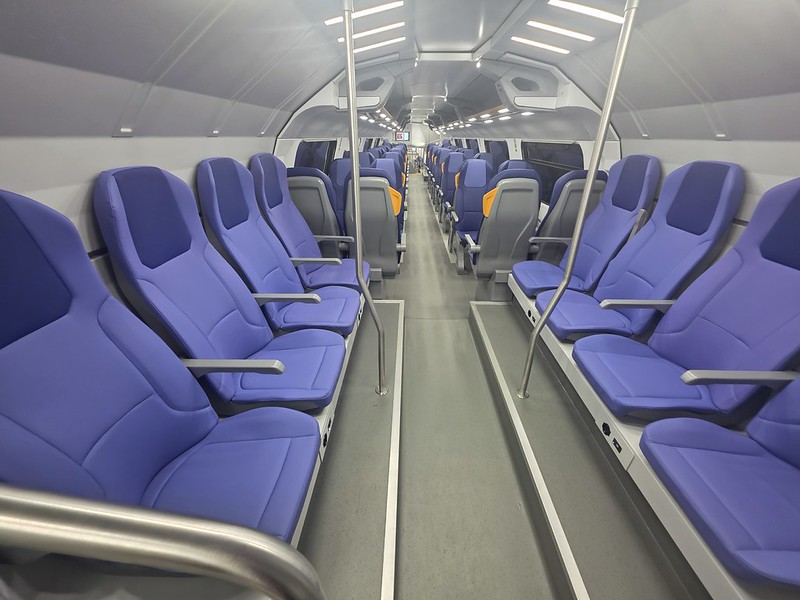
Here’s the train, all clean, shiny and well presented.
There was lots of space and I’ve come to really like these Rock trains (or Hitachi Caravaggio) that they use on regional routes. They’re modern, they have power outlets, they’re double deckers and they’re comfortable with clear signage.
I changed seating styles to have a little nap.
Getting there….
And safely in Orte for a little exploration. Although this transpired not to be very exciting, but more of that in the next post….
For those confused where we are in my riveting blog, I’m now going back a couple of weeks as I had to get from Cardiff to Ljubljana using whatever means possible, but I could only get flights costing £9 with Wizz Air Multi Pass. My first expedition was to get to Rome, then to work the rest out afterwards. There’s my flight, the 21:40.
A quick visit to Big Smoke and due to increasing prices of what is covered by Priority Pass, I’ve cut down to pineapple juice and chicken tenders. All very healthy.
Calamari and pineapple juice at Nolito and I’m never entirely surprised and delighted by their calamari so I’m going to shake things up and change this order up next time. I should probably get out more….
Oh great, it’s nearly Christmas.
The Rome flight was delayed by around 40 minutes, meaning that it was the last one out of Luton Airport in the evening. This means that everyone sitting here was going to Rome, unless they were perhaps muddled up.
It’s all happening now!
Here we are, the last flight out of Luton Airport.
Boarding and this is aircraft registration HA-LGV, seemingly another one (from my extensive records that aren’t anywhere near complete) that I haven’t been on before.
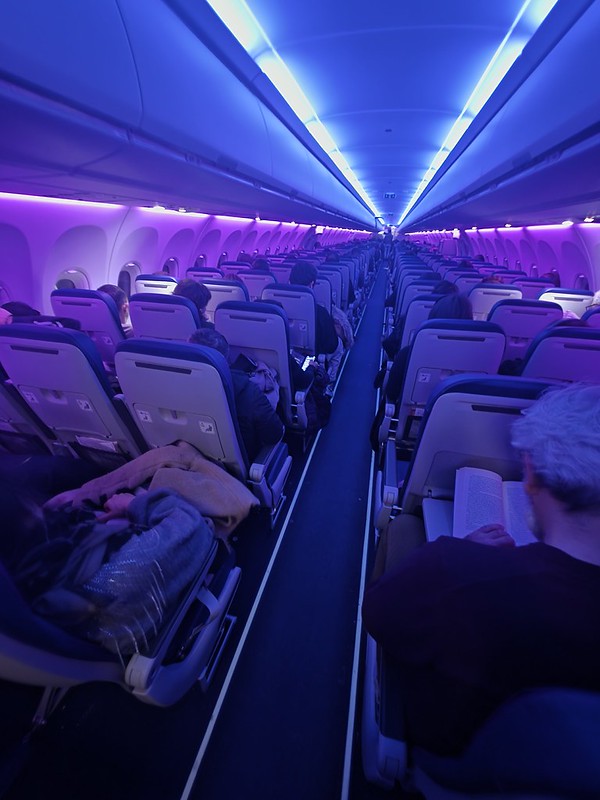
There were quite a lot of sleepy passengers on this flight, which was around 80% full. As ever with Wizz Air, the flight was well managed, the aircraft was clean, the crew were friendly and absolutely nothing went wrong. There’s a lot to be said for uneventful flights. The seating Gods gave me an aisle seat for this flight, so that was handy.
We all disembarked from the front of the aircraft as they wanted to use a jet bridge for this late arriving flight, but then there was no-one to unlock the door. So I stood here for a few minutes.
At this point it was decided that we’d be getting a bus to the terminal and this is always a slight faff. But, I was in no rush.
Safely in Rome and I got to use the semi-automated digital border control system for the first time, as Poland doesn’t seem to be using it fully yet. There was quite a queue for this, but it was all painless.
A helpful service…. I sat here for a while as the baggage reclaim, which I never have a need to use, had some power points and I wanted to be fully charged for my next little adventure. By fully charged I mean my devices, I was not fully charged as this was a sleepless overnight onwards expedition.
The pub stop en route from Cardiff to Luton was the JD Wetherspoon operated The Bear in the fine town of Maidenhead. This was all rather appropriate because this is where Liam grew up, although he didn’t take up drinking until he became friends with me, I suspect I drove him to it. But, anyway, this pub is also listed in the Good Beer Guide so that’s another box ticked.
It’s quite a spacious arrangement and using the chain’s history notes about the pub name, which is one of the few that they haven’t named themselves.
“The name of this historic inn was perpetuated when it became a Wetherspoon pub in 2010. The Bear has been on this site since 1845. Previously, it was at the corner of Park Street and High Street. The Bear is recorded in 1489, when the landlord charged ‘an unlawful price for provisions’. In the early 19th century, it was one of the town’s main coaching inns, but was converted into a private house in 1845.”
The real ale selection and there’s a couple of interesting options there, as well as the Greene King IPA for those who want something to clean their shoes with or something.
My now obligatory carpet photo.
I was slightly surprised that this pub is on the cheapest price band for the chain, I thought being on the Elizabeth Line into London they might have gone for some premium pricing. There are our drinks on the screen and these were made promptly, but not served before the food arrived. As we were sitting by the counter I asked if we could possibly just take the drinks as the food arrived, with the team members helpfully facilitating that.
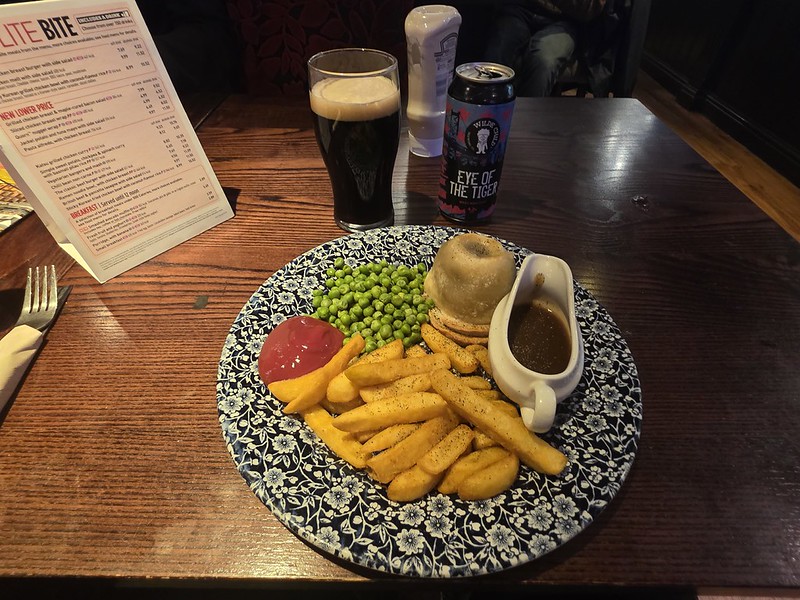
This might have been the third day in a row that I had this…. Well, actually, it was the third day in a row, but I like their steak pie and especially so when it’s just over £7 including a drink. The included drink is the Eye of the Tiger from Wilde Child, a very agreeable beer which had a taste of marshmallows and chocolate, certainly verging on decadent.
As it’s a JD Wetherspoon pub, I feel the need to look at the online reviews and this venue is rated around average for the chain.
“On the 8th Nov 2025 I attended the rememberance day in maidenhead as I am a veteran with 24 years service. My partner was away so I brought the dog with me. There where lots of veterans outside the weatherspoons so i decided to buy a pint there. I had my medals and could be clearly identified as a veteran. On buying a pint I was then approached by a staff member and told that I would not be served as my dog wasn’t a service dog. I wasn’t even allowed to stand outside with a drink which i offered to do. The staff where very polite. Mr Weatherspoon, if it wasn’t for veterans then your pub wouldn’t exist or you would now be serving German beer. Shameful, stupid rules Mr Weatherspoon. You should be ashamed.”
Just about every JD Wetherspoon pub is littered with reviews about why they should be exempted from their dog ban, including how well behaved it is, how quiet it is, how it wouldn’t cause any trouble. They’ve made it simple by just banning all non-assistance dogs, I’m not entirely sure why Tim Martin should be ashamed.
“I recently visited this pub and unfortunately had a poor experience. After ordering and paying for a drink, I was informed that dogs were not allowed on the premises due to pub regulations. While I understand and respect their policy, this information was not clearly displayed, leading to an unnecessary purchase and inconvenience. Furthermore, the pub’s cleanliness left much to be desired. I recommend they make their dog policy much more visible at the entrance to prevent similar situations for other customers.”
In fairness, there isn’t a sign out the front about this, or there wasn’t when we visited anyway.
“Ordered a Stella for £4.37, poured half and then left me for 5 minutes to change the barrel and then brought the warm half a pint back and proceeded to continue to fill. I asked for a fresh pint and he wasn’t pleased that a customer could do that!!! Cheap pub but don’t expect a great experience”
I suspect quite a few pubs would be surprised that a customer would ask for a keg beer to be changed in such circumstances. I’ve removed the unnecessary comment about the team member…..
“Ordered food and had it delivered @8.30 only to be told by the doorman that we needed to leave by 9pm because we had children. The manger was unsympathetic and said half an hour was ample to eat food! When asked if he had children he said no!! To which I replied how do you expect children to eat within half an hour especially those with additional needs! No compensation received”
It does sound ample 🙂
“Absolutely disgusting service from the male server and manager on shift this evening. I ordered food through the app – I asked if the server could provide me with allergen information regarding the side salad sauce (I have coeliac disease and this is not on the allergen menu) the server refused to help me in any way, saying that it’s “company policy” to not give out any allergen information. I then approached the bar where I heard him bad mouthing me to the manager who said “well I’m not going to give her any information either”. In the end I asked to see the sauce bottle and the manager acted as if this was a huge inconvenience rather than a simple task. Ridiculous.”
It’s not on the allergen information charts as it’s not an allergen, team members aren’t going to be easily able to give advice on this and that seems to me a very sensible and responsible company policy.
“Unfortunately its hard to give a good opinion on this pub as it’s damaged in reputation for losing its lively atmosphere and hosting a good night out.”
I suspect the chain quite liked losing its lively atmosphere to be fair.
“Slow service but the beer used to be good at this Wetherspoons pub. Tables never too clean, and always a bit sticky. Now that it lost its good beer guide place 2018 no point to bother. Go to Coppa Club, it is only up the road.”
At least it’s back in now 🙂
Anyway, I digress once again. I rather liked it here, it was busy, the team members were friendly, the service was efficient, the prices are firmly towards the lower end of the scale and the beer range was entirely acceptable. All quite lovely.
Leaving Tredegar House, my first birthday weekend (as in the first of two, I’m not aged one) was coming to an end, with Richard walking to his car to go to one of his specialist locations. But, this wasn’t before a lady called upon Liam to fix her car, which he did admirably. Given that Ross isn’t a confident driver, I can’t drive and Richard drives into hedges, she picked the right person from the four of us.
Anyway, off Richard went. Richard was a little sad as he doesn’t like his car any more as he’s seen how nice a car Liam now has. Ross commented this was evident by the amount of junk thrown on the back seat as Richard tries to hide looking at the car itself. But we didn’t say anything.
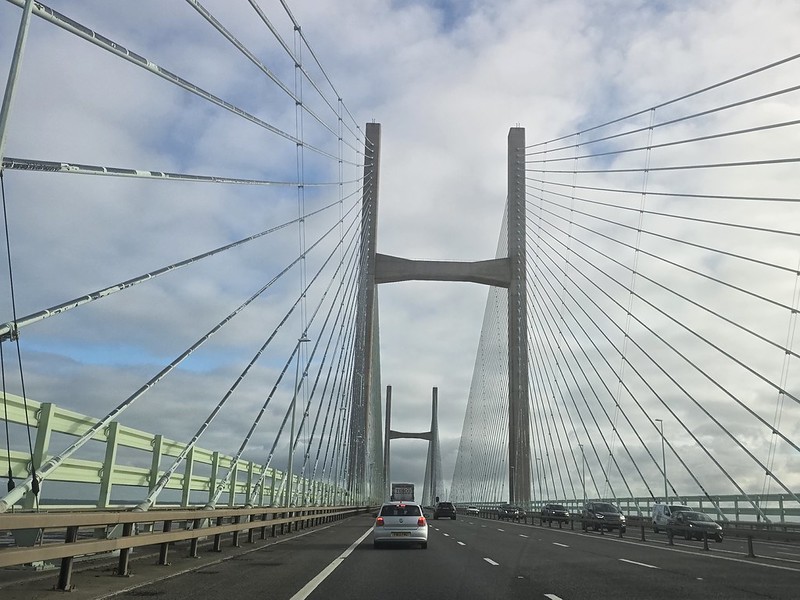
We crossed over the Severn Bridge.
Back into sunny England, this is the Second Severn Crossing, more formally known as the Prince of Wales Bridge.
The end of a rather lovely weekend in Wales. We stopped at a JD Wetherspoon in Maidenhead, which is Liam’s hometown but more about that in another post (about the pub, not Liam’s family history).
Always a bit sad, but there go Liam and Ross after dropping me off at Luton Travelodge, as I only do decadent travel.
I’ve stayed here a few times before, it’s nowhere near the airport but I like walking.
The room was clean and comfortable, located at the far end of a corridor away from the lift, just as I like it.
In the morning, I walked the three miles into the centre of Luton whilst listening to podcasts, nothing like a bit of politics to start the week.
A very nice, and keenly priced, breakfast at JD Wetherspoon. I fancied a hot chocolate, but Keir Starmer has banned them, but the coffees tasted fine and the breakfast was cooked perfectly.
Then to collect my free weekly Greggs sausage roll, this didn’t disappoint.
Then another three mile walk to Luton Airport as I’m not paying for that DART. The weather was tolerable, the walk was not really exciting, but it’s good for the soul to walk six miles before a flight I’ve decided. With that, I needed to work out how to get to Ljubljana for my second birthday weekend….
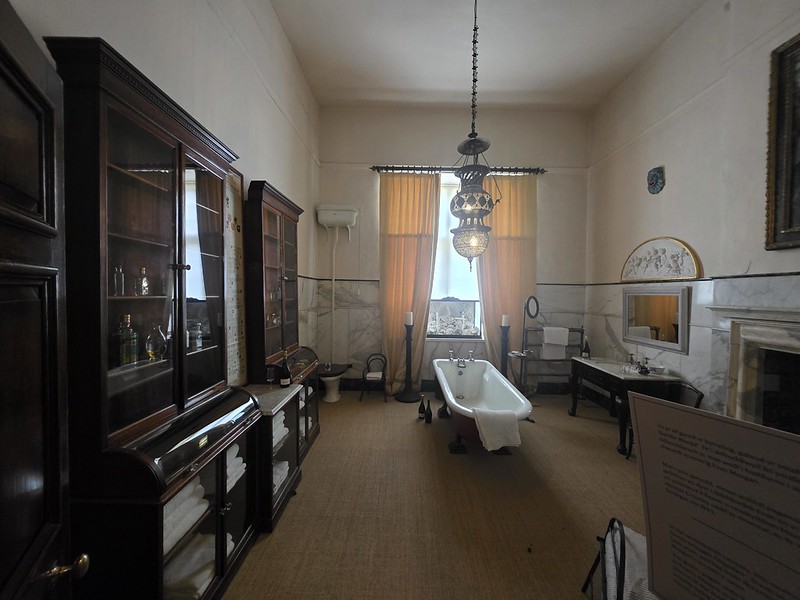
When Tredegar House was originally built this was a room known as the Green Wrought Chamber. The Victorians turned it into a bathroom and that’s how it’s displayed today.
Visible on the right hand side on the wall, above the mirror, is a pagan style head and that’s a nod towards what the National Trust call “the “Evan Morgan’s eccentric tastes” which I assume to mean they find him a bit odd.
Evan Morgan (1893-1949) was very interested in the supernatural and Aleister Crowley, who was a character however you look at it, stayed at the house on numerous occasions. Evan, who didn’t have children and is thought to have been gay (despite two marriages) left Tredegar to his uncle, Frederick Morgan. Evan had his bedroom in his adjoining room and there are numerous reports that he would meet his guests whilst lying in the bath. How the upper classes live….
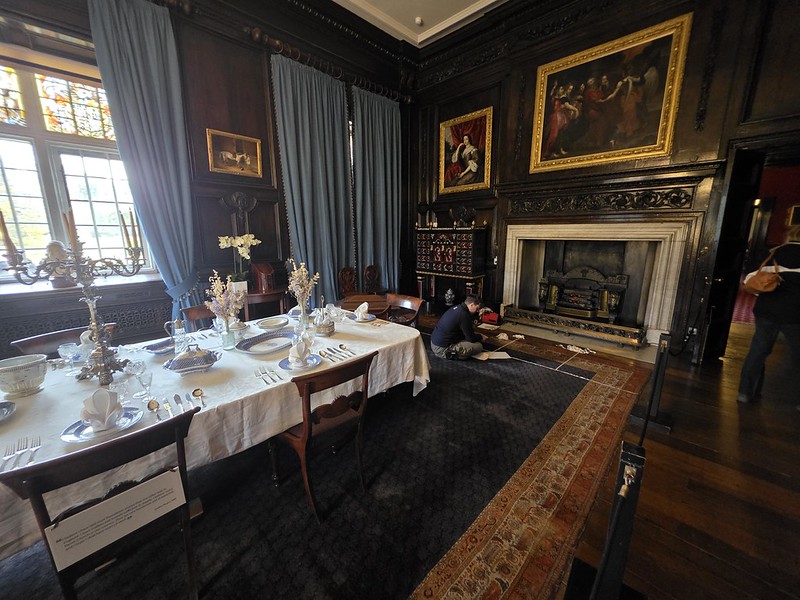
This is the rather grand dining room, previously known as the Best Parlour, the Great Parlour and the New Parlour. It was where the Morgan family would have dined with all sort of decadent foods such as pheasants, lamb and chicken bakes.
There was a man from the National Trust sitting on the floor and I didn’t like to ask what he was doing, but he seemed to be enjoying it. During the period that this building was in use as a Catholic girls’ school, this room was used as their chapel.
Here’s a photo of that fireplace from 1908.
I wonder if civil engineers could do this to ceilings, as it gives me a design idea. This was installed here in the 1860s, replacing an earlier one that was likely either not decadent enough or which was falling down.
A serving hatch in the room which was installed here during the Victorian period and which the note mentions is now a little rickety (they used a different word, but I think that’s what they meant). Apparently this room has apparently been used in Dr Who and Torchwood, amongst other TV programmes.
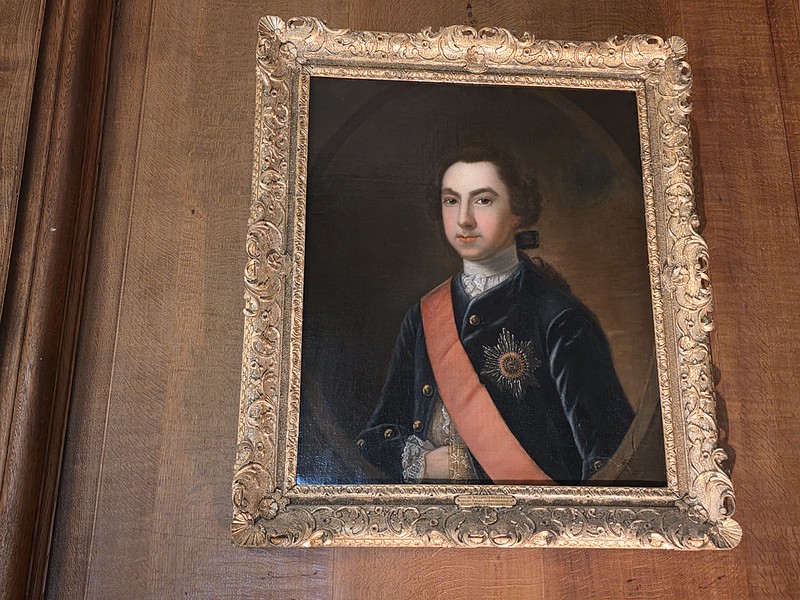
This portrait is of William Morgan the elder (1700-1731), the eldest son of John Morgan who was a Welsh politician of some note and of considerable influence. John also owned Tredegar House and passed it down to William in 1721 when he died.
William served as the Whig MP for Brecon and later for Monmouthshire, being returned for both in 1722, but he chose Monmouthshire. There was nearly always a Morgan as the MP for this constituency from the 1650s until the constituency was abolished in the 1880s, although one of the successor seats of South Monmouthshire was represented by a Morgan until 1906.
William married Rachel Cavendish, a daughter of the Duke of Devonshire, so that was handy at keeping power in the family. William was also one of the wealthy and enthusiastic Government supporters who was created a Knight of the Bath when that order was revived in 1725 and he was wearing his sash in the painting. William died young, although I’m not entirely sure what the cause of his death was as it doesn’t appear to have been recorded, but the estate was left to his son William Morgan the younger (1725-1763).
It’s not known who the painter was, but the National Trust note that on the artwork there is:
“Painted lower frame: Sir William Morgan, K B B.1700 D.1731 married Rachel, eldest daughter of William, 2nd Duke of Devonshire, KG
Written paper on crosspiece of stretcher frame: Sir William Morgan, Knight of the Bath, eldest son of John Morgan, esqr. of Tredegar. Belonged to Ruperra, 1783″
It doesn’t take much walking around Tredegar House to realise the power and influence of the Morgans on local and national politics, they had some considerable wealth going on here.
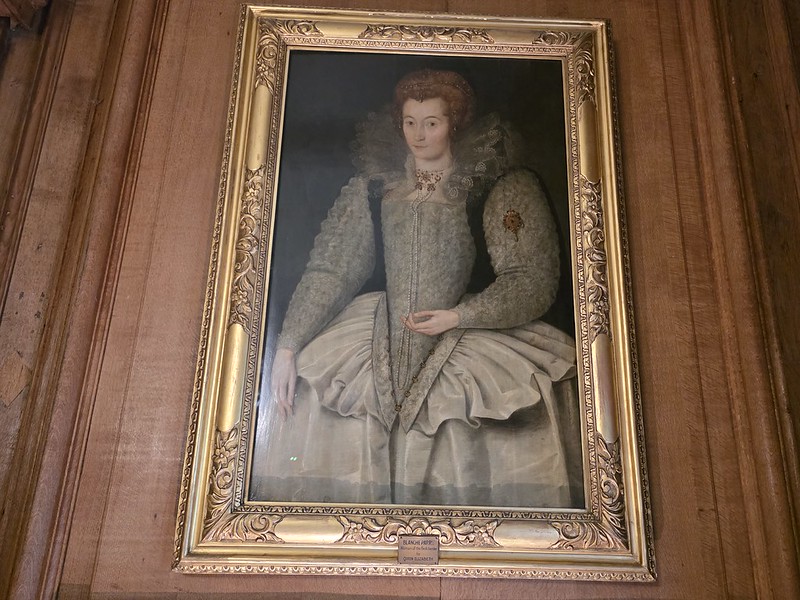
This painting at Tredegar House is of Blanche Parry (1508-1590) and is still owned by Newport Museums and Galleries. The fashion is very similar to that of Queen Elizabeth I, but Blanche was a Woman of the Bedchamber to her, so that is perhaps not an entire surprise. I suspect that this role, which was nearly always held by aristocrats and was more about travelling with the Queen and offering social support, was likely rather an interesting one and it came with some significant power. Parry was an aide to the Queen for over fifty years, so she must have picked up some considerable gossip during that period.
It might have been painted by Marcus Gheeraerts the Younger (1561-1632) who was perhaps best known for the Ditchley Portrait of Queen Elizabeth. The information about the painting also notes that the frame is from the eighteenth century, so it is later than the artwork itself. The realistic and grand artwork is also very much a statement of power and influence, no doubt a source of some pride to her family.
Blanche wasn’t directly linked to Tredegar House, but she was connected to the Welsh Marches, so perhaps there was some family history interlinked there. Or it might be that Newport Museums and Galleries acquired this artwork and thought that Tredegar House was the best place to just pop it.
Another day, another flight with my Multipass from Wizz Air. This was my 55th flight with it, although it comes to an end next week. I plan to renew it as my two loyal blog readers will note from my frequent Wizz Air postings on this blog that I’m quite an advocate of them now.
Anyway, I started at Big Smoke with some chicken tenders.
Then Nolito for some olives and beer.
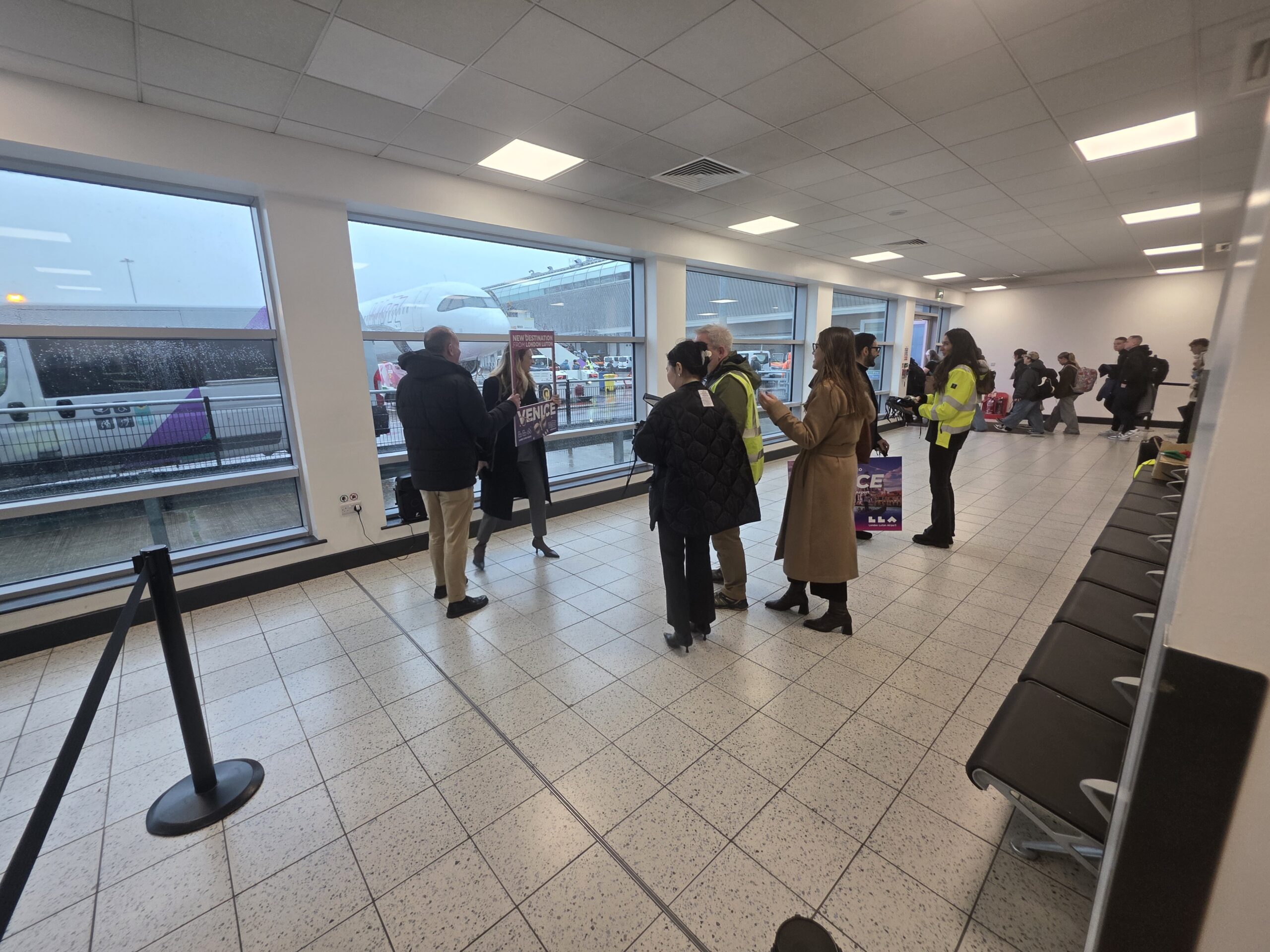
Then boarding from Gate 22 which was as usual for Wizz Air ordered and well managed. It was immediately apparent though that there was something special going on.
That special event was that it was the inaugural flight from London Luton to Venice Marco Polo airport, so they were making something of a thing of it.
The boarding then began.
The aircraft was 9H-WDH, which I don’t think that I’ve been on before and it feels as though it’s becoming quite unusual for me to note that.
The flight was at near capacity and the seating Gods had unusually given me a middle seat. I boarded and the passenger in the aisle seat asked if I minded sitting there as he wanted to sit in the middle seat next to his partner. This, at the time, pleased me.
However, on board, there was an announcement that they had hidden goodie bags around the aircraft. To cut a long story short, it transpired that they’d hidden it on my original seat, so I didn’t get the goodie bag that the seating Gods had tried to give me….
One amusing side to this is that the passenger on the other side of the aisle had heard the announcement that it was a white envelope. He excitedly pulled out from the seat pocket what he thought was the white envelope and looked inside enthusiastically. He read the outside and then kept it. It was actually the sick bag that is in every seat….
Anyway, the crew were impeccable as usual, the aircraft was spotless and the journey was uneventful (other than for my missing goodie bag). It’s a wonderful route and I’m glad Wizz Air have started it, although it’s ironic after travelling around Europe for 15 years and finally getting to Venice last week that I’ve ended up here again….
And safely into Venice airport where the security process took just minutes as they’ve installed the new entry system and it’s working well. Straight to the bus and into the city. And in the future I’m not changing seats, well, not on inaugural flights anyway.
I did get one free memento though, a Venetian mask which will be going to Liam’s little girl, unless it scares her and then it can just go to Liam in that case.
This is quite a decadent room, some suggest that it’s the finest in the house. It was designed to be one of the state rooms, primarily where guests could relax at the end of the evening. The Morgans fancied some European influences in their grand room and it’s decorated with pine panels designed to look like walnut.
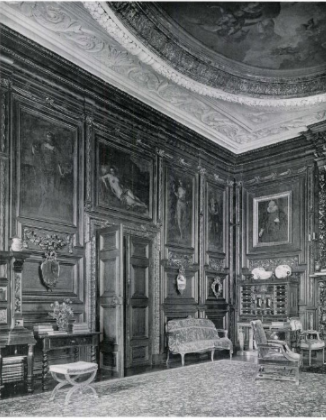
Here’s what the room looked like in 1908. During the Newport Council period, they plonked a bed in the middle of the floor so that people could lie down and look at the ceiling, but the National Trust have gone for a more tried and trusted method of using an angled mirror. They also did well to ensure that this room was kept well maintained when it was a school, although the council did refresh all the gilt decoration during their ownership.
Those twisted columns are designed to look like marble, but they’re actually made of wood. This was all arranged by William Morgan who managed to complete pretty much all of the decoration in the house without needing later generations to complete the work.