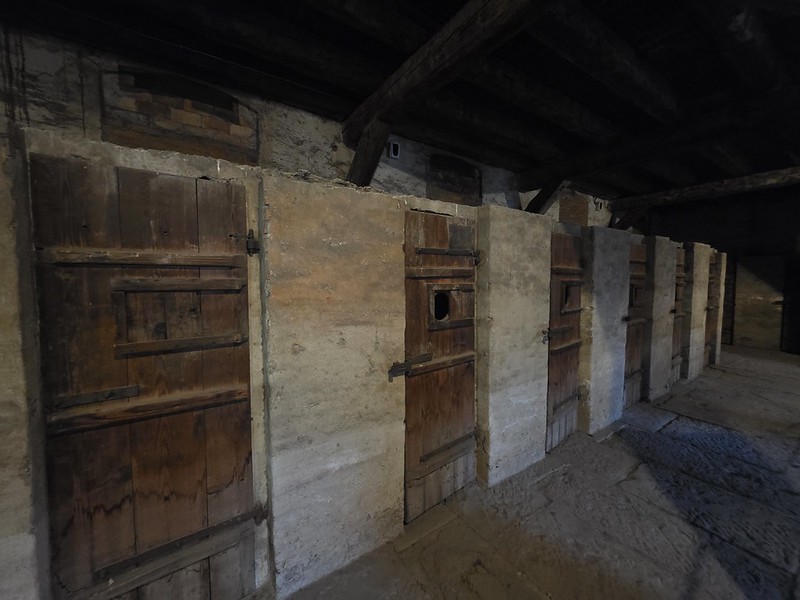
These are the prison cells at Risiera di San Sabba and the building was a warehouse for the rice-husking business that operated here, so these were hastily constructed by the Nazis in around 1943.
I think that it’s fair to say that they weren’t built for comfort or to cover the sanitary needs of the prisoners.
That’s it, a wooden bed shoved inside and not giving a great deal of space for anything else. They also weren’t single cells, despite looking like that, they were each designed for up to six people.
The rest of the room and it now has something of a haunting feel to it. There are seventeen cells in this room and they were reserved for Slovenes, Croats, partisans, political prisoners and Jews, all of whom were expected to be killed or deported soon after arriving.
When the site was turned into a museum in the 1960s, these cells were kept, although I’m not sure if they had been altered in the period between 1945 and 1965 when the building was used as a refugee camp. I’m not entirely sure what the authorities would have done with them during that time, it hardly seems like suitable accommodation for refugees.
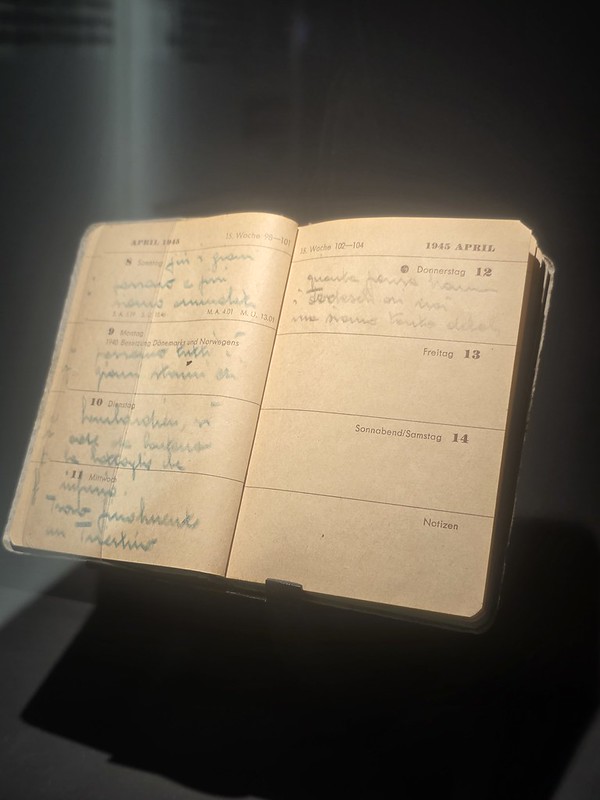
Some of the cells at Risiera di San Sabba, but more on those in another post. One of the political prisoners who found himself here was Giordano Dudine and he had previously spent time at Buchenwald and Gross-Rosen.
This exhibit is of Dudine’s diary and the camp was taken by the Allies a couple of weeks after this, although the Germans tried to destroy the crematorium and any evidence of what had taken place here. The diary was donated by his son, also Giordano Dudine, in 2009. Unfortunately, I can’t find any online content from this diary, so it’s not entirely clear what he was writing about and that would have perhaps given visitors a greater insight into the period.
There are numerous powerful exhibits at Risiera di San Sabba in Italy, where Jews and political prisoners, amongst others, found themselves.
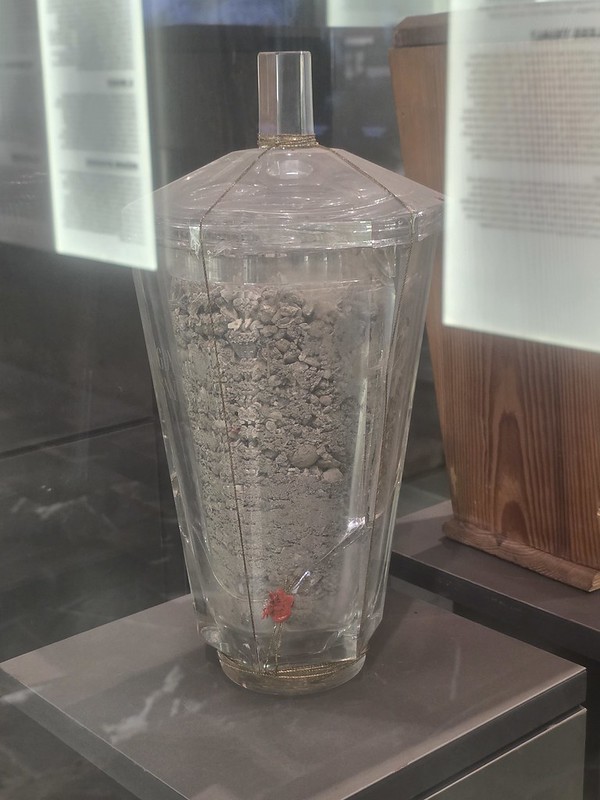
These are ashes from Auschwitz concentration camp, placed here in 2005 by the National Association of Former Nazi Camp Deportees organisation (ANED). I don’t know the back story to this of when they were collected, but I imagine that this was shortly after the end of the Second World War. Their symbolic meaning is what is powerful though, there were around 6,000 Jews in Trieste in 1938, with around 1,500 left after the Second World War whilst today, there are around 600 members of the Jewish community in the city.
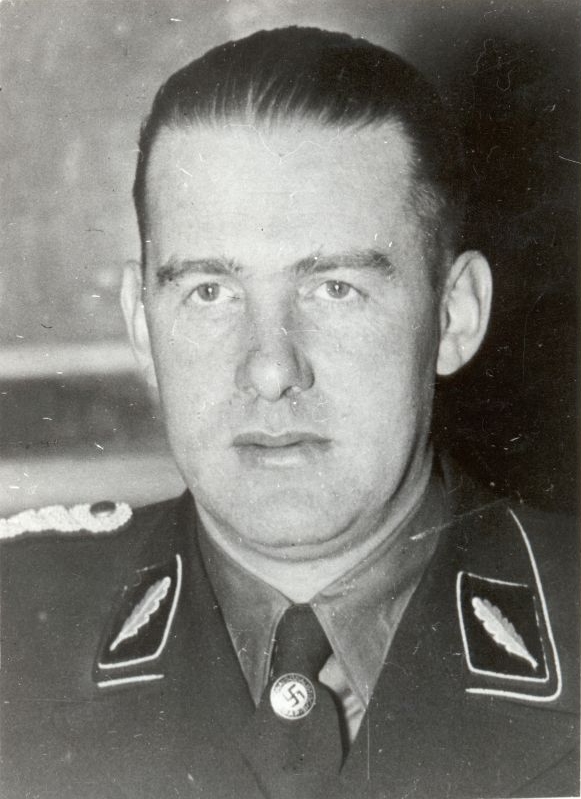
There will now follow a series of posts about Risiera di San Sabba, the only concentration camp in Italy with a crematorium and a location that I’ve visited before. Firstly, there’s one individual whose name I’ve come across a few times over recent years and I hadn’t realised that he was born in Trieste.
Odilo Globocnik has a reputation for being one of the most evil men of the Nazi regime, which is hardly known for its tolerance and understanding anyway. You could make a claim that some individuals almost got caught up in the Nazi regime as part of their military career, maybe Karl Dönitz who was ultimately found not guilty of crimes against humanity.
But there are others who saw the Second World War as an opportunity to murder people and destroy settlements. Reinhard Heydrich, a pretty pathetic figure who had been dismissed from military service due to his behaviour, but he happened on the right career move for him by attaching himself to the Nazis at just the appropriate moment.
Then there is Odilo Globocnik, who helped to create and then ran Operation Reinhard, the plan named after Heydrich to murder all Polish Jews. He was not an accidental bureaucrat reluctantly following orders but an eager organiser who pushed for ever more brutal “efficiency” as he might call it, massively enriching himself through theft while treating mass killing as administrative routine. His actions weren’t the product of confusion or wartime chaos but of deliberate, committed cruelty, carried out with zeal and without remorse, leaving a legacy of human suffering on an appalling scale. He deliberately sought out people to murder and took huge joy in what he did.
Odilo Globocnik was given the huge job of being appointed as the Gauleiter of Vienna in 1938, a role he was incapable of doing. He managed to cause all manner of political turbulence of the sort even the Nazis didn’t want and he was fired after it was realised that he was a conman who was stealing huge sums of money. Despite this, Himmler allowed him to transfer to Lublin, where he restarted his career with some zeal.
Globocnik was responsible from that point for the Lublin Ghetto and he then liquidated the Warsaw and Białystok ghettoes. He was also involved with the creation of the Majdanek, Treblinka, Sobibór and Bełżec extermination camps where millions of people died. He got involved with the killings as often as he could, he was a brutal figure.
After being sent to Trieste, he wrote to Himmler on 4 November 1943 to tell him that Operation Reinhard had been concluded and the concentration camps could be dissolved. His work then focused on Trieste and the establishment of Risiera di San Sabba, ensuring that any Jews would be liquidated but also ensuring that any political dissidents, as he might call them, would be arrested. Mussolini by this time had been overthrown, so there was a power vacuum where the Germans wanted control to prevent the partisans from seizing it. However, when the Allied troops started to retake territory, he fled into the mountains.
The British found Globocnik on 31 May 1945, but he bit down onto a cyanide capsule and killed himself to avoid trial. It might be a myth, but it’s said that the local priest refused to bury him in his church, he was too evil for consecrated ground, so he was shoved into a hole near the church.
That is the background for Risiera di San Sabba, a former factory preserved now as a reminder of the war crimes that took place here.
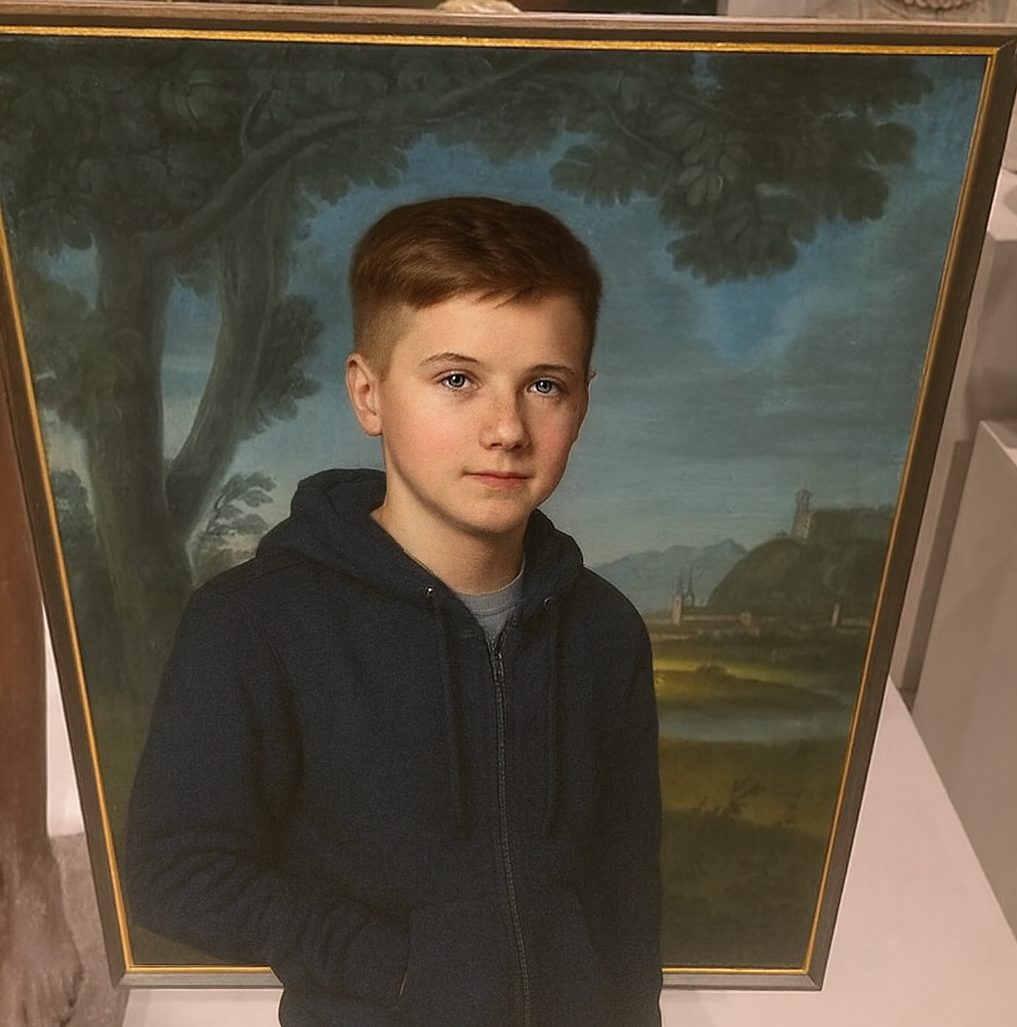
I just want to go back a little to a post that I made a couple of weeks ago, relating to the above painting of Peter Kozler in the city museum of Ljubljana.
AI is very heavily overdone at the moment, but it’s hard to get away from the imagery and content that it can produce. I’ve started to see some museums and galleries using it more frequently to add further depth to their collections, and I like that innovation.
This is how AI has responded to my request to bring him to life as a modern day person and to have him stepping out of the portrait. It might not have done a perfect job, but I like the option to interpret so many exhibits in a different way. This feels far more human to me, I rather think that it has brought it to life.
I had one more night in Ljubljana than the others, so I decided to stay at the Art Hotel before moving to the Ibis Styles. I arrived a little late in the evening and received a text from the hotel reminding me that I needed to check-in relatively promptly as their reception didn’t open late. I received this message when just about to enter the hotel, but I was fortunate that there were no earlier issues with the railways or Flixbus.
The team member at the reception desk was helpful and friendly, so the check-in process was efficient and easy. It was a relief to get to the hotel safely, as it had been quite a journey over a few days to get here from Rome, all without any transport issues fortunately.
The room was clean and comfortable, with a bath in the bathroom which I always consider preferable. There was also a kettle, which isn’t something that I can always rely on and indeed the Ibis Styles didn’t have one (well, they had their own, just there were none in the rooms).
I popped to Lidl for a healthy evening snack.
The view from my window over the hotel’s little outside seating area, although it was a bit wet for anyone to want to sit there.
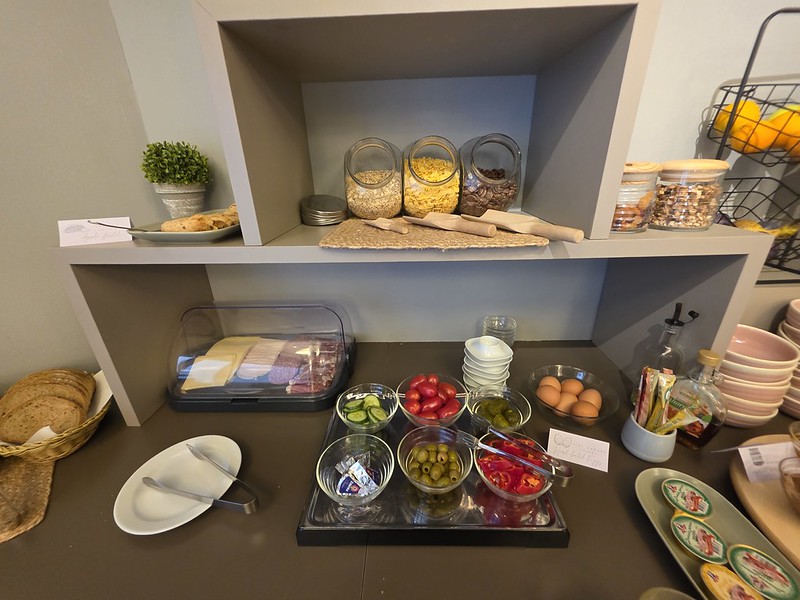
Breakfast in the morning was included in the room rate and I’m perfectly content with bread, olives, tomatoes, cucumber, gherkins and peppers, so this worked well for me. They did have some apple strudel, indeed it’s visible at the top left of the photo, but I forgot to go back for some.
A nice light breakfast with orange juice and yoghurt. I did get myself quite a few more tomatoes and olives, I might well be able to live just on those. Well, assuming Greggs was still open so that I could get a chicken bake or three.
You could pay extra for some more items and perhaps a coffee from the machine should have been included as the filter coffee that was provided was a bit, er, unappealing. I was entirely pleased with the breakfast arrangement overall though, with the room price being towards the lower end of the scale.
Anyway, I very much liked this hotel and found that the welcome was friendly, there were no noise issues and everything was clean and tidy.
And with that, I went to meet the others as they were arriving in Ljubljana, so I’ll now jump back to Trieste where I temporarily left the story….
I can’t say that I ever really look forward to using Flixbus, there’s usually some sort of issue attached to their journeys which just makes things difficult. However, the journey from Trieste to Ljubljana is relatively quick by coach and hard by any other method, so given it was reasonably priced, I booked it.
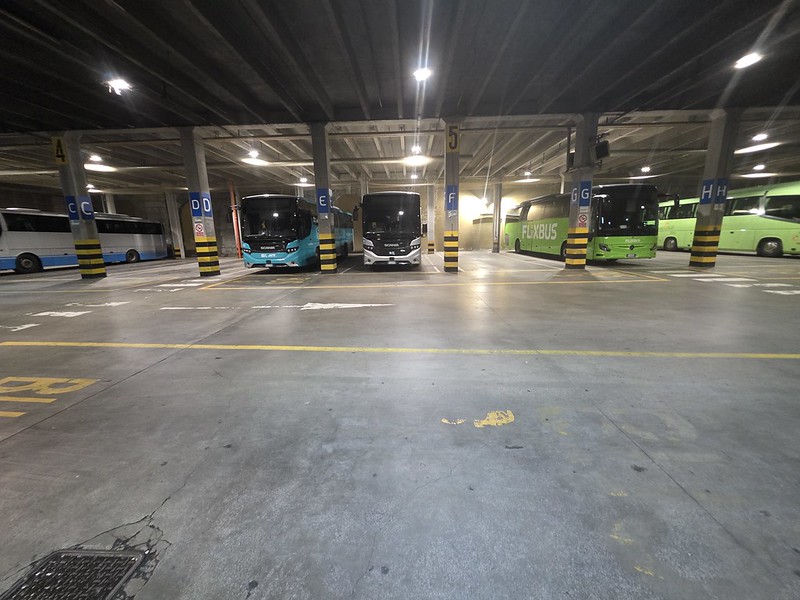
In the above photo is where it’s meant to leave from, at the downstairs of the coach station. They make very clear on the ticket location not to wait outside the coach station.
And here’s the Flixbus that stopped outside the coach station. Fortunately, someone came in and told everyone waiting that the coach was departing from outside, but it was a bit of a faff for those with luggage to have to move at short notice. Apparently this isn’t actually where it usually stops, I have no idea what their logic was that night.
Flixbus doesn’t always force people to have a seat reservation, but they did on this service. And, it was the usual mess and chaos, although my window seat was free and I didn’t have any issues. An upset lady did though have a problem as her seat was already taken and a staff member came over to resolve it, then he realised that about six people were in the wrong place and it would be too difficult to fix without ending up playing some odd form of Jenga on a moving coach. With that, the coach pulled off and the poor lady, by now quite upset, fell over. The staff were very friendly, but Flixbus makes very little simple.
And safely into Ljubljana…. I will continue to try and avoid Flixbus, they’re a public transport option of last resort for me as there’s nearly always something that’s a problem. But maybe I’m being unfair as I just prefer trains……
After my brief one night stay on Wednesday, I decided to head off to Trieste as I had to meet the others on Friday in Ljubljana. Constructed after the Second World War, the current railway station is one of the modern buildings with river frontage in this part of Venice.
I had a little wait for my train, so I went off to look around the railway station. The first Venice Santa Lucia railway station was constructed in 1861 and it takes its name from the church of Santa Lucia which they pulled down to allow for the new station building.
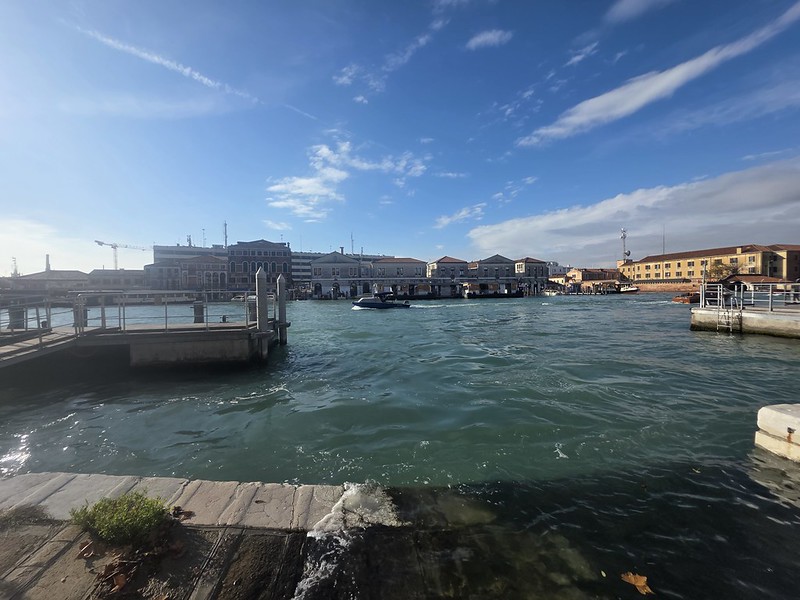
This is the view from the side of the railway station, this is one beautiful city. I have seen anything as beautiful as this since Lowestoft railway station flooded.
And here’s the train, departing from platform 1.
Regular readers of this riveting blog will now be familiar with the interior of Hitachi’s Rock trains. This is the top deck.
And the lower deck.
I’m very grateful that the signage on these trains is clear.
Leaving the beautiful city of Venice.
They might not be easy to take photos of, but there are some lovely views from the line near to Trieste as the train entered the Istrian peninsular.
The long platforms of Trieste railway station.
And back in my favourite Italian city of Trieste and it appears that there’s some work being done in the main departure hall.
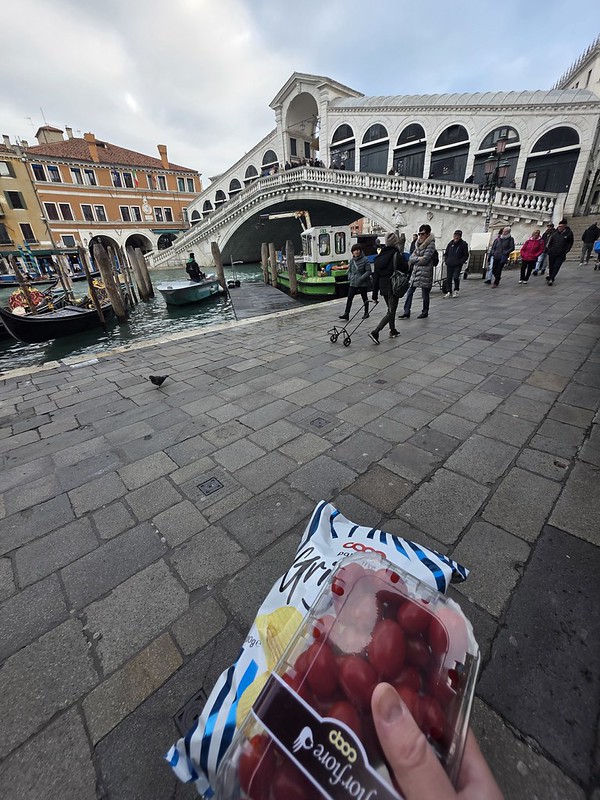
The breakfast of champions, some tomatoes and crisps from the local Carrefour supermarket.
In the background is the Rialto Bridge which might look serenely permanent today, but this crossing has had some sub-optimal times over the centuries. The first crossing here was a twelfth century pontoon bridge which, being essentially a glorified floating raft, was never going to win prizes for stability. Its wooden successor of 1255 did a little better until 1310 when it collapsed during Bajamonte Tiepolo’s revolt, which must have been a lively afternoon. A later version soldiered on until 1444 when it gave up entirely under the weight of spectators watching the wedding procession of the Marquis of Ferrara, so I suppose that could be defined as memorable and then fire then damaged it in 1514 because Venice likes to keep things interesting.
After all that melodrama, the city perhaps rather sensibly approved Antonio da Ponte’s stone design, completed in 1591, and it has stubbornly refused to fall down ever since, as if determined to prove it can behave like a proper bridge. It’s got shops on both sides of it today and it has become the major bridge in the city and something of a tourist destination. Although there are no benches around here, so don’t come here expecting to eat tomatoes.
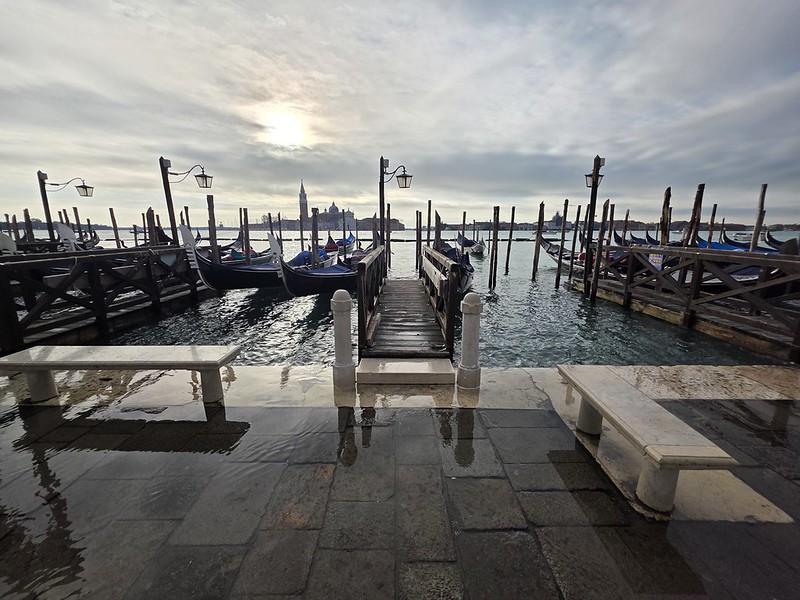
I didn’t have that long in Venice, it was a morning rail journey to my next destination of Trieste, but here’s some photos of that little morning meander.