Author: admin

  • Twyford – St. Nicholas Church (Barbara Savory)

    Twyford – St. Nicholas Church (Barbara Savory)

    20250511_154005

    This grave at St. Nicholas Church in Twyford commemorates the life of Barbara Savoury, the daughter of Coulsey and Elizabeth Savory. Coulsey seems an interesting person, he was a small-scale landowner who found himself in a financial situation later in life that was sub-optimal, although like Alan Partridge, he bounced back. He was to die in 1837 and was buried in the church, although his gravestone is no longer extant.

    At first, I struggled to read the name on this grave, but the death at a young age was visible and I was intrigued. It was easy to work out by going to do the burial records of the church from that year and this is the only death in 1800. Barbara died on 6 December 1800, aged just two years and three months. Although there’s quite a lot of media attention about her father over the decades, there’s no mention of Barbara other than the birth and funeral record. A few years after her death, her parents had another girl who they also named Barbara, although she also died young and was buried on 4 February 1829 at the age of 20. Her parents also had a son called Edward who was born in 1807 and he grew up and lived in the village, later naming his own child Barbara Savory and I’m pleased that she had a much longer life. So, in some form, the name of young Barbara did live on.

  • Twyford – St. Nicholas Church

    Twyford – St. Nicholas Church

    20250511_154106

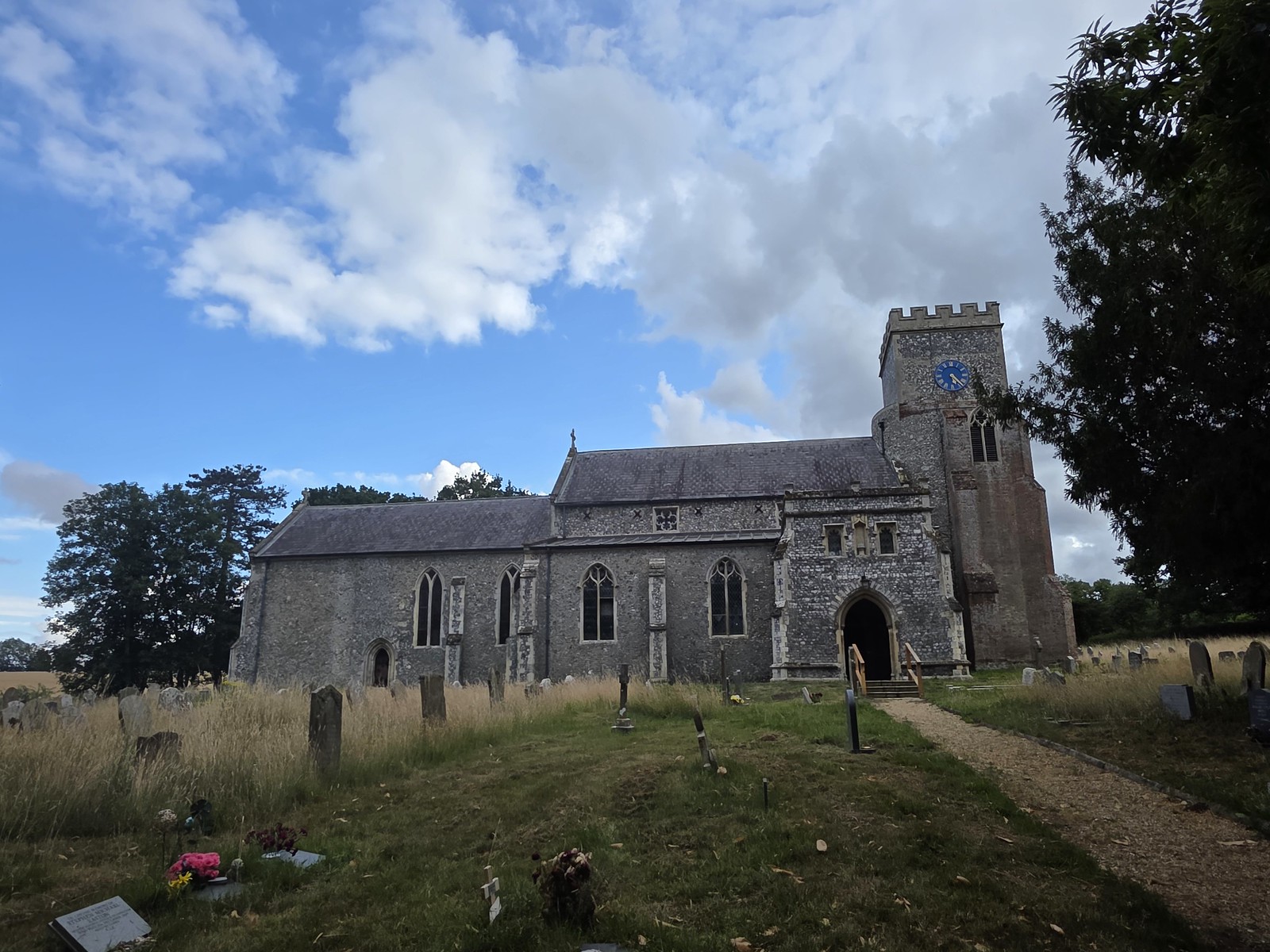
    St. Nicholas Church in Twyford feels both remote, but also heavily impacted by the heavy road going right by it. The village currently has fewer than thirty residents, which has inevitably made this rather challenging to run as a viable church. The name of the village, meaning ‘double ford’ is Saxon, but there’s no evidence of a religious building here from before the Norman period. It’s thought that the nave dates to the early twelfth century and the chancel is a little later, although they are now under the same roof, which I’m not entirely sure has always been the case. George Plunkett came this way in 1992 and since that visit, the render has been removed from the chancel so that the historic stone is visible.

    20250511_153918

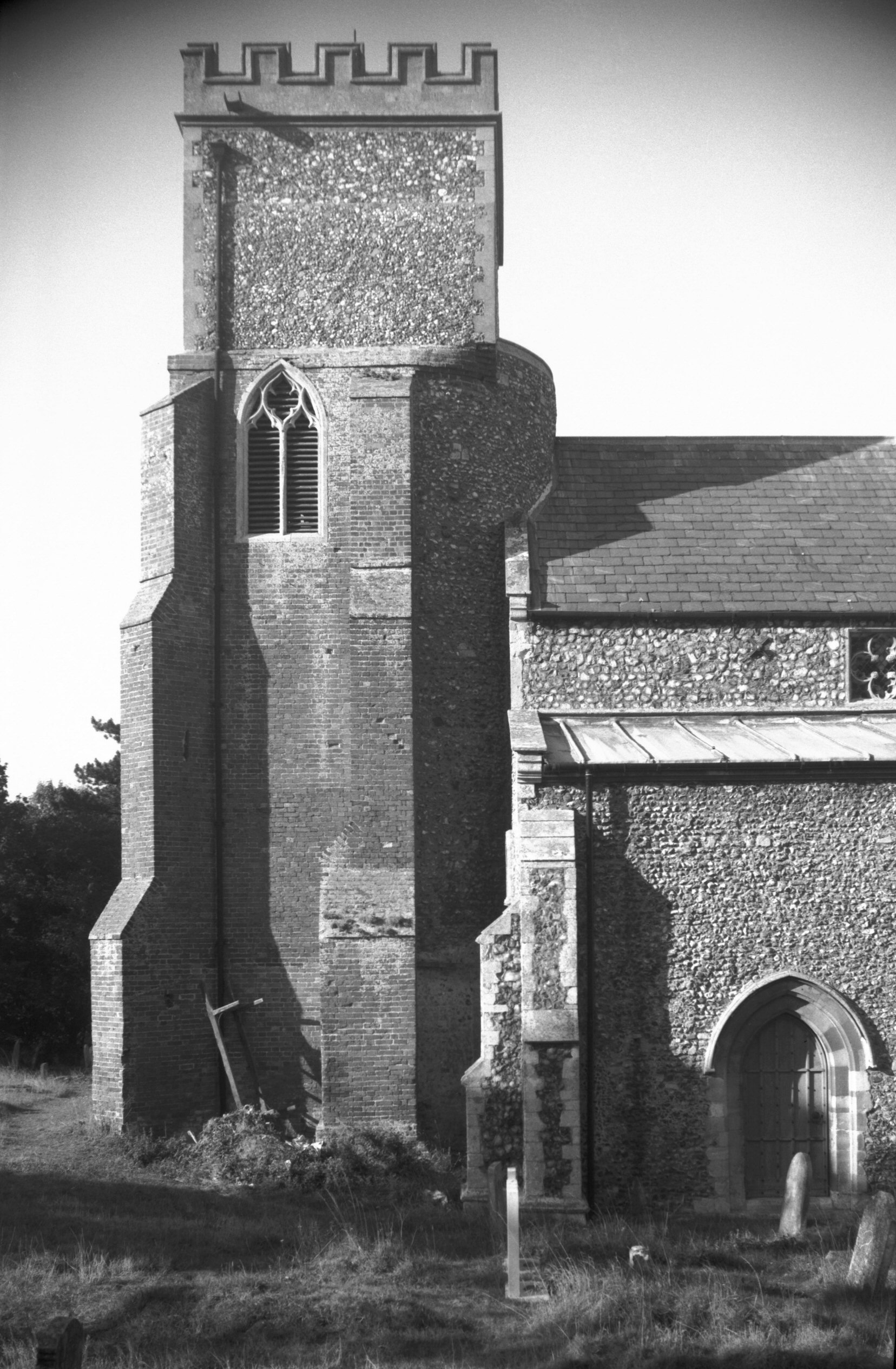
    There’s scaffolding up as there was a little incident a couple of years ago when a tree fell down during a storm and hit the church and some gravestones. This porch, which could arguably be called a tower, has been added to the church in 1732 and I’m not sure that it was ever the most congruous of arrangements.

    20250511_153936

    Work on the porch, which is expected to be completed by the Autumn of 2025. Unfortunately, the church was locked and so it wasn’t possible to look inside.

    20250511_153847

    The news update about the matter.

    20250511_154337

    It’s not clear that there was ever a tower to this church, although it would have likely been where the porch is located if there had been, which I doubt was the case. There looks like a bricked up door here into the nave, although it’s hard to make out.

    20250511_154201

    The end of the chancel. There was some remodelling during the Victorian period, but I suspect it was more tidying up than anything more substantial.

    20250511_154246

    This former doorway is thought to date from the fourteenth century and it’s another church that I’d like to go inside, but I suspect arranging that would be relatively difficult. It’s positive that there is funding to repair the damage to the porch, but I can imagine this is a tough one to fund raise for given the limited local population size.

  • Bintree – St. Swithin’s Church (Grave of John Gill)

    Bintree – St. Swithin’s Church (Grave of John Gill)

    20250511_152129

    This grave is located at St. Swithin’s Church in Bintree and I took a photo of this gravestone as some sort of record given the perilious state that it’s in. It has transpired to be older than I had realised as the only evidence I can find of a burial at this church of a John Gill was on 15 October 1773. He married Anne Brooke at the church on 4 June 1759 and they had a son also called John Gill, but I’m not sure that the younger one was buried here. Looking at the photo in some detail does seem to suggest that the 1773 date is still visible, but it is very hard to read.

    I thought that the gravestone looked early nineteenth century, but ChatGPT thinks:

    “This style of headstone—with its scrolled “shoulders,” rococo shell-and-cherub motif at the top, and the deeply incised lettering—was most popular in the mid-18th century. My best guess is that this grave marker dates to around 1740–1760, making it roughly 260–280 years old.”

    Google Gemini comes in with:

    “I would estimate the gravestone likely dates from the late 1700s to the early 1800s.”

    So, this sandstone gravestone is something of a survivor, dating back to 1773, although I’m not sure how many more decades it’ll hold out for.

  • Bintree – St. Swithin’s Church (War Grave of Ernest George Vince – Deserter)

    Bintree – St. Swithin’s Church (War Grave of Ernest George Vince – Deserter)

    20250511_151925

    Located at St. Swithin’s Church in Bintree is the Commonwealth War Grave of Ernest George Vince.

    Ernest was born in 1888, the son of George Vince and Susanna Vince, the younger brother of James and Emma. George and James worked as bricklayers and this is also the trade that Ernest went into a few years later and he’s listed on the 1911 census as being the only child of the family still living with his parents. I can tell he struggled at school as his records are on-line and he was last in the class and on 11 July 1900 it was reported by the school that he was working illegally and I can imagine that he was being inducted into the bricklayer trade early on.

    And herein lies what is likely a tale of woe and an individual probably not really given a chance before things went wrong. Over the next few years there was a constant run of criminality, including stealing a watch on 20 March 1907, stealing a bicycle on 1 July 1916, stealing a bicycle on 28 August 1916 and, once again, stealing another bicycle on 4 April 1917. He was also found guilty of larceny with intent to defraud, obtaining food and lodging by false pretences and numerous other cases of cheating. On 24 March 1917, the press reported that he had deserted from the British Army and when arrested by soldiers he had managed to escape from them. He lied about being a soldier to a lady in order to get food and accommodation, deciding not to mention he was a deserter.

    He was a private with the service number 13442 in the Machine Gun Corps (infantry), formerly 18316 in the Norfolk Regiment, but his service records don’t seem to exist in any useable form. Ernest died on 28 December 1917 and was buried on 4 January 1918.

  • Bintree – St. Swithin’s Church

    Bintree – St. Swithin’s Church

    20250511_152542

    Next on the tour that Richard and I took around was to visit St. Swithin’s Church in Bintree, which was unfortunately another one which was locked up which achieved protection against anyone stealing anything and also protection against anyone seeking religious solace. Its dedication to St Swithin isn’t the most common and there’s a fascinating list of the numbers at https://www.blanchflower.org/cgi-bin/qsaint/qsaint.html, showing Swithin at 47th. The village of Bintree is listed in the Domesday Book, so it’s likely that there was some sort of religious building in the village during the Saxon period.

    20250511_152431

    The bulk of the church dates from the fourteenth century, but there are some twelfth century elements so perhaps that was the date of the first stone building on this site. It’s all quite clean and ordered without the usual mismatch of windows and features that are evident in churches. Whether that’s because it was all constructed at the same time, or rebuilt in the late nineteenth century, I’m not entirely sure. George Plunkett has a 1992 photo of the church taken from a similar angle to this one.

    20250511_152328

    The chancel is quite stubby and not very interesting from the exterior, but this is primarily as it fell down in 1806 and a smaller replacement was completed in 1815, which was then faffed about with by the Victorians in 1865. It was mentioned in the local media in 1903 that the church was in a poor state of repair, but enough money had been found to reroof the nave, so this feels like it has been a slightly neglected arrangement at times and I wonder whether it wasn’t given the same extensive modernisation (effectively often entire rebuilds) that other buildings were given by the Victorians. It has been a rather High Church arrangement in the past, but I’ll come to that separately as there are some interesting stories relating to that.

    20250511_152251

    This is quite exciting, it’s a grave cover that is thought to be that of Richard de Langbrigg, a parish priest who died in 1270. It’s an impressive survivor and it has its own Grade II listing, although he’s a little unlucky as he was located within the former larger footprint of the chancel and he’s now stuck just outside of it.

    20250511_152049

    The end of the chancel, representing the rebuild after the previous one fell down. It’s all neat and tidy to be fair.

    20250511_152053

    Helpfully dated, but I don’t yet know who those initials relate to.

    20250511_152056

    I don’t know what this is, perhaps a stone-mason’s mark?

    This church has seemingly endless contradictory dates in various sources and there doesn’t seem to be as much information about its history in common sources as some other nearby churches, even taking into account that it was historically often called Bintry Church to add extra confusion. It appears that they’ve been reluctant to routinely open this church for some time, but it is now operated by the Diocesan Churches Trust which is effectively a sign that it has fallen out of use but they just don’t want to deconsecrate it. It’s an intriguing building, hopefully I’ll be able to get to see inside at some point. This is one of those churches that I have a suspicion I’ll find out a lot more about at some stage, but at the moment it feels like something of an enigma.

  • 200 Years Ago in Norwich : Great Hospital Expanded

    200 Years Ago in Norwich : Great Hospital Expanded

    In my latest occasional series of newspaper articles from 200 years ago this week, this was published in the Norwich Mercury in May 1825.

    “A special assembly of the Corporation was held on Wednesday last, to consider of making an increase to the Great Hospital. In the Commons, the following proposition was made by Mr. Goodwin, and seconded by Mr. Bennett—“That a new ward should be erected capable of containing twelve beds.”

    Mr. Skipper moved, as an amendment, “That an addition be immediately made to the Great Hospital, by the erection of forty cottages.” This was seconded by Mr. Edw. Taylor. On a division the numbers were,

    For Mr. Skipper’s amendment 27
    Against it 9

    —Majority 18″

    I took my exams in the Great Hospital, so I feel some sort of connection with the place. The institution dates back to 1249, when Bishop Walter de Suffield set it up to care for “twenty poor folk” – a mix of aged, infirm and needy townspeople. Over the centuries it grew into a complex of almshouses, a chapel, a schoolroom and a small infirmary. The beginning of the nineteenth century was a challenging time for Norwich in terms of the number of people struggling, the clothing industry was becoming less financially lucrative and the population of the city grew from 37,256 in 1811 to just under 50,000 a decade later.

    But back to the expansion of the hospital, as during a special assembly of the Corporation, held on a Wednesday in early May, the matter of increasing the hospital’s capacity was brought forward. Mr. Goodwin proposed the erection of a new ward capable of housing twelve beds, a proposition that was seconded by Mr. Bennett. However, an amendment was swiftly introduced by Mr. Skipper, suggesting a more substantial addition in the form of forty cottages. With regard to “the Commons”, the city of Norwich possessed a civic structure where freemen, individuals who had either inherited the status, completed an apprenticeship, or purchased the right, could participate in civic matters within a common assembly. By 1790, the electorate in Norwich included both freeholders and freemen who held the right to vote for key municipal officers, including the mayor, sheriff and members of the common council. They had some more money to spend from the rental income that they were generating and this was an early form of the social care that slowly evolved.

    Matters seem to have changed a little in the planning, as there were twenty cottages erected in 1826. They’re still there today, known as the White Cottages, although they’re mostly used as offices today.


  • Food from Every Stall on Norwich Market (2025 Edition) – Week 13 and Bun Box

    Food from Every Stall on Norwich Market (2025 Edition) – Week 13 and Bun Box

    20250516_132014

    This week’s attempt to eat at every food stall at Norwich Market was Bun Box, which we visited in 2023 when we last embarked on this little project. Last time we visited, I wasn’t entirely sure about the value for money when I ordered a chicken katsu bun and I thought that the pricing was towards the higher end of the scale for the market.

    20250516_131429

    The menu board. Incidentally, I didn’t take as many photos of the stand generally as I didn’t want the police to think that I was trying to capture them in my little arrangement. Neither James or I remembered that they did these more substantial meals which are listed on the lower menu, but having checked on the menu board from last time, not a great deal has actually changed. The price increases here over the last two years are relatively small, mostly either 50p or £1 on the price of a meal.

    20250516_131551

    The list of sides. The service was friendly and personable, with the queueing system clearly signed as it might not otherwise be entirely obvious. The stall was busy when we were there and the team member was warning customers that they might face a ten or fifteen minute wait. The stall has clearly built up something of a loyal following judging by the numbers of customers who were coming here, with the menu being quite broad.

    20250516_132014

    We had an eight minute wait for the food, but that seemed reasonable given how busy it was. They prefer cash, but they do accept cards as well. They give customers a numbered ticket and also try and batch together food orders so groups get their food at the same time.

    20250516_132549

    I ordered the spicy chicken don which cost £9. This was pieces of panko chicken with sticky rice, teriyaki sauce, lettuce, spring onion, sriracha sauce, sesame seeds and Japanese mayo. This surprised and delighted me much more than when I had the bun a couple of years ago. The chicken was very slightly dry, but the coating added flavour and the sauce added some extra taste. The sesame seeds and spring onions added texture and the rice was suitably sticky. The large pieces of lettuce covered in sauce were a bit of a faff to eat and could have been smaller, but I felt that the whole meal was filling and represented decent value for money.

    IMG-20250516-WA0002

    James sashayed excitedly towards the counter and went for a spicy chicken bun which was £5.50 and he seemed pleased after ordering. When the two meals arrived, with his looking like a little side to mine, he then promptly spent the next half an hour complaining about how small his selection was. He received one piece of chicken, mayo and lettuce, which didn’t seem to me to be quite as good value. I wonder if they’d be better charging a little bit more and giving customers two of the buns, as James didn’t find his selection as filling as mine. Indeed, he complained about numerous things about the bun, but he was centred on that he finished eating it in about twenty seconds. I think he spent longer taking a photograph of it rather than eating it, but I didn’t say anything. I’m apparently meant to explain that he was disappointed about the amount he received compared to how many chips he got last week, but I feel that I’ve done that now.

    Basing this on just my experience, I thought that this was all quite agreeable, with the service being friendly and the food having a suitable depth of taste and flavour. However, for value for money, I’d personally go for one of the larger meals.

  • Foxley – Church of St. Thomas the Apostle (Mabel Annie Purdy – 1883-1913)

    Foxley – Church of St. Thomas the Apostle (Mabel Annie Purdy – 1883-1913)

    20250511_150708

    This grave at the Church of St. Thomas the Apostle caught my eye as it commemorated the life of Mabel Annie Purdy who died according to the gravestone at the young age of just 28. I was initially confused as the church’s birth register notes that a Mabel Annie Purdy was born on 25 November 1882 and baptised on 15 February 1883. However, I then noticed a birth of Mabel Annie Purdy on 7 August 1883 and baptism on 26 October 1884, so I assume the first little girl died and they wanted to give their next child the same name. Both girls were the daughters of Henry Purdy, a publican, and Rosina Purdy (nee Connell). The pub that they ran was the Chequers in the village, which closed in 1968, but apparently the pub sign remains in place so the building on Stocks Hill remains. Henry was a farmer and he was the licensee of the pub between 1863 and very early in 1913, when he died, which is quite a tenure.

    Mabel was mentioned in the Eastern Evening News on 14 April 1902 when her beautiful singing in a concert in Bawdeswell to raise money for the Foxley church bells was mentioned. These church bells have had a substantial amount of fund raising over the years…. The Downham Market Gazette also mentioned on 29 December 1900 that Mabel was excellent at needlework and the Eastern Daily Press on 24 October 1901 mentioned that Mabel and her sister Ada were bridesmaids at the wedding of Albert Green and Edith Purdy. At least those newspaper mentions add a little colour to the detail of her life, I always find it a little sad when it seems nearly nothing is known.

    Mabel died on 23 April 1913, not long after her father died. Unfortunately, I can’t find any mention in the local newspapers as to why she died, so that remains a mystery for the moment at least…

  • Food from Every Stall on Norwich Market (2025 Edition) – Week 12 and Lucy’s Fish and Chips

    Food from Every Stall on Norwich Market (2025 Edition) – Week 12 and Lucy’s Fish and Chips

    20250514_131743

    This week’s episode of James and I working our way around every food stall at Norwich Market. And, this week, it was a visit to Lucy’s Fish and Chips, where James and I have been going for over a decade and which received the incredible accolade as our second (well, my second as I’m writing it) stall in 2023. James only walked by three people he knew today, although I suspect there were more as he disguises the interactions to pretend he’s anti-social. The stall also has a sister outlet on the market which we’ve already visited this year.

    20250514_131748

    The menu and the prices, with an apology printed on the counter that price increases have been necessary due to increasing costs. The price increases are in keeping with other stalls, with the haddock going from £5 to £6.50 in two years and the cod from £6.50 to £8. The stall accepts cash and card, although there’s now a sign stating that they prefer cash. The queueing system felt suitably logical and the stall was constantly busy when I was there, with a wide selection of different items being ordered.

    20250514_131816

    The specials are visible in the background and a reminder that they use vegetable oil here. There’s also a vegan and vegetarian menu available to broaden their appeal to non-fish eaters.

    20250514_131859

    I decided against the battered cauliflower, though to be fair, anything’s an improvement on plain cauliflower. The service was friendly, engaging and personable, although it helped that they knew James as they probably remembered some odd social interaction he had with them years ago or some joke or pun he made. There’s an informal and inviting feel to this stand, so I felt welcome. I went for the small cod, chips and curry sauce for £6.50, which I thought was reasonably priced. It took twelve minutes to be prepared which seemed a long time as James got him immediately, but sometimes food is worth the wait and they were busy.

    20250514_133917

    The seating area where we were able to get a seat, although James had a bit of a wait to get us one. Not that it mattered to me as I was standing on the other side of the stall excitedly waiting for my number to be called out. The problem with us deciding these stalls on the day is that I don’t know in advance to bring my own ketchup, as I’m too tight to pay whatever the cost is here. The seating area was clean and ordered, with customers sitting here fairly reliably having ordered from the stall and not being interlopers from nearby stalls which don’t have their own executive seating area.

    20250514_133010

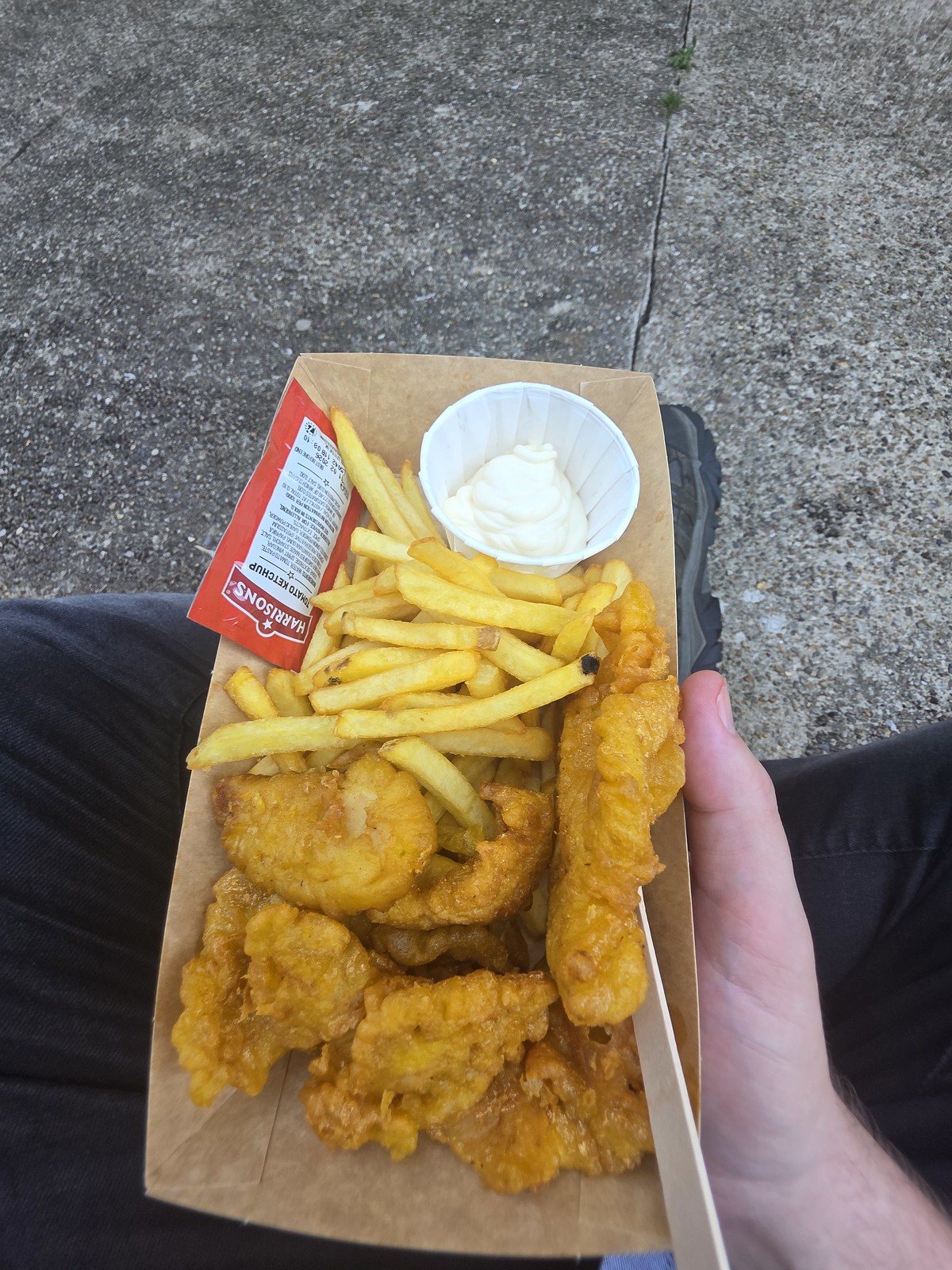
    The cod was larger than I expected and they had forgotten the scraps (which I insist on calling them, although they call them crispies at the stall), but willingly added them in a bag on request. The bottom of the cod was perhaps a little soggy, but the fish flaked away and had a depth of flavour. The batter had some crispiness to it and a pleasant taste, whilst the chips were firm on the exterior and suitably fluffy on the interior. The curry sauce was also served as a generous portion and added to the whole delicious arrangement.

    IMG-20250514-WA0005

    James went for his usual and he was moderately annoyed to discover they’d forgotten that his usual was two small battered sausages and not just one. He forgave them though, one of the few stalls where he would. I do remember the butcher’s sausages that they used to have here and I do miss those, although James was content with the quality of his battered option today.

    I left the stall feeling that I had enough food as it was sufficiently filling and the value for money was excellent. The cod was of a decent quality, the service was friendly, the surroundings were clean and it was good to be back. This is, once again, one of the best stalls that we’ve visited this year on the market. All really rather lovely.

  • Foxley – Church of St. Thomas the Apostle

    Foxley – Church of St. Thomas the Apostle

    20250511_150230

    Next on the tour of Norfolk churches that Richard and I were embarking on was the Church of St. Thomas the Apostle in Foxley. Unfortunately, the church was locked, so I’ll have to limit myself to just the exterior of the building. There has been a church here since Saxon times, although it was rebuilt in stone in the Norman period and most of the nave is from the early fourteenth century and the chancel a little earlier.

    20250511_150532

    I’m assuming these trees mark an extension to the churchyard.

    20250511_145915

    The tower with its not very subtle built-in staircase. The bells in the tower were restored and rededicated in January 2014 by the then Bishop of Norwich, the Rt. Reverend Graham Jones. The bell ringers here have had some challenges over the years, as the Downham Market Gazette reported in November 1879 that £5 was needed to restore the bells as they had been out of use for some time. There was then another fund raiser in 1901 as the bells needs work again, and indeed, nearly every newspaper article mentioning the church over the last 300 years has been about these bells.

    20250511_145934

    The porch was added in the middle of the fifteenth century.

    20250511_145945

    The porch arrangement, now missing its niche statue which was likely removed during the Reformation, was funded by the local Grey family.

    20250511_145953

    The wall painting is from the nineteenth century when the Victorians tidied the building up.

    20250511_145958

    The porch door which is around 700 years old and it does look like it has some heritage to it. I make my usual comment that it still feels special to be able to see a door that has been used by generations by the local congregation and it’s so old that it was originally a door to the pre-reformation Catholic church.

    20250511_150157

    The end of the chancel and this part of the building dates from the late thirteenth century.

    20250511_150127

    The chancel which looks like it was rendered at one point, but that has at some stage mostly fallen off. The render does make quite a lot of sense in terms of protecting the building, and it’s likely the church was rendered for quite a chunk of its history, but it’s nice to see the raw stone underneath.

    20250511_150250

    The side of the chancel, which appears to have been increased at some point given that odd brickwork at the top.

    There are apparently some interesting elements inside, including the fourteenth century font, the old pulpit and the repaired rood screen, but they’ll have to wait until we visit again when the church is open.