Author: admin

  • Dictionary of the Vulgar Tongue – Day Eighty-Four

    Dictionary of the Vulgar Tongue – Day Eighty-Four

    The Dictionary of the Vulgar Tongue was first published at the end of the eighteenth century, and given that the Coronavirus crisis is giving too much time to read books, I thought I’d pick a daily word from it until I got bored…..

    Cold Pig

    This cheery little phrase is defined as “to give cold pig is a punishment inflicted on sluggards who lie too long in bed: it consists in pulling off all the bed clothes from them, and throwing cold water upon them”. The phrase was relatively common in the late eighteenth and early nineteenth century, then started to fade away and instead meant damaged or returned goods. The phrase is still used today by some shops who use the term to mean seconds or returns, but the original definition of cold water seems to have been lost.

  • Bath Abbey – William Oliver Tablet

    Bath Abbey – William Oliver Tablet

    This lengthy memorial tablet is to the memory of William Oliver (1659-1716), a medical pioneer who was the uncle of William Oliver, also a medical pioneer from the city, who invented the Bath Bun and Bath Oliver. He was buried in Bath Abbey, which is where this tablet remains in place today.

    This William Oliver spent some of his time as the surgeon responsible for Lord Monmouth’s army, something which would have rather an innovation at the time.

    His tablet reads:

    “In memory of William Oliver MD FRS. He was descended from the family of Trevarnoe, in the County of Cornwall. While he was prosecuting the study of physick in foreign universities. The miseries of his country called aloud for a deliverer. He was ambitious of contributing his might to so great a work. He came into England an officer in King William’s Army in 1688. He was appointed physician to the fleet in 1693 and continued in that station till the year 1702. He was appointed physician to the hospital for sick and wounded seaman at Chatham in 1709 and in the year 1714 he had pleasure to have his old fellow sailors committed to his care. He being then appointed physician to the Royal Hospital at Greenwich in which honourable employment he died a bachelor on 4 April 1716. His love to this city, where he practised physick many years appears in his writings”.

  • Langley – Name Origin

    Langley – Name Origin

    And, since I’ve written about the origins of the place name of Hardley, here’s Langley since they share a village sign. Back to The Concise Oxford Dictionary Of English Placenames.

    Langley, Norfolk. Langale in Domesday Book, Langeleg in 1201. 

    This one is easy for the dictionary to define as there are Langleys up and down the country, all nearly certainly derived from the old English ‘long leah’, or long wood, both of these words having Germanic roots. Confusingly, later on ‘lea’ came to mean an open area of land, just to make things complex.

  • Hardley – Name Origin

    Hardley – Name Origin

    Moderately intrigued following seeing the village sign, I went back to The Concise Oxford Dictionary Of English Placenames. I certainly know how to have an entertaining afternoon…. Anyway.

    Hardley, Norfolk. Hardale in Domesday Book, Hardele in 1115, Hardeleygh in 1268. Hard clearing, perhaps referring to hard soil. Some forms have halh.

    The ‘halh’ is the old English for cave, closet or corner, which has apparently slipped into the settlement’s name over time. Some of the area around Hardley is today marshland, so a hard clearing would make sense in this context.

  • Hardley and Langley Village Sign

    Hardley and Langley Village Sign

    I’m not sure that I’ve seen a village sign with two different village names on it, but this is the sign for Hardley and Langley. The two villages have somewhat merged together and their formal name is now ‘Langley with Hardley’, which were both historically separate parishes.

    According to the village’s own web-site, both parishes had their own council in 1894, but they were amalgamated in 1928. There was some debate about dropping the name of Hardley, but the residents of Langley must have been a vocal bunch, and so their parish wasn’t forgotten. The school districts had already been merged in the 1870s, so it looks like harmony prevailed in the end.

    The Hardley side of the sign has Hardley Church on it, along with birds and sweeping views of the landscape, whilst the Langley side of the sign has Langley Abbey and a wherry on it. All colourful and bright, a rather lovely village sign and it’s also been placed pretty much on the official boundary between the two villages.

  • Buckenham – Name Origin

    Buckenham – Name Origin

    Further to my visit to Buckenham this week, this is the origin as given by The Concise Oxford Dictionary Of English Placenames. To confuse things just slightly, there are three Buckenhams in Norfolk, Old Buckenham, New Buckenham and what is mostly now just called Buckenham, but has historically been known as Buckenham Ferry.

    Buckenham, Norfolk. Buchanaham in Domesday Book, Bokenham Ferye in 1451. From Bucca’s Ham.

    Ham is a village or settlement, with Bucca being one of the early leaders of what became known as the Anglo-Saxons, a similar word origin to Buckingham, as well as the other Buckenhams in Norfolk. Unless he meandered around a lot between Buckinghamshire and Norfolk, I assume this was some related group of people who came to Norfolk in the seventh century. Incidentally, the ferry at Buckenham operated until the 1940s, but more on that another time….

  • Dictionary of the Vulgar Tongue – Day Eighty-Three

    Dictionary of the Vulgar Tongue – Day Eighty-Three

    The Dictionary of the Vulgar Tongue was first published at the end of the eighteenth century, and given that the Coronavirus crisis is giving too much time to read books, I thought I’d pick a daily word from it until I got bored…..

    Cold Burning

    The dictionary definition probably says as much as needs saying (writing) about this…

    “A punishment inflicted by private soldiers on their comrades for trifling offences, or breach of their mess laws; it is administered in the following manner: The prisoner is set against the wall, with the arm which is to be burned tied as high above his head as possible. The executioner then ascends a stool, and having a bottle of cold water, pours it slowly down the sleeve of the delinquent, patting him, and leading the water gently down his body, till it runs out at his breeches knees: this is repeated to the other arm, if he is sentenced to be burned in both”.

    Most references to this bizarre punishment seem to derive from this book, but given some similar other goings-on, I imagine it was probably a real thing and not made up by the author in the way some entries perhaps are.

  • Buckenham – St. Nicholas’s Church

    Buckenham – St. Nicholas’s Church

    This is the secluded church of St Nicholas in Buckenham. Unfortunately, the churches are currently closed given the ongoing health issue, but it’s possible to peer inside at the boxed pews and otherwise quite empty interior. There’s not much else in the area of the church, although it is a short walk from Buckenham railway station for those who can navigate themselves onto one of the few trains which stop there.

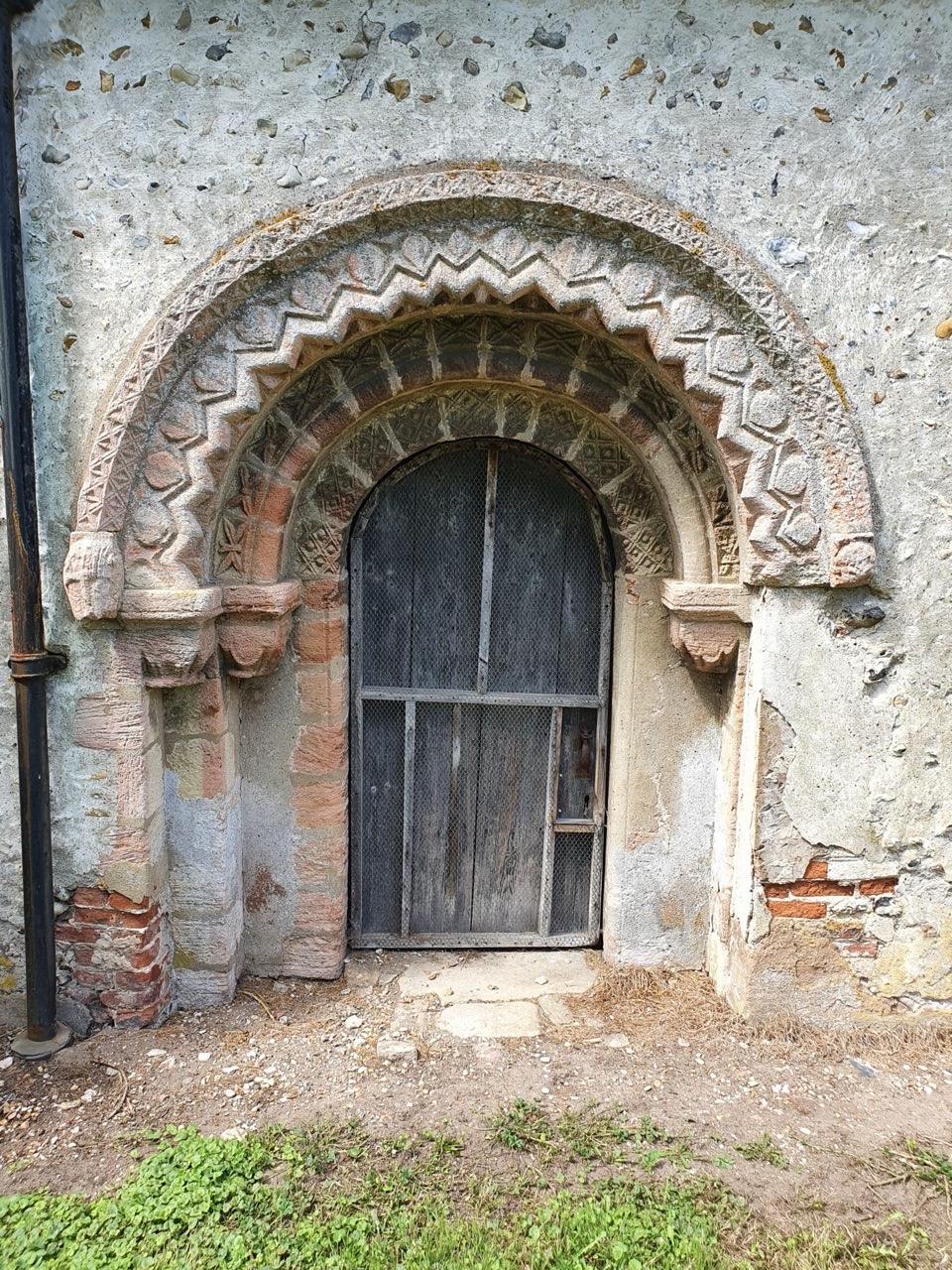
    The Norman tower, which was originally round and was later reworked to make it octagonal. That’s also an original Norman doorway and is in situ and probably wasn’t moved here from elsewhere in the church.

    The entrance to the stairs within the tower.

    The nave, which is the oldest part of the church and dates to the eleventh century.

    The fourteenth-century chancel.

    The north side of the church.

    The east window, and this tells a story of its own. The church was deconsecrated in 1968 and was just left by the Church of England to a slow abandonment. Fortunately, it was taken over by the Redundant Churches Fund around ten years later, but there had been vandalism and destruction during that time. One of the oldest bells in Norfolk was stolen and much of the Victorian stained glass had been smashed. The Churches Conservation Trust gathered up what glass they could and they’ve reset it in the upper part of the window, but the lower part is now just plain glass. This could though have very easily had a different fate, perhaps something more like what happened at Bixley.

    It’s difficult to know whether this is a deliberate wildlife garden approach to their graveyard, or whether they just haven’t been able to cut the grass recently. The village of Buckenham depopulated over the centuries, so there hasn’t been much of a congregation to support it for some time. The church was remodelled in the 1820s, which gives it a different feel to the much more brutal and comprehensive restructurings of the later nineteenth century, although a guide from the beginning of the twentieth century called the changes “fitful and destructive”. Numerous Roman remains have been found in the area, suggesting some form of Roman encampment locally, likely because there was a ferry site nearby.
  • Cantley – Cantley Marshes

    Cantley – Cantley Marshes

    And, just photos, from my walk yesterday around Cantley Marshes, a 650-acre Site of Special Scientific Interest. The RSPB oversee the area and there are numerous rare birds that reside here, along with numerous deer that we saw darting around. And lots of cows, fortunately not near the footpath. I also like to think that they’ve removed the snakes, but I suspect they’re still in there somewhere….

    There’s Cantley sugar beet factory in the background, which looms over the local countryside somewhat and has done since it opened in 1912.

  • Dictionary of the Vulgar Tongue – Day Eighty-Two

    Dictionary of the Vulgar Tongue – Day Eighty-Two

    The Dictionary of the Vulgar Tongue was first published at the end of the eighteenth century, and given that the Coronavirus crisis is giving too much time to read books, I thought I’d pick a daily word from it until I got bored…..

    Cod

    Defined by the dictionary as “a cod of money; a good sum of money”, this word originally meant a small bag, container or pouch from the old English ‘codd’. So, perhaps, the phrase came from that origin, ‘a container of money’. As an aside, the fish likely took its name as it looked similar to an old leather pouch, although the word ‘cod’ seems to have had tens of meanings over the centuries.