[this was a project that got delayed due to Covid, but I’ll finish this one in 2024!]
I feel that I’ve done enough posting about walking for a bit, so it’s time to return to my other true love of pub visiting…. This will be a bit of a holding page until I can start my visiting (and I might revisit the pubs I’ve already frequented, such is my commitment to high standards with this project).
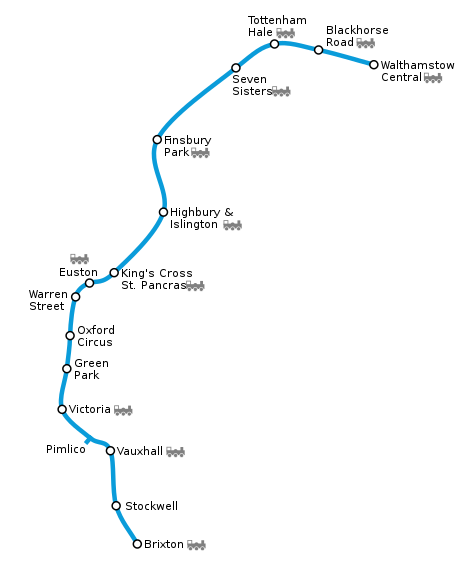
I’m staying in London frequently over the next few months, so my little project is to find a favourite craft beer pub near every underground station in the city. To ensure that I select only the finest, I’m aiming to go to three carefully (sort of) chosen options near each station, then I can pick the pub that meets my requirements the best based on my little visit.
I’m going to start with the Victoria Line, which has 16 stations, so, 48 pub visits (or potentially more if I find some extra interesting looking pubs in a locality). I think I might enjoy this little project trying them all out. I’ve currently still got some gaps in the planning process, all suggestions welcomely received. I’m hoping to have completed the Victoria Line stations by the middle of June if this goes to plan.
STATIONS:
Walthamstow Central (The Untraditional Pub, The Village Pub, Wild Card Brewery Barrel Room)
This is the story of my completing the LDWA 100, something which I didn’t actually always think I’d be able to do. Unlike the previous training walks, I’m going to tell this story in a different way, which is just my feelings about each section of the walk. I usually take hundreds of photos during walks, but when walking 100 miles there are different priorities. My friend Nathan also walked with me for the first 60 miles, but these are my experiences rather than his. These posts are more introspective than usual and there will be an index to these ten ‘stories’ on this page.
Finishing the walk felt a long way from the start, which was at Ness Point in Lowestoft…… My final time was 38 hours and 28 minutes, which really is quite a lot of walking if I’m being honest.
The LDWA has never had a virtual 100 before, something required of course because of national events that sadly meant that South Wales never got to hold their event. For me, the virtual 100 is what I considered to be an easier option than walking the actual event, so this was all ideal for me. I liked that there were no navigational challenges because of the route that we had chosen, I liked that I had a support car near me throughout the entire event, I liked that the route was flat, I liked that I got some road walking in and I liked that I got sleep at home (albeit for an hour). But, I want to stress with some force, that for many taking part in the main event in a few weeks that this is harder than the actual 100, as the checkpoints, camaraderie and support are all near essential. This virtual 100 counts as a proper 100 in the eyes of the LDWA and rightly so, it shouldn’t be under-estimated.
Will I do another 100 is a question that I’ve been asked several times. The problem for me here is that I have no motivation to do another one, I know that I’ve walked 100 miles and I’ve reached that challenge. Although, as the current chair of Norfolk & Suffolk LDWA group, which has just secured the 2025 LDWA event, I’m pretty certain to walk the marshal’s event of that.
What I have learned is that I met a challenge that I didn’t honestly think I could reach, and numerous N&S members have admitted they were’t confident that I’d finish either. This element of completion is far more important to me than anything else, it’s a transferrable achievement for me mentally. My next challenge will likely be creating an on-line project relating to beer, something I’ve been pondering for a while (any excuse to visit more pubs). And I can be driven on by knowing that the 100 challenge was something I didn’t think that I could do, but I then managed to finish.
That means my message to others is to consider taking part in a challenge event. The LDWA offer challenge walks of 18 miles all the way up to 100 miles, fully supported with checkpoints, food & drink and route descriptions. Perhaps just take part in an 18 mile challenge, maybe with friends, see what happens. Perhaps for some people they’ll hate it and not do another one, but it’s an experience to chalk up and another chance to try something new. And trying new stuff is an adventure.
I give huge credit to people who manage to walk 100 after 100, such as Jayne and Chelle who walked with me for some of the way. I don’t know how they do that, that’s proper determination that I’m really impressed by. But I don’t have that in me, I’m too lazy and too distracted by pubs and travel to shoot for that sort of target. But there’s something addictive about completing challenges, whether it’s walking or in other aspects of life.
So, I hope that people consider giving a challenge event a go and see where it leads, and I can’t wait to hear the stories of people taking part in the main event in a few weeks.
I’m a huge fan of the random, it’s something that I can do more in life. The thought of trying random new experiences and going to random new places, some of which I might not like, but many more of which I perhaps will. I’m hoping to find something new and random to be challenged by now and I hope that the experience proves to be one that engages and delights me. The 100 has renewed my passion in adventure and challenges, so that’s been a real boost.
As for the LDWA, I now feel much more confident in completing 26 mile challenge events in the future, they seem quite easy compared to what I’ve just done. I will certainly do that as we have great members, have great challenge walks and there’s some really lovely food available at them, all for a reasonable price. For anyone who wants to have a go, there’s all the information that you could ever want at https://www.ldwa.org.uk/.
My advice for anyone completing the 100 is to spend a lot of time working on your mental strategy, as this is what stops a lot of people from finishing. Break the route down, create mini targets and don’t think of the entire distance. Be conscious that night-time is a low for many, but that energy is also magically restored in part with the breaking of dawn. I liked Seal Skinz socks and putting Sudocrem on my feet every ten miles, as well as wearing cycling short to avoid any rubbing. Eat and drink regularly, even when you feel that you don’t want to.
I’d say that anyone walking the 100 should enjoy it, but there are of course moments when the whole idea just seems stupid and unnecessary, as well as when there is perhaps pain and discomfort. Planning for those dips is useful, so that you can create strategies to get round them.
As a final thanks again, to Richard and Liam for their support team throughout the entire event, as well as to Jayne, Chelle, Paul, Kathleen, Rob and Brian for walking sections with me. And congratulations of course to Nathan, who completed an amazing 60 miles and with whom I wouldn’t have been able to start this whole project. Hopefully he’ll forgive me for coming up with such ideas and for the adventures we had on our training walks (not least youthhostelgate).
Thanks also to Dave Morgan as well. It’s of course been difficult for him seeing his young protégé storm through the event with fewer injuries than him, but I hope he doesn’t dwell on those negatives (it’s just the survival of the fittest), and remains proud of the wonderfully brave 100 he completed and for his constant support over the last year (and even his threats to send me Bud Light and fruit). Alan Warrington has also offered endless good advice, as have members of the NEC and those who helped with my interviews about taking part in the 100. I considered carefully every piece of advice offered and put into place very many of them.
So, in a few weeks it’s the turn of hundreds of others to do the same in the main event and there’s still a few days left to enter at https://www.sientries.co.uk/list.php?event_id=7793. Just under 450 have entered, so that’s a lot of stories to be told. And sorry to Julie Cribb, the national chair, who is now going to be forced to finish the event, otherwise she’ll never hear the end of it from me 🙂
This is the story of my completing the LDWA 100, something which I didn’t actually always think I’d be able to do. Unlike the previous training walks, I’m going to tell this story in a different way, which is just my feelings about each section of the walk. I usually take hundreds of photos during walks, but when walking 100 miles there are different priorities. My friend Nathan also walked with me for the first 60 miles, but these are my experiences rather than his. These posts are more introspective than usual and there will be an index to these ten ‘stories’ on this page.
For the very observant, the image above is the same as in the previous section, as the last ten miles were walking back along the Marriott’s Way along sections that I’d already walked.
At something like 91 miles, I was pleased to see Chelle, Jayne, Brian, Kathleen and Paul (and Fred of course!) waiting for me as I walked back into Cawston. It was great to have a few people to walk to the end with and to distract me. Mentally I felt entirely happy here, I wasn’t particularly tired and I knew that the ten miles would soon melt away. There was no pain to deal with, so this was just a standard day walk to end the adventure with.
This part of the walk went quickly in my mind and I was delighted to have some of Jayne’s flapjack that she had brought along, as for a couple of brief moments I felt quite worn. The flapjack soon restored my spirits once again to continue on, meaning that I didn’t need to stop at 95 miles at a checkpoint arrangement.
The last few miles were mostly back along the Ashwellthorpe Loop, which meant I arrived back at Whitwell railway station having walked 98.5 miles. I do remember here running towards Leon pedalling furiously towards me on his bike, such as was my excitement at the whole event nearly being over. I knew that I could likely walk another 15 or 20 miles, but that seemed rather pointless and I think my support team would have been slightly annoyed about that little arrangement.
As we were at 98.5 miles we had to walk back along Marriott’s Way a little and I decided that I’d stop at a clearing that I could see ahead when I got to around 99.5 miles (I was aiming for 100.5 miles and had put in an extra half mile in case I had miscalculated the distance, as finishing at 99.99 miles would have been bloody irritating). By chance, this is a clearing where I’d stood a few weeks before pondering the 100, so it felt an appropriate place to turn back.
And that was the end, the 100 was reached at the Whitwell railway station, something which wasn’t particularly planned, but felt appropriate given I quite like railway history. Above is me with Liam and Richard, who I couldn’t have completed the event without, their support for the entire 100 miles was incredible.
Thanks again to those who walked with me, followed me on tracking and sent me so many supportive messages. I know that I couldn’t always reply to them, but I read and appreciated each of them.
As for my thoughts about this whole challenge, I’m saving that for the next post (will this never end?!?!?!).
This is the story of my completing the LDWA 100, something which I didn’t actually always think I’d be able to do. Unlike the previous training walks, I’m going to tell this story in a different way, which is just my feelings about each section of the walk. I usually take hundreds of photos during walks, but when walking 100 miles there are different priorities. My friend Nathan also walked with me for the first 60 miles, but these are my experiences rather than his. These posts are more introspective than usual and there will be an index to these ten ‘stories’ on this page.
This section of the route took me from Reepham to Aylsham and then back a little way along the same path, as Aylsham is located at the end of the Marriott’s Way. As I mentioned in the last section of this riveting adventure (or seemingly endless drivel, depending on your point of view) I had come up with one of my excellent plans, listen to music for five miles and then take Pro Plus and just hopefully get an energy burst to take me to 90 miles.
Richard walked with me for a short way from Reepham, but he was manning the support vehicle, so that was just for a relatively short stretch as he needed to acquire Pro Plus and reposition his car. At that point, I put music on and somehow managed to enter some sort of trance as I just walked and walked. I realised that I was going at four miles per hour, which is a fast walking pace, and I had the slightly embarrassing situation at one point when I overtook a jogger. I pondered whether this was sensible, and then decided that I just had to eat the miles up and there was little point trying to maintain a slower pace this far into the walk. I also worried that someone would think I’d pinched a bike for this section if I’m being honest (although my friends know that I walk faster than I cycle, so I’d hardly do that).
I messaged the support team and told them to scrap the 85 mile checkpoint as I intended to just march into Aylsham that I hoped would take me to around 88 miles, which is where Richard was going to be located with the car. I arrived into Aylsham a little short of that estimate, at 87 miles, but the time it took me to cover the seven miles was fast and I felt in excellent shape. To not have any pain, stiffness or issues at that stage of the walk seemed like a miracle and I didn’t want to question that.
At 87 miles, I sat in Richard’s car for a while, and he made me some cheap tea (not one of my decadent ones). It did the job though, and I also ate more than I felt I wanted, focusing on getting enough sugar and salt. I lingered at this stop, as it felt right, so I think I was in the car for around 25 minutes, which was a little bit of a luxury compared to previous stops. But, I was now entirely confident I’d finish, confident I’d finish before it got dark and confident I wouldn’t be injured.
I knew that the last ten miles would be challenging, so Richard walked back with me two miles along the path, to take me to 89 miles, before he had to go back and collect his car. We did a much slower pace than I had been doing, as I knew that the last section would now just be a steady and reasonable pace, not a charging off pace. There was a slight concern about power on my phone, as my charger had gone temporarily missing (it was later found safely), but Richard’s charger did the job (well, sort of, I think he got it off the back of a lorry, but I didn’t say anything). That meant at 90 miles I was approaching Cawston, and I knew that I had friends from the LDWA who were going to walk the last stretch with me.
As for my thoughts, I think I had stopped questioning why I was doing the event at this stage, as it didn’t much matter. As I was 90% in, I just wanted to carry on and finish, although I was considerably annoyed to discover Dave Morgan had rushed around with a quicker time. I reminded myself that he was injured and I wasn’t, which made me feel better, and is a reminder that these amateurs rush off without taking as much care as I had done. I shall issue him with some of my top tips for next year (mainly learn to keep it long and flat, not long and ridiculously hilly).
This is the story of my completing the LDWA 100, something which I didn’t actually always think I’d be able to do. Unlike the previous training walks, I’m going to tell this story in a different way, which is just my feelings about each section of the walk. I usually take hundreds of photos during walks, but when walking 100 miles there are different priorities. My friend Nathan also walked with me for the first 60 miles, but these are my experiences rather than his. These posts are more introspective than usual and there will be an index to these ten ‘stories’ on this page.
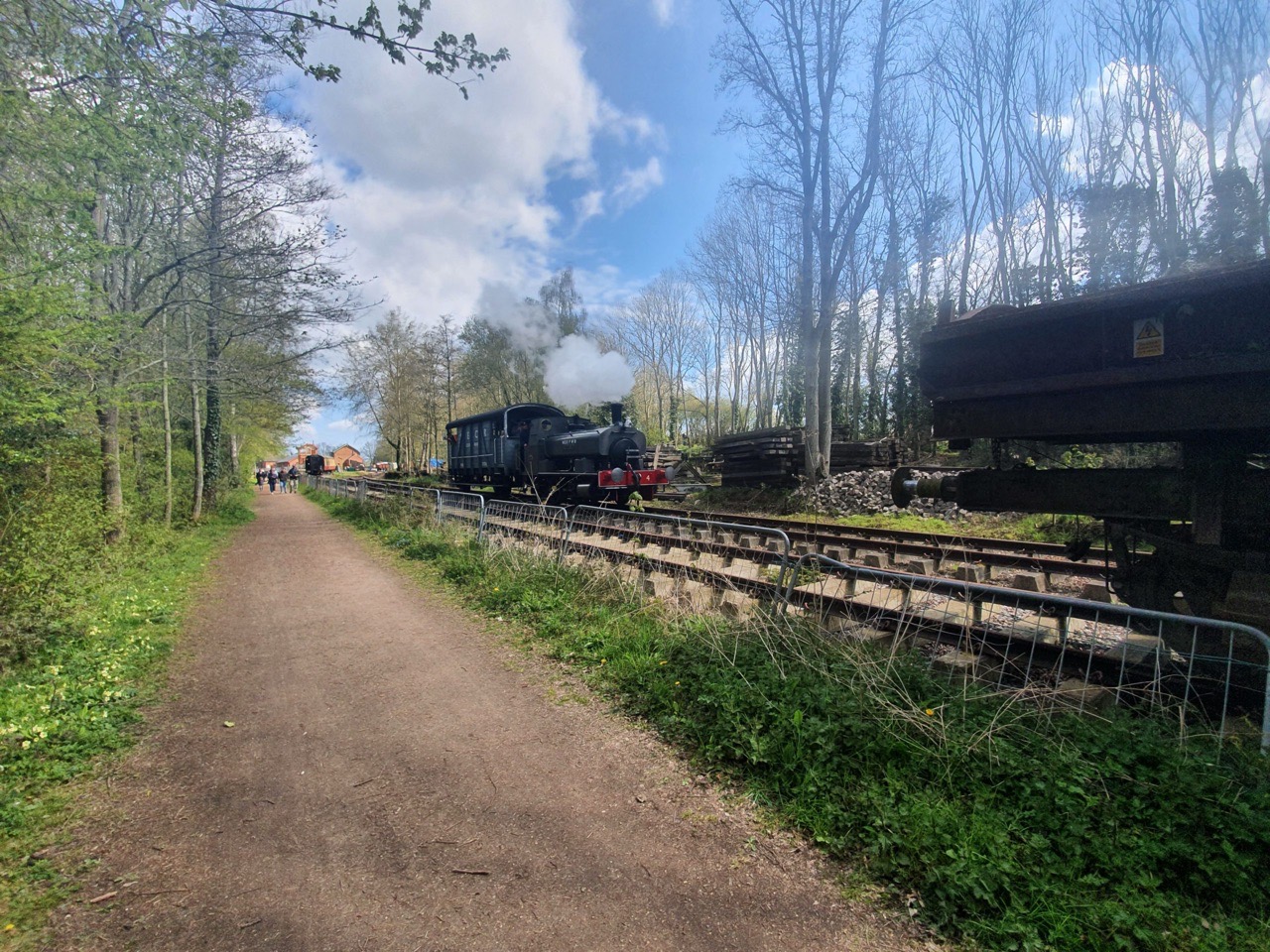
The 70 mile mark was one where I knew I’d finish the entire distance, but I couldn’t get out of my mind that I had a lot of hours of walking left. Paul kindly walked the 70 to 80 mile section with me, which was much appreciated, as I had become quite bored of listening to music and needed some human company again. This section of the walk took me around Attlebridge at 70 miles, to Whitwell Railway Station at something like 74 miles and to Reepham at 80 miles. If anyone looks at a map they’ll note that Whitwell Railway Station and Reepham are very close together, but then Google the Themelthorpe Loop (worth reading about for anyone interested in railway history).
When I’m writing this up, the distance of ten miles might not sound much, but it is in context of the whole 100 event. It takes over three hours to walk each of these sections, and when tired, that is something of a slog. I felt that the section to Whitwell Railway Station seemed to take much longer than it had when we reccied the walk a few weeks ago and things started to feel a little more difficult. There was some sort of event on at the station, which is now a heritage railway, and I was a little envious of the people sitting near the cafe having something to eat and drink after going on a two-mile stroll. A little walk like that seemed entirely sensible, right and proper, especially if there was a pub visit afterwards.
I did still remember to do the important things, such as eat food at every checkpoint that was there for me, something like five miles apart. I also kept drinking water to remain hydrated, being very grateful that this support was being offered just for me. As I approached the 80 mile mark, I did feel weary, and I pondered whether I should do my ten mile check of my feet. I decided to, but agreed with Paul that this should be the last, as there was little that I’d be able to do at the 90 mile mark, and it was more hassle than it was perhaps worth taking the time to faff about doing that. There was something quite satisfying about knowing at 80 miles that the next time I’d be checking my feet was when I got back home and it was all over.
I’m not sure that I was always entirely coherent during this stage of the walk, although I sometimes wonder that in general life to be honest. I do remember forgetting the end of the sentence that I had started, although I reminded myself that I was now aged over 30 and these things were inevitable at the best of times. But thanks to Paul for bearing with me, it was all very useful.
The reaching 80 miles worried me though, as I realised that I still had 20 miles left to do. I knew that as a percentage of the walk that it wasn’t very much, but it was still effectively 7 hours of walking and that’s a lot when you’re tired. So, I devised one of my plans, which are usually bloody awful, but this was a good one. I decided that from 80 to 85 miles I’d listen to music, and then I’d get Pro Plus (which Richard had kindly volunteered to locate for me) as a little treat at 85 miles to last me to 90 miles. I hadn’t had any caffeine, painkillers, alcohol or energy drinks of any kind, and nor had I even needed a blister plaster. So, I thought a little pick-me-up at 85 miles would be a good plan, and I was pleased with my new strategy. At least it was something to help get me through what was looking to be the tough 80 to 90 mile section, and also meant that Chelle and Paul could celebrate a well-deserved birthday lunch.
What happened between 80 and 90 miles didn’t quite go to the plan that I had carefully devised (well, quickly botched together)……
This is the story of my completing the LDWA 100, something which I didn’t actually always think I’d be able to do. Unlike the previous training walks, I’m going to tell this story in a different way, which is just my feelings about each section of the walk. I usually take hundreds of photos during walks, but when walking 100 miles there are different priorities. My friend Nathan also walked with me for the first 60 miles, but these are my experiences rather than his. These posts are more introspective than usual and there will be an index to these ten ‘stories’ on this page.
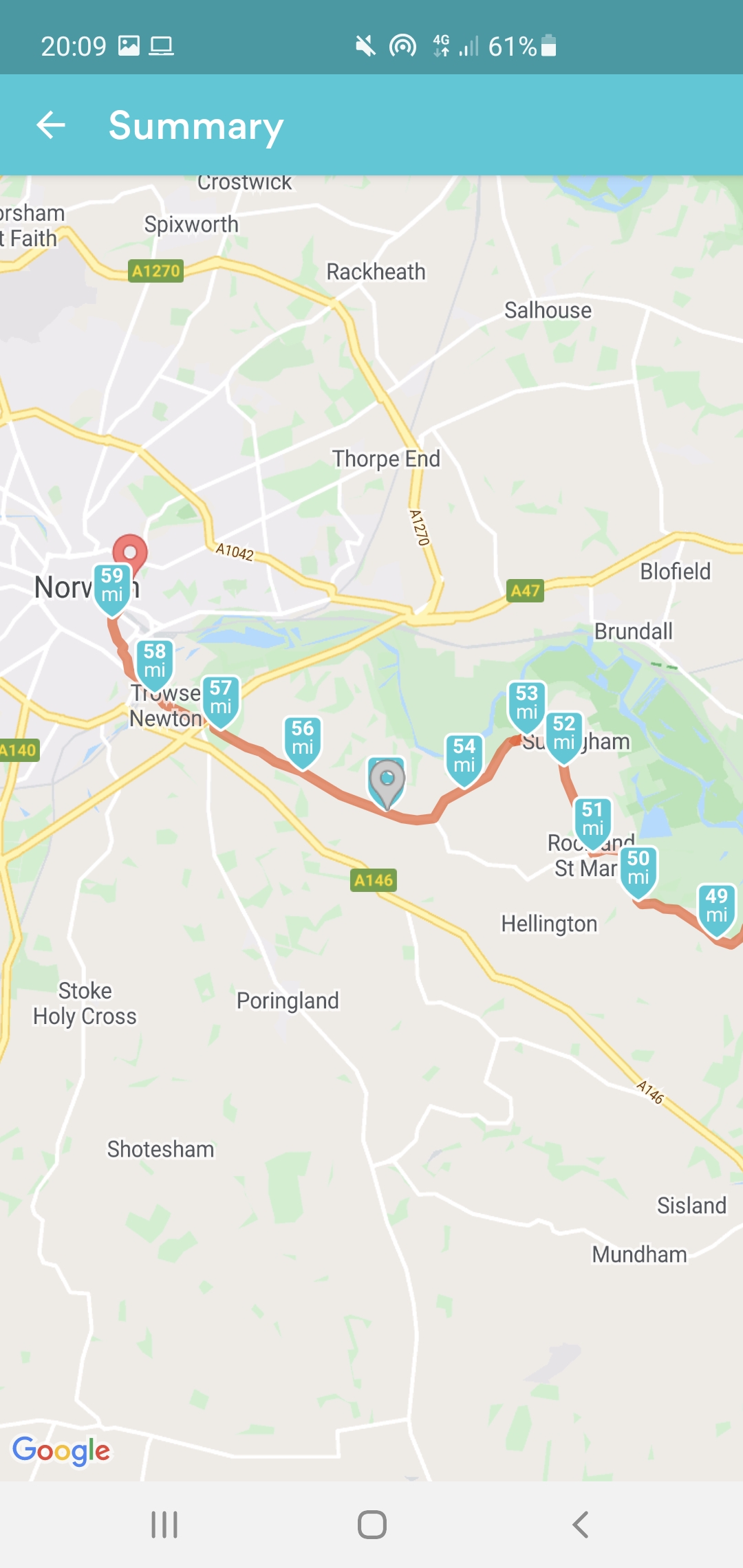
For anyone observant, the mapping changes above as my Runkeeper file corrupted for the 60-100 mile section, but I’ve included the Google route map for anyone wondering which way I went. Effectively, I just followed Marriott’s Way to the end and came back though.
In the last section of this story, I mentioned that Nathan dropped out and I went to bed for one hour with an expectation that I too would do the same when I woke up. The problem I had was that I wasn’t actually that bothered about walking the 100, strange as it seems. I’ve been a member of the LDWA for eight years and haven’t really shown much interest in it, but this became a useful lockdown project for Nathan and myself. So, it was “our thing”, even though perhaps neither of us really wanted to do it. I say perhaps, but I’m pretty sure I can say with confidence that neither of us wanted to do it.
Again, this raises the question of why walk 100 miles? I think I answered that it was a challenge that the two of us had, and we thought it would be an adventure, which we certainly had along the way with the training walks. But, we were always more interested in the pubs, or the gossip, or the stories that flowed. I suspected that we’d never do a long distance walk of anywhere near this length for some years, there are too many other things to do in life.
It meant though that I had 40 miles left to go and I’d have to walk that alone, that was my thought when falling asleep. I woke up and expected to be hurting, to have blisters forming and to have stiff legs. Before I could ponder whether that was the case, I realised I had woken up five minutes before my alarm, despite having just a short period asleep, and that seemed strange. I paused to think about the state of my body and I realised that I also was in no pain, I had no blisters and no stiffness in my legs. It might sound ridiculous, but I was slightly disappointed. I wanted to go to the pub, there’s a beer at the Artichoke that I really wanted to have and I thought that I could justifiably hobble there in the afternoon if I had been hurting.
But, I also thought that here I was caught up in this challenge and I’d done 60 miles, and could now likely complete it. I don’t like walking alone, not because I’m scared, but because I get bored. I want to mention here that there are different sorts of walkers in the LDWA. Some battle around the 100 in pain, because they have a stubborn streak that sees them in regardless of what happens, and they’ll complete the event year after year. Then there are people like me, we want to have a go at stuff, but we don’t have that determined streak. I’ve often accepted failure if I’m hurting a bit, not least with my first coast to coast challenge with Liam a few years back, because I’m not actually that stubborn. Belligerent perhaps, but I’m not very stubborn.
However, I now had the choice of walking alone and having Liam in the support car for mobile checkpoints every five miles, or to ask Liam to walk with me, but then I’d have no support car for a while. I went with the option of walking alone. Some have said this was brave, but I’m not sure it was, it was just I could do it and I didn’t have a good enough reason not to.
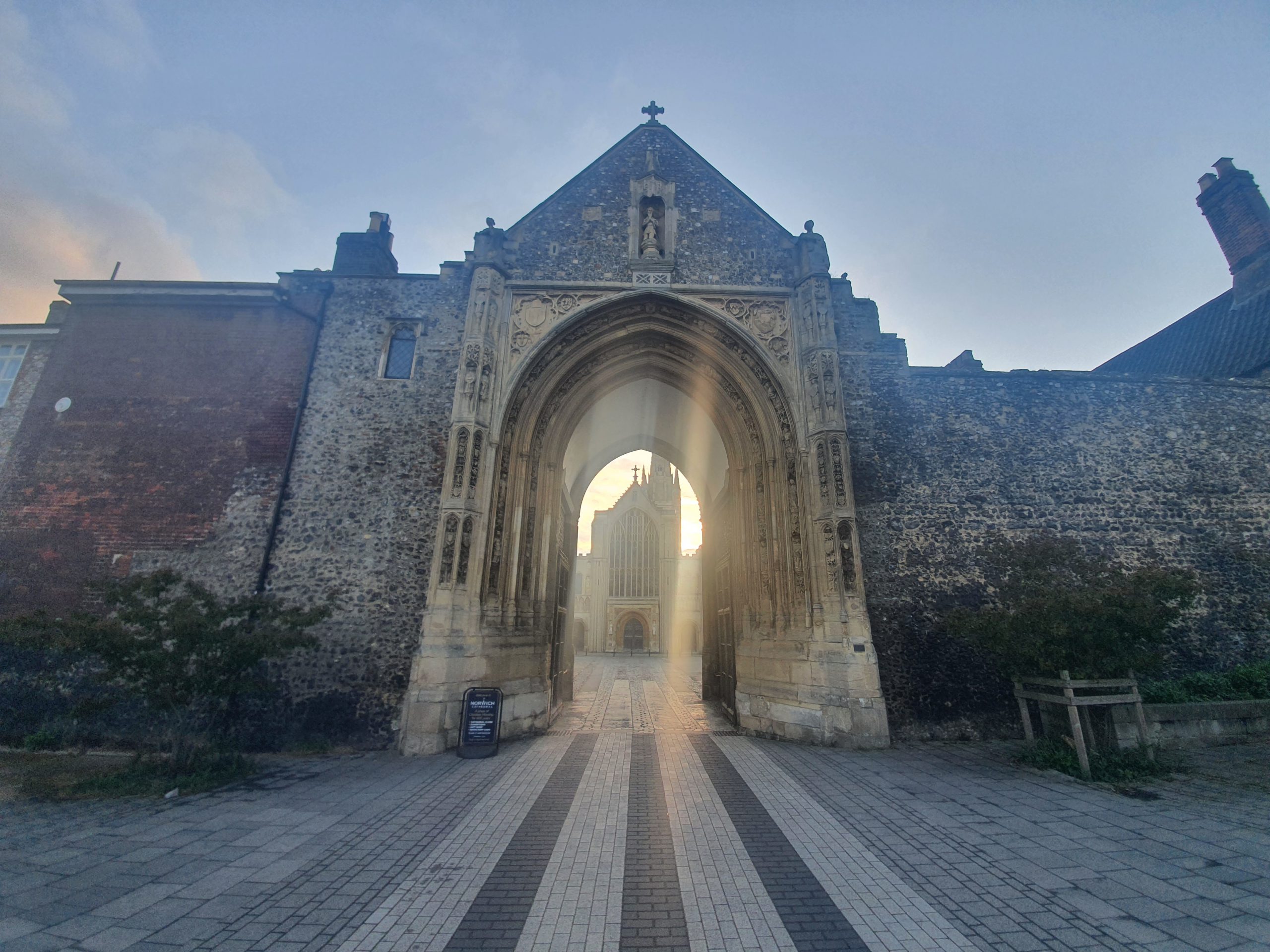
I took a longer route in Norwich than I needed, because I wanted to walk by the Cathedral and through the quiet city centre where dawn hadn’t long broken. I liked the still city, it gave me a boost of energy and I happily and contently meandered to the start of Marriott’s Way, the path which would take me to my 100 mile target. I had headphones and music playing, they were the distraction that I needed. Many 100 entrants say that dawn brings a new burst of energy, like a resetting of the body, and I felt like that. The weather was again perfect and I was comfortable.
I didn’t take many photos during this stretch of the walk, which went through Drayton and Taverham. I knew I had to take photos at regular intervals as proof of my walk to get the certificate, so I found what looked like nice pieces of countryside to include. Given that I had shared my tracking with over 100 people, I’d have struggled to have cheated on this walk by getting the bus, but collating evidence was important as that’s a requirement the LDWA rightly have for this virtual 100.
After going through Taverham, I picked up speed and I’d say that I started to enjoy the walk. The thought of the pub had gone out my mind and I could slightly sense that I could finish the 100. And I now just wanted to do that, to get it out of the way and to say that I had done it. At something like 70 miles, I reached Liam’s car at Attlebridge for my regular 10-mile check of my feet. Chelle and Paul were back again to help me, a really lovely gesture given that it was Chelle’s birthday and she could have been anywhere she wanted celebrating, but instead she was helping someone finish the 100. She’s a walking hero through and through.
Other than for a few seconds of cramp in the car, all was well with my feet and I was still not in any pain or difficulty. The changeover of support car was then about to take place, with Richard taking over until Liam returned later in the day to see me complete the walk. At the 70-mile mark, my completing the walk perhaps wasn’t inevitable, but I knew for the first time that I’d definitely complete the 100. At that point, there was nothing that I could see stopping me joining the ranks of LDWA members who had walked 100 miles. I’m not sure completing the 100 was ever important to me before the walk, but when you’re 70 miles in, its importance starts to increase.
This is the story of my completing the LDWA 100, something which I didn’t actually always think I’d be able to do. Unlike the previous training walks, I’m going to tell this story in a different way, which is just my feelings about each section of the walk. I usually take hundreds of photos during walks, but when walking 100 miles there are different priorities. My friend Nathan also walked with me for the first 60 miles, but these are my experiences rather than his. These posts are more introspective than usual and there will be an index to these ten ‘stories’ on this page.
This section of the walk was one that we thought would be easier than it was, as we’d hoped to be buoyed up by the return to Norwich at the 60-mile mark for a brief rest. I took no photos during this ten mile stretch, partly because it was dark and partly because there were times that I started to think about giving up for the first time.
At the 50 mile KFC stop, we had decided to shift our plans away from walking Wherryman’s Way and instead walking along the quiet roads in the area. We did this as it was simply quicker to walk on road, it wasn’t navigationally challenging and it meant that we had Richard and his support car nearby at all times. And perhaps that was a mistake. Instead of going with our checkpoints every five miles or so where we met our support team, we didn’t have a target over than Norwich. So, it all started to drag. Three miles might not sound far, but it’s still an hour of walking in the dark, and is there any point in doing that?
By 53 miles, I was silently questioning why I was doing this walk. I had gone past my longest ever walk milestone (the 52.5 mile Shotley 50 in 2017) and was reminded that I wasn’t that engaged with walking. The hopes that Nathan and I had that we could inspire each other with our best chat just started to fall away a little. I think it’s fair to say that Nathan was also coming to the same conclusion that he was questioning the point of the walk as well. From what I’ve heard from others, this is not a rare occurrence amongst walkers.
The first night is a dangerous time on the 100 mile event, as it’s when the body wants to be in bed and the end point is some distance off. Actually, it’s a long way off. We slowed a little and I think both separately started to be mentally depleted by this whole challenge, which was worsened by the dual disaster of a broken head-torch and Richard’s car breaking down at the same time. Nathan suggested that perhaps this was just a sign, and actually, I started to think he was right. He actually normally is on quite a few things, but we won’t dwell on that.
I had been told that this was a mental challenge rather than a physical challenge, so I think I lied to both of us by saying we must push on just a bit more and try and see if we could make progress and walk through this. I didn’t much want to continue though, I wanted to go to bed. I was very near to suggesting to Nathan that we abandon the walk, tell everyone that we’d got to 55 miles and could enter next year’s event (which we probably wouldn’t have done) and should spend Sunday in the pub drinking stouts and other decadent beers. We could claim that we had walked a long way, get some praise and then move on, perhaps switching our future endurance events to playing pitch n putt before going drinking.
We stopped for a while and sat in Richard’s car, and full thanks to Liam for getting out of bed at about 01:30 to fix Richard’s car and restore our vision. Liam is, to be honest, incredible. Hopefully he won’t read that, friends don’t need too much praise in life. I felt slightly unwell for a few seconds, and that worried me. I switched to Liam’s more comfortable car and told myself I could have a 15 minute sleep, although I didn’t need it (well, I did, but it didn’t feel like the right time).
The element that dragged me on was that I knew I could get into Norwich, however annoying it was, so I wanted to just see how far I could get. Maybe a miracle would allow me to get into Norwich, sleep, and then carry on. But, I don’t have great willpower, and so if Nathan felt he wanted to stop, I was pretty destined to give up as well. However, between us, we did both manage to get into Norwich, and that’s when Nathan called it a day as his feet were starting to blister. And, in my mind, with Nathan stopping, I told myself I’d try and carry on the next day, but I was prepared to stop.
As for Nathan, I think his walk was incredible. He’s gone from not being involved in long distance walking a year ago to walking further than most members of the LDWA have ever walked, a tremendous 60 miles. There’s a danger that anyone thinks 60 miles is a failure as the walk is 100 miles, but, if we’re being honest, we’d only intended to walk 60 miles a few weeks ago. The extra bit to 100 miles was only ever something of a pipe dream. We told people that, but I’m not sure how much they realised we were seriously looking at only doing 60 miles for a long time.
In the first part of this series of posts about the walk, I mentioned about I was unsure why I was doing the walk. As we reached the home stretch, I was of course disappointed that we wouldn’t both finish the 100. There was the thought that if we could finish the 100, then we could meet other challenges. Not walking related ones, not even health related ones, but any of those random ideas we’ve come up with about projects we could do and run (no pun intended) successfully.
It’s nonsense though, because 60 miles was enough. We’d done that, that was enough evidence we could achieve things, perhaps it just meant we were sensible enough to know when to stop. What it meant though was that if I wanted to go on the next day, I’d have to do it alone. As I went to bed that night (for all of an hour) I was already writing the blog posts in my mind of why I’d quit. I knew some people would be disappointed, not that I hadn’t finished, but they’d be disappointed for me. Fortunately, I fell asleep quickly, without pondering this whole thing too much.
This is the story of my completing the LDWA 100, something which I didn’t actually always think I’d be able to do. Unlike the previous training walks, I’m going to tell this story in a different way, which is just my feelings about each section of the walk. I usually take hundreds of photos during walks, but when walking 100 miles there are different priorities. My friend Nathan also walked with me for the first 60 miles, but these are my experiences rather than his. These posts are more introspective than usual and there will be an index to these ten ‘stories’ on this page.
This section of the walk took us from Loddon along the Wherryman’s Way by the River Yare and then into a point just short of Rockland St. Mary. Chelle and Paul had left us at Loddon, but we had the surprise of Rob (another successful LDWA 100 completer) joining us for a big chunk of this section of the walk.
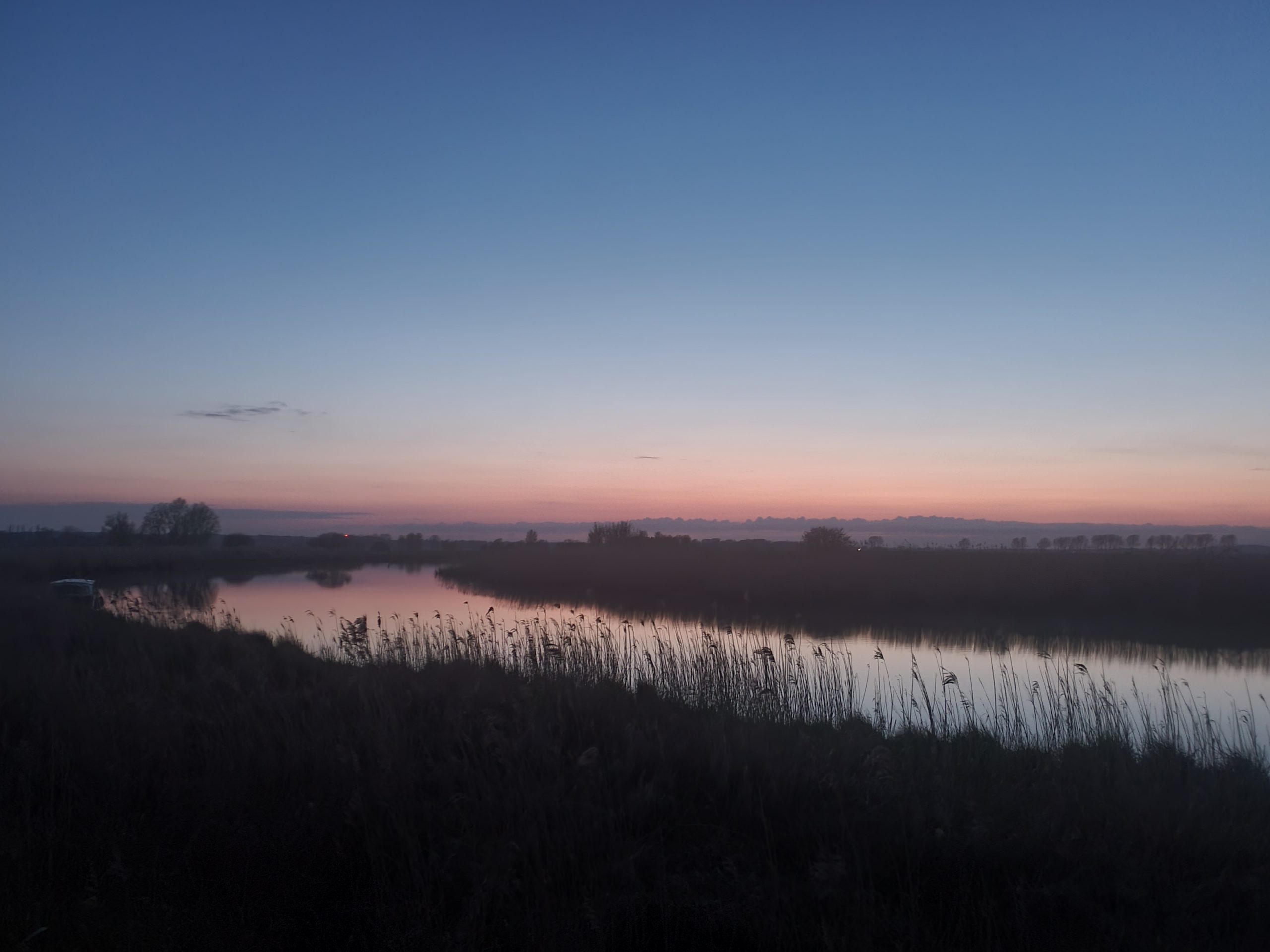
The quiet and still river at sunset.
The not so quiet Cantley Sugar Factory, reminding me slightly of seeing Las Vegas in an otherwise dark Nevada sky (you have to use your imagination for that a bit, but it does dominate the local Norfolk countryside with its bright lights).
Not a great photo, but this was the KFC treat at 60 miles, which Richard had kindly rushed to us from Norwich. He was in charge of the support car for this section, and again, I must say how much we appreciated his help. There’s another tip here, which is ensure that you get some of the food treats that you want, whether that’s something sensible like KFC or even something perhaps just a little less sensible such as fruit. Whatever it is, it’s another little target to look forwards to.
I felt this stretch of the walk went better than we had anticipated, as we had expected the walk into Norwich between 50 and 60 miles to feel easier than this section. Unfortunately, that wasn’t to be, but it meant that at 50 miles things seemed pretty much at ease. We had gotten used to walking at night, frightened only once by a pack of hungry yelping wolves (or a solitary muntjac deer, they sound similar) and from them on Rob had helped to distract us with conversation. I also feared for a moment that I was breaking out into a sweat, but it seemed to be more the condensation of the evening. We might have recognised that if we’d done more night walking, but that’s a bit of an effort to organise and it usually seems a much better idea to go to the pub.
Richard had set up the tables and chairs at 55 miles for us to have a stop and sit down at Hardley Staithe, and I had another of my slightly decadent teas to pass the time. I wasn’t particularly hungry at this stage, but carefully made an effort to eat a few things to ensure that I had enough salt, sugar and other essential nutrients.
That I don’t have much to write about my feelings during this stretch tell their own story, I think we had gotten into a rhythm of walking, buoyed up that we were some way ahead of schedule and were in as good as a shape physically as we could have hoped for. We also decided that we’d amend our route from 50 miles onwards, which was to go off Wherryman’s Way and to walk along the road. I think we felt that this was a chance to make our lives as easy as possible to get into Norwich. But, the next section was to prove to be more testing. Quite a bit more testing.
This is the story of my completing the LDWA 100, something which I didn’t actually always think I’d be able to do. Unlike the previous training walks, I’m going to tell this story in a different way, which is just my feelings about each section of the walk. I usually take hundreds of photos during walks, but when walking 100 miles there are different priorities. My friend Nathan also walked with me for the first 60 miles, but these are my experiences rather than his. These posts are more introspective than usual and there will be an index to these ten ‘stories’ on this page.
This 31 to 40 mile section was all on the Wherryman’s Way, taking us from just past Berney Arms, onto the Reedham ferry and then into the town of Loddon.
I can’t recall what I said to the sheep that upset them……
We were pleased that the river bank was cut back and easy to walk on, this was a real problem for us last year on the first occasion that we walked along Wherryman’s Way. It was also positive to see a new stretch of the long distance trail had been opened up at Reedham, meaning that there’s no requirement to walk alongside a busy road down into Reedham ferry.
Back to my thoughts during this stretch though. The section to Berney Arms had dragged a little bit, but this meant that the walk into Reedham was slightly shorter than I had anticipated given I’d gotten muddled up about distances. Reedham was always a bit of a high point, as it meant we got to go on Reedham Ferry (the only way to continue on the long distance path) and also got to enjoy a little BBQ kindly laid on by Liam.
With this entire walk, we had split it into two distinct chunks, the first stretch which was 60 miles from Lowestoft to Norwich, and then the second stretch which was 40 miles from Norwich towards Aylsham. I had the treat of a one hour sleep between these two stretches to look forwards to, which was hardly ideal, but was still something of a treat to think about. This meant that reaching 40 miles was effectively two thirds of the way through the first day’s walking (we had decided we’d call the first 60 miles as day one, and the second 40 miles as day two), and that was a useful mini target. For anyone thinking of walking this distance, it’s essential to have these mini targets and to chalk them up as small victories.
A mistake we’d made was not putting more food into our bags for the stretch into Reedham. Having support cars meant that we didn’t have to carry 48 hours worth of food, but I felt that I only needed a chicken bake and a Scotch egg for that section, and ultimately I felt I could have done with more. I’d say looking back now though that I was pleased with how much water I was drinking, and I ensured I always had enough throughout the walk. I was always hydrated and this is another key element of making the walk achievable, which is drinking water even when the body might not think that it needs it. For that matter, it’s important also to eat enough, to deal with the calorie burn and to keep the body sustained.
We timed the Reedham ferry perfectly (although it’s hard to time it badly, the longest wait possible is probably about four minutes) and Liam had set up the BBQ in the car park opposite. This provided us with our first proper sit down and Richard had kindly ensured that he had brought some garden chairs for us to sit on, indeed, some of his best quality ones. I’m not sure that we were hugely hungry, but the sausages, burgers and chicken were all very welcome and I had one of my slightly decadent peppermint teas.
We were met by Chelle (who is a proper 100 walker, there’s little that she doesn’t know about long distance walking) and Paul (another experienced 100 walker) who walked with us into Loddon. That marked the 40 mile stage, which meant it was time for the ten-mile checking of feet and reapplication of Sudocrem. I had feared that I might have had a blister forming, but that was just in my imagination, and I was starting to get confident that my footcare strategy was working. This is something I really haven’t given enough thought about before, often not being fully prepared, and it’s absolutely essential to get this right for something like the 100.
I was quite hopeful at this stage, as we had been refreshed by the BBQ and Richard had kindly bought half of the Co-op to ensure that we had enough food and drink for the night-time sections. All we had to do was to get to 50 miles, and then walk the final stretch into Norwich. For the first time I started to worry though about the night-time section, this wasn’t something we’d done much of and there were some navigationally challenging moments ahead.
I’d say that I left the 40 mile mark confident, but slightly nervous of how the next 20 miles would unfold.
This is the story of my completing the LDWA 100, something which I didn’t actually always think I’d be able to do. Unlike the previous training walks, I’m going to tell this story in a different way, which is just my feelings about each section of the walk. I usually take hundreds of photos during walks, but when walking 100 miles there are different priorities. My friend Nathan also walked with me for the first 60 miles, but these are my experiences rather than his. These posts are more introspective than usual and there will be an index to these ten ‘stories’ on this page.
Preparations at Breydon Water for the drone flying, which unfortunately didn’t quite work out due to the strong winds. But it was worth a try and at least Richard got his drone back safely.
The bird hide on Wherryman’s Way that I’ve walked by many times and never gone in. I popped in to have a look this time, which probably explains the relatively steep ascent on this section of the route.
I’m not sure that the younger members of the support team really comprehended my bravery despite my telling them several times.
But, back to the walking. The stretch between 21 and 30 miles took us from the Outer Harbour in Great Yarmouth to Great Yarmouth Minster and the neighbouring cemetery area, before then leading us onto the Wherryman’s Way.
It was quite a boost to get onto the Wherryman’s Way, which was at about 24 miles into the route, as this was the walk back home to Norwich and it’s a path that we’ve completed before. The first stretch is easy to navigate and we were looking forwards to seeing Richard and Liam for the drone flying section, all a little bit of a boost. The temperature conditions were perfect, a slight breeze and not too much sun, as this is an area where it wouldn’t be hard to get sun burnt and I didn’t want that to add to my list of worries.
It was at about the 28 mile mark that I started to become a little disappointed, as Berney Arms was further down the route than I had remembered. It didn’t much matter, as the distances were the same, but I just wasn’t quite at the location I thought that I was. However, I was buoyed somewhat by knowing that we were about to hit 30% of the distance and that we could have a decent sit down at Berney Arms with our food.
As for my thoughts during this stage, I remained upbeat because I wasn’t injured or hurting, and that meant confidence that I could at least keep going for some time yet. But the enormity of the whole walk started to hang a little at around the 28 mile mark, despite all the mental thoughts I had worked on about remembering that this was just a series of short walks and not to think about the big picture. I’m not sure that I had much time to think about the big picture for this stretch, as conversation took over and proved to be a useful distraction.
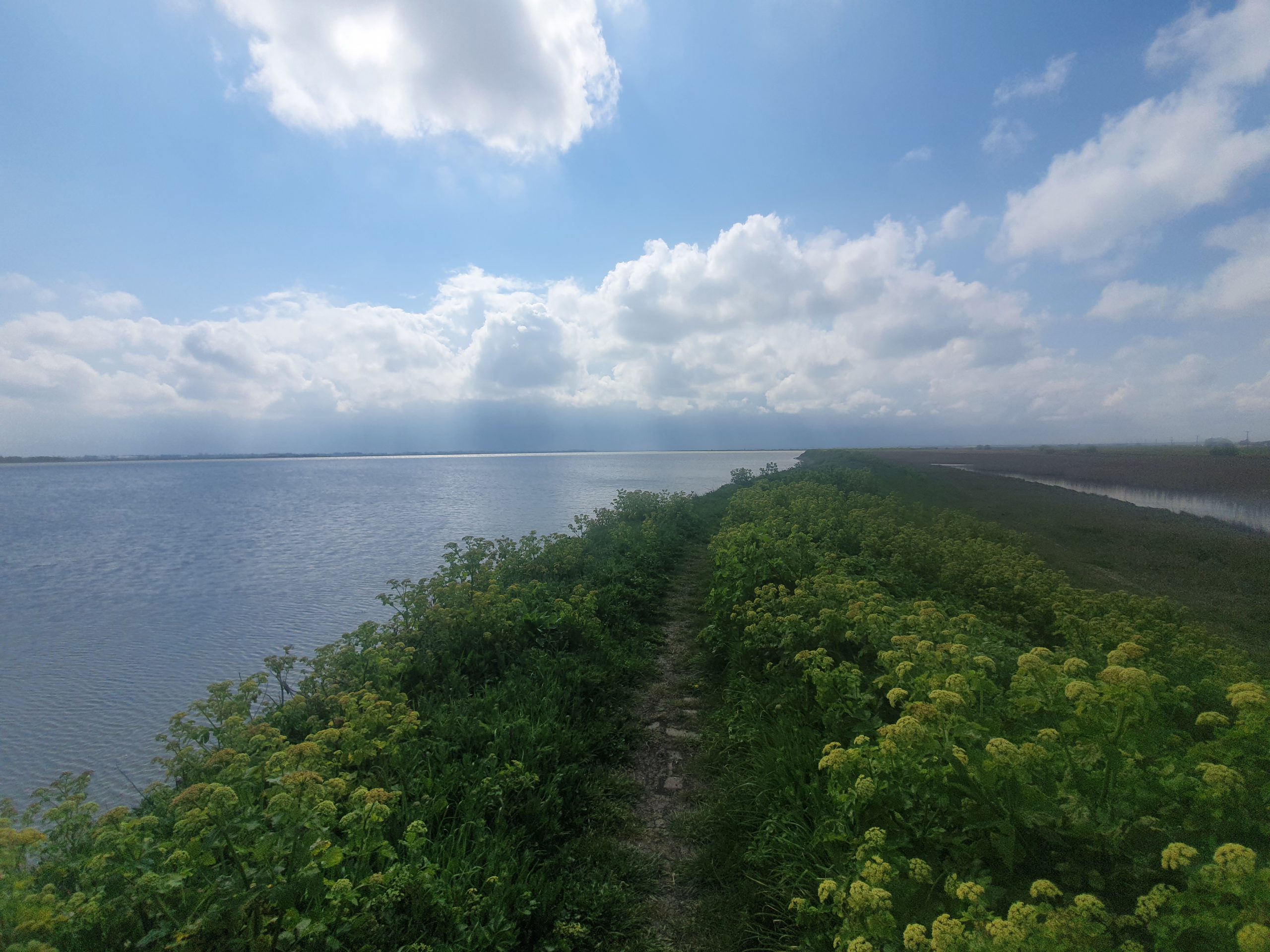
Despite my comments earlier about liking cities, pubs and beer gardens, there was still something quite special about the peace and quiet of this path. We saw nearly no-one (other than for a party of five sitting having a picnic on a little bit of sand, and I admire how far they had carried their things with them to get there) along the path and the river was still and quiet, with the Norfolk big skies up above us. This stretch is perhaps one of the most beautiful on the walk and the reason that I’ve completed Wherryman’s Way twice before and still come back for more.