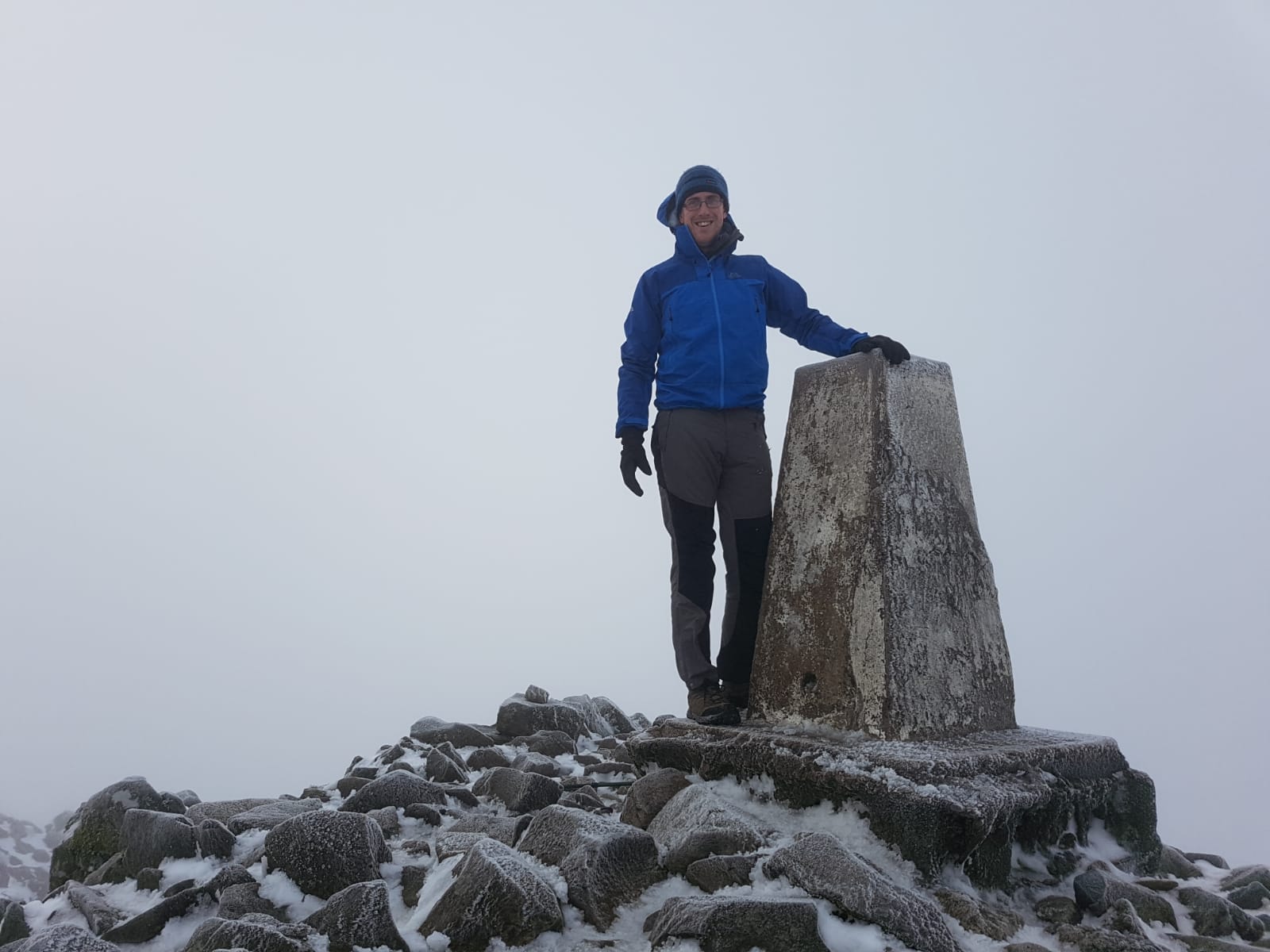
Below is an interview that took place between Emily, the LDWA’s new social media content volunteer, and David Morgan (above in a pensive mood), the inspirational and formidable former chair of the LDWA, on his recent 100 success. There’s
more about the LDWA 100 here, including details of my little attempt at the 100. These resources will be moved to the LDWA’s new web-site when it’s completed, so that future generations can be inspired by them 🙂
NB, can I just add personally to Dave’s comment “I think a few would have had a thing or two to say about this climb that we put into the route”. Yes, I can absolutely confirm they would have done, and I would have likely been writing a very strongly worded letter myself.
Anyway, onto Emily’s interview.
For those who don’t know you from previous events, how many times have you done a 100?
I first entered the LDWA 100 in 1995 when I started the Shropshire 100. In total, I have entered 22 and successfully completed 19.
What worries/concerns did you have before you started, if any?
My main worry about walking the virtual 100 was not having enough water to remain hydrated. I was so lucky that my friends and family supported my effort and so I was able to drink just as I would normally do on a ‘normal’ 100 mile event. I have walked enough 100s on my own so I had no fears about being alone and as I had co-designed the route I was very comfortable with the fact that I would be able to navigate my way around as I am very familiar with the area in which I was walking.
You started this walk by yourself and walked large sections alone. Were these bits tougher for you than those where you had company? How valuable were your walking companions in keeping you motivated?
I did walk large sections of my virtual 100 alone and in the early stages I had no issues at all. I had great weather, had far reaching views and because I had left early I was able to see plenty of wildlife. Consequently, the earlier sections when I was walking alone were a delight. However, when it became clear that I was carrying an injury that had been exposed by the fact that I was walking a longer than normal distance, walking alone became a lot tougher. The worst part when walking alone was during the night and so when I met friends who essentially walked with me until close to the end, it was a huge boost. We enjoyed great conversations, had a good laugh and their company took my mind off the injury that I was experiencing.
Were there any sections of the route which are particularly memorable for you? Anything that will stay with you for a long time (for better or for worse!)
There were many on this route. In the early stages I was lucky to see deer at close quarters due to the fact that I had started at 6am and the deer were still active. The sunset on Hatterall Ridge in the Black Mountains was mesmerising and the colour of the sky was turned a gorgeous pink. As I descended from Hatterall Ridge I hear my first cuckoo of 2021 and the cloud inversion seen enveloping the Wye Valley from The Kymin was a real treat. From a negative experience, the knee pain that developed from about 50 miles really played on my mind and I won’t forget the negative feelings in a hurry!
How did you cope with the lack of support that an organised ‘non-virtual’ walk provides? You were very fortunate to have people to meet you with supplies and hot food but I’ve heard it said that the LDWA aid stations are the best for providing much needed food and support. Did you miss this?
I think that I was truly, truly blessed with the amount of support offered to me by my family and friends. I can honestly say that due to the support that I received that I didn’t miss the checkpoints that I would ordinarily visit on the annual 100. At every location that my family and friends met me I had a choice of either sweet or savoury food and there was always an option for me to have either a hot or cold drink. In some ways this 100 will be the most memorable for me due to the love and support that was offered to me throughout my 100 mile adventure.
After walking 50 miles, facing a long night of walking in the dark, and struggling with a sore knee, did any doubt start to creep in?
Absolutely. I have been really fortunate to have stayed injury free for many years and the last time that I had a knee issue on the 100 was in 2006. So, when this issue started so early into the event, I was very aware that I had a problem. I think that my lowest point was at about 5am when I realised that I couldn’t walk downhill in the way that I needed to and with so far still to go.
Several times in the film, you said you were hoping your knee would hold. Was there ever a time where you thought you might have to throw in the towel, due to the knee or anything else? What was it that kept you moving?
Yes, I did consider the prospect of retiring and mulled this over in my mind as I approached Monmouth where I knew I was having breakfast at 70 miles. I was worried that I might be doing long term damage without knowing what the cause of the pain was. I’m quite a stubborn person though and I weighed up the options. When I arrived in Monmouth I had been moving for 24 hours and had completed 70 miles. Therefore I knew that I had a further 24 hours if necessary to walk 30 miles and if I slowed down and was particularly careful on descents, I would be able to manage the issue I was experiencing. The other factor in keeping going was due to the support that I had received from my family and friends. I didn’t want to let them down, particularly as they had either stayed up all night to support me, or had driven large distances and had little sleep themselves to ensure that they were at specific locations to meet me. Their support kept me going and I just broke the walk down into stages so I would simply concentrate on walking from one location to another as opposed to looking at the fact that I had a considerable distance still to go.
Was the route, which you’d helped to design, as good as you’d hoped it would be? With hindsight, would you change anything?
Yes, it was absolutely superb and it is such a shame that the LDWA family wasn’t able to enjoy the route. It was such a varied route. It followed two of Wales’ great rivers with the Usk in the first half and the Wye in the second. We offered lots of ancient woodlands, rolling countryside with far reaching views, the Black Mountains, Offa’s Dyke National Trail and the Wales Coast Path that passes through the Gwent Levels. Yes, it was definitely as good as I had hoped.
I did chuckle at the fact that many would have been pleased to miss out on the big climb out of Llanthony to Loxidge Tump, a climb of 1432 ft ascent in little over a mile and half! I think a few would have had a thing or two to say about this climb that we put into the route! The only thing that I would have wanted to change would have been the route out of Tintern. We are blessed with a fabulous path network in the Wye Valley and I’m not sure that the route we had proposed was the best to Penterry Church. I think I might have made an alternative suggestion to the committee although I’m not sure that others would have agreed with my suggested plan!!
For those of us who are daunted by the thought of walking 100 miles, having done many yourself, what advice would you give?
Never ever look at the fact that you have such a long distance to walk. Break it down into stages and concentrate on walking that stage. So, look at the fact that it is 7 miles from the start to checkpoint 1 and not think about the bigger picture. Only start to think about the bigger picture when you get to 75+ miles. Prepare yourself physically by walking as much as you can, incorporate hills into your training as it is the hill-work that really raises your fitness levels and understand that you will experience negative thoughts and doubt during the early hours. For me it’s always from 4am until dawn. If you know the feelings will come you know you can ignore them as once the sun rises again, the body responds and you start to feel positive again.
A few fun, simple ones:
What was the best thing you ate on the route? (For the foodies among us!)
Norma’s beef stew at Llanthony. A truly hearty stew that filled my belly although when I was 2/3 up Loxidge Tump I was slightly regretting the decision to eat as much as I had!!
You saw a huge variety of animals on your route! What was your favourite?
The pigs at Forest Coalpit. They always snuffle and grunt and approach me when I walk through their paddock. It’s almost as if they are friends saying ‘hello’ to walkers passing through. They love to have a scratch!!
For many of us, the hills are all about the views. Were there any parts of this route that you’d recommend, for the view?
There are a few views I’d recommend.
1. Gray Hill (Stage 2) with fine views over the Severn Estuary to the Mendips and Cotswolds.
2. Cefn Hill (Stage 3) with fine views over Mynydd Maen.
3. Deri (Stage 6) with fine views over Abergavenny and the Usk Valley to Blorenge and Llangattock.
4. Loxidge Tump (Stage  with superb views down the Vale of Eywas.
5. Hatterall Ridge (Stage with far reaching views over Herefordshire.
6. The Kymin (Stage 12) with a bird’s eye view over Monmouth and the Wye Valley.
How long did it take you to fully recover from the event?
I haven’t fully recovered yet. The knee issue has been diagnosed as a tight quadriceps muscle that in turn pulls on my Iliotibial Band. So, the knee isn’t actually the issue, it’s the muscle. Sadly, it’s an overuse injury and the 100 didn’t cause the injury but simply exposed an underlying issue that, if I’m honest, I’ve known about for some time. So, it’s sessions of physio to loosen the knotted and tight muscle, stretches and strength exercises plus rest for about a month to allow the muscle to slacken off. Rather frustrating but at least I now know the cause of the pain!
Will you do another 100?
I’ve done 19, so I suppose I’ll answer the question with a question. Does it ever rain in Wales?
******
Huge thanks to David for taking the time to answer these questions. I’m sure we all hope that the physio helps and stops this issue from occurring in future. Although, to be honest, if you’re going to suffer from an overuse injury, the 100 is probably the most likely time for it to appear! I, for one, am disappointed that we aren’t all able to experience the route that you designed but with luck, in future, some of us might!
I hope this was entertaining and informative to some of you. A massive good luck to everyone tackling the virtual 100 next weekend. I’m looking forward to hearing everyone’s stories.