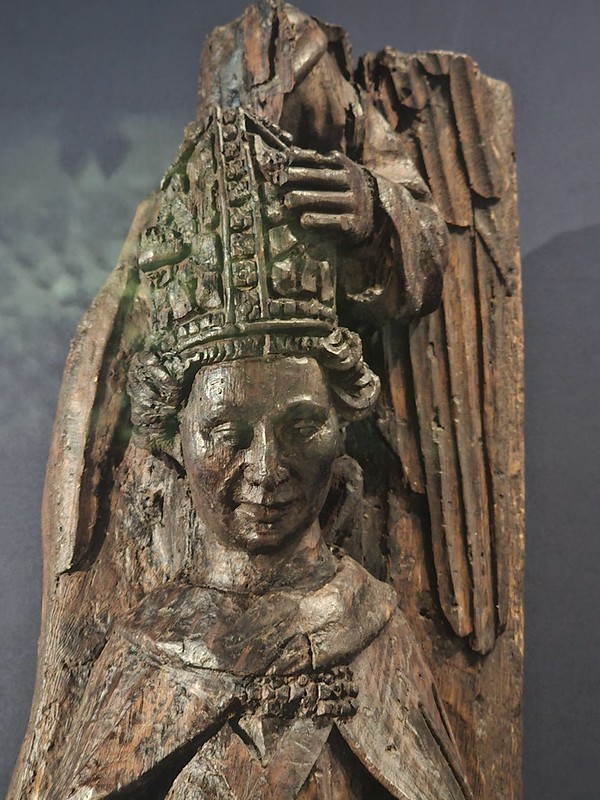
I’m easily intrigued and I really rather liked this wooden statue which is on display at the Gallery of Medieval Life at Norwich Castle Museum. The museum has focused on this as they wanted to show the mitre, the bishop’s headgear as they refer to it, something which had been a thing since around 1000. Interestingly, the mitre went away in the Church of England for several centuries in this country following the Reformation, it has only come back in the last 150 years.
This rather decadent piece of carving is from St. Peter’s Church in Upwell and was added to the collections of Norfolk Museum Service in 1891. Quite what happened then I have no idea, but I assume that there was some Victorian restoration at the church. It’s a little bit too big to be a pew end carving, but I’m not sure where it was located in the church.
It’s a defaced statue. But this is exciting, it was created in 1460s but was destroyed in the Reformation when the face was smashed up. It’s difficult to understate how evil the Catholic church had become, corrupt to the core and preying on the poorest in society, but it must have been devastating to communities to see their religious icons destroyed by the mob.
This is a time where I can mention the idiot that was Henry Brooke, Baron Brooke of Cumnor, who recommended in his report that several medieval churches in Norwich should be demolished. Fortunately, his report was so idiotic and simplistic that it galvanised a community against him, and the decision was not to demolish several city centre churches. That’s certainly a reputation to leave, that your work was so incompetent that upset enough people to change the situation and save these churches, with the City Corporation being forward thinking and brave in their offer to take on the leases.
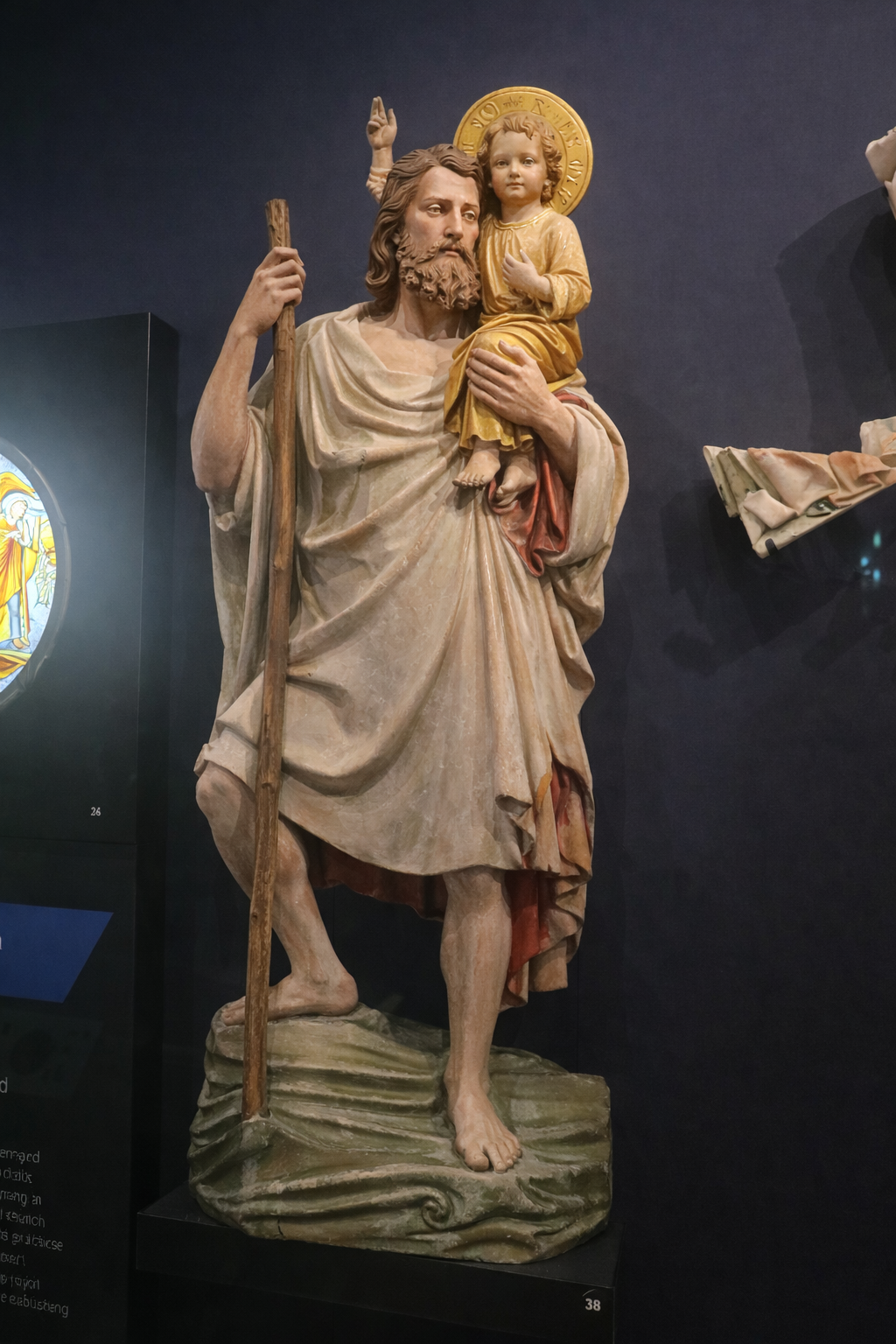
One of the churches that he wanted to demolish was St. Laurence’s Church on St. Benedict’s Street, which is also where this defaced statue was found discarded in the porch. There’s enough of it remaining for it to be identified as a sculpture of St. Christopher carrying Jesus Christ across a river.
Here’s AI’s attempt at completing the statue once again. It’s quite an impressive restoration to be fair.
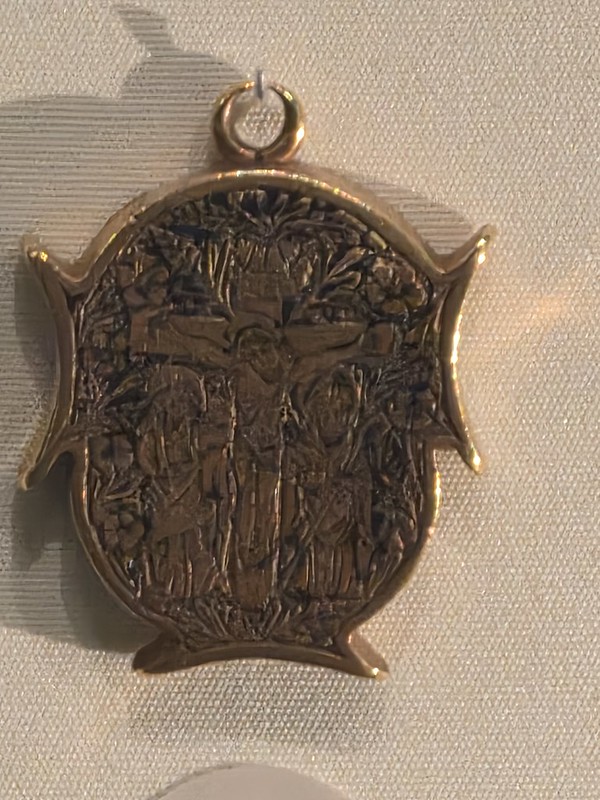
Located in Norwich Castle Museum’s excellent Gallery of Medieval Life is this reliquary, although the backing plate has fallen off and the relic lost. This was created between 1475 and 1500 and was at a time where the number of relics on the market had reached a ridiculous level, a situation not helped by the corrupt Catholic Church. Even as the church desperately defended itself as the Reformation spread across Europe, they still couldn’t bring themselves at the Council of Trent to end the veneration of relics.
But, I digress. This likely held a relic owned by St. Anthony and the reliquary is made from gold and is highlighted with black enamel. It was found between 1850 and 1852 by “a waggon driver who was pulling into a gateway” although I’m not entirely sure I understand that sentence from the information panel in the museum but elsewhere the museum says the driver “found it in a puddle” which is rather more relatable.
Matlaske is a village pretty much in the middle of nowhere in north Norfolk, located halfway between Holt and Aylsham. Richard and I visited the village’s church there a few years ago and rather lovely the building was too…. Anyway, it’s a beautiful reliquary and I wonder whether the owner popped into the village church in the late 1400s or the early 1500s with their new acquisition.
Located in the museum’s new Gallery of Medieval Life is this really rather lovely copper allow roundel, dating from around 1400 to 1530. It shows St. Mark’s winged lion (a symbol of the city of Venice) and it was likely part of a tomb slab.
It was once in St. Michael’s Church, Coslany which is a church that is still standing, located near to the rather wonderful White Lion pub on Oak Street. This is now a redundant church, having ceased religious services in 1971, which has been used by a variety of occupiers over recent years and it currently houses the Oak Circus Centre.
I find this sort of object fascinating because of the journey that it has been on. Originally funded by a family for their relative’s tomb, it was perhaps taken during the Reformation to either save it or by an opportunist wanting to keep it. It’s survived for several generations and it has been in the collections of Norfolk Museum Service since 1977.
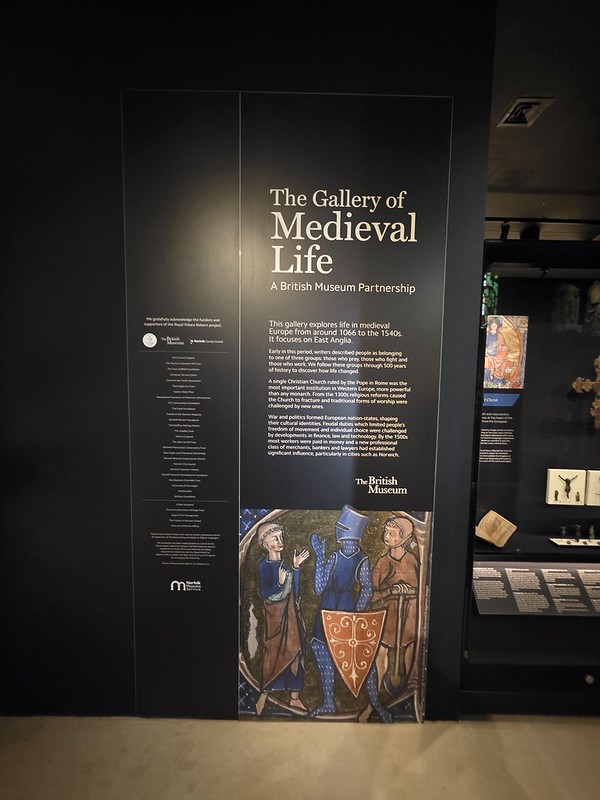
This, for me, is the best part of the renovation of Norwich Castle and it’s the introduction of the Gallery of Medieval Life in conjunction with the British Museum. There feels like a massive step-up in terms of the curatorship here, the signage and explanation panels are just so much better than in the rest of the museum. There are lots of delights here in terms of the exhibits, more of those in other posts.
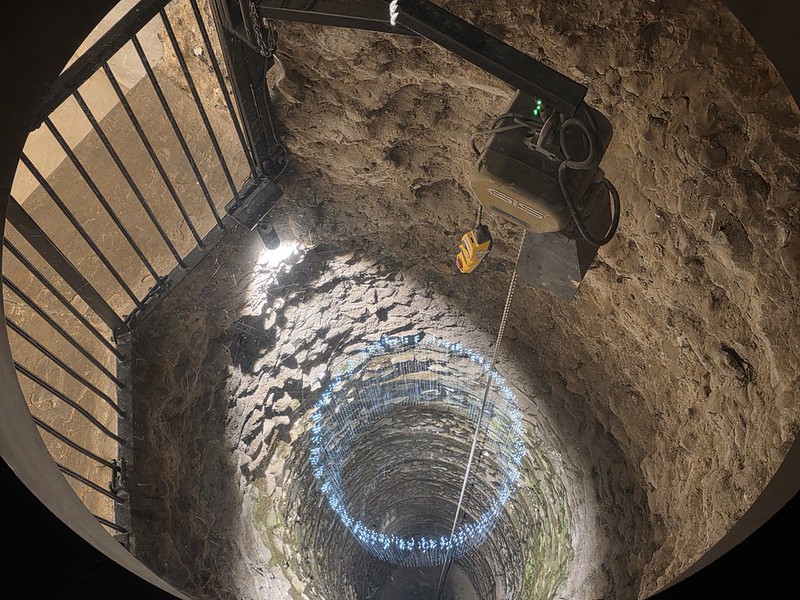
There are numerous structural things that are also in this exhibition space, which include the castle’s original well.
As my feet show, you can step on the glass which covers the well. It’s no longer possible to throw money into the well [I’ve realised this isn’t true], that’s a change with the new renovation and it doesn’t impact me as I’m too tight to throw money down a hole. The money used to be donated to Friends of the Norwich Museums and they got several hundred pounds every year, so I’m not sure if they get money from other collection boxes instead.
Very pretty.
The well is 36 metres deep and it’s quite an impressive sight looking down. It was once 65 metres deep in the medieval period as it ran through more of the castle structure, allowing access to clean water.
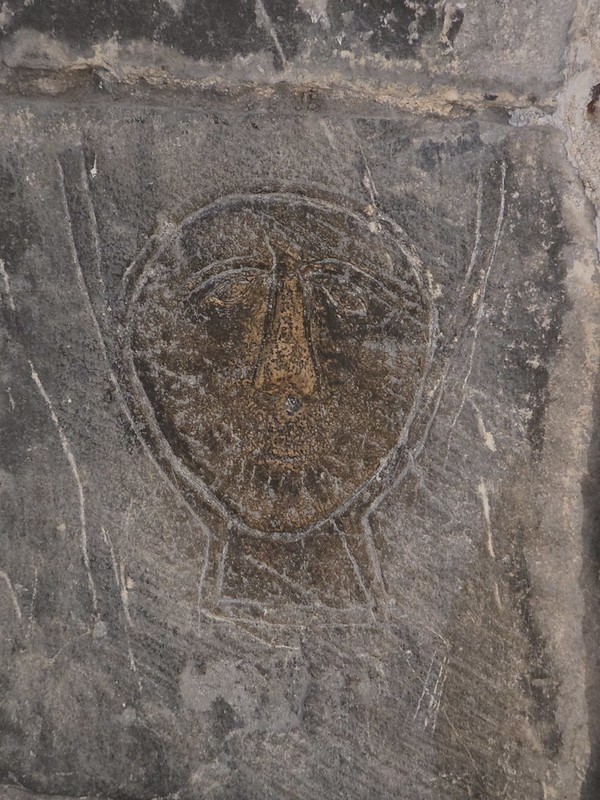
This is a carving in the stone near to the new entrance of Norwich Castle Museum’s redesigned keep. The museum notes that it dates to the thirteenth century and has been retouched many times, so although they don’t know who it was, they suspect it was a revered local religious figure. I assume that there’s a possibility that it’s the Virgin Mary, but it’s quite possible that no-one will ever know. It’s nicely preserved though and very visible to visitors to the museum.
One huge improvement here at Norwich Castle with the extensive works is that the battlements have been opened up permanently, rather than only accessible for certain tours. The lift was already broken, which is entirely sub-optimal for those with accessibility needs, with no indication on when this will be resolved. One thing I find a little odd is that they’ve put glass between the battlements so it’s quite hard to look through clearly unless you’re tall, there’s a fair few negative reviews about that already.
I very much enjoyed looking over Norwich, there’s Rose Lane towards the bottom of the photo on the right, with Norwich railway station in the centre-right.
Norwich railway station.
Rose Lane and this was a useful time to test my phone’s zoom. At maximum zoom, I could read the Hollywood Cinema sign clearly on the soon to be demolished Anglia Square, so it’s fair to note that there were excellent views.
Mousehold Heath towards the rear.
The soon to be demolished Anglia Square at the left on the rear, and the white building is where I was able to zoom in on the cinema sign.
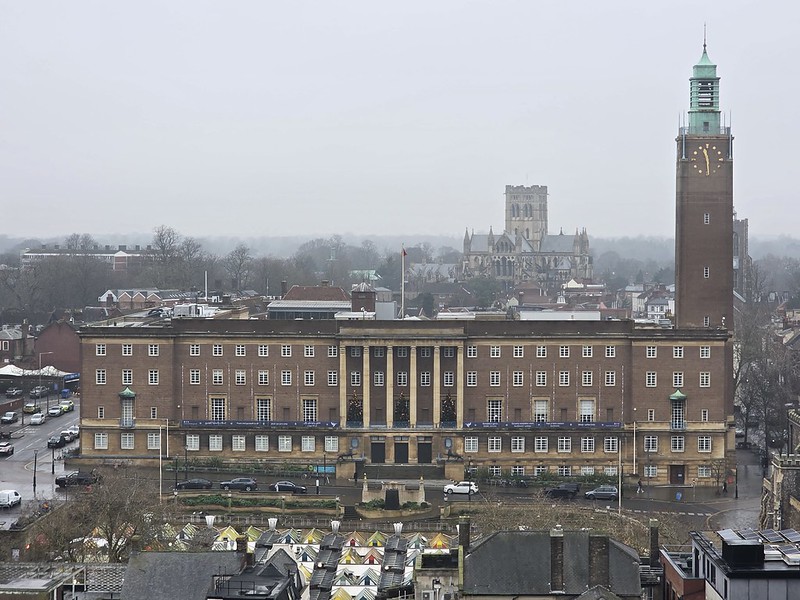
Norwich City Hall.
Looking from Castle Meadow at the front through to Norwich Market.
Norwich Market.
I’ll return to the museum a few more times in the year I imagine, hopefully to get more photos across Norwich when it’s a bit brighter. But, I am impressed at the work they’ve done to open up the battlements, that feels a real positive and I hope they can make it fully accessible again soon.
As I’ve managed to get an Art Fund pass at a discounted price, there will now be a year’s worth of posts about places that I can get in for free. One of them is Norwich Castle, recently re-opened following a substantial refurbishment and renovation. More on this later, but the changes weren’t as bad as I expected and there are some definite positives about the investment that has been made here.
Having noted that, this room seems to me though as something of an incoherent mess in terms of the history, it’s unclear to me what they’re trying to show here. They’ve put a throne into the chapel and the relatively undamaged original sanctuary is in the corner. I’m struggling to believe that the chapel would have once had a large throne looking at the window and no other furniture or religious paraphernalia other than a lectern. I know that we wouldn’t have had rows of pews in here, but the layout seems odd to me.
I’m also unsure why they’re suggesting that the Caen stone was painted white so it would have had the appearance of Victorian toilets. Unless this is their interpretation of what new Caen stone would have looked like, but that seems aspirational in terms of the brightness. In other locations it was just left as it was, it’s an off-white or cream coloured stone anyway and so why would they paint an interior wall with what I assume the castle is suggesting is limewash? They might have wanted to use bright colours in the way that Norwich Cathedral was decorated, but I’m not convinced they chose white. But, I’m sure they’ve done this for a reason, but it’s a shame they haven’t explained anyway (either in the room or online) their logic here.
The museum might have been better trying to use graphics to show what the room might have looked like, I just find it unlikely the Normans made their chapel in Norwich different to everywhere else. AI can be very over-rated, but I ran the images of this room through Gemini and ChatGPT, both of them concluded that this was a medieval function room where visitors would have been welcomed by the gentry. This is what it looks like to me, I’m very much struggling to understand this as a chapel layout.
Anyway, that aside.
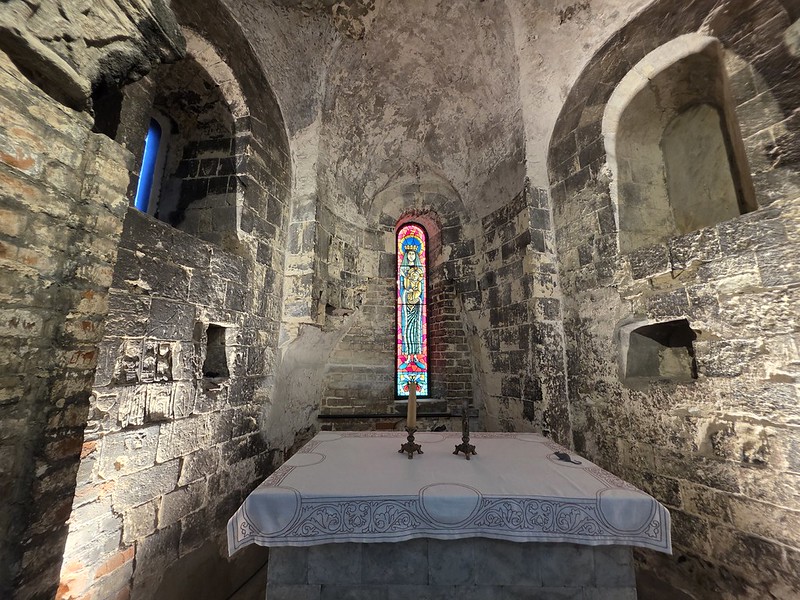
This is the sanctuary, so the original Norman architects were using this as the chapel’s altar although it’s at an odd angle. But, when you’re the King, you have the option to do things as you want.
I can’t find out whether this is entirely new stained glass for the new project, but it’s rather beautiful.
What the project has delivered is some beautiful lighting so that graffiti is easily visible, here’s what I assume is Mary.
There’s certainly a variety of graffiti here, the museum thinks these date from a period of over several hundred years.
Despite not being in a rush, I happened to be the first person through to landside, so with everyone following me I had to concentrate on going the right way so I didn’t get muddled up and look an idiot. My initial intention was to walk the 25 minutes to the hotel, but then I realised from Google Maps that this looked rather more challenging than I had anticipated.
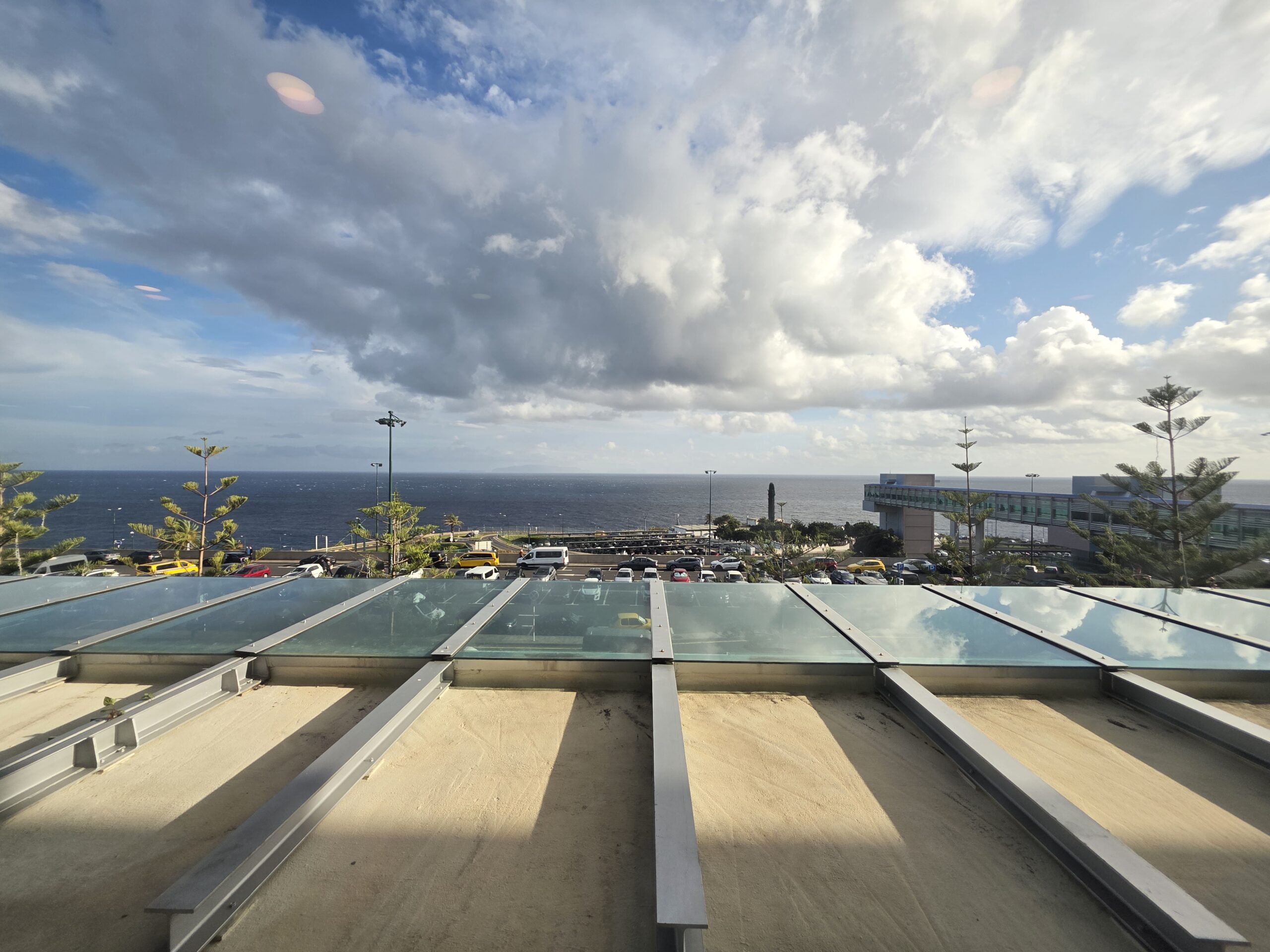
There were nice views of the Atlantic from the airport and I realised that although it was technically possible to walk to the hotel, it would involve some ridiculously complex navigation alongside roads not designed for pedestrians. Some people had walked it, and it is possible, but I decided to see if there was a bus.
It soon transpired that there were no buses, or at least, no sensibly priced ones and just more expensive shuttles. However, I looked at Uber and realised that the taxi fare to the hotel was £3.40 which is what I would have happily paid for the bus. I went down the stairs to brace myself for the whole stress of taxis.
Now, I don’t like taking taxis, they are too decadent for me and have a level of stress that’s too high for me. I like trains, buses, planes and things I don’t have to interact with in this individual way. However, I’m very polite and have a 5 star rating on Uber, unlike my friend Richard who has plummeted to very low levels. I tell Richard that he needs to think from the driver’s perspective, but he’s very demanding.
After some slight faffing whilst the taxi worked out how to park, and me being annoyed as I realised I was charging a waiting fee of 6p when I was in the right place, the friendly driver turned up. The drive took about eight minutes and I apologised for the short journey, but the driver said he preferred them as he could easily return to the airport.
I had by this point calmed down about the 6p surcharge and was safely at the Hotel Solar Bom Jesus, a cheap and clean accommodation option that seemed well reviewed on-line. More on that in another post, as I rather liked the hotel. Incidentally, I found the taxi hunting process so stressful that I didn’t get any photos.
Anyway, my revelation was that for my time on Madeira I was going to have to take taxis everywhere, not something that usually happens on my travels. Actually, it’s so notable, that’s why I’ve given it a post all to itself….
Back on the rail network from Warszawa Śródmieście station and every time I come here I wonder when they’re going to renovate this as it’s getting ever more rickety. The train signage here is a bit basic, but fortunately Google Maps informed me that my train was running eight minutes late.
I’ll just add here that a train ticket to the airport costs about 85p.
Now this was exciting as there was a ticket check, as the inspectors do monitor this line reasonably frequently. To my right were what I think were a Polish mother and daughter, the former was quite elderly. I, as I may have mentioned, cannot speak Polish of any merit, but I was able to understand enough of the conversation to hear what was going on.
It boiled down to this:
ELDERLY WOMAN : “The ticket machine was broken”
INSPECTOR : “So you have no ticket?”
ELDERLY WOMAN : “I’d like to buy a ticket now”
INSPECTOR : “Yes, you can, that will be 580zl [about £120] including the fine”
ELDERLY WOMAN : “But the machine was broken”
INSPECTOR : “You have no ticket”.
This went on until the train pulled into the airport and it was clear that the pair thought they were getting off and the inspector would forget it. No, the doors opened and he locked the one they were standing by.
I sat on those seats to watch the whole affair unfold, as I don’t get out much. And indeed, the two ladies weren’t getting out much, but their card did and they paid the penalty fares. This is why fare evasion on the Polish rail network seems to be so low, the inspectors will enforce those without tickets.
Very Christmassy. Airport security was interesting, the lady in front of me took a ridiculous amount of time to put her things in the bag. Fortunately, Polish airport security is friendly, calm, collected and told her to hurry up. She got annoyed and so she found herself being interrogated for the entire time I was at security. I like a bit of drama.
Anyway, I reached the lounge and got myself a Greek salad, chicken wrap, coffee and an early morning beer which was to fortify myself for the flight which would take over five hours to get to Madeira. This is another one of my favourite lounges, as there are power outlets, unlimited chocolates, unlimited olives and unlimited Feta cheese.
Mine was the 11:20 flight.
Boarding at the gate was uneventful as it was organised, fast flowing and there were plenty of seats around. Fortunately, Madeira is in Schengen, since it’s part of Portugal, so I didn’t have to faff about with any border control.
This is aircraft 9H-WNS, yet another one that I haven’t been on before. The flight lasted for five hours and thirty minutes, which is quite a strain on a budget airline if I’m being honest. I normally like having my bag under the seat in front of me, but after five hours I was getting annoyed that it was in the way of my legs that needed stretching.
The seating Gods gave me an aisle seat which was very fortunate for a flight of this length, so that did give a degree of comfort. The couple in the window and middle seat were very agreeable and didn’t barge into my seat space, with the crew merrily plodding up and down with the trolley a few times.
The flight cost me £8.99, so I can’t really complain and I find spending this amount of time without a phone signal to be quite relaxing in many ways. I have rather decided, that despite Wizz Air being a perfectly competent and comfortable airline, that flights of this length are perhaps just a bit much.
Safely in Madeira, which is my first time to the island. I understand that pilots require special training to land at this airport as there are strong winds and there’s not a huge amount of space to work with. The landing was sudden but seemed smooth, although I’ve never doubted the competence of Wizz Air pilots as they always seem professional and calm to me.
The view from the runway and the winds were certainly getting up at this stage. I had intended to walk to the hotel, but events meant that didn’t happen….. But more of that in the next ‘riveting’ post.