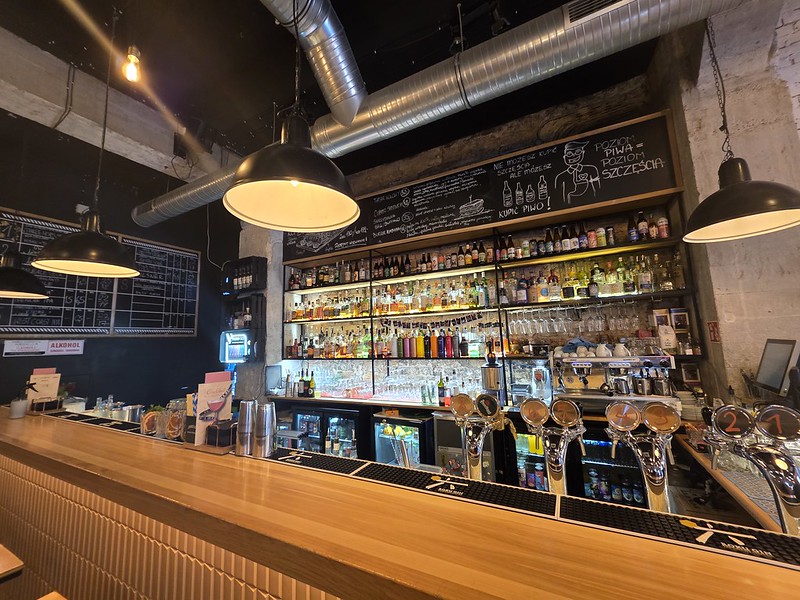
Doctors’ Bar is a centrally located craft beer bar and restaurant in Wrocław, with their current beer listings at https://doctors-bar.ontap.pl/. I understand that the bar was formerly the taproom of the Doctor Brew brewery and hence the name, although I don’t think that’s the case any more. Either way, this venue is open for long hours and it has quite an extensive list of cocktails in addition to the craft beer range.
I like this, they have a copy of the beer board outside and it’s very uncommon to see this. It is a marvellous idea though, look at those tempting options and if I was someone meandering by on a regular basis I’d be tempted in simply by seeing the words “pastry sour”. I don’t get out much, it’s simple things that excite me in life….
The bar area felt modern and on-trend with the general ambience feeling inviting. Most people here seemed to be coming for food, perhaps because they have a low priced lunch menu, so there was table service available, but I headed to the bar to order. The service was friendly and helpful, it all felt a welcoming place to be. The prices were moderate for the beers and although I was tempted by the 11% Imperial Baltic Porter, I thought that it might be just a little too much at lunchtime.
I went for the Pretty Tatanka from Magic Road, a brewery from Warsaw who regularly come up with some really rather lovely sours. This one was no exception, it had a suitable level of sourness and it had lingering flavours of apple and mango.
I rather liked it here, it’s quite a large venue with a choice of different seating types and everything seemed clean and tidy. Customers seemed to be enjoying their food from what I could see, whilst I was sufficiently surprised and delighted by the eight beer taps.
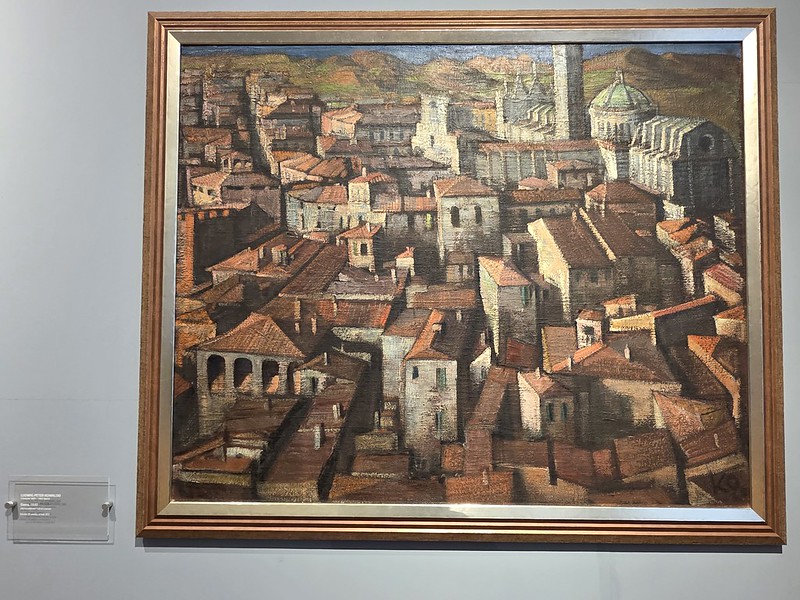
This artwork at the National Museum in Wrocław was painted by Ludwig Peter Kowalski (1891-1967) and I’m intrigued by this more in terms of the artist than this particular work. It is a stylistic view of the Italian city of Siena which is quite alluring, but it was painted in 1930 and this was at a time when nationalism was starting to increase across Germany. Kowalski had served in the German military during the First World War, but he studied in Italy and in 1927 he went to work at the Academy for Art and Crafts in Breslau (now known as the Polish city of Wrocław). His works were not liked by the new Nazi regime as they weren’t keen on the expressionist movement, he was tolerated for a short period before being dismissed in 1934. He was effectively forcibly moved in 1945 when the borders were changed and a couple of years later he went to live in Berlin for the rest of his life.
I might be alone in this, as I often have random flights of fancy about these matters, but there’s something in looking at an artwork painted nearly 100 years ago knowing that the artist couldn’t have possibly have predicted what would have happened to him. The city in which he worked would cease to be German, he would be fired from his job and forced to move elsewhere in the country, eventually securing some financial reward but likely struggling throughout the 1930s. That somehow all felt rather more imposing than the artwork in front of me. And it also reminded me that I haven’t been to Siena.
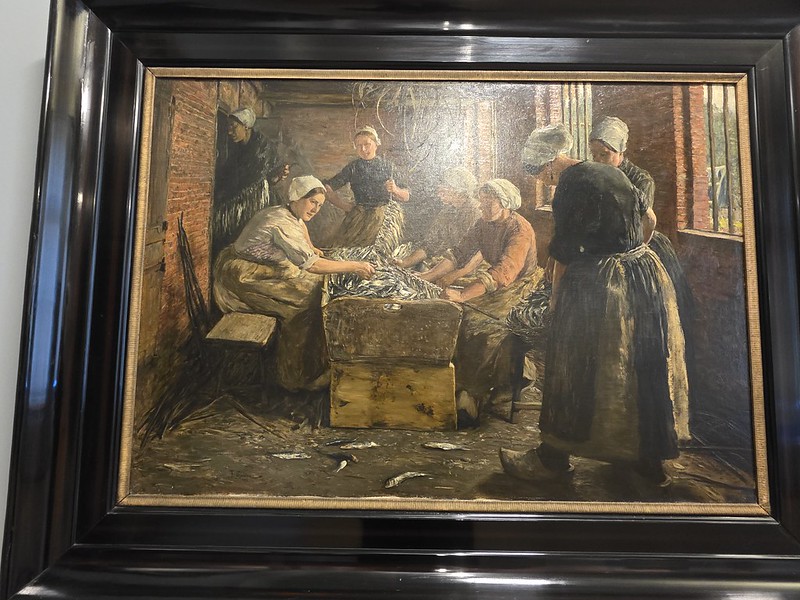
This painting is located in the National Museum in Wrocław and it rather intrigued me because it reminded me of the Herring Lassies (or Herring Girls) who used to work in Lowestoft from the mid nineteenth to mid twentieth centuries. In Lowestoft, they tended to work in threes with two of them gutting the herring, whilst the other packed it. Although it was a useful form of money, and some adventure, for the women, the working and living conditions were sub-optimal and I doubt that the conditions in the painting are much different.
It was painted by Franz Skarbina (1849-1910) who was a German artist who primarily painted images from his home city of Berlin and he tried to capture urban life. The artwork was painted in 1888 and although he was in Berlin that year, he had been travelling to Northern France, Belgium and the Netherlands in the years before that, which is from where I imagine the painting was inspired. There’s an interesting article at https://www.bbc.co.uk/news/articles/cy63lpy251zo about those who did the job in Scotland and it sounds tough to me.
The second visit on this 2025 set of visits to all the food stalls on Norwich Market was to Lucy’s Chips, which is also known as the mushy peas stall. Here’s the exterior of the stall and also a reminder to my two loyal blog readers of when James and I visited in 2023. There is a sister outlet at the market called Lucy’s Fish & Chips and here’s that blog post from when we visited in 2023.
The menu and I remember going for the Steak & Kidney pie last time. I tried to go for the Cornish pasty this time, but they didn’t have any available, although I’m always partial to some southern fried chicken fillets and I was tempted by those. I didn’t ever say that I was classy…. I have to confess that I forgot that the stall sells mushy peas, as I really should have ordered that given the provenance of that here, but maybe on our third visit here. There’s no seating area, but there is a little place to stand and we were able to have that space this time as the stall wasn’t very busy when we were there.
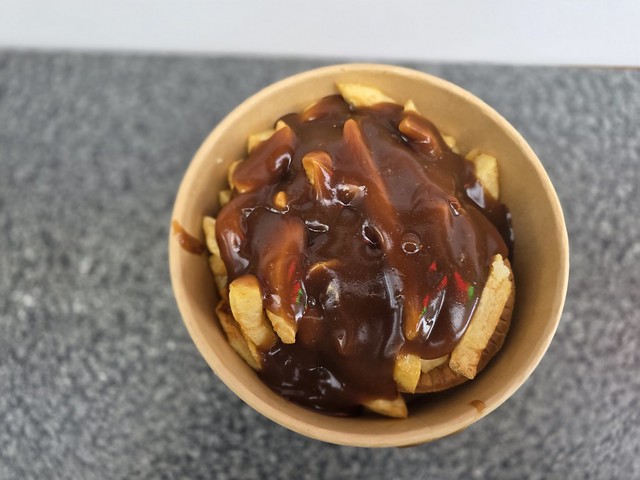
Remembering the quality, I really wanted another steak pie like last time, but I’m trying to always order something different on this second run of visits (that’s how professional I am), so after my first choice wasn’t available I went for the rather similar meal of chicken & mushroom pie. The price has gone up from £5.50 two years ago to £6 today, which is one of the smaller price increases that we’ve seen on the market. The quality was OK, it wasn’t overly decadent and it had a pleasant taste but it wasn’t overrun with pieces of chicken. Fortunately, it wasn’t much overrun with mushrooms either as I’m not overly keen on them. The gravy was very thick, which is fortunately as I like it, with the chips being suitably fluffy on the interior and firm on the exterior. Given that I treat my body as a temple, albeit as a slightly large temple, this was quite a stodgy meal to have at lunchtime and I did need a little recovery lie down after it.
James went for the cheesy chips and regretted not going for chips and curry sauce as he did before. I think he would rather the cheese had been melted more, although if I have to have cheesy chips, I prefer the cheese to be raw (or whatever term you want to use for non melted cheese).
And the photo that James took of his food and I’m not sure if that ‘Mushy P’ was deliberate or not. Everything at the stall was clean and tidy, with cutlery pro-actively provided and I was given the chance to add salt and vinegar to the chips before they put the gravy on the top.
I remember that this was a contender last time for being the best stall, but I’m not sure that there was anything exceptional enough here to surprise and delight me, but such is the high standard of Norwich Market. As usual, James has declared the winner of this year’s market visits even before we visited one, but I’m very professional and I remain open minded…..
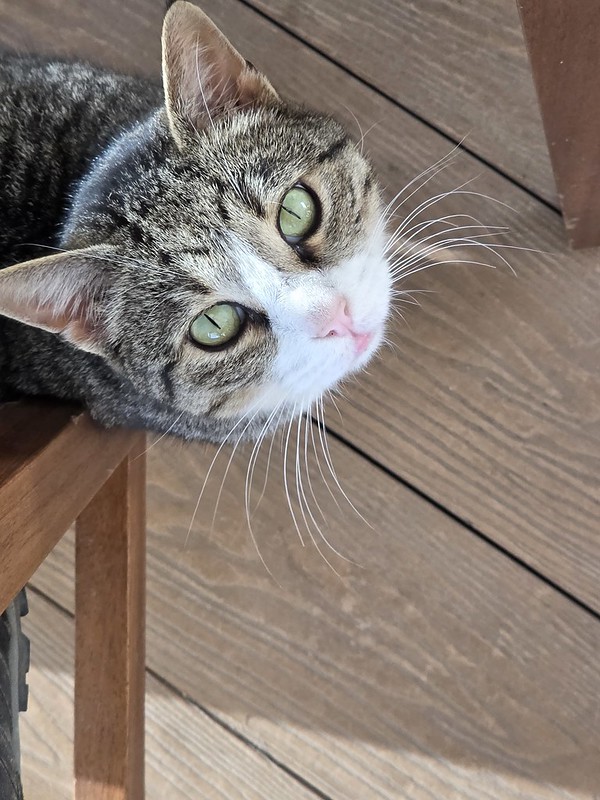
I will confess that even I’m getting annoyed at the adverts on my blog, which is just because I let Google choose the best placement. Anyway, there are evidently too many and I’ve worked out the settings that stop the ads from interrupting the flow of my beautiful text. I think I might have a celebratory beer later to mark this event and here’s a photo of the cat I liked in Athens that Richard wouldn’t put in his suitcase to bring back. Also, no-one else commented on the interrupting ads, so many thanks to everyone for their patience.
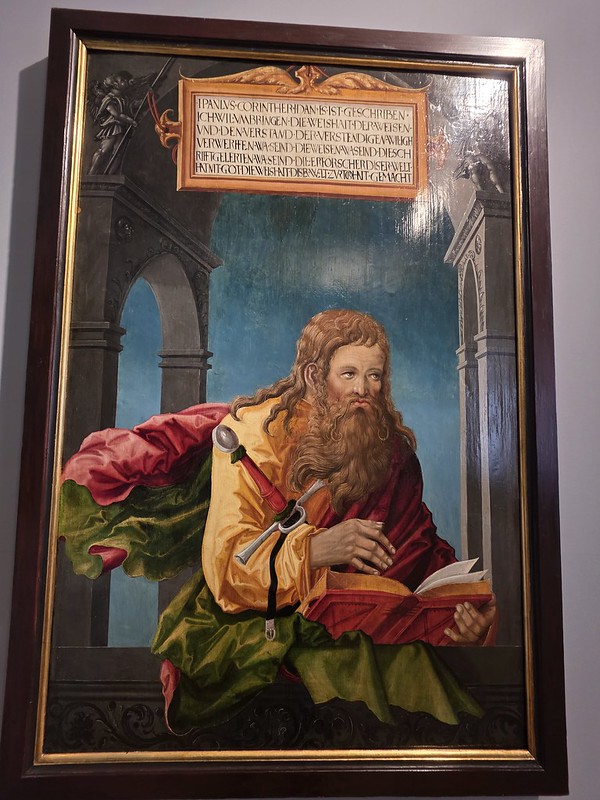
Located in the National Museum in Wrocław, this painting is by Ambrosius Holbein (1494-1519), the brother of Hans Holbein the Younger of Tudor painting fame. The text at the top relates to Paul’s letters to the Corinthians in the New Testament and talks about God not needing the understanding of humans, as frankly, they don’t know as much as he does. I can think of a President who has a similar mindset, but I’d better divert into politics for too long. Anyway, given that this Holbein died young at the age of around 25, there aren’t a large number of artworks still surviving although the Kunstmuseum in Basel has several. This is also where he likely died (the city, not the specific art museum) and Basel is also where his brother worked for several years. The museum has this dated as 1522, but they note that Holbein died in 1521 (no-one is entirely sure when he died), so something might be slightly off here or it was just finished off by someone in his workshop.
The background blue colour is in other paintings by members of the Holbein family and it’s apparently called Azurite, a form of copper which was mined in the Saxony area at the time. I don’t have any art knowledge to add much here, but it’s a vibrant and bold painting but there’s no information provided at the gallery or on their web-site as to the provenance and where it has been located for hundreds of years. And it’s a reminder that I should look at going to Basel as I’ve just noticed that Wizz Air fly there.
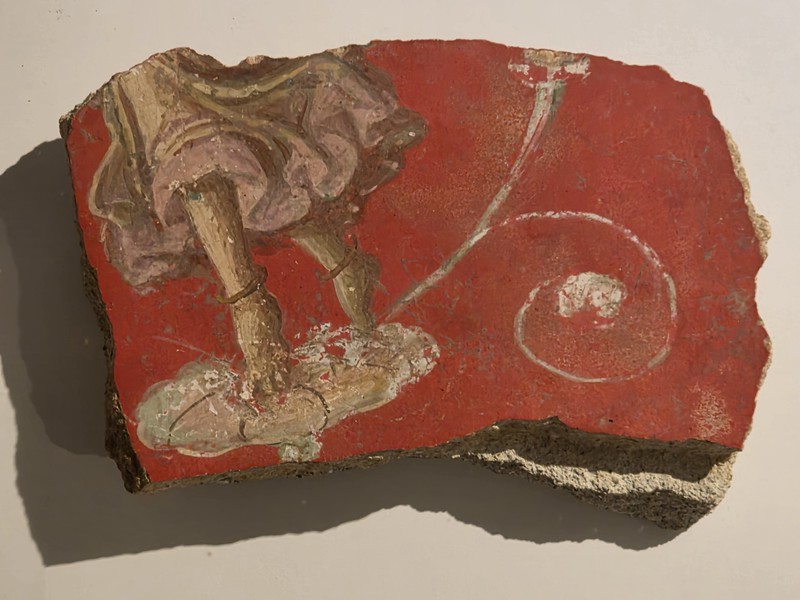
I like a bit of colour with historic exhibits and this fresco dates to 79AD, or at least just a little before, when there was a little incident at Pompeii. Located at the National Museum in Wrocław, rather than being there in its own right it was more embedded in an exhibition entitled ‘Miracle Workers’ which was “intended as an exhibition which describes and presents the world made by human hands, which first was created in the human mind and imagination, and then in a perfect way materialised in the utilitarian objects.”
Having been to Pompeii, I’m aware that there is no shortage of frescoes from the site, but I’m still intrigued by the vibrancy of the colours and how they managed to be preserved under a heap of volcanic ash for so long. It has rather lost its context although Google Gemini has a go at working it out, telling me:
“The figure’s legs and the spiral object are difficult to interpret definitively without more context. However, the spiral object could be a stylised representation of a thyrsus, a staff associated with the Greek god Dionysus (Bacchus in Roman mythology). If so, this would suggest the figure is a follower of Dionysus, such as a maenad or satyr.”
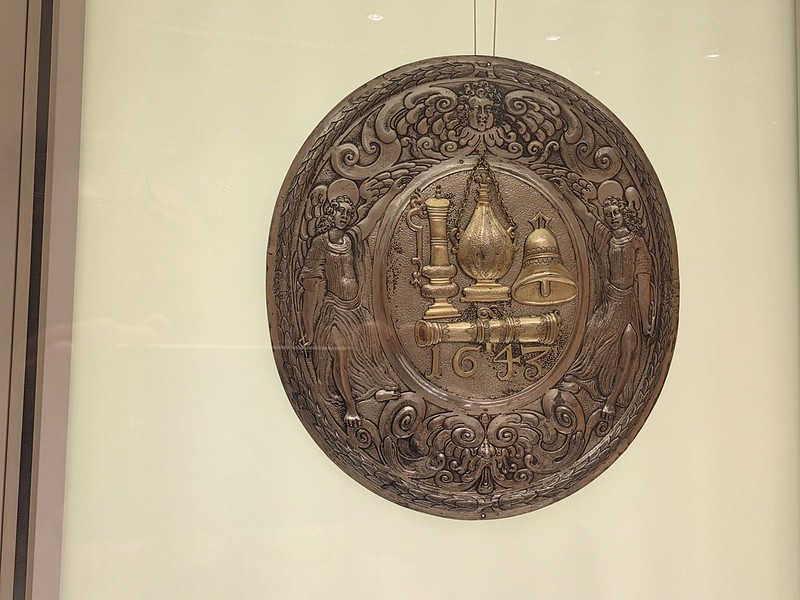
The English translation at the National Museum in Wrocław of this item reads “funerary guildshield”, but that’s not a phrase that is used anywhere on-line, but it seems that “funerary shields” are a thing. However, an Internet search mainly brings up this museum and some on-line games, which suggests that this museum has a strong collection of them. The museum explains on their web-site:
“The custom of decorating coffins during funeral ceremonies with valuable, often silver, coffin shields (escutcheons) displaying the coat of arms of the corporation the deceased was a member of, was adopted in the 16th cent. by corporations of professions – guilds. The shields were not nailed to coffins but only attached to them (fixed with string), and after the funeral they were put away (protected by special cases) to await the next such ceremony.”
This all means that the museum’s English translations are spot-on, it’s just that I’ve never heard of this concept before. After meandering around on-line, something I’m prone to do, it seems that this was something done by the middle classes in mostly Germanic lands. This one is dated 1643 and relates to the brassfounders, bellfounders and pewterers guild. Back in 1643, the city was part of the Hapsburg Empire and the city name would have been Breslau. The shield was made by George Nitsch, who was a craftsman living in Wrocław who specialised in metalwork and it’s crafted using repoussé and chasing techniques, which involve hammering and shaping the metal from the reverse side (repoussé) and then refining the details from the front (chasing). I’d add that I didn’t know about these metalwork terms, but that’s what happens when you faff about on-line when intrigued by things. On the shield there is imagery of a bell, a candle and some, er, metal piping along with the rather cherub like religious symbolism around the outside.
The period between 1618 and 1648 really wasn’t a good one for Wrocław as Holy Roman Empire and Swedish troops keep battling their way around the city breaking things and arguing with their swords, with nearly half the city’s 40,000 residents dying of plague. Indeed, there’s a real chance that this shield was taken to a member of the guild who had died of the plague, something which adds a rather solemn note to proceedings.
Anyway, I’ve rather digressed, but I liked this exhibit as it’s a new genre of things I’ve discovered that I know nothing about.
I’ve been to this museum before, back in 2017, but I can’t remember much about it and I seem to have taken relatively few photos to try and remind myself. Unfortunately for my two loyal blog readers, I decided to take rather more photos today and, given that, I feel a need to write about some of artworks. That means there might be a heap of rather less then riveting posts as I’m hardly an art historian, but it’ll keep me amused for a while.
The welcome was friendly and a security guard gave me an introduction of where to go. It’s a well-laid out museum and surprisingly well signed as I often find myself getting a bit muddled up.
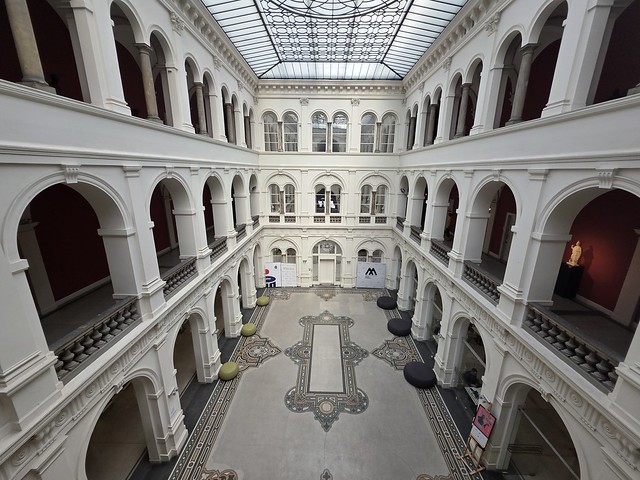
The museum was opened in 1948 in a building that was built between 1883 and 1886 and was previously used as the Silesian Regency Office. The city was known as Breslau until the Germans lost it following the Second World War and many of this museum’s collections are from the part of Poland that became Ukraine when European borders were redrawn. Located in a different building which has now been destroyed, the German equivalent at the time was the Silesian Museum of Fine Arts, but most of those holdings were lost in the conflict, although some have made their way here to this museum.
The museum is substantial in size and I meandered around for three hours before I felt that I had seen enough. It would be possible, and my friend Susanna would do this, to stay there all day to properly see all of the collections.
There are a lot of staff here monitoring the collections and they were all professional with the exception of one younger female staff member who decided she would follow me about the rooms that she was responsible for. It neared the point that I was going to question what she was doing, but I decided against it to avoid any diplomatic incidents and just left those rooms rather quicker than I would have liked. It was very odd, I can’t recall it happening anywhere before and I thought at first she was just looking to find an opportunity to engage about some of the artworks.
The view from the museum. Anyway, there may now follow a few posts about certain artworks in the museum until I get bored.
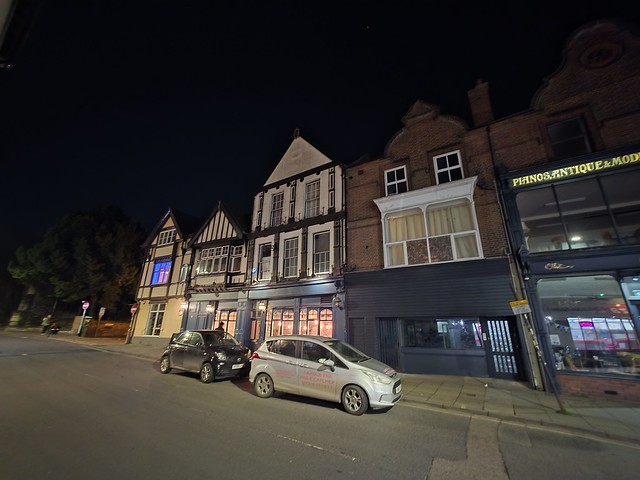
This was the seventh pub on our perambulation around Norwich, the former Lawyer pub on Wensum Street. I would note that this was the end of the formal part of our endeavours (we are very precise with our study days) and we then went to the White Lion and Artichoke who are both due a separate write-up on another day. As they often are, https://norfolkpubs.co.uk/ have been very useful at trying to unpick the history of this venue and its previous names:
1831 – 1972 : The Grapes
1972 – 1977 : Silver Dollar
1977 – 1980? : Silver Jubilee
1980 – 1996 : The Lawyer
1996 – 2004 : The Fugitive and Firkin
2004 – 2018 : The Lawyer
2018 – 2025 : Chambers Cocktail Company
If it were my choice, which I accept that it isn’t, I think I’d rather they’d stuck with their historic name of the Grapes, but more in a moment about why it felt appropriate to get rid of that. The building interior has been quite knocked about internally over the decades, but it’s known to have had an alcohol licence from the early 1830s and perhaps earlier than that. I have no idea what possessed them to change the name to the Silver Dollar, it sounds like some Las Vegas casino and I’m not sure that Wensum Street has ever really been about that. The building owners are a little different to many pubs in the city, it was effectively what would now be called free trade until 1932 when it became owned by Backs and then it was taken over by Henekeys in 1952 before returning to free trade. Then it was purchased by Ind Coope and it became owned by the De’ath family in 2004 when the Lawyer name was restored.
I’m having unusual problems with the history of this pub as it’s hardly appearing in any historic records other than as a wine vaults, a wine wholesaler or wine merchants, so I’m wondering if this really was ever much of a pub and it was more of a place where wine was sold. That would fit the name of the pub and it’s unusual lack of a brewery owner, along with the rather obvious fact that it isn’t shown as a pub on any Victorian maps. Backs and Henekeys were also wine merchants, so I don’t think that they had many drinkers of beer in here until the 1970s. I’m sure many other pub experts could have told me all that, but I’m merrily defining the history of this building as being heavily based around wine with beer being a recent addition to proceedings.
There was a member of door staff, but he proffered a friendly welcome and the atmosphere was rather quieter than the Wetherspoons over the road that we’d just come from. There’s no real ale, but there’s the beer board and I tried to order the Foghorn from Brewpoint, but they had sold out. The service was friendly and immediate, with customers being served in turn. Incidentally, the lack of real ale is a relatively new thing, in 1987 the ‘Best Pubs of Great Britain’ book reported that they had four beers which included Adnams Bitter, Courage Best Bitter and two guests.
For the second time in the evening I went for the Alpacalypse from Salt Brewery, which was still light and hoppy, being rather pleasant. Incidentally, that’s not the bubbles from the keg beer, it’s because the glass is just a little dirty (or has some soap residue or similar) and the bubbles are sticking to the side.
Oooh, craft beer. There’s no food offered here, but this drinks list is extensive.
I fear that the venue and I have rather different definitions of craft beer. And although that might sound snobbish, the majority of pubs along Wensum Street and Magdalen Street have a better range of craft beers than here, so it seems a little strange to me that they are defining themselves in this way. Incidentally though, their prices are towards the middle of the scale and aren’t over-priced, so there’s a positive.
The bar which I think I can say was frequented by a rather different audience to that of the Glass House which is opposite, but that perhaps fits in with the historic situation of it primarily selling wine rather than beer. The bar looks quite old and traditional, but it’s actually a modern reproduction which was installed here in the 1980s. It was clean and comfortable, the music was at an appropriate level and the vibe felt informal and welcoming.
The venue is focused on cocktails, although there are some clues to that from their name, and there’s an extensive list of those. The cocktail I like would be something I think I would call the Emperor’s Single Tear of Golden Ambrosia which is a craft beer served with nothing else other than a theatrical flourish, I don’t need multiple ingredients in my ideal drink. Anyway, I digress. I’m not the venue’s target demographic here as I assume they’re going for a refined audience that wants to have a more decadent experience rather than someone that is seeking craft beer or real ale served alongside some Wotsits. However, it’s evident that their model is working as they’ve been trading for seven years and it seemed reasonably busy when we were there, so they’re doing well to keep the pub going.