
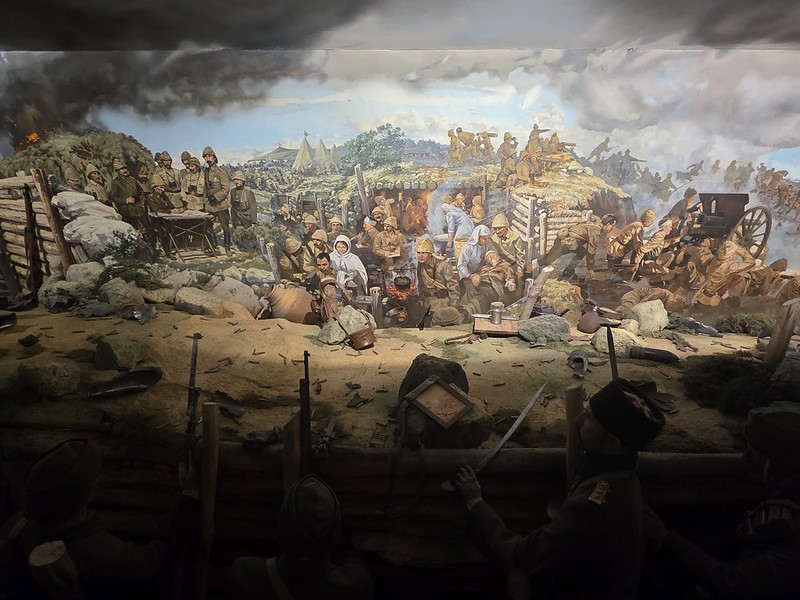

Although I’ve completed my write-up of my trip to Turkey, Georgia and Armenia, there was quite a lot that I missed out and have meant to come back to. This is one of those posts, but the summary of the trip is at https://www.julianwhite.uk/turkey-georgia-and-armenia-final-thoughts/, with a link to all the blog posts that I wrote up telling the story of that little adventure.

There are a number of dioramas at the Anıtkabir, the mausoleum of Mustafa Kemal Atatürk. These ones are about the Çanakkale campaign (better known here as the Gallipoli campaign) which was fought between 1915 and 1916. The allies hoped to seize the Dardanelles, take Istanbul, knock the Ottoman Empire out of the war and open a reliable sea route to Russia.

It began with the allies making a naval attempt in February and March 1915, which ran into mines, mobile artillery and the awkward reality that narrow waters are excellent at turning expensive ships into sinking lessons. After heavy losses on 18 March, the plan shifted to an amphibious landing, but that again had a sub-optimal ending.

The landings on 25 April 1915 brought British and French forces, alongside the ANZACs (Australian and New Zealand Army Corps), onto multiple points of the Gallipoli peninsula, only to find the Ottomans dug in, well-led and fighting with a defensive advantage. Months of trench warfare followed, marked by appalling casualties, disease, supply problems and offensives that gained metres at a time and then promptly lost them again. Ottoman resistance, galvanised by capable commanders including Mustafa Kemal Atatürk himself, turned the campaign into a defining moment of national memory in Turkey, while in Australia and New Zealand it became a tragic story of identity and loss.

This whole conflict was a real victory not just for the Ottomans, but for their prestige and honour. The Ottomans were ultimately left defeated by the First World War, but from there came the new Turkish nation.

The text of Atatürk’s speech in the 1930s:
“Those heroes that shed their blood in the territory of this country! You are in the soil of a friendly country here. Therefore, rest in peace. You are lying together with the Mehmetçik, side by side, in each other’s arms. You, the mothers, who sent their sons from faraway countries! Wipe your tears away. Your sons are now lying in the bosom of ours. They are now in peace and will rest in peace here forever. After losing their lives on this land, they have become our sons as well.”