

I’ve touched on this issue before, but the newspapers from 200 years ago are littered with suicides and this often seems to be underplayed throughout history. This article in the Norwich Mercury from 200 years ago this week noted:
“And the same day, at the Workhouse, in the parish of St. Andrew, on the body of John Gowing, aged 35 years, who, in a fit of insanity, threw himself from his bed-room window into the stone yard of the said Workhouse. Verdict accordingly.”
The reason that it mentions “the same day” is that there was another suicide reported in the weekly newspaper.

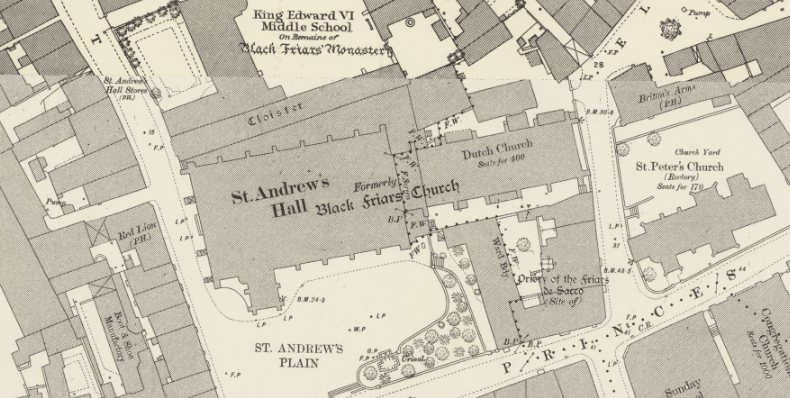
The workhouse in question here is in St. Andrew’s and it was located in the cloisters of St. Andrew’s Hall, best known today perhaps as the home of Norwich Beer Festival. In the above map from the 1880s, the site of the workhouse was the King Edward VI Middle School.
John Gowing was baptised on 29 December 1793, the son of Robert Gowing and Martha Tutthil, and it appears that the age in the newspaper article was wrong, he died at the age of just 31. I can’t be sure that this is the same John Gowing who committed an appalling crime in 1817, but the details provided do fit although I can’t find the transportation record.
“John Gowing and Daniel Thorpe, the latter only 13 years of age, were indicted for feloniously stealing and carrying away out of the house of Wm. Thorpe, linen-draper at Langley, a quantity of gold and silver coin, his property, on the 10th of April last. This case excited considerable interest. The youngest prisoner, who was admitted King’s evidence, was the orphan nephew of the prosecutor, and had been brought up and educated at his expense; the other prisoner was his servant; and, from the testimony of the child, corroborated by other evidence, it appeared that Gowing had for some time past been urging the boy to rob his uncle, and that he had frequently done it, giving what he had got to Gowing, and receiving, as his portion, whatever part he was pleased to give him. The prosecutor was in the habit of keeping a quantity of guineas and other gold coin by him in a small spice box, which had a lock and key to it. Gowing had procured a key which fitted it, and repeated visits had been made to the old gentleman’s magazine without his suspicion being excited, as whenever his nephew made his attacks, Gowing stood sentinel to prevent a surprise. At length the key accidentally breaking in the lock, Gowing persuaded him to take away box and all. This was done, and the whole booty was delivered to Gowing. The box was broke open, and the contents shared between them in such proportion as Gowing thought fit. These facts being fully proved, the Jury found the prisoner, Gowing—Guilty.—Mr. Justice Abbott, in pronouncing sentence, animadverted in severe terms on the prisoner’s conduct: first, in having seduced a child of the tender age of Thorpe to rob his benefactor; and next, in having himself become a party to rob his employer, who had placed a confidence in him. The humanity of the prosecutor had induced him to prefer this indictment in such a form as did away the capital part of the offence. The Court, however, felt itself bound to inflict the severest punishment in its power upon him. That punishment was, that he should be transported beyond sea for the term of seven years.”
John was buried at St. George Colegate on 23 July 1825, which is a church that I walk by frequently. I can’t find him listed in any family trees or referred to online, which made me wonder how many people have thought about him over the last 200 years. Either which way, it’s all really rather sad.