
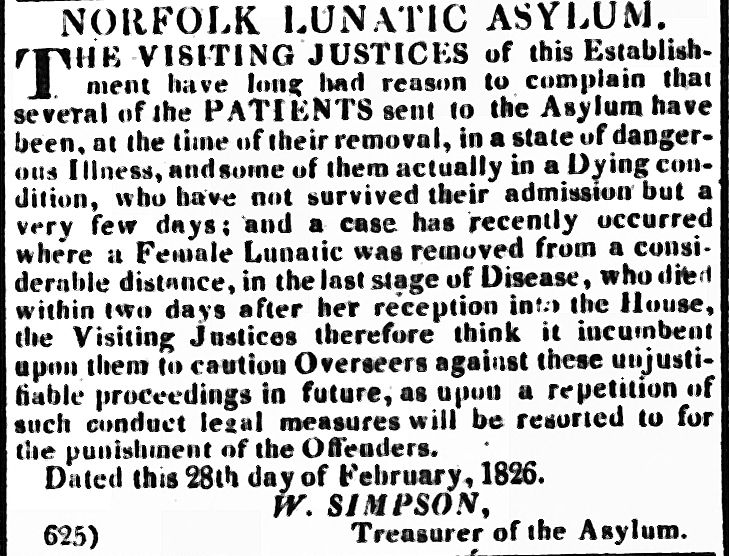

And back to 200 years ago this week in Norwich….
“NORFOLK LUNATIC ASYLUM : The Visiting Justices of this Establishment have long had reason to complain that several of the PATIENTS sent to the Asylum have been, at the time of their removal, in a state of dangerous Illness, and some of them actually in a Dying condition, who have not survived their admission but a very few days; and a case has recently occurred where a Female Lunatic was removed from a considerable distance, in the last stage of Disease, who died within two days after her reception into the House, the Visiting Justices therefore think it incumbent upon them to caution Overseers against these unjustifiable proceedings in future, as upon a repetition of such conduct legal measures will be resorted to for the punishment of the Offenders.
Dated this 28th day of February, 1826.
W. SIMPSON,
Treasurer of the Asylum.”
And here’s the early welfare state system in action, where money has been raised to look after those with mental health issues at an asylum, but local parishes have been sending whoever they can to stop them being a problem to them.
The overseers in these parishes were tasked with managing the poor laws, although there wasn’t a great deal of money around and there was already some tension about who should be funding this. And there were extreme financial pressures as unemployment was rising, populations were rising and suffering was increasing. The joining together of parishes to provide workhouses was a handy way of hiding poverty, but I can imagine the keenness of the overseers to use the county asylum as a way of removing people from their parish.
I’ve posted numerous times before about just how bad mental health must have been at this time, they were very regular articles in the press in the 1820s about suicide and self-harm, but in the main, there must have been a lot of people struggling that had nowhere to go for help.
As an aside, the building is what became known as St. Andrew’s Hospital, although it opened in May 1814 as the Norfolk County Asylum. It remained in use as a mental health facility, later becoming part of the NHS in the 1940s, but closed in the 1990s following a move towards care in the community.