

Although I’ve completed my write-up of my trip to Turkey, Georgia and Armenia, there was quite a lot that I missed out and have meant to come back to. This is one of those posts, but the summary of the trip is at https://www.julianwhite.uk/turkey-georgia-and-armenia-final-thoughts/, with a link to all the blog posts that I wrote up telling the story of that little adventure.

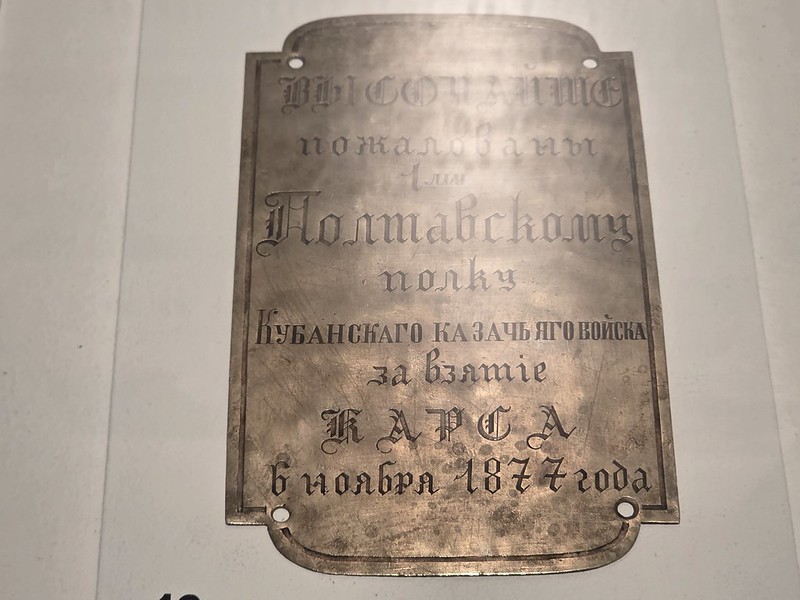
This is a memorial plaque from a very proud Russian Government which was given to the Poltava Regiment. Translated, it reads:
“By the Highest (Imperial) will, [it was] granted to the 1st Poltava Regiment of the Kuban Cossack Host for the taking of Kars, 6 November 1877.”
[Host in this case means a regional Cossack army]
We didn’t go to Kars on this trip, but it was the final destination of our long train journey where we got off at Erzerum. I intend to visit Kars as it has no shortage of history, although I might not sit on a train for the best part of two days to get there. Well, not in one go.
Anyway, the city of Kars had been a Russian target for some time, they’d tried in 1807, in 1821, in 1828 and in 1855. They started again in 1877 and suddenly decided to attack on 17 November 1877 (or 6 November 1877 in the old style calendar) and to everyone’s surprise, not least the Russian Government, it was captured. The city was given to Russia, they liked it and they held onto it until 3 March 1918.
The situation then gets complex, the Ottomans lost it to the First Republic of Armenia in October 1918, but to everyone’s surprise once again, Armenia lost it in October 1920 after a botched military defence. In 1945, the Soviet Union told Turkey that they wanted it back, something which worried many, including Winston Churchill. After discussions, in 1948, the Soviets decided that they’d withdraw their claim to the region. The border between Armenia and Turkey has been formally closed since April 1993, but it has been effectively closed for a century. It is something of a remnant of the Iron Curtain.
But, back to the plaque in the museum. This would have been seen as a great military victory for Tsar Alexander II and he would have been very pleased with his Cossack soldiers. The Tsar was a more pacifist leader than some in Russia, but he was very keen for military expansion in this region, something that the population of Kars could have probably done without at the time. Indeed, Kars is one of those locations that, if history had gone differently, could have been in Turkey, Russia or Armenia.