
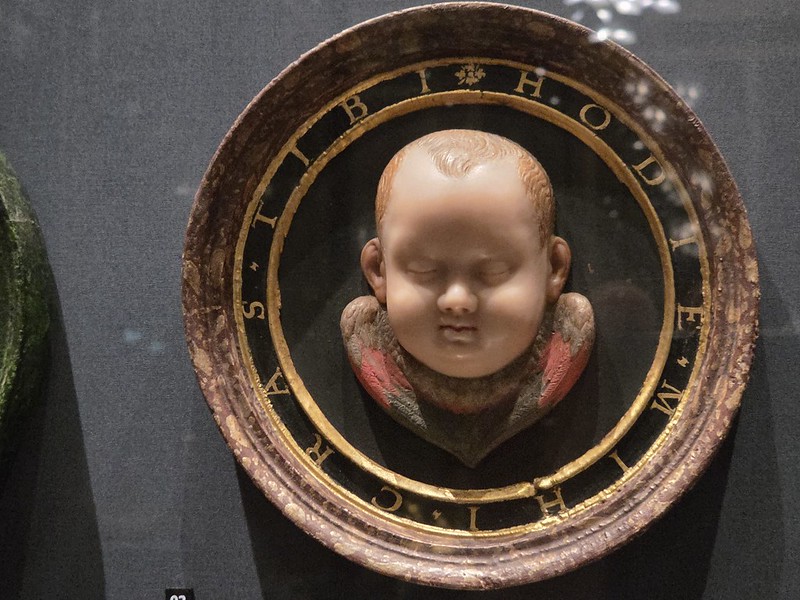

This is a sixteenth century wax head of a sleeping child, mounted like a holy relic in a carved wooden tondo. I’m really more showing off there that I have learned a tondo is a circular work of art…. This is another piece of Habsburg-era oddness, a 1589 Austrian creation and I more wonder whether this child is at rest or quietly plotting something. Made of wax and wood, this disembodied cherub seems to me to be more of a masterpiece of serene discomfort. The inscription around the frame, “Hodie mihi, cras tibi”, translates loosely as “Today me, tomorrow you” which is not exactly comforting, especially when delivered via a child’s severed (albeit sleeping) head. It was likely designed as a memento mori, a not-so-subtle reminder of the fleeting nature of life, which I’m not sure people living at this time needed additional reminders of. The museum notes that these are fragile and rarely survive, although I suspect someone shoved it in a cupboard as I think it’s more unsettling than beautiful. But each to their own…..