

Erzurum Castle stands as a formidable testament to the strategic military architecture of Eastern Anatolia, perched on a central reasonably sized hill that has dominated the landscape for nearly 1,600 years. Originally established by the Byzantine Empire under Emperor Theodosius II in the fifth century, the fortress served as a vital bulwark against eastern invasions and transitioned through the hands of various powers, including the Seljuks and Ottomans.

There was a charge of €3 for foreign visitors, it was less for locals, but that was a reasonable cost. I paid with a note that I had, receiving the change back in Turkish lira.

The entrance gate.

Inside the castle complex.

This is the masjid, or mosque, which the sign notes dates from the twelfth century and has been repaired on numerous occasions. I’m not an expert in Turkish architectural history, but it looks rather new to me.

Inside the mosque.

The clock tower which was constructed between 1124 and 1132. It was commissioned by Emir Saltuk, the ruler of the Saltukid Principality, to serve the dual purpose of a minaret for the Castle Masjid and a military watchtower for the inner citadel. The transition from a religious and military tower to a clock tower occurred in the mid-19th century. During the reign of Ottoman Sultan Abdülmecid, the top of the minaret was damaged, and a wooden, Baroque-style room was added to house a clock mechanism. This clock was reportedly a gift from Queen Victoria to the people of Erzurum which was a lovely gesture from the British, so they must have wanted something.

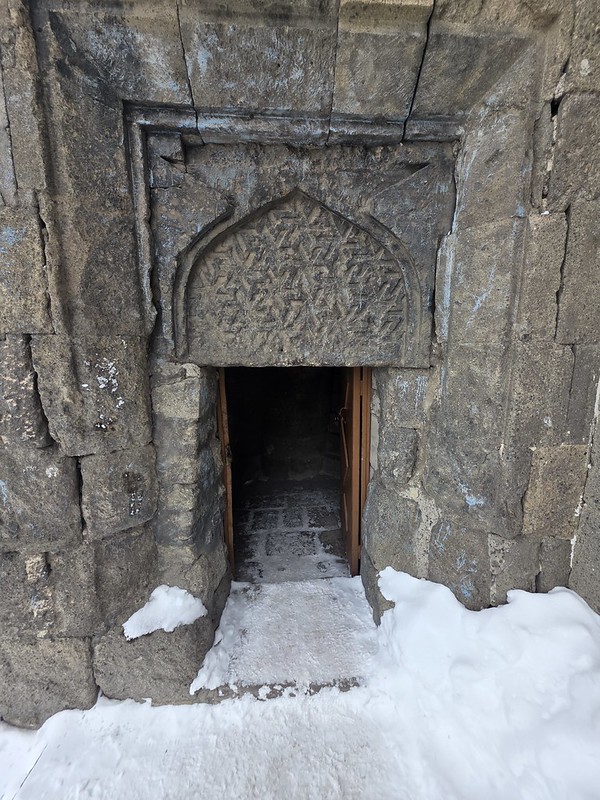
The entrance to the clock tower.

The steps up, all very manageable for me.

I’m scared of heights, so I wasn’t doing icy sloped steps up, especially when I saw someone else struggling. Jonathan went up and told me about the view, which I decided wasn’t much different from the one I could see from outside.

I could cope with these steps to get back down and I decided that I was brave enough and didn’t need to push matters….

Another view of the interior although it was a little hard to make out what was happening architecturally given the amount of snow. It was an interesting way to spend around forty minutes as there’s not a huge amount to see here, but it’s a very important part of the city’s heritage.