
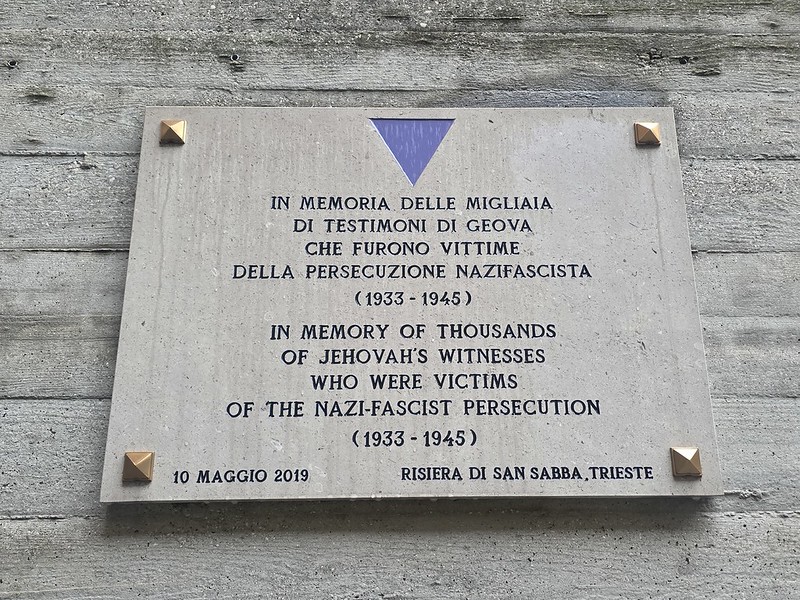

This memorial is located near to the entrance of Risiera di San Sabba, commemorating the lives of all those Jehovah’s Witnesses who died during the Nazi regime.
This is a moment to mention August Dickmann (1910-1939) who was the first person shot by the Germans for refusing to fight for religious reasons. This story wasn’t a secret, it was reported in the UK that Dickmann, a committed Jehovah’s Witness, had said that he could not sign the Declaration of Commitment that the Nazis demanded.
Dickmann did this whilst at Sachsenhausen concentration camp, but his bravery had been evident for some time. He continued his faith even though it was banned by the Nazis in 1933 and he was sent to Esterwegen concentration camp in 1935, before being sent to Sachsenhausen in October 1937. His brother joined him there in March 1939, both still refusing to give up their faith.
On 15 September 1939, a firing squad led by Rudolf Höss, later perhaps best known for being the camp commander at Auschwitz, executed him in front of 8,500 people. At the front of that group were all of the other Jehovah’s Witnesses, around 380, and this was an act that was meant to shock them into joining the German military.
Hermann Baranowski, the camp commander, was no doubt pleased with his work and he went back out after Dickmann’s body was being removed to ask the other conscientious objectors to step forwards to indicate that they would now sign the Declaration of Commitment.
Two people stepped forwards. And those two had already signed it, but they wanted to say that they wanted to remove their signatures after what they had just seen. That takes some incredible bravery and it seems that Baranowski found this response completely sub-optimal and promptly stormed off. Dickmann had said that those who sought to use violence would regret their actions and Baranowski was dead within months and Höss was executed after the end of the war.
Jehovah’s Witnesses were the first Christian denomination to have been banned by the Nazis and around 10,000 were sent to concentration camps. Around 250 were executed and around 3,500 died whilst being imprisoned, whilst children had been taken away from their parents since the mid 1930s. Others in the Nazi movement saw the followers as white and committed Christians, so many found themselves saved, but the opposition from the religion meant that Hitler wanted them gone from Germany.