
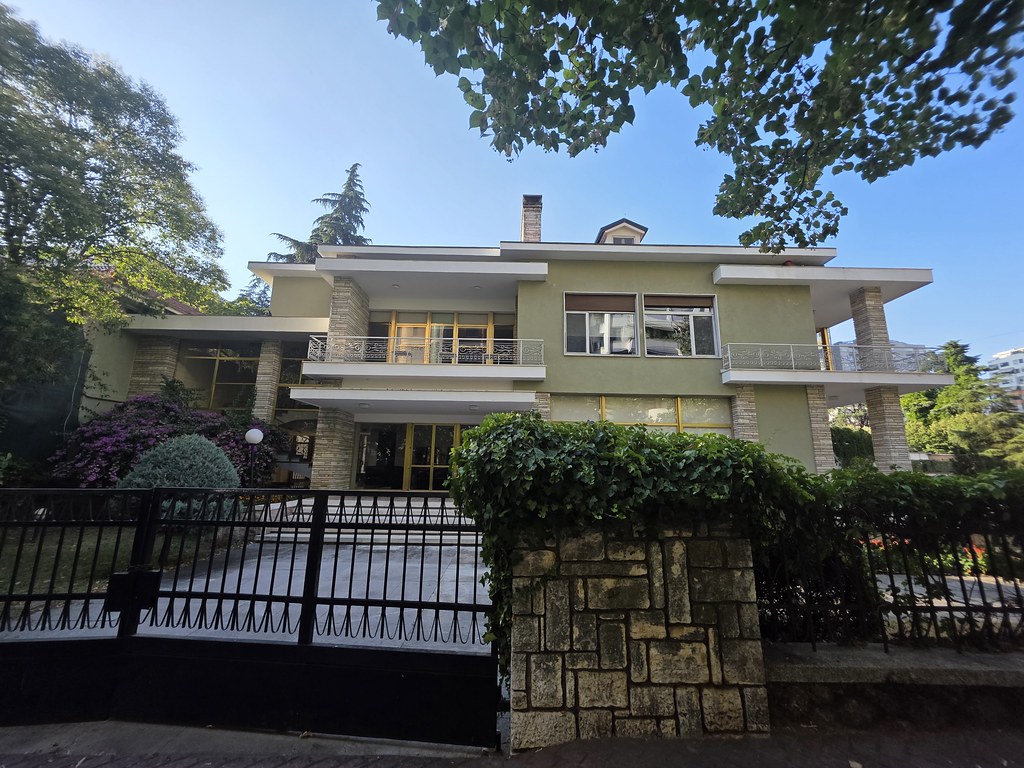

Hidden away in the once-exclusive Blloku district of Tirana where the political elite once lived is Vila 31, the former home of the dictator Enver Hoxha (1908-1985) sits there looking quite unassuming. Constructed between 1972 and 1973, it was designed to be modern yet suitably imposing, the kind of place where a dictator could pretend to be modest while secretly enjoying the perks of power. There was a private cinema, a basement swimming pool and even a secret tunnel to an underground bunker as nothing screams ‘I trust the people’ quite like a hidden escape route under your own living room. Although a lot of this he blamed on foreigners, whilst Albania suffered financially, Hoxha told his population that the west as so jealous of Albania’s wealth that they might invade at any time to share in the prosperity. This ridiculous lie is perhaps why Hoxha didn’t let any Albanian travel outside of the country, it all has rather North Korea vibes to it.

This entire neighbourhood was once sealed off from ordinary Albanians and only the party elite could live here, and mere mortals weren’t even allowed to walk through it. Hoxha and his family lived surrounded by books, some of them on subjects he happily banned everyone else from reading. He also spent vast sums of the country’s money on importing fashionable European interiors, whilst bankrupting the country and mocking foreign design.

When Hoxha died in 1985 and the regime collapsed a few years later, the villa became a strange sort of relic. It wasn’t demolished, because no one quite knew what to do with it, but it also wasn’t turned into a museum or shrine. For years it sat there behind drawn curtains, an awkward reminder of the past while the rest of the neighbourhood filled with lively cafes and bars. Indeed, opposite the property is a KFC, the first in Albania, which I felt the need to pop into in order to cool down. The photos are evidence of just how bloody hot it was in Tirana when I was there….
And as for now, it’s been reborn as an artist residency. The marble floors and gloomy halls that once hosted political plotting now welcome painters, writers and filmmakers. Instead of propaganda speeches, there are poetry readings and instead of whispered paranoia, there are film screenings. So a house that was once a symbol of control and isolation has become a space for creativity and free expression. A former dictator’s stronghold now full of people doing exactly what he spent decades suppressing, Hoxha would absolutely hate it and we can all drink craft beer to that thought.