

Skanderbeg Square is the beating heart of Tirana, though it feels more like the lungs on a quiet day, expansive, calm and just a little surreal. It’s named after Albania’s national hero, Gjergj Kastrioti Skanderbeg, the 15th-century warrior who spent his life resisting the Ottoman Empire. His statue, naturally, takes centre stage, and it’s one of those heroic bronze figures that makes you feel slightly inadequate about how you’ve been spending your time. More on this statue in the next post though.

The square itself is enormous and it’s been redesigned in recent years with big, open stone spaces and a few splashes of greenery. It has the slightly odd quality of being both monumental and oddly minimal, which I think is part of its charm, especially now they’ve booted the cars out of it during the recent redevelopment. It’s ultimately a huge space with a lot of nothing going on at the centre. The history of this square started in 1925 when Armando Brasini was handed the task of shaping the new and shiny Albanian capital. Brasini, an Italian architect with a flair for the dramatic, came up with a grand Neo-Renaissance vision and his work was later continued by Florestano Di Fausto, who refined the Neo-Renaissance theme with what could be described as articulate angular solutions. Then came 1939 and the Italian invasion of Albania, and, as often happens when new regimes arrive, so did a new architect. Gherardo Bosio stepped in with a fresh master plan, tweaking the original designs to suit the occupiers’ tastes.

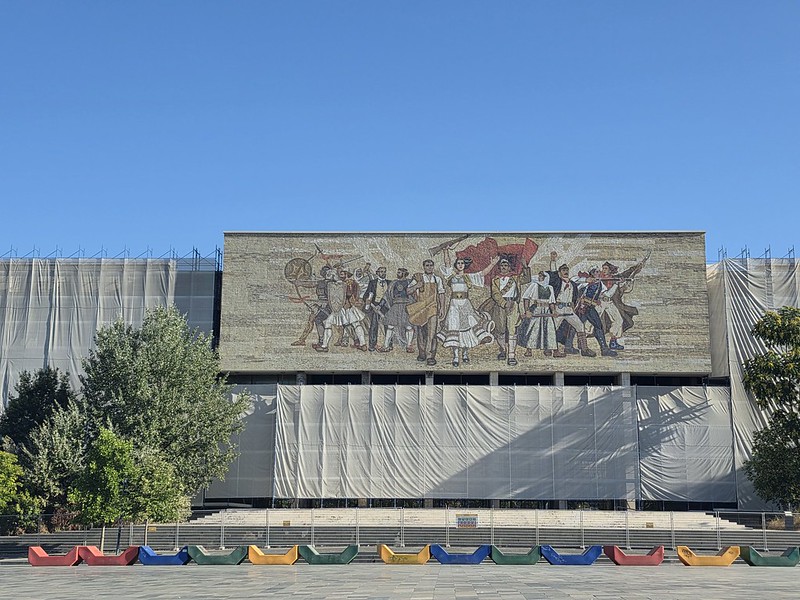
The mosaic at the National History Museum is called “The Albanians” (Shqiptarët) and it dominates the façade. It was created in 1981, during the height of the communist era, and is essentially a giant socialist-realist postcard in mosaic form. The mosaic had started to fall into disrepair, but in 2023 the restored version was unveiled which was partly funded by the European Union. There were calls for it to be removed, but this was a part of history that it was decided to preserve.

It’s a curious architectural cocktail as it’s Ottoman, fascist-era Italian, Soviet-inspired communist and modern Albanian, all happily coexisting in one giant open space. It shouldn’t work, but I think that it does, mostly because Tirana has decided to stop apologising for its past and just embrace the whole lot. The yellow building in the middle is the Tirana International Hotel and the old looking building to the right of that is the Downtown One Tower. Mostly hidden by the trees on the right is the National Opera House.

On the left is the Bank of Albania building, which was constructed in the 1930s, and in the centre of the photo is a skyscraper currently under construction.
The square is really also the unofficial stage for whatever Tirana decides to celebrate, protest or showcase. It’s a larger space than I had anticipated and there could be a little more seating and shady areas, but it’s all quite glorious and an architectural jumble which comes together quite nicely.