
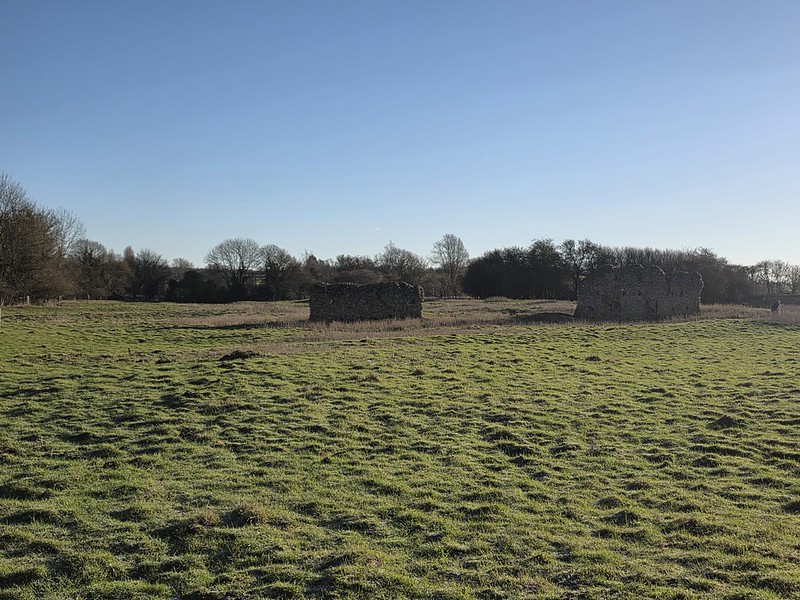

It was an unexpected surprise to walk into a field on the Stansted Stagger and see the remains of a former Cistercian abbey.

To be fair, there isn’t much of this abbey left, but at least there’s something. The bits that remain here are two fragments of the west range of the abbey. I would have explored them more thoroughly but I didn’t want to faff about looking at bits of old stone when I was meant to be on a 26 mile walk. Although I did think about it.
The abbey was founded in 1153 having been established by Maurice fitz Geoffrey and his overlord, Robert de Ferrers, who was the Earl of Derby. The first monks to populate the abbey came from Warden Abbey in Bedfordshire.
The abbey was situated on a tributary of the River Chelmer in north-west Essex and its dedication is believed to have taken place on 22 September 1153, which corresponds with St Maurice’s feast day, chosen in honour of the founder. While founded in the middle of the 12th century, the construction of the entire monastery complex is often credited to the second abbot, Simon, who served from approximately 1188 to 1214.
The site experienced significant hardship on Christmas Day 1215 when it was pillaged by the army of King John. Soldiers reportedly broke into the church during mass, ransacking chests and carrying off valuables, an event that required the monks to spend the next five years reconstructing the church. It’s fair to say that they probably considered this as completely sub-optimal.
The abbey functioned as a Cistercian community until its dissolution on 28 February 1536 under the religious reforms of King Henry VIII. Today, very little of the original monastic buildings remain, except for some stone wall fragments in the above photo and the chapel by the gate. This chapel, known as the capella extra portas, was built around 1220 for the use of visitors and now serves as the Tilty parish church, but a little more about that in the next post.