Tag: Wroclaw

  • Wrocław – National Museum in Wrocław (After Herring Catch by Franz Skarbina)

    Wrocław – National Museum in Wrocław (After Herring Catch by Franz Skarbina)

    20250318_120003

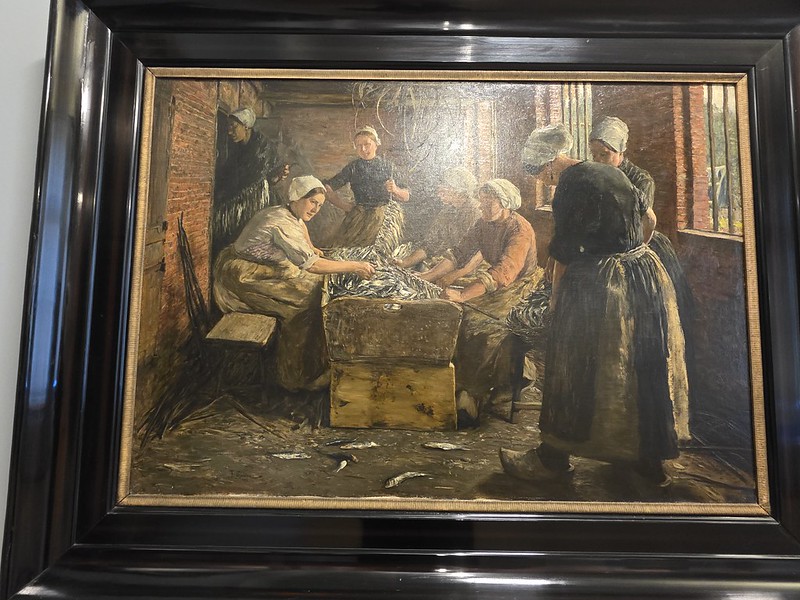
    This painting is located in the National Museum in Wrocław and it rather intrigued me because it reminded me of the Herring Lassies (or Herring Girls) who used to work in Lowestoft from the mid nineteenth to mid twentieth centuries. In Lowestoft, they tended to work in threes with two of them gutting the herring, whilst the other packed it. Although it was a useful form of money, and some adventure, for the women, the working and living conditions were sub-optimal and I doubt that the conditions in the painting are much different.

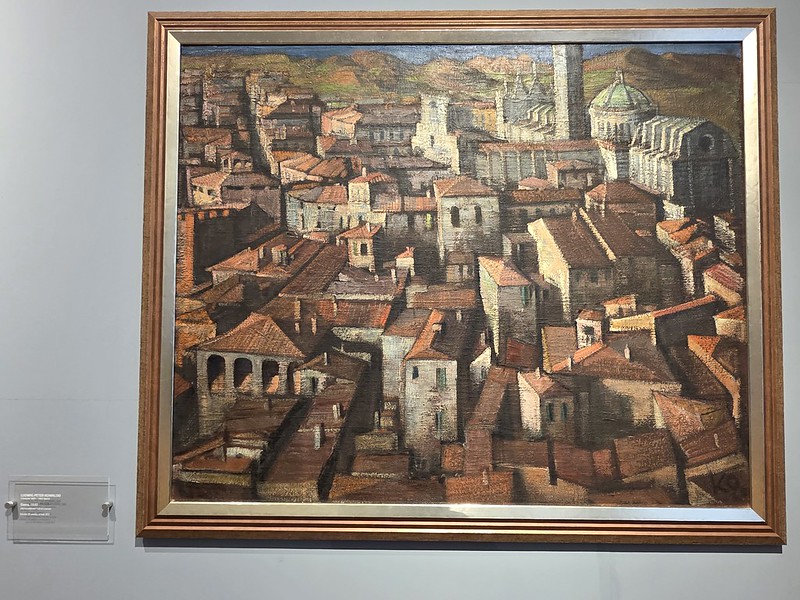
    It was painted by Franz Skarbina (1849-1910) who was a German artist who primarily painted images from his home city of Berlin and he tried to capture urban life. The artwork was painted in 1888 and although he was in Berlin that year, he had been travelling to Northern France, Belgium and the Netherlands in the years before that, which is from where I imagine the painting was inspired. There’s an interesting article at https://www.bbc.co.uk/news/articles/cy63lpy251zo about those who did the job in Scotland and it sounds tough to me.

  • Wrocław – National Museum in Wrocław (St Paul the Apostle by Ambrosius Holbein)

    Wrocław – National Museum in Wrocław (St Paul the Apostle by Ambrosius Holbein)

    20250318_112849

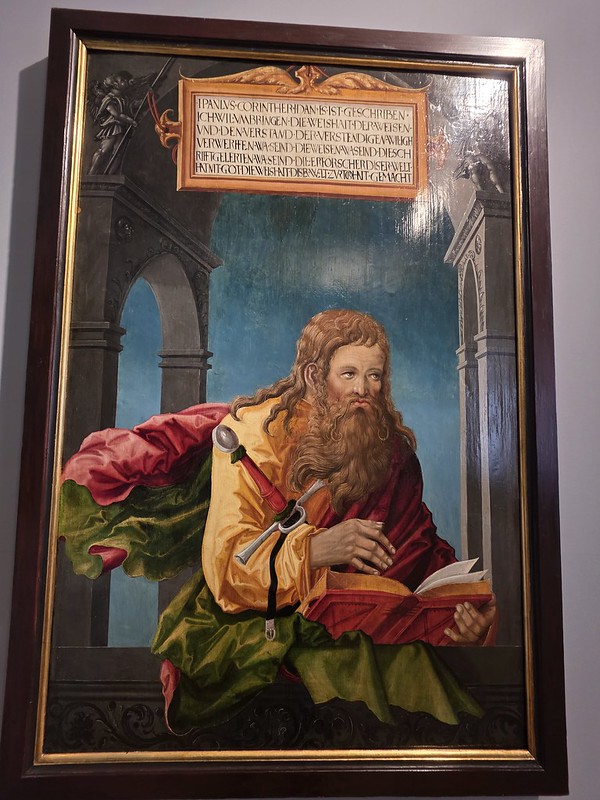
    Located in the National Museum in Wrocław, this painting is by Ambrosius Holbein (1494-1519), the brother of Hans Holbein the Younger of Tudor painting fame. The text at the top relates to Paul’s letters to the Corinthians in the New Testament and talks about God not needing the understanding of humans, as frankly, they don’t know as much as he does. I can think of a President who has a similar mindset, but I’d better divert into politics for too long. Anyway, given that this Holbein died young at the age of around 25, there aren’t a large number of artworks still surviving although the Kunstmuseum in Basel has several. This is also where he likely died (the city, not the specific art museum) and Basel is also where his brother worked for several years. The museum has this dated as 1522, but they note that Holbein died in 1521 (no-one is entirely sure when he died), so something might be slightly off here or it was just finished off by someone in his workshop.

    The background blue colour is in other paintings by members of the Holbein family and it’s apparently called Azurite, a form of copper which was mined in the Saxony area at the time. I don’t have any art knowledge to add much here, but it’s a vibrant and bold painting but there’s no information provided at the gallery or on their web-site as to the provenance and where it has been located for hundreds of years. And it’s a reminder that I should look at going to Basel as I’ve just noticed that Wizz Air fly there.

  • Wrocław – National Museum in Wrocław (Fresco from Pompeii)

    Wrocław – National Museum in Wrocław (Fresco from Pompeii)

    20250318_111832

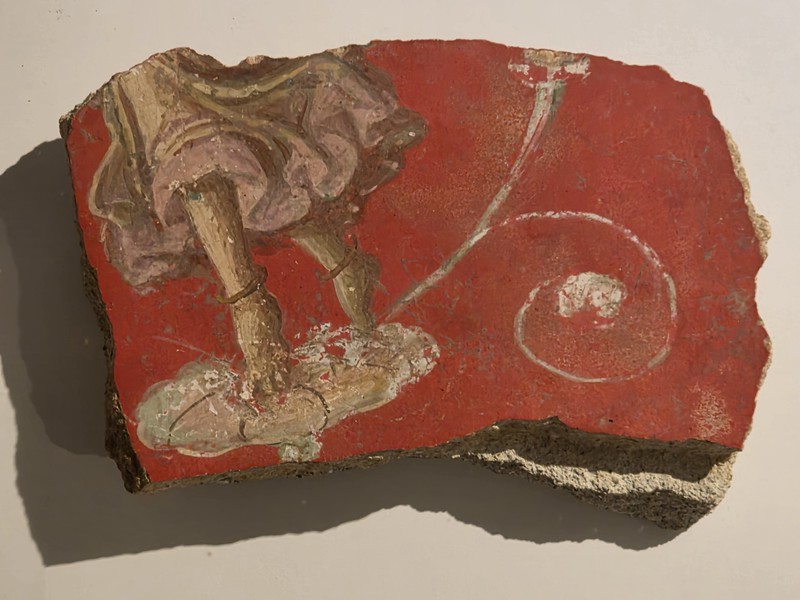
    I like a bit of colour with historic exhibits and this fresco dates to 79AD, or at least just a little before, when there was a little incident at Pompeii. Located at the National Museum in Wrocław, rather than being there in its own right it was more embedded in an exhibition entitled ‘Miracle Workers’ which was “intended as an exhibition which describes and presents the world made by human hands, which first was created in the human mind and imagination, and then in a perfect way materialised in the utilitarian objects.”

    Having been to Pompeii, I’m aware that there is no shortage of frescoes from the site, but I’m still intrigued by the vibrancy of the colours and how they managed to be preserved under a heap of volcanic ash for so long. It has rather lost its context although Google Gemini has a go at working it out, telling me:

    “The figure’s legs and the spiral object are difficult to interpret definitively without more context. However, the spiral object could be a stylised representation of a thyrsus, a staff associated with the Greek god Dionysus (Bacchus in Roman mythology). If so, this would suggest the figure is a follower of Dionysus, such as a maenad or satyr.”

    I’ll go with that….

  • Wrocław – National Museum in Wrocław (Funerary Shield)

    Wrocław – National Museum in Wrocław (Funerary Shield)

    20250318_111335

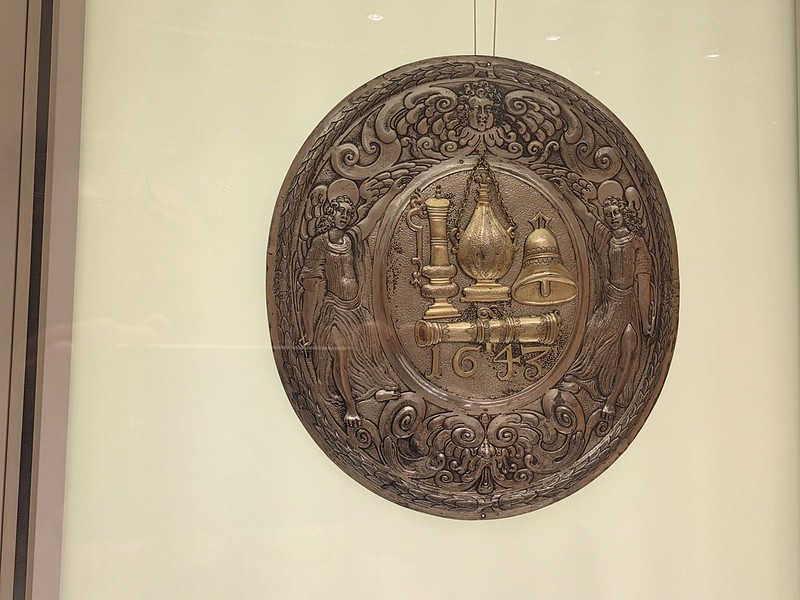
    The English translation at the National Museum in Wrocław of this item reads “funerary guildshield”, but that’s not a phrase that is used anywhere on-line, but it seems that “funerary shields” are a thing. However, an Internet search mainly brings up this museum and some on-line games, which suggests that this museum has a strong collection of them. The museum explains on their web-site:

    “The custom of decorating coffins during funeral ceremonies with valuable, often silver, coffin shields (escutcheons) displaying the coat of arms of the corporation the deceased was a member of, was adopted in the 16th cent. by corporations of professions – guilds. The shields were not nailed to coffins but only attached to them (fixed with string), and after the funeral they were put away (protected by special cases) to await the next such ceremony.”

    This all means that the museum’s English translations are spot-on, it’s just that I’ve never heard of this concept before. After meandering around on-line, something I’m prone to do, it seems that this was something done by the middle classes in mostly Germanic lands. This one is dated 1643 and relates to the brassfounders, bellfounders and pewterers guild. Back in 1643, the city was part of the Hapsburg Empire and the city name would have been Breslau. The shield was made by George Nitsch, who was a craftsman living in Wrocław who specialised in metalwork and it’s crafted using repoussé and chasing techniques, which involve hammering and shaping the metal from the reverse side (repoussé) and then refining the details from the front (chasing). I’d add that I didn’t know about these metalwork terms, but that’s what happens when you faff about on-line when intrigued by things. On the shield there is imagery of a bell, a candle and some, er, metal piping along with the rather cherub like religious symbolism around the outside.

    The period between 1618 and 1648 really wasn’t a good one for Wrocław as Holy Roman Empire and Swedish troops keep battling their way around the city breaking things and arguing with their swords, with nearly half the city’s 40,000 residents dying of plague. Indeed, there’s a real chance that this shield was taken to a member of the guild who had died of the plague, something which adds a rather solemn note to proceedings.

    Anyway, I’ve rather digressed, but I liked this exhibit as it’s a new genre of things I’ve discovered that I know nothing about.

  • Wrocław – National Museum in Wroclaw

    Wrocław – National Museum in Wroclaw

    20250318_110319

    I’ve been to this museum before, back in 2017, but I can’t remember much about it and I seem to have taken relatively few photos to try and remind myself. Unfortunately for my two loyal blog readers, I decided to take rather more photos today and, given that, I feel a need to write about some of artworks. That means there might be a heap of rather less then riveting posts as I’m hardly an art historian, but it’ll keep me amused for a while.

    20250318_110656

    The welcome was friendly and a security guard gave me an introduction of where to go. It’s a well-laid out museum and surprisingly well signed as I often find myself getting a bit muddled up.

    20250318_110726

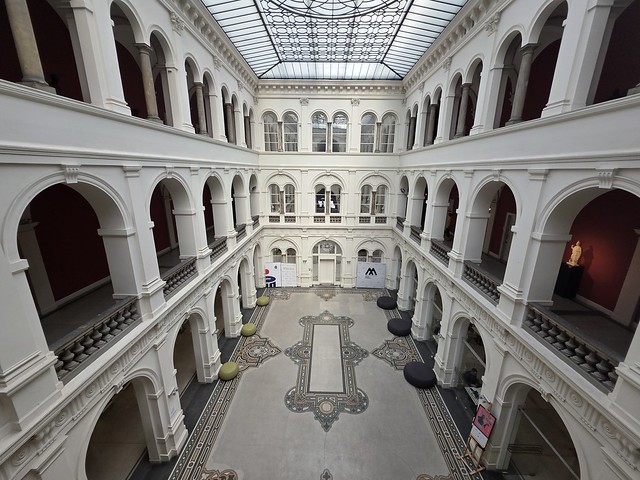
    The museum was opened in 1948 in a building that was built between 1883 and 1886 and was previously used as the Silesian Regency Office. The city was known as Breslau until the Germans lost it following the Second World War and many of this museum’s collections are from the part of Poland that became Ukraine when European borders were redrawn. Located in a different building which has now been destroyed, the German equivalent at the time was the Silesian Museum of Fine Arts, but most of those holdings were lost in the conflict, although some have made their way here to this museum.

    20250318_133208

    The museum is substantial in size and I meandered around for three hours before I felt that I had seen enough. It would be possible, and my friend Susanna would do this, to stay there all day to properly see all of the collections.

    20250318_124702

    There are a lot of staff here monitoring the collections and they were all professional with the exception of one younger female staff member who decided she would follow me about the rooms that she was responsible for. It neared the point that I was going to question what she was doing, but I decided against it to avoid any diplomatic incidents and just left those rooms rather quicker than I would have liked. It was very odd, I can’t recall it happening anywhere before and I thought at first she was just looking to find an opportunity to engage about some of the artworks.

    20250318_123206

    The view from the museum. Anyway, there may now follow a few posts about certain artworks in the museum until I get bored.

  • Wroclaw – Polish Pottery

    For those who love Polish pottery, some photos from one of the shops in Wroclaw which was selling it. The mention of Bolesławiec pottery in the top photo is the reason I post about this, as this traditional blue and white design comes from the town with this name. The town, which is a relatively short distance from Wroclaw, is now seen as the home of this type of pottery, which often also has some green and yellow elements added.

  • Wroclaw – Book Sculpture

    I always like a nice book sculpture, although I hope they didn’t damage the books with this one. It was advertising some sort of book fair, part of a wider literary festival which was taking place when I was in Wroclaw.

  • Wroclaw – Zdrój Fountain

    This fountain was installed in Wroclaw’s market square in 1996 and was designed to show the modernity of granite and glass against the city’s historic buildings. It’s quite an impactful structure and I had thought it was rather more modern than it actually was. All very lovely.

  • Wroclaw – Cathedral of St. John the Baptist (Photos from Tower)

    This was one of the easiest journeys to the top of a church or cathedral tower in Poland, primarily because there were no steps and instead there was a handily located lift. I think this is mostly because the cathedral was badly damaged during the Second World War, so when the building was reconstructed it was relatively easy to install a lift.

    So, some photos from the top….

  • Wroclaw – Hala Targowa

    The city’s market hall building is a spectacular piece of engineering, constructed between 1906 and 1908. The building was designed by Richard Plüddemann and Heinrich Küster, at a time when Wroclaw was part of the German Empire and was known as Breslau.

    Through some piece of good fortune, this was one of the buildings which wasn’t damaged during the Second World War, so it re-opened again soon after the end of the conflict. Other than for some repairs and improvements made between 1980 and 1983, it remains broadly as it would have been 100 years ago.

    When I visited the hall it was relatively busy, with most people appearing to be locals buying their produce. In some cities I get the impression that the majority of people there are tourists who are more interested in taking photos than making any purchases from the stalls. I must admit that this was what I was doing, although I did buy something from one of the hot food stands at least on this occasion.