Tag: Westminster

  • London – Westminster (Borough of) – Lamb and Flag

    London – Westminster (Borough of) – Lamb and Flag

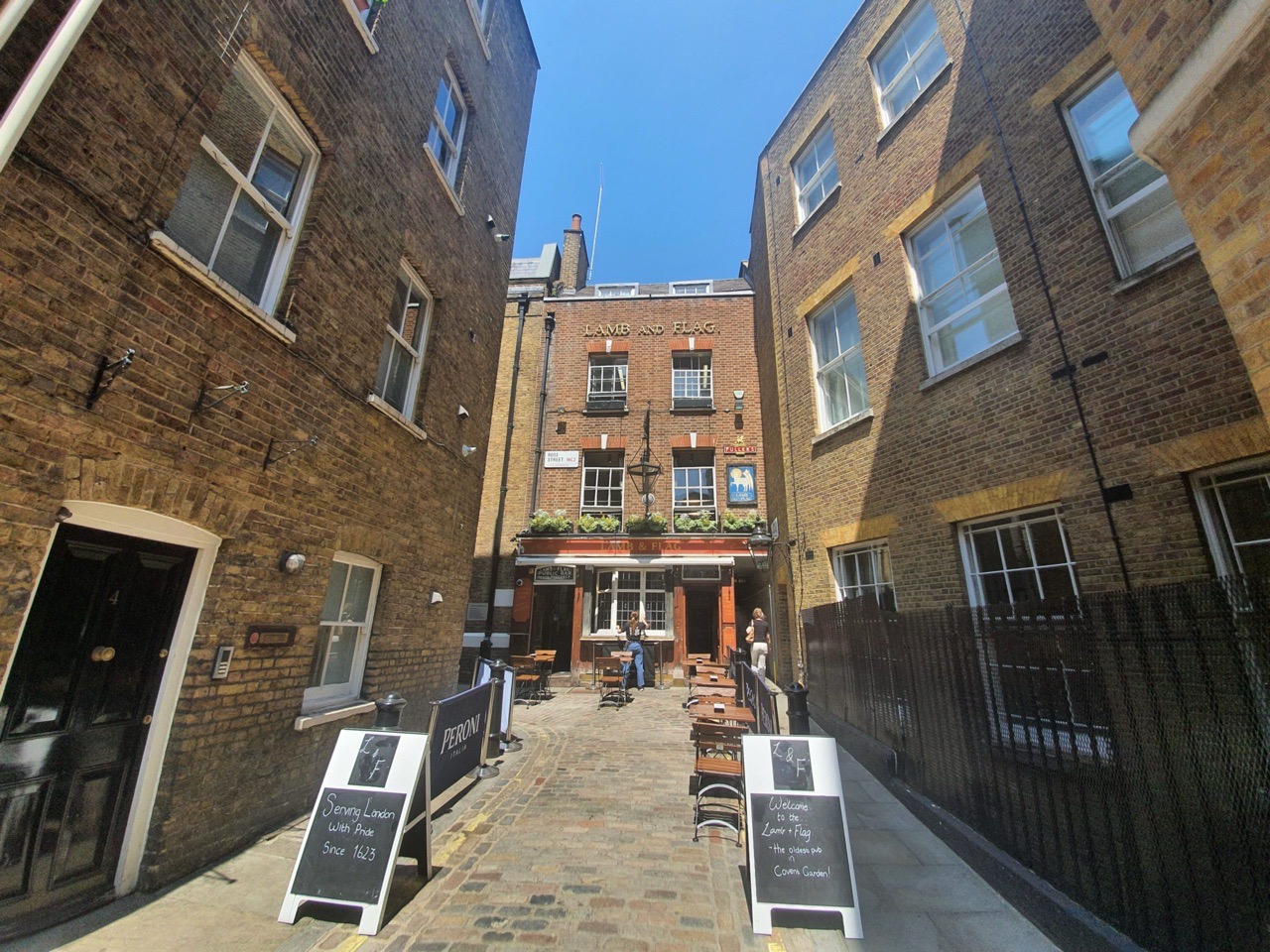
    This is a bit lovely, one of the oldest pubs in the area, perhaps dating to as early 1688, but the timber frame is no later than the mid eighteenth century. Former customers include Charles Dickens, Karl Marx and John Dryden, so there’s some considerable history here. I partly treat the money I spend at these places (which is hardly a decadent spend as I’m only buying half a pint) as an entrance fee to see these remarkable buildings. For those who are craving my riveting comments on craft beer, I’ll be visiting other locations more suited to that later today, in a desperate attempt to cater to my huge audience of about three.

    Some have claimed that the pub is perhaps the oldest in London, although I’m quite sceptical about that. But, it’s heritage is undeniable, although as often with these things, the pub and its licence can move about a bit as buildings were reconstructed and developed. It’s known that there was a pub around here, and very likely this building, from 1772 and at that stage it was known as the Cooper’s Arms. The pub changed to its current name in 1833 and it was another location where boxing matches were held frequently judging from the newspaper reports. More recently, in the late twentieth century, there were theatrical performances that took place upstairs.

    There was another friendly welcome at the entrance to this Good Beer Guide listed pub which all complied with track and trace. I had a quick meander around the pub and took a photo of the beer options whilst I was walking by.

    I had a bit of a dilemma here and I looked very British and awkward in trying to find where to sit. There was a large group in the rear of the pub which I didn’t want to disturb, and it was a restaurant area upstairs. So I temporarily moved to the front of the pub, but didn’t want to take that table of four as that seemed greedy. But I didn’t like the high table that I had acquired for myself, so I placed my order and then faffed about a bit pondering where to go.

    I then decided to go outside, before realising all of the tables were reserved, so I shuffled back inside like some confused idiot. Actually, I’m sure the member of staff thought exactly that, but she didn’t show it. I mentioned that I hadn’t realised they were reserved, but she politely explained they actually weren’t, it was just to ensure that customers got the attention of a staff member before self-seating. So, I shuffled back outside and sat in the blazing heat. I didn’t feel that I could back inside without the staff member fearing for my sanity. My phone warned me it was over-heating, my trusty Chromebook switched off three times in some sort of part panic and part strop, whilst I just melted. I pretended to passing pedestrians and customers that I was enjoying the lovely hot weather, but I feel I made a bit of a mistake here (I’ll add that I’m currently inside another pub which is very cold, so myself and my devices are recovering fast).

    The beer that I ordered was Oliver’s Island from Fuller’s Brewery, which was average and unexceptional. It was well-kept and yet again at the appropriate temperature (I see little reason to say more than this for generic real ales) so I was suitably refreshing in the tropical London heat. The beer cost £2.50, but as I mentioned earlier, that’s sort of partly an admission fee to feel part of the heritage of a pub where I can sit where Charles Dickens sat. And since I kept moving about inside, I probably covered quite a few bases in that regard.

    Other than I nearly combusted in the heat, this was a clean and comfortable environment. Relaxed, informal and friendly, I liked this pub and find it remarkable just how quiet Covent Garden is at the moment. It’s a pub that is worth visiting though, a little bit of London history.
  • London – Westminster (Borough of) – Round House

    London – Westminster (Borough of) – Round House

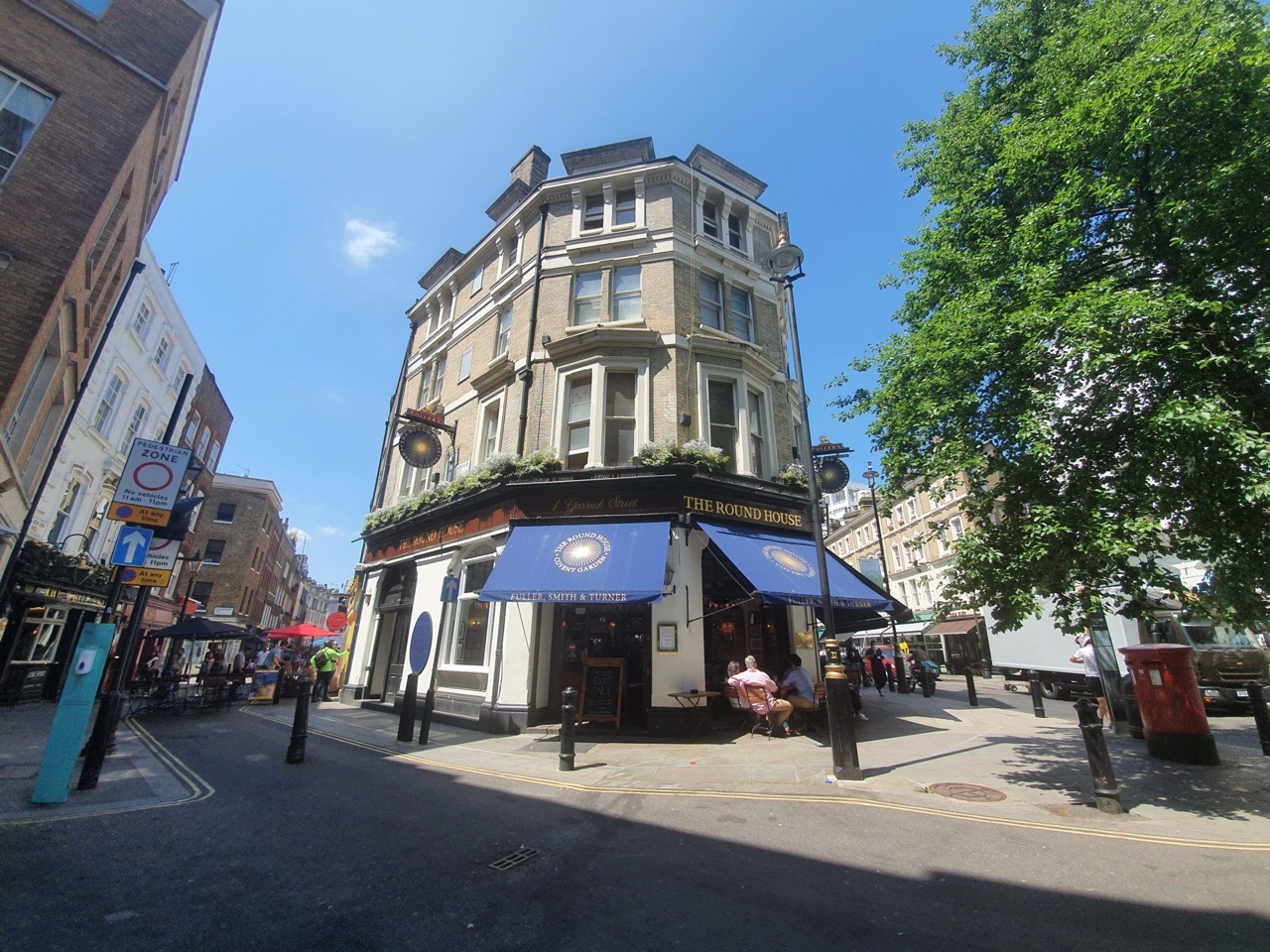
    This Fullers pub is located in Covent Garden, in the heart of the tourist action. Or what would usually be the beating heart if it wasn’t for Covid, as everything is rather muted at the moment in terms of the number of people about.

    There was a friendly welcome from the staff member who was making an effort to be helpful and conversational with customers, so that was rather lovely. Table service was being offered and the process was well managed and the environment was clean and comfortable. I was offered a choice of tables either inside or outside, but on this occasion I went for inside.

    It’s an interesting and quirky building and it’s evident from its shape why the pub has its name. Fullers purchased the pub from Punch Taverns for £3.3 million in 2009, which is fortunate as if it was up to Punch Taverns it’d like be a Tesco Express or similar by now. CAMRA mention that the pub was built in 1863 and was known as the Petters Hotel until 1943.

    There were a couple of real ales on, although I only later realised that there was a Tiny Rebel beer on that I would have had if I had known. I went for half a pint of the Hophead from Dark Star Brewing, an acceptable and quite average beer. But, given the heat it was suitably refreshing and the pricing wasn’t unreasonable given the location. All absolutely fine, although there was nothing exceptional to surprise and delight me.

    It’s a pleasant little pub and food is served as well, the traditional Fullers menu being available, although I didn’t see anyone order food when I was there. The pub is well reviewed, so seems a safe option for tourists to the area when they finally start to return again.

  • London – Westminster (Borough of) – Trafalgar Square Fourth Plinth

    London – Westminster (Borough of) – Trafalgar Square Fourth Plinth

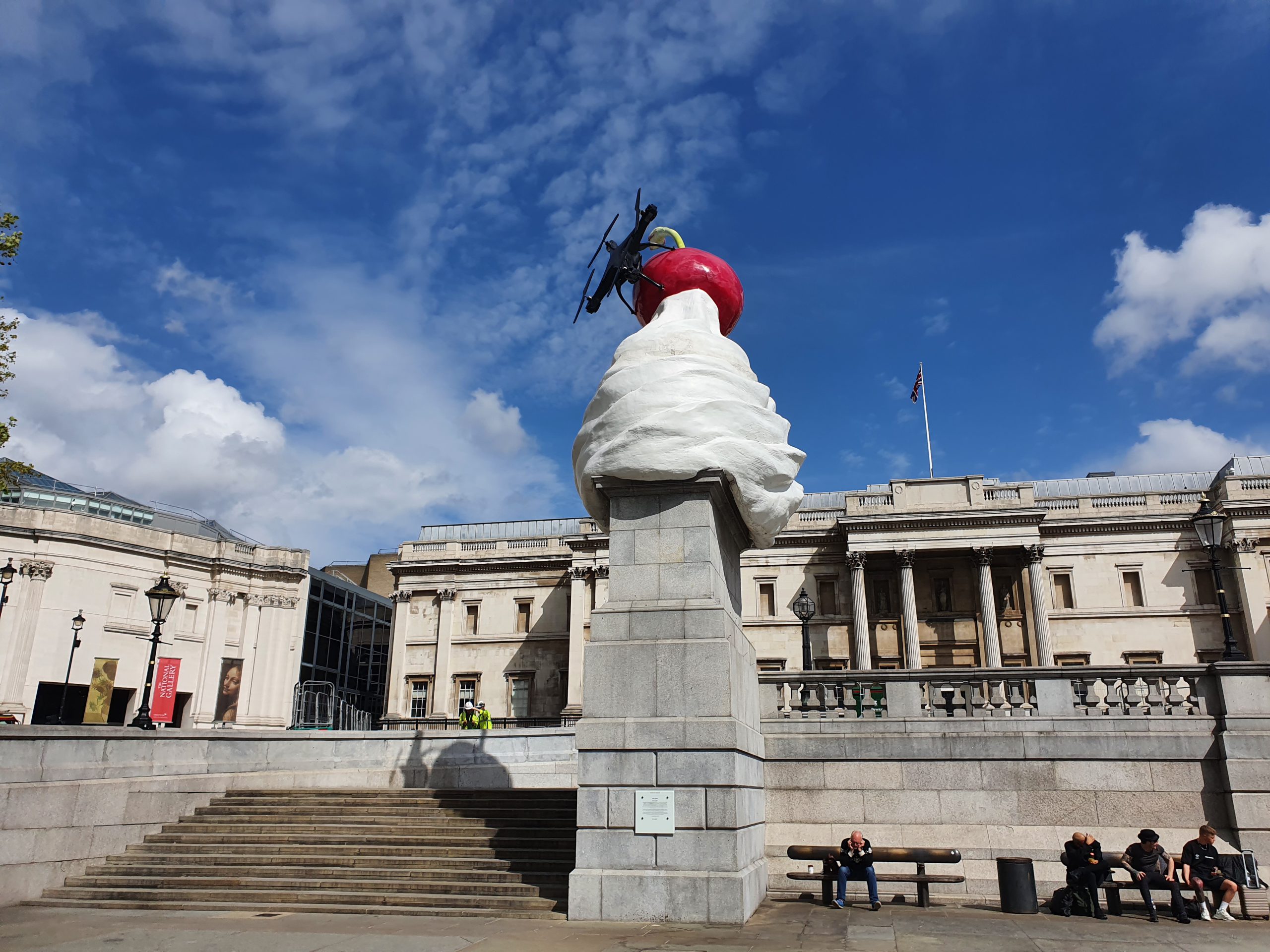
    This is the current art installation on the fourth plinth in London’s Trafalgar Square and it’s the thirteenth to be placed there since this project started in 1998. The installation is by Heather Phillipson and the description reads:

    “This sculpture attempts to address the specific physical context of the square, whilst considering a broader ideological one. How do we negotiate congregation, the intimacy of personal experience, broadcast and surveillance in one space?”

    That puts it better than I can as I didn’t really understand it.

    What I hadn’t realised before is that if you go to https://web102.secure-secure.co.uk/theend.today/, then it’s possible to see a live feed from the drone which is on the fourth plinth. I was in a bit of a rush to get a train and so I’m not really that visible in the above image, but that’ll do, it is definitely me (although mostly my shadow, but perhaps that’s in keeping with the art installation).

  • London – Westminster (Borough of) – National Gallery

    London – Westminster (Borough of) – National Gallery

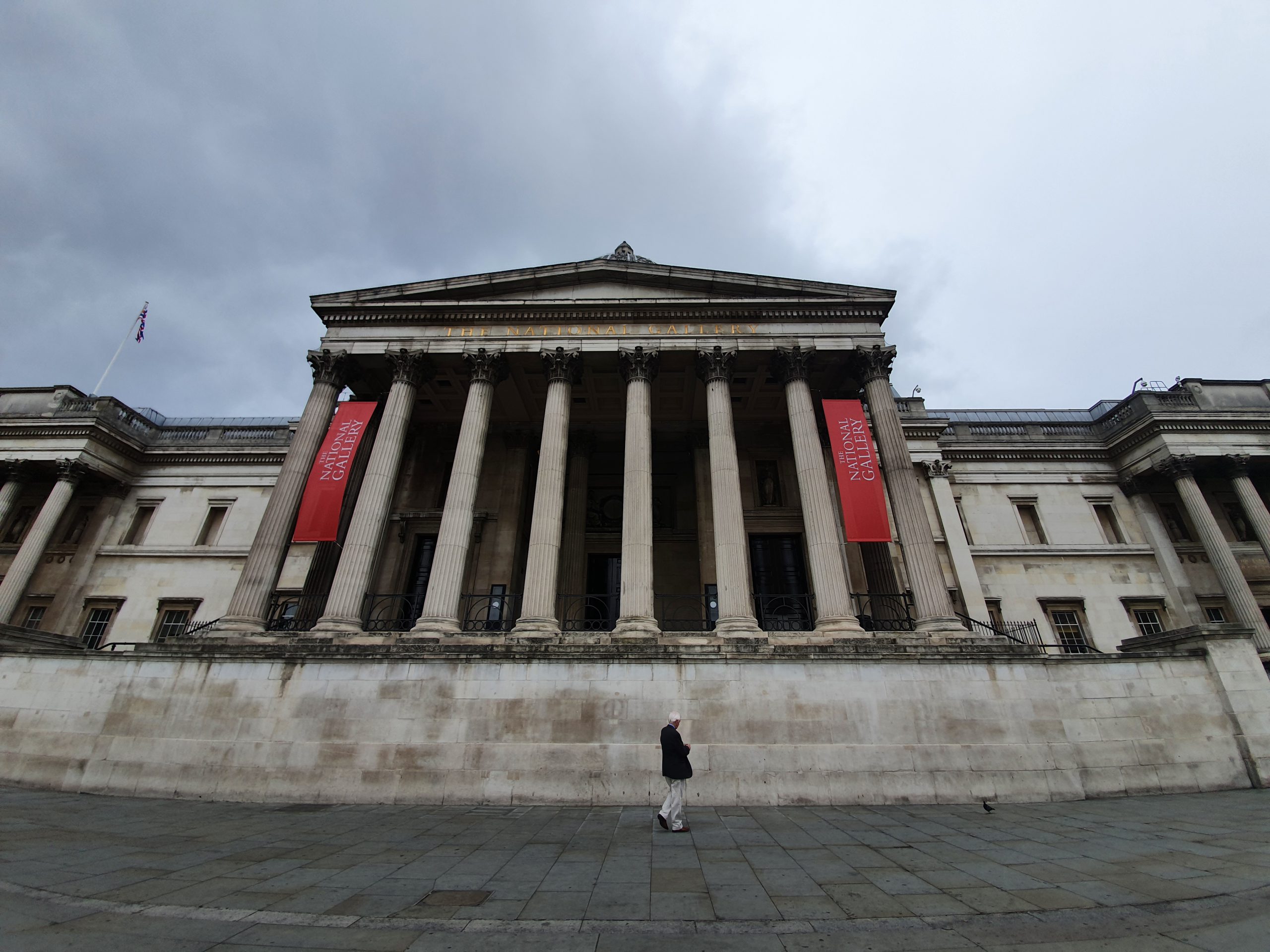
    I wasn’t enormously thrilled about how the British Museum handled their visitor flow yesterday, with people clustered together. However, the National Gallery, to quote a phrase of someone I know, surprised and delighted me with their arrangements.

    Visitors go to the Sainsbury Wing Entrance and the time of the ticket is clear, turn up no more than fifteen minutes before. There was a staff member guiding visitors and he was helpful, giving clear instructions to everyone and there was plenty of space for people to wait. I liked this, he was chatty and welcomed visitors with a smile and those without tickets were dealt with politely.

    The member of security staff was humorous, engaged and keen to welcome visitors. I admit that mine was the first bag of the day that he had to check, but nonetheless, he smiled and made conversation. And, the staff at the gallery were all engaging and they looked like they wanted to be there. Two staff were talking to each other about a painting, a moment which it occurred to me that I’ve never seen before. The staff were pro-active and welcoming visitors, giving the impression that their role was that of aiding the visit of someone new to the gallery (or someone experienced wanting help), rather than just being there for security.

    The gallery has information about every one of its artworks on-line, and this is useful and accessible. It added an extra dimension to the artworks, although that had the disadvantage that I stayed for three hours and still didn’t even get half-way round. I’ve booked another ticket on-line for in two weeks, but this experience reminded me that the National Gallery is, along with the Met in New York, perhaps the best gallery in the world.

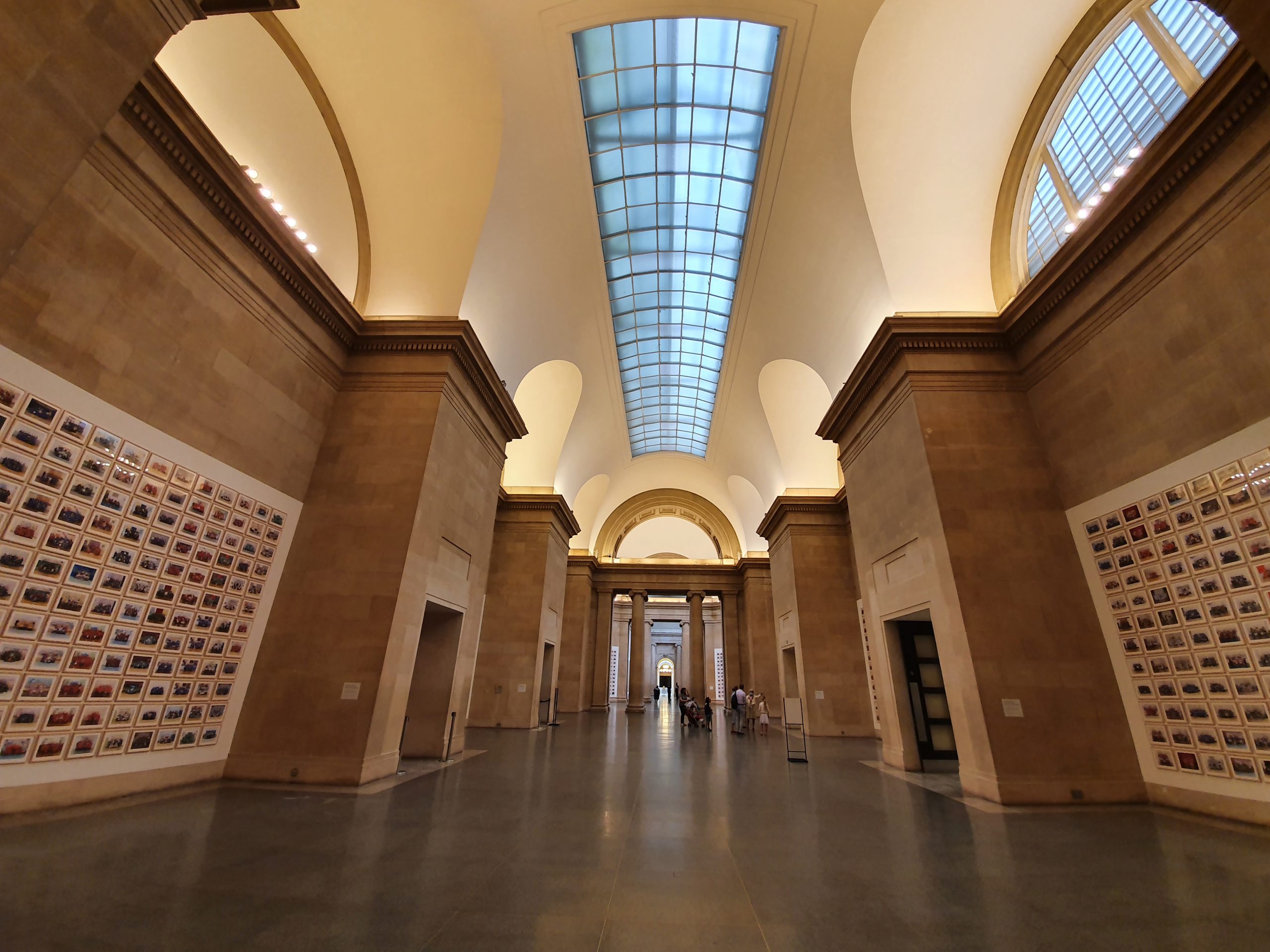
    Impeccable and a perfect example of how to handle visitors during these uncertain times. And below, some photos of the galleries…

  • London – Westminster – Tate Britain (Portrait of the Artist’s Wife by William Dobson)

    London – Westminster – Tate Britain (Portrait of the Artist’s Wife by William Dobson)

    The gallery note that William Dobson (1611-1646) was “considered to be one of the best English artists of his time” and I have no reason (or knowledge) to argue with that. There’s a watercolour from the 1830s which shows the painting on display at Howsham Hall, a grand house to the north-east of York and not that far from Castle Howard. Dobson was a court painter for King Charles I and was a respected artist of this time. Unfortunately, his allegiance to the Monarchy didn’t end well for him when Parliamentarians started to take power, he fell out of favour and died in poverty at the age of just 35.

    The artwork is of Judith Sanders, Dobson’s second wife, and it was painted in the late 1630s. It’s not known where the painting went until it was noted as being at Howsham Hall, where it remained until the sale in November 1948 when it was purchased by the Rev. Denzil Wright. The Tate acquired the artwork in 1992, although it had gone on display at the National Portrait Gallery in late 1983.

  • London – Westminster – Tate Britain (Distant View of York by Alexander Keirincx)

    London – Westminster – Tate Britain (Distant View of York by Alexander Keirincx)

    This isn’t a great photo of this artwork, which is a distant view of the city of York.

    Fortunately, the gallery has released copies of its artworks on-line, so here’s a better one. This painting was one of ten that were commissioned by King Charles I to show some northern and Scottish scenes. It was then housed at Whitehall Palace, before being sold at a sale of Commonwealth assets on 3 May 1650, the second of such disposals (and more were to come) of the Monarch’s property. This painting was purchased at the sale by Remigius van Leemput for his collections and it came to Tate Britain in 1986, so it has been on a long and circuitous journey to end up nearby to Whitehall once again.

    The artwork was painted by Alexander Keirincx (1600-1652), a Flemish landscape painter who specialised in wooded scenes and imagery of English castles and landscapes. He painted this series of artworks in 1639, before moving to Amsterdam in 1641 where he lived until his death.

    Work by the Tate suggests that the painting isn’t entirely historically accurate, so it’s unclear whether or not the artist did visit York or he just shoved something together from existing drawings. Interestingly, six of the paintings from the same series came up in the late twentieth century, two of which ended up at the Scottish National Portrait Gallery in Edinburgh and the other at the Yale Center for British Art in New Haven, Connecticut (which has the largest collection of British paintings in the world outside of the UK). Some of the other paintings that came up for sale didn’t sell, so they could be anywhere at the moment.

  • London – Westminster – Tate Britain (Lady Elizabeth Grey by Paul Van Somer)

    London – Westminster – Tate Britain (Lady Elizabeth Grey by Paul Van Somer)

    Lady Elizabeth Grey, the Countess of Kent (1582–1651), looks a formidable character in this painting by Paul Van Somer (1578-1621). She was married to Henry Grey, the 8th Earl of Kent, a land-owner and MP, but they didn’t have children to pass their wealth onto. Grey’s interesting, er, display in her painting wasn’t unusual for a mature woman of the time, but only one from the middle or upper classes would get away with that.

    The artwork was painted in around 1619, but what is perhaps the most notable about this is that it became part of the art collection of King Charles I. It was later acquired by Friends of the Tate Gallery in 1961, although there’s no other provenance listed on the gallery’s web-site, so goodness knows where it has been for the last few centuries…..

  • London – Westminster – Tate Britain (Wire and Demolition by Prunella Clough)

    London – Westminster – Tate Britain (Wire and Demolition by Prunella Clough)

    I’m still working with my theme that it’s lazy to generalise all modern art as difficult and pointless, when much of it has meaning and depth. But, along with that, I’m suspecting that when a gallery has nothing to say on it either, then it probably doesn’t have a great deal of meaning. It might still have value, but if no-one can offer any perceptive comment on it other than just a guess, then you could just have a drawing by a child on the wall.

    This painting, or whatever it is, is by the esteemed artist Prunella Clough (1919-1999) and the gallery has decided not to put anything in its summary of the artwork. So, the entirety of what the gallery has to offer here is:

    “Clough’s paintings of urban and industrial scenes were often inspired by objects the artist noticed during walks around sites of interest. Here Clough references a piece of old wire discovered on a building site.”

    But, yet, there are many artists who have reflected on the urban theme and have given something a little more defined whether it be in photographs, drawings, paintings or sculpture. Each to their own though, the gallery acquired this in 1982 and so its been shoved on the wall now for the best part of 40 years.


  • London – Westminster – Tate Britain (Karl Lagerfeld Bean Counter by Anthea Hamilton)

    London – Westminster – Tate Britain (Karl Lagerfeld Bean Counter by Anthea Hamilton)

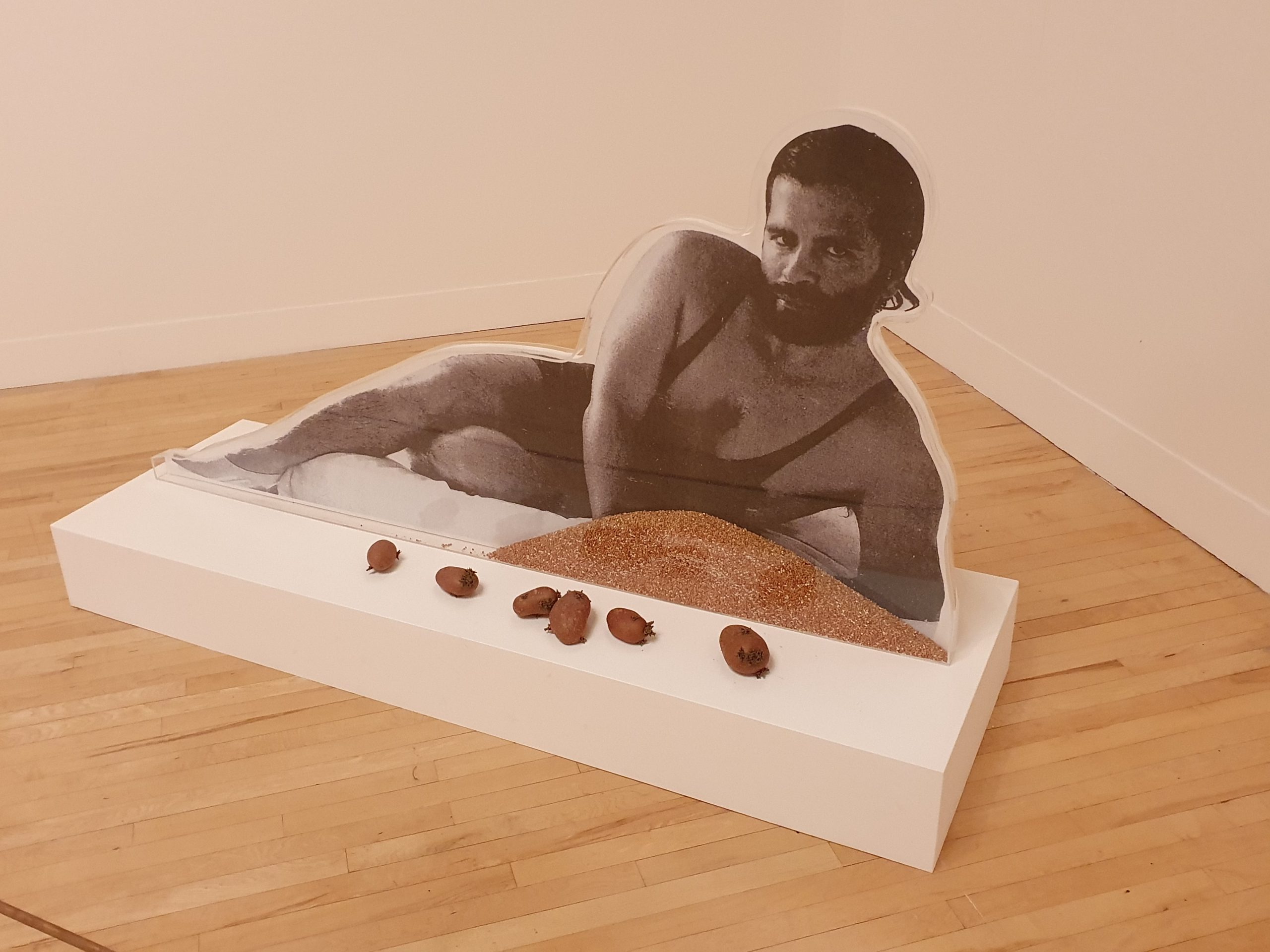
    Tate Britain acquired this artwork in 2019 and the artist is Anthea Hamilton (1978-). I’m not entirely sure I understand it, but I think it’s trying to raise a debate about the essence of how an individual is viewed by society and the processes involved with that. Karl Lagerfeld has quite a defined image today, but this is him when younger as part of some fashion shoot. I don’t understand the potatoes and buckwheat, but perhaps that it’s just to create an informal and humorous foreground to the imagery.

    The Guardian said “there are plenty of cues but you have to keep improvising the lines” with regards to works by Hamilton, which seems a suitable comment. Some modern art annoys me when it seems pointless, but when it provides cues, it gives it some relevance. Anyway, it’s clear that I don’t know what I’m writing about, but I like that the artwork isn’t pretentious.

  • London – Westminster – Tate Britain (Horizontal Stripe Painting by Patrick Heron)

    London – Westminster – Tate Britain (Horizontal Stripe Painting by Patrick Heron)

    I don’t understand great swathes of modern art, but there’s becoming an easy way to see if the art gallery that the artwork is located in has a clue either. Sometimes, the gallery can produce detailed information about the thought processes behind a painting, and that can give me an understanding of what is happening.

    It’s clear that the Tate Britain has absolutely no idea here with this artwork by Patrick Heron (1920-1999). They haven’t even bothered to fill in the artwork summary, as I’m not sure that they have anything to say. Their entire comment on this (bearing in mind a lot of their paintings get paragraphs of text) is:

    “Heron resisted the total abandoning of subject matter and even such works as this have been seen in relation to landscape, the horizontal bands and colours perhaps suggesting the horizon at sunset.”

    The gallery acquired this artwork in 1972, so after nearly fifty years, they’ve found nearly nothing to say on it. It was designed for an office (Lund Humphries), where they needed to change it for another of Heron’s works, and Heron himself noted:

    “I believe that the actual spatial sequences of the room which has been designed at Lund Humphries are in a sort of contrapuntal relationship with the illusions of space which my canvas creates from its floating position on one of the walls in that room. Actual space is chopped up, marshalled, articulated and as it were modelled by the screens and counter and the hanging slatted ceiling, and this is done in such a way that this actual space marries with the illusionistic space in the stratified spatial bars which ascend in chords of different reds, lemon-yellow, violet and white up the length of my vertical canvas. As your eye climbs the “steps” of differentiated colour in my canvas, so you yourself may step back into the actual spatial areas of the room. Seen from straight in front, the bars of colour in the canvas ascend directly into the parallel bars of the slats overhead, which advance not only towards the bars of the painting, but into them—or so it seems, since the slats are brought right up against the surface of the canvas at a point 3 ft. below the top of it. The top yard of the canvas is thus designed to be read through the slats of the hanging ceiling. There is, therefore, a continuous progression of horizontal parallels right from the foot of the painting in front of you, up the canvas, and then backwards, right over your head, along the hanging grid of slats under which you are standing or sitting. And not one of these parallel horizontals is equal to another, either in colour, breadth, or in the interval of its placing. The colour bands on the canvas are obviously dissimilar in every respect; but that the double row of slats overhead should also be uneven in appearance is due partly to perspective and partly to the different spacing of the upper and lower rows of slats.”

    Crystal clear. Anyway, I don’t like it, I think it looks ridiculous. I don’t expect the art world will be too bothered by this announcement of mine…. What I have started to establish here is when galleries don’t seem to have a clue what an artwork is about either.