Tag: Thyssen-Bornemisza Museum

  • Madrid – Thyssen-Bornemisza Museum (Floor 1)

    Madrid – Thyssen-Bornemisza Museum (Floor 1)

    [I originally posted this in July 2018, but have reposted it to fix some broken image links]

    Following on from my visit to the excellent Thyssen Museum, I arguably stunned the art work with my analysis of the artworks on the second floor. Well, perhaps less stunned, as was totally ignored, but that’s probably for the best. I’ve rather forgotten exactly what floor some of the artworks were on, but from what I remember, the below were all on the first floor.

    20180716_144036

    Henri Matisse’s Canal du Midi which was painted in 1898 and which is apparently painted with oil on cardboard, which is then attached to plywood. Sounds very professional…. The painting was for a while owned by Leo Stein, the American art collector and older brother of Gertrude Stein.

    20180716_141507

    Édouard Manet’s Horsewoman which was painted in 1882 and is the only artwork by this artist that the gallery has. Manet was ill when he started to paint this artwork and the model was Henriette Chabot. He was keen for the artwork to be recognised by the Salon, a French organisation that was highly influential for artists, in 1884.

    20180716_143617

    Edvard Munch’s Evening which was painted in 1888. This, rather randomly, reminds me of the immense security operation there must be at the gallery, and indeed at tens of other galleries around the world. Munch paintings have been stolen on numerous occasions, and it must be very difficult to defend such a large building from a potential attacker.

    The painting includes Munch’s sister, Laura, and there are two other people in the artwork, standing by a boat. There were also once another two people in the painting, but Munch removed them, perhaps so that Laura remained the primary focus.

    20180716_141425

    Vincent van Gogh’s Les Vessenots en Auvers which was painted in 1890, shortly before he killed himself. The photo is taken from a strange angle as that’s the nearest I could get to it, as it was one of the most popular paintings in the gallery. Actually, I could have patiently waited for a clearer photo, but I didn’t have the energy to faff about.

    20180716_143555

    Henri Matisse’s The Yellow Flowers which was painted in 1902. It looks like a load of splodges to me, but I’m not very artistic, so let’s go with the gallery’s description instead. They say “the despondency triggered by the scandalous bankruptcy of his parents-in-law, who had been his financial mainstay during the early years, and the influence of the Nabis dulled his palette and simplified his compositions”.

    20180716_141346

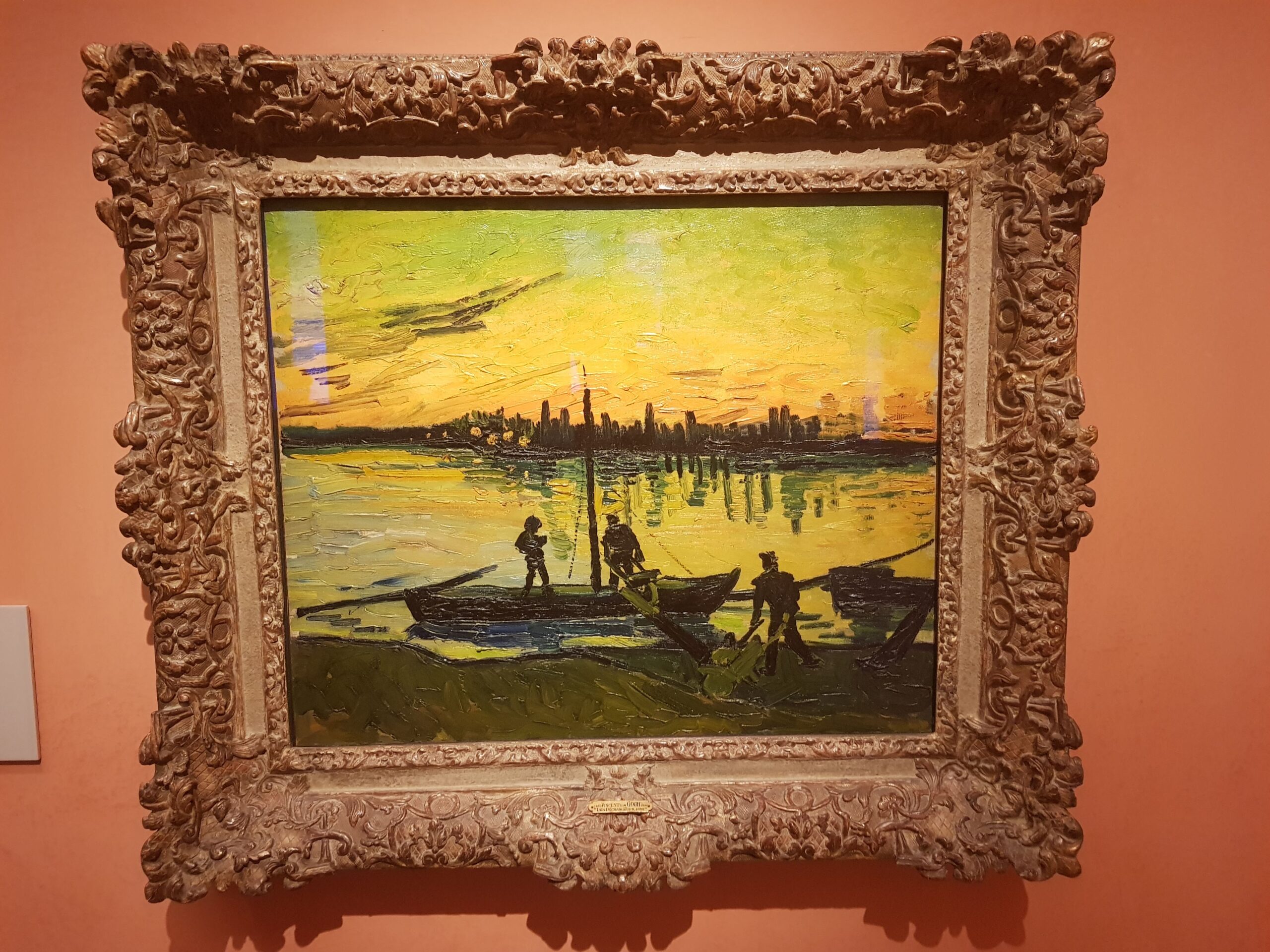
    Vincent van Gogh’s The Stevedores in Arles which was painted in 1902. The gallery has a long and detailed description of the meaning behind the painting, but the colours are certainly vivid and contrasting.

    20180716_143343

    Andre Derain’s Waterloo Bridge which was painted in 1906. It’s not entirely clear from the photo, but the painting is comprised of lots of paint dots (apparently called the pointillist technique) and it was painted from the Victoria Embankment. The Houses of Parliament are in the painting, although are a little difficult to make out.

    20180716_140733

    Something a little different, John Frederick Peto’s Toms River, painted in 1905. The painting is named after his house, and the HH is painted on, it is thought it refers to his grandfather, Hoffman Ham. The Star of David is there as an acknowledgement to the suffering of Jewish people, although it is hard for anyone to imagine just how much worse that got for so many Jews in the following decades.

    20180716_141301

    Paul Gaugin’s Street in Rouen which was painted in 1884. The gallery has eleven works by Gaugin and they show a range of his different artistic styles. The gallery notes that he painted this during the period in which he was moving from being an amateur to a full-time artist.
  • Madrid – Thyssen-Bornemisza Museum (Floor 2)

    Madrid – Thyssen-Bornemisza Museum (Floor 2)

    [I originally posted this in July 2018, but have reposted it to fix some broken image links]

    I spent rather longer at the Thyssen than I had anticipated, as I felt that there was such a depth to the collection. That this gallery has been established from a private art collection marks that even more remarkable.

    As I mentioned in the above post, the gallery has information on nearly every artwork on its web-site, which added an extra dimension to many of the paintings. I also could have downloaded photos from the gallery’s web-site rather than use my own photos, which are often not quite level, but it didn’t feel quite as personal…

    20180716_122746

    Canaletto’s Grand Canal from San Vio which was painted in 1723. The gallery has seven artworks by Canaletto, one of the largest collections of his works in the world. The gallery acquired this artwork in 1958 from the Liechtenstein collection, which slightly confuses me, as I’m not sure why it was sold. But other works by Canaletto were also sold at the same time, and at least has been bought back by the Liechtenstein collection. Their collection is housed in Vienna, although it can only now be accessed by going on a tour, there’s no standard access to the public any more.

    20180716_124837

    Edgar Degas’s Race Horses in a Landscape which was painted in 1894. The gallery has four works by Degas and this painting was once owed by Louisine Havemeyer. I confess my knowledge of artwork is rather limited, but I liked the description that the gallery has of this work, “it is also interesting to note the brilliant hues that Degas used as if they are spices in an exotic visual stew”.

    20180716_124819

    Edgar Degas’s The Pond in the Forest which was painted in 1867. The gallery doesn’t give any information on the history of this painting, but relying on the web-site again, they note “Degas laid his dark browns and greens onto a white primed canvas with large brushes and proceeded to use the palette knife to scrape the surface, revealing the canvas weave and the white priming throughout the painting”. I also like how Degas mocked those artists who painted outside, instead of sitting inside a Greggs to complete their artwork (I’ve obviously modernised the exact location of where Degas completed his paintings, but I’m sure it’s broadly accurate).

    20180716_122724

    Back to Canaletto, and this is the 1748 artwork of the South Facade of Warwick Castle. I hadn’t realised he had painted so many artworks in England, I had rather thought he had mostly concentrated on Italian scenes. Referring again to the level of depth on the gallery’s web-site, they’re able to share the information that this artwork was in Warwick Castle’s billiard room in 1853 and in the breakfast room by 1893. Warwick Castle, and most of its contents, were sold in 1978 and that is when this gallery purchased the work.

    20180716_122235

    Jan Brueghel I’s Christ in the Storm on the Sea of Galilee which was painted in 1596. The colours of this painting are bright and vivid, not quite what I would expect of an artwork which is over 400 years old. The oils are painted onto copper and there are similar artworks painted by the artist in numerous galleries.

    20180716_124731

    Claude Monet’s The House among the Roses which was painted in 1925. Painted just a year before the artist’s death and this artwork is one of a series of six. To my hopelessly untrained eye, I didn’t even notice the house (which I’m assuming is quite an important of the artwork given the title of the piece) until standing back a little.

    20180716_130918

    Raphael’s Portrait of a Young Man, painted in 1518 and for some time thought to have been painted by Giulio Romano. The face is beautifully painted, but I think it’s fascinating to read about the lengthy process of art experts deciding who painted it. It appears that it was painted by more than one person, following the analysis of the various brushstrokes and styles across the artwork. On the bright side for these art historians, it seems unlikely that whatever their decision is that they can ever be proved wrong…

    20180716_124800

    Pierre-Auguste Renoir’s Wheatfield, painted in 1879. The artwork was painted at Wargemont, in Normandy, and is an early impressionist piece.

    20180716_122056

    Peter Paul Ruben’s Portrait of a Young Woman with a Rosary, painted in 1609. It is known who the sitter is, which is unfortunate, and it’s thought that the painting remained in Ruben’s family until 1853. It was then owned by numerous private collectors before being purchased by the gallery in 1979.

    20180716_130952

    Hans Holbein of Joven’s Portrait of King Henry VIII, painted in 1537. This is the younger Holbein, and perhaps the best known for his paintings of members in the Tudor court. It’s not entirely clear whether this portrait was in the King’s private collection, but it was later owned by the Earl of Sutherland. It was then sold privately before being purchased by the gallery, and it’s one of the highlights of the collection.

    20180716_121720

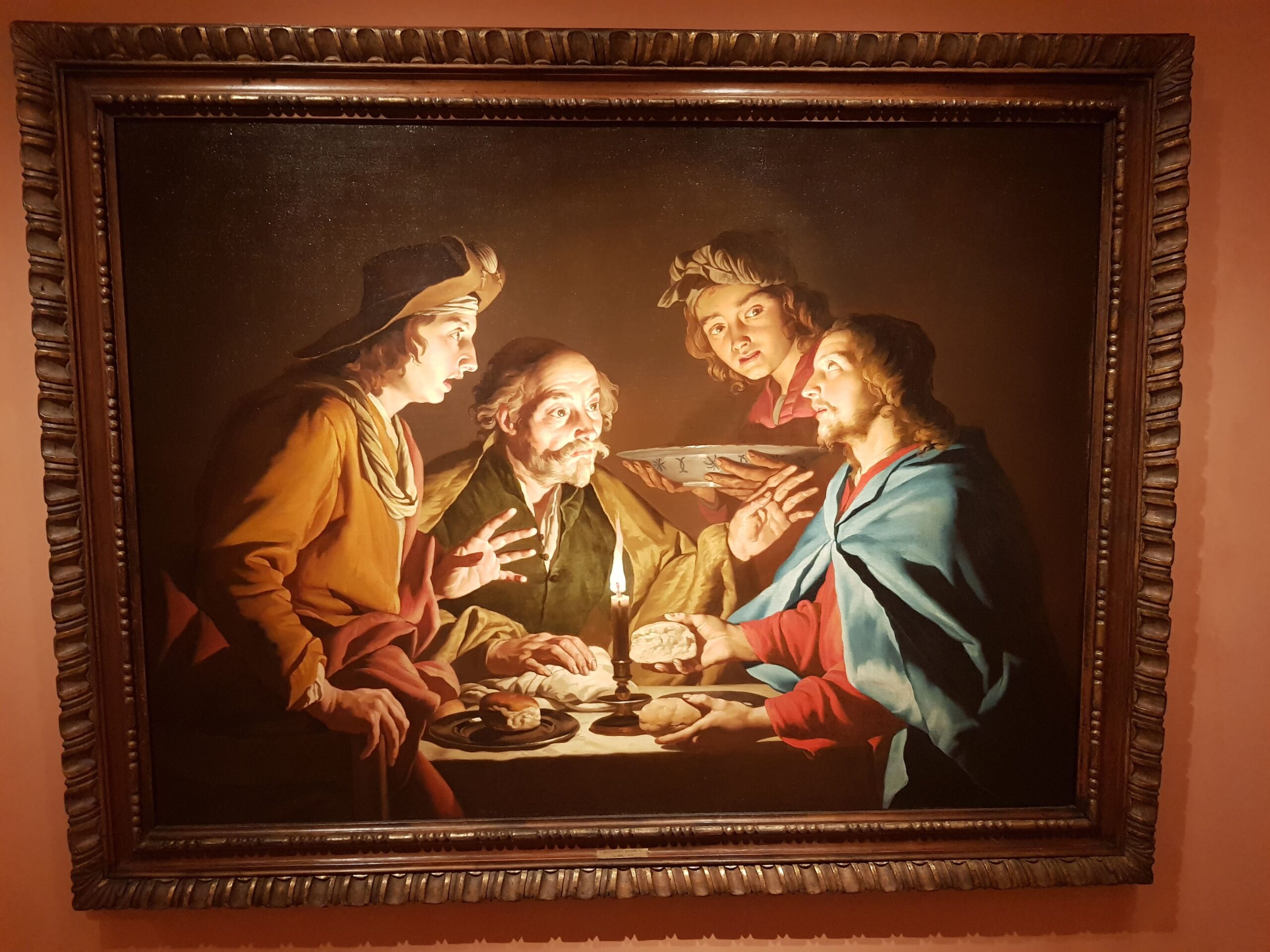
    Matthias Stom’s The Supper at Emmaus, painted in the 1630s. I hadn’t heard of the artist, but I did really like the colours which were used, it did feel that a light was being pointed at the centre of the canvas. For some time this painting was located in the West Indies, before being owned by a family of wine-growers in Bordeaux.

    20180716_125544

    John George Brown’s Tough Customers, painted in 1881. This was another artist that I’d never heard of, but I thought his artwork was particularly interesting. Reading more about him, apparently he’s popular, but art critics aren’t too impressed by his work. But I like him anyway  🙂   He liked painting street urchins and those with no money because he felt that he related to them. He was mainly painting children in New York, but he was actually a British artist who originally came from Durham.

    20180716_125654

    Another work by John George Brown, this time entitled The Bully of the Neighbourhood and this was painted in 1866. The gallery’s web-site notes that the artist liked to tell a story, which is clearly evident in this painting.

    20180716_130832

    Correggio’s Portrait of a Man, painted in 1520. It’s not quite agreed whether this painting is by Correggio or by El Greco, but it spent much of its time located in Brussels. It isn’t known who the sitter was, but it is currently thought that he had a role of a magistrate.

    20180716_124621

    Alfred Sisley’s Evening in Moret, painted in 1888. I always thought Sisley was a British artist, which is technically true, but he spent most of his life in France. The painting is of the River Loing in central France, and the artist painted numerous similar scenes in different seasons of the year.

    20180716_130752

    Wolfgang Beurer’s Portrait of Johann von Rückingen, painted in 1487, which makes this one of the earlier portraits in the collection. There was some detective work to ascertain who painted this work, and it was only established in the twentieth century.

  • Madrid – Thyssen-Bornemisza Museum

    Madrid – Thyssen-Bornemisza Museum

    [I originally posted this in July 2018, but have reposted it to fix some broken image links]

    I had a lot planned for today, which included walking around Madrid to understand the layout a little more, then an art gallery and then some churches and restaurants. Unfortunately, I got a little hot walking about so didn’t manage more than about a mile and then I visited Thyssen-Bornemisza Museum.

    The Thyssen, as it is known to friends (their friends, not mine), is an art gallery which I read had a manageable number of artworks, as opposed to the nearby Prado. I visited today as it was free entrance, which was sponsored by Mastercard. There was a long queue to get in, but it moved quickly and so it took under ten minutes for me to get in, which was very reasonable.

    I thought that two hours would be enough time for me to look around and I was aware that on Mondays the gallery opened from 12:00 until 16:00. So, I start my walking around the gallery at 12:10, and before I know it, it’s 15:45 and they’re starting to clear everyone out.

    The free entrance policy is a really good one, but it did inevitably make the galleries rather busy. But it wasn’t excessively crowded, and I do always fear for those galleries with nearly no-one in them, as they lack atmosphere. I also liked that they let visitors take photos, as that seemed to increase the level of engagement.

    Frankly, I thought that the gallery was impeccable in its presentation, design and flow. What I really liked is that their web-site has extensive details on just about every artwork in the gallery. So, a visitor can read in depth about any painting they like, as well as read more about the artist. I can’t begin to understand how long that took them to create, but it added substantially to my visit.

    Given that I haven’t managed to do much else today, I will write about some of the artworks that interested me, split over the three floors (floor 0, floor 1, floor 2 ) that there were located in the gallery. I’ll add links to those when they’re written, but I’d certainly recommend a visit here, even at the full admission price.

  • Madrid – Thyssen-Bornemisza Museum (Floor 0)

    Madrid – Thyssen-Bornemisza Museum (Floor 0)

    [I originally posted this in July 2018, but have reposted it to fix the broken image links]

    And in the last of my three part series which has shaken the art world (ahem) is the ground floor of the wonderful Thyssen gallery. Artworks I liked from the other two floors are at floor one and floor two.

    20180716_150653

    Francis Bacon’s Portrait of George Dyer in a Mirror which was painted in 1968. I hadn’t realised that Bacon died in Madrid in 1992, although this is his only artwork that the gallery has. George Dyer was Bacon’s partner, and he killed himself in 1971 by taking an overdose of drugs.

    This artwork went a little over my head, so I’m again reliant on the gallery’s web-site to try and explain what it’s all about. They note that “the violence and brutality of the image, focused on the distortion of the main figure whose face is contorted by a spasm, as if being subjected to a number of forces from which he cannot break free, is heightened by a circular halo of light from a source located outside the painting”.

    20180716_151052

    Pablo Picasso’s Head of a Man which was painted in 1913. I have no idea what this represents, and reading the gallery’s description, I’m not sure that they have either. They mention that elements of a face are visible and that it gives “a certain impression of reality”. I’m not entirely clear what that means, but then again, perhaps art isn’t always created to mean anything.

    20180716_150459

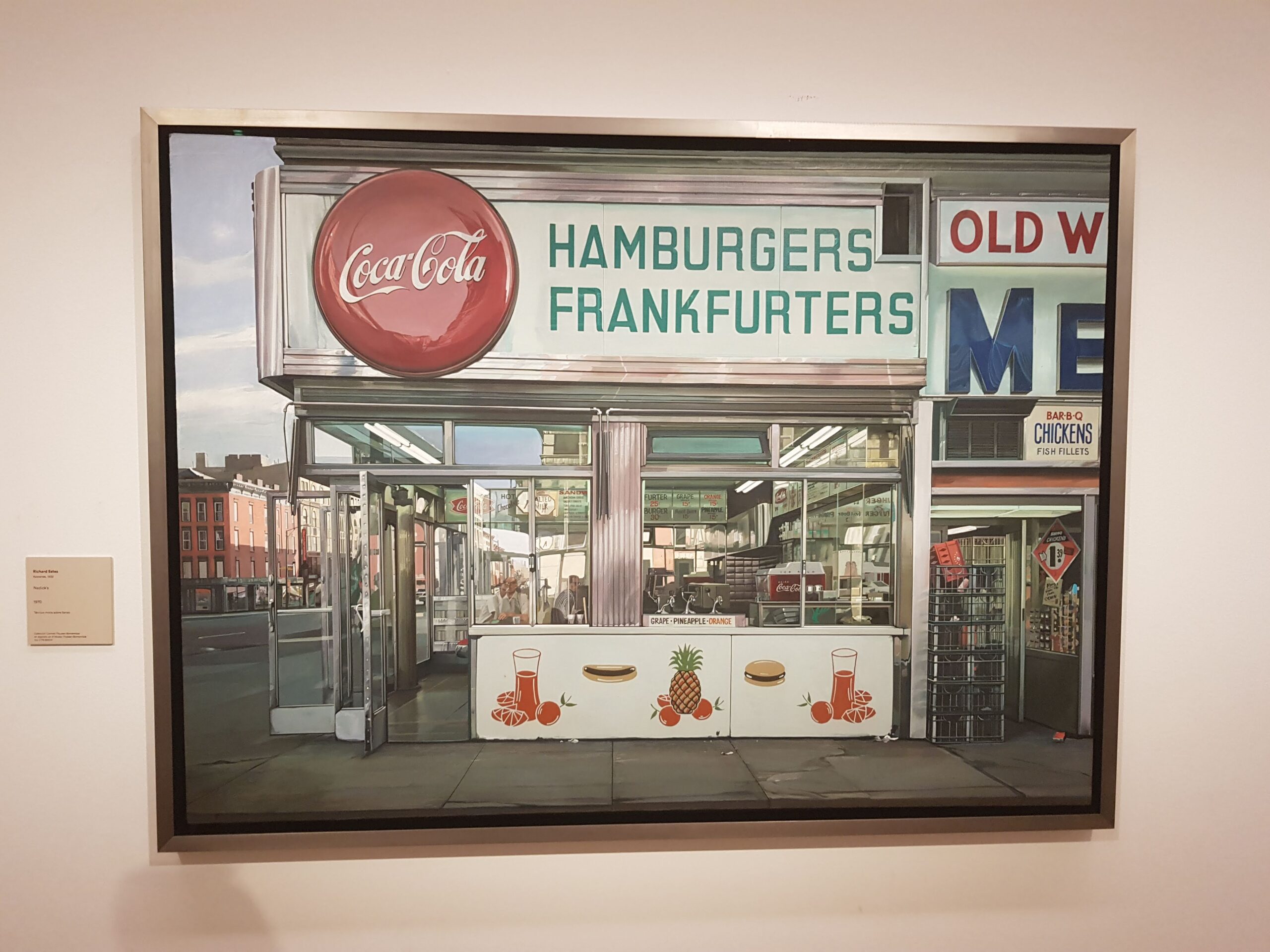
    Richard Estes’s Nedick’s which was painted in 1970. It’s apparently part of the photo-realism, or hyper-realism, and this is something that I can better understand. The content is obviously rather close to my heart, but the clarity of the painting and the clarity I thought is rather beautiful.

    20180716_150924

    Kurt Schwitters’s Merzbild Kijkduin which was painted in 1923. The gallery has five artworks from this German artist and this particular one takes its name from a village near the Hague. Until 1957 this artwork was owned by Hannah Höch, whose work was labelled as degenerate by the Nazis, and she buried her entire art collection, which I imagine locally includes this one, in a well in her garden.

    20180716_150441

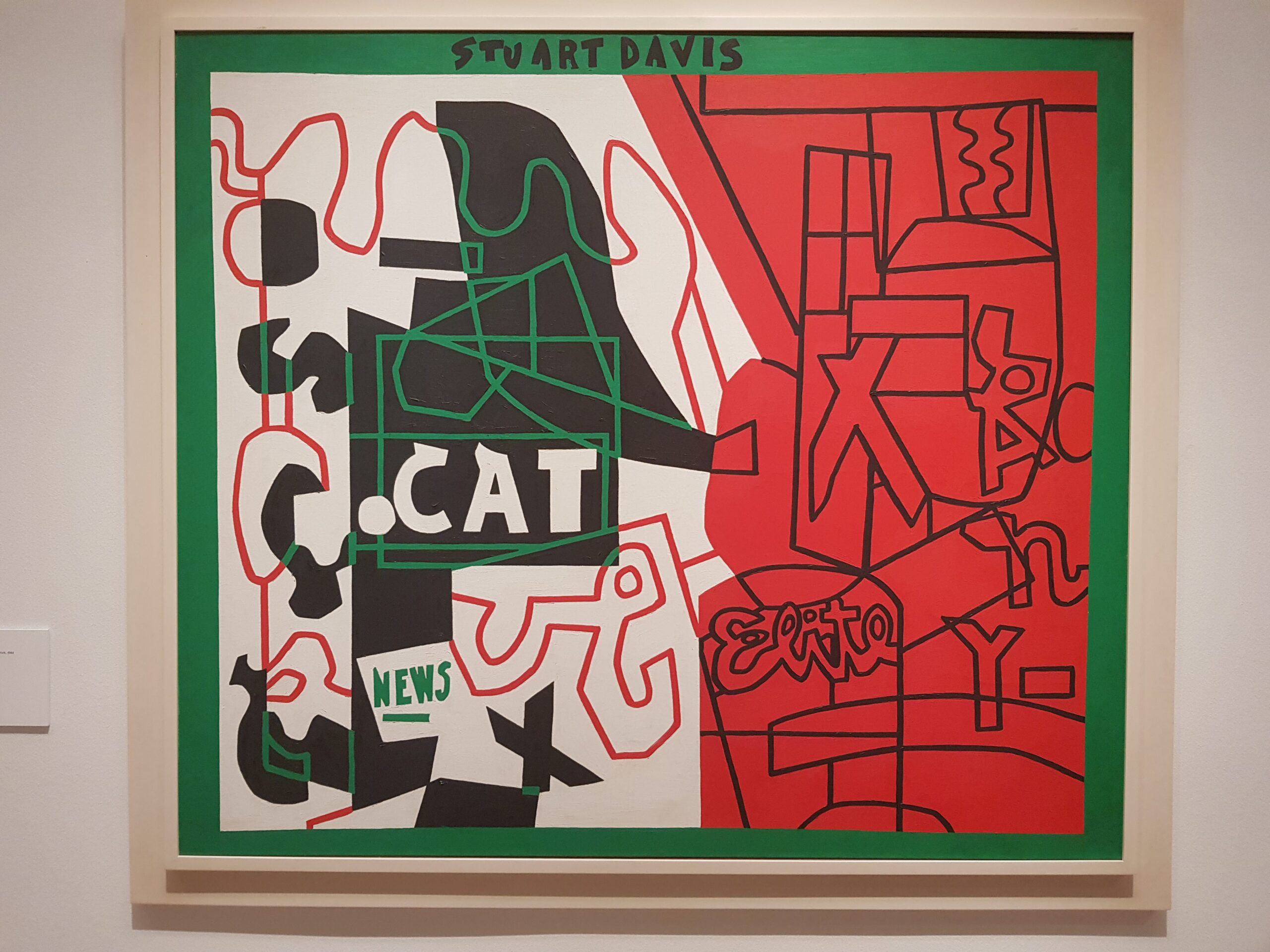
    Stuart Davis’s Pochade which was painted in 1956. I’m becoming ever more intrigued into how art experts explain artworks such as this, which don’t seem to mean anything. The gallery description of the artwork is interesting, but can’t explain what the point of it is, or any meaning behind it.

    The Wikipedia article about the artist notes “with the belief that his work could influence the sociopolitical environment of America, Davis’ political message was apparent in all of his pieces from the most abstract to the clearest”. I’m at a loss as to how this artwork influences the sociopolitical environment of the US, but I’d be interested to know what thinking lay behind it.

    20180716_150824

    Marc Chagall’s The Cock which was painted in 1928. This seemed a popular artwork when I visited, it seemed to attract people to come over. I can’t add anything much to it, other than to quote the gallery’s description that “Chagall depicts a loving embrace between the animal and a female figure that is generally identified as a harlequin”.

    20180716_150421

    Roy Lichtenstein’s Woman in Bath which was painted in 1963. This is the only artwork the gallery has by the artist, and it’s one they are proud of given their coverage of it in promotional material. To me, this sort of painting rather defines America in the 1960s. Apparently artworks by Lichtenstein reach tens of millions of pounds, quite remarkable given that it’s only fifty years old.

    20180716_150057

    Edward Hopper’s Hotel Room which was painted in 1931. This was another popular artwork with a queue of visitors waiting to take a photograph of it. The gallery has four of Hopper’s works and the theme of this painting is to show loneliness in a hotel room in a city. I rather like hotel rooms, but for those who don’t, there’s a lot of depth in this.