
Tag: The Walters Art Museum

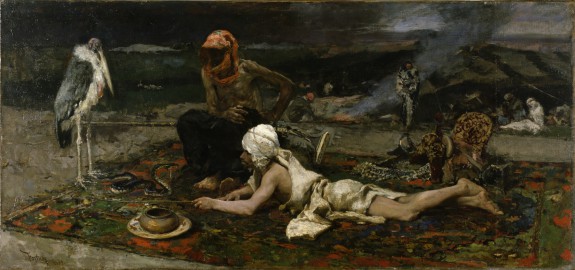
  • Baltimore – The Walters Art Museum (Hindu Snake Charmers)

    Baltimore – The Walters Art Museum (Hindu Snake Charmers)

    Taken in 2015 on a phone and the image compressed by Google hasn’t done much for this….

    Fortunately, the museum allows free use of their images, so this one is rather more useful.

    Painted by Marià Fortuny (Mariano José María Bernardo Fortuny y Marsal) in 1869 (he lived from 1838-1874), it was inspired by the journey that he made on General Prim’s military expedition to Morocco in 1860. The gallery notes about this painting:

    “The artist, a collector of Islamic decorative arts, includes such accessories as a copper bowl, luster plate, and saddle.”

    Anyway, it looks like an angry cobra which is being charmed by a turbaned man, with what I think is a stork looking on excitedly.

    But, what I still think is exceptional is the sheer amount of information that the museum has provided about this painting. It was revarnished in 1951, had its condition checked in 1980, was examined for a loan in 1988 and then subjected to a technical study in 1989. And the provenance of the painting is also detailed, acquired by DH Foll of Geneva, sold in an art sale auction in New York in March 1887 to William Thompson Walters and then acquired by inheritance in 1894 by his son, Henry Walters. The painting was then given to the new museum in 1931 by Henry Walters, where it has remained since. I find this depth of information about a painting to add so much to understanding it, it’s a shame so few museums offer this level of detail.

  • Baltimore – The Walters Art Museum (Colosseum by Giovanni Paolo Panini)

    Thanks again to the Walters Art Museum policy on having photos of their exhibits available to download, I’m again using their version rather than my considerably less sharp photo. The painting by Giovanni Paolo Panini is more favourable to the Colosseum and to the Arch of Constantine than they deserve, made more attractive for the purposes of the artwork. The artwork was painted in 1747, in the middle of the artist’s career.

    The museum, keen to give the provenance of every artwork, notes the history of the ownership of this painting:

    “Tyrwhitt-Drake, Shardeloes, Amersham, Buckinghamshire [date and mode of acquisition unknown]

    Agnew, London [date and mode of acquisition unknown]

    David Koetser, London and New York [date and mode of acquisition unknown];

    Walters Art Museum, 1954, by purchase.”

    The first owner, Tyrwhitt-Drake, was from the family descended from Sir Francis Drake and it was purchased for their country home in Buckinghamshire. I imagine that it was collected as part of some grand tour of Europe by a younger member of the family. Agnew and Koetser are art dealers, so I assume that the family later needed the money and wanted to sell this painting.

  • Baltimore – The Walters Art Museum

    The Walters Art Museum in Baltimore is one of the few museums around the world which has placed into the public domain photos of nearly every major item in their collection. This seems to me a wonderful gesture which is in keeping with the aim of a museum, which is to promote and share knowledge.

    And, as if that wasn’t enough, they’ve gone further and made a real effort to detail the provenance of items in their collection. This isn’t a unique policy, but it should be much more common in my view. So, visitors to the museum can discover not just more about a particular item, but also how it came to be in the collection of a Baltimore institution.

    I visited the museum in the summer of 2015 and the museum was so clearly laid out, with friendly staff, that I remember much of my visit. There is also no admission charge, a decision made in 2006, to try and enable as many people to visit as possible. Out of all the museums and galleries that I’ve visited, this remains one of my favourites.

  • Baltimore – The Walters Art Museum (Pilgrimage Flask)

    Using the Walters Art Museum photo rather than own, this fascinating little item is a pilgrimage flask, which was worn around the neck of those going on pilgrimages across Europe. It was originally filled with holy water from the Shrine of Thomas Becket in Canterbury Cathedral. There aren’t many of these which survive in such good condition, and to someone, this would have likely been one of the most important things that they owned.

  • Baltimore – The Walters Art Museum (Cat Mummy)

    Cats were bred near to temple sites and they were mummified as a gift to the Gods. The cats were mummified on an industrial scale and sadly a vast number were destroyed during the nineteenth century. In Liverpool in 1890, a consignment of 180,000 mummified cats were sold as fertiliser.

    The museum’s photo of its cat is of course somewhat better than mine…. This cat was carefully and tightly wrapped in linen and when the museum x-rayed it they discovered that “its neck was intact, with the forelegs pressed down against the body and hind legs folded together”.