I can’t make the text of this out and it’s not helped that someone has punched four windows in the side of this building on Deanery Way. But, Google Gemini AI is my tool of choice here, and it’s fairly confident that the only word that this can be is Adamsons. It goes further and suggests that it’s a business run by Daniel Adamson (1820-1890) but he was an engineer and that doesn’t strike me as the normal business to paint up on the side of a wall. So that’s another little mystery as far as I’m concerned, but as an aside, I thought Stockport looked quite attractive architecturally.
Tag: Stockport
-

Stockport : Stockport Railway Station
Well, where would we be without a little post about a railway station?
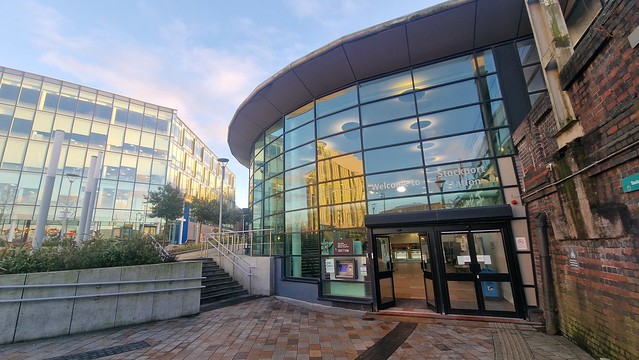
The first railway station in Stockport was at Heaton Norris, but it was a sub-optimal location and alongside the construction of the Stockport Viaduct, this became the next central station in 1844 when it was opened by the Manchester and Birmingham Railway. The company was taken over in 1846 by LNER and in 1865, the Stockport, Timperley and Altrincham Junction Railway connected with the existing lines, solidifying Stockport’s importance as something of a railway hub. In the early 2000s, there was a construction project to modernise the whole arrangement which included the building of this glass-fronted extension.
A sign outside the station which notes that in June, July and August 1940, Stockport welcomed over 1,200 evacuees from the Channel Islands. The children were cared for by local families until the liberation in May 1945. The Channel Islands were the only occupied part of the British Isles and that was an enormous number of children for the local area to take. Most were integrated into the local education system, which caused some capacity issues to say the least. By all accounts, the local denizens did themselves proud with the support and generosity that they offered to the children. There were some localised issues and it became problematic when Manchester was bombed, but there have been long-standing connections between Stockport and the Channel Islands since this evacuation.
And the platforms. When I left Stockport I went via Crewe and London, because the direct train to Norwich is fiercely expensive and really not very good. There’s still quite a Victorian feel to the whole station and there’s a Platform 0 because it opened in 2008 and rather disturbed the numbering system.
-

Stockport : Joseph James
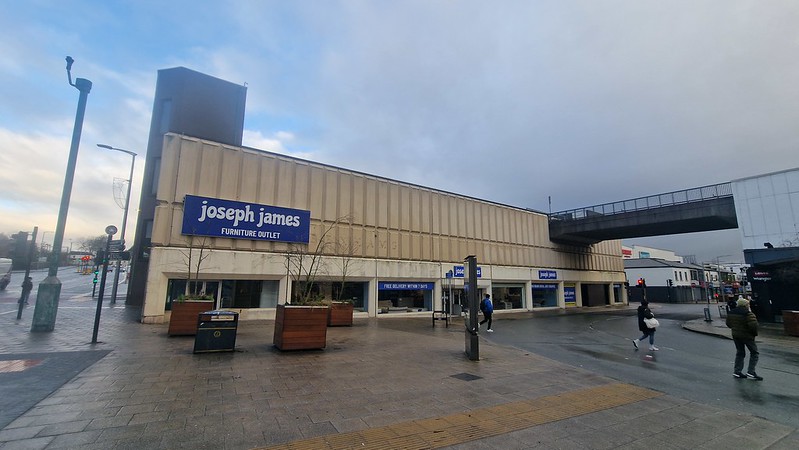
This post is of little relevance, although that’s the hallmark of this blog, but for reasons unknown I’ve been shown on TikTok the videos of Joseph James for months. I’ve wondered what random algorithm gave me that given they have two stores nowhere near me, one in Manchester and one in Stockport, but it was a little bit of excitement to see one of their outlets in what was once the Debenhams building. I’m easily pleased… But, the videos are worth seeking out, a couple of people setting up a business as a furniture outlet.
-

Stockport : Angel Inn
Next on my tour of Good Beer Guide pubs in Stockport was the Angel Inn and I’m not sure that I would have noticed it if I had just been walking by, the scaffolding is quite dominant here.
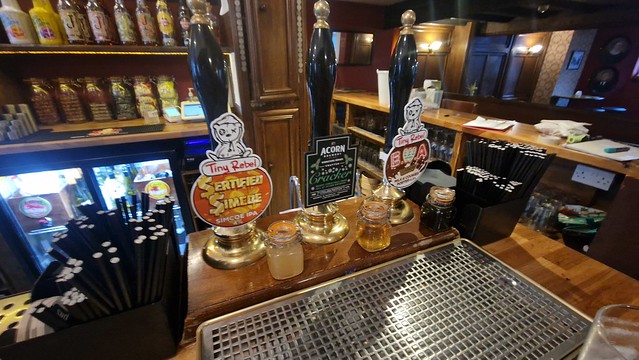
The beer list, there was a decent mixture of cask and keg.
I’m a big fan of Tiny Rebel so it was a little bit of a treat to see two of their beers on cask.
The interior is functional rather than jazzy. It was early January when I visited, hence the Christmas tree. More on the history in a moment, but its change of uses over the last few decades have led to some of the traditional feel perhaps being a little lost.
The first beer was half of the Sertified Simcoe from Tiny Rebel, which was a punchy, hoppy and juicy little number. Acceptable crisps too.
More interior. It was a welcoming environment with friendly service and warm surroundings.
This was, as far as I’m concerned, about as good as cask gets. It’s half a pint of the EWA from Tiny Rebel, well rounded with a suitable amount of sweetness. It was creamy and tasted of cookies and Twix, really rather decadent.
This whole set-up is interesting as I just assumed it had been a pub for centuries and it did indeed have a long history, but it stopped being a pub in the 1950s and turned instead into a retail outlet. However, 57 years on, it was reopened as a pub and that seems like a really good idea to me. In terms of the building, it dates from the 1500s and has a wattle and daub construction, having first been turned into a pub in the early nineteenth century. Always a positive thing to see a pub being reborn, especially one in such an historic building and the wide range of cask and keg options added to the excitement. Thanks to the Good Beer Guide for directing me here.
-

Stockport : Petersgate Tap
Back on my tour of Good Beer Guide pubs around the country, this two storey pub is located in what was formerly a betting shop. There’s now a mix of craft and real ale going on, alongside numerous real ciders and a bottle shop area upstairs.
The beer selection and they’re also listed on Untappd.
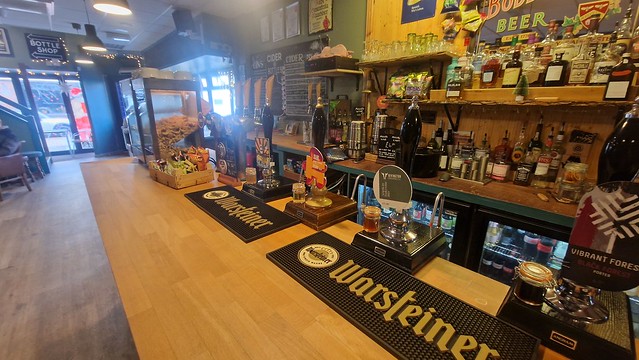
The bar arrangement and there was a friendly welcome from the staff member.
I had two half pints, the first was the Barncliffe Bitter from Small World Beers. A clean and hoppy beer with a rather lingering bitterness, but pleasant.
I had high hopes for the Black Forest from Vibrant Forest Brewery, but there was little chocolate, just some oats and not much else. The beer tasted a little tired, not much vibrancy going on here.
Anyway, a rather nice bar and I can see why this has found itself in the Good Beer Guide. It’s a relatively small independent venue, so it has that micropub vibe, with no loud music going on. The on-line reviews are positive other than one nonsensical one star review that there was only one dark beer available on the bar, which is not unreasonable in a small pub. The angry customer went marching off to Wetherspoons, although I know that even they sometimes only have one dark beer available and it’s not even really fair to compare a large national chain with a small micropub. The prices were towards the lower end of the scale for what I’m used to, although the cost of beer in Stockport is lower than the national average. All really rather lovely.
-

Stockport : Hat Museum (Part 2)
The second part of the hat museum, or at the least the way I walked around it, is the lower floor which is where all the hat action used to take place. There’s a small museum area which visitors walk through first, to explain the importance of the industry and how it evolved.
The British Felt Hat Manufacturers’ Federation (BFHMF) was a significant organisation in the history of British hat making, particularly during the late nineteenth and much of the twentieth centuries. It served as a trade association representing the interests of felt hat manufacturers in Britain, which I suspect isn’t a huge industry today. This included both producers of wool felt and fur felt hats, attempting to deal with competition from overseas and ever changing fashion trends. It played a role in setting and maintaining quality standards for felt hat production within its membership and would have been involved in negotiations with trade unions representing workers in the hat-making industry regarding wages, working conditions and other labour issues. It lasted until 1976 when it merged with another union, which promptly closed a few years later.
There was a lot of real animal fur used, including from beavers and rabbits.
A recreation of an early hat workshop, which was known as a Bow Garret.
A bag of just under half a kilo of animal fur.
This company was from Denton, near Manchester, something of a hat making hotspot.
Injury to children was a little sub-optimal and these factories really weren’t that safe. Fur was treated with mercury before it arrived at the factory and hatters losing their hands due to accidental engagement with the machinery wasn’t entirely rare.
A planking kettle, which heated a mixture of water and sulphuric acid, which sounds just a little dangerous to me. The heat, moisture and friction caused the fibres to lock together, the hood of the hat would shrink and become thicker. The sign at the museum notes that this was the last process to be mechanised, with the kettle still being used to train apprentices in the 1950s.
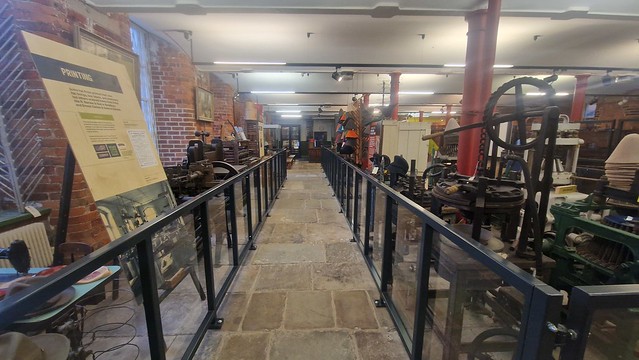
This is the main part of the museum, the floor where tens of thousands of hats were made.
Rather an impressive collection, this is from William Plant & Sons who were hat block manufacturers set up in 1828 and the last surviving in their industry in the North of England. They closed in 1976 and the contents of their workshop and museum were removed and donated to Stockport Museums.
The former office of William Plant & Sons.
A collection of machines and hat making equipment.
The main floor of the factory.
A sign for Christy & Co Ltd, located at 175 Bermondsey Street in London. They had been founded in 1773 by Miller Christy and their main factory was located in Stockport. The company still exists today, although they’ve now moved to Luton. As a fun fact, the only two football teams with the nickname the Hatters are Stockport County and Luton Town.
As noted on this sign, much of the industry has now shifted to China.
A punching machine from Doran Manufacturing.
A hat rack with a Billycock hat, designed specifically to sell to plantation owners in the West Indies and America.
Some of the equipment was quite chunky…..
A settler, which firmed up the felt so that it held together during the next process.
A multi-roller which is where the hoods were rolled into and they mixed with boiling water and acid, shrinking the hat slightly every time on its 28 passes through. They couldn’t do this in one go as there would be creasing to the felt hat.
A stumper.
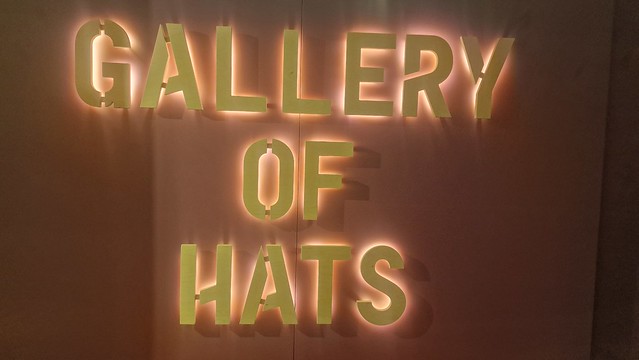
Hat signs.
The factory floor is the bottom one, although the new entrance to the museum is on the main road. My visit to the museum lasted around forty minutes, but it was an interesting one and as I mentioned in my last post, it’s a really positive thing that this has been preserved. A hat museum in Stockport is going to be a challenge to get people to, but they offer tours to build engagement and there’s a shop at the site. The museum first opened in 2000, it’s at Wellington Mill (built in 1830) and it’s where the Battersby Hat Factory operated from. It’s definitely worth a visit and it’s located near the railway station.

-

Stockport : Hat Museum (Part 1)
I’m not sure that I’m very interested in hats, so that’s something of a confession to start proceedings off with. However, there’s a free hat museum in Stockport that the council seems proud of, so I thought I’d go to see if I was captivated by the arrangement. And yes, I deliberately put that pun (cap-tivated in case it wasn’t obvious) in there in honour of my friend Nathan, who was very impressed with my hat based puns when I told him about my visit here. Actually, that makes like it sounds like he’s dead, but he isn’t. But, he’s one of those irritating people in life who is very good at puns as he’s quick witted, so I’ll take my hat off to him for that.
The council notes that “we re-opened in March 2024, and expect to be busy for several months, so we recommend that you pre-book your general admission tickets”. I slightly doubted exactly how busy a hat museum in Stockport would be, but I booked my free ticket on-line and turned up at opening time. There were two people booked in for the entire day, including me. Anyway, guaranteed a visit now amongst the throngs, the friendly team member mentioned what was in the museum. She mentioned that there was a dressing up area on a higher floor where I could try hats on, but I think we agreed without words that I wouldn’t be doing that.
There were no other visitors, which I found helpful as I didn’t want to be distracted with all this looking at hats. Here are some Mayoral hats from Mrs Clara Grant, the first female Mayor of Stockport. I won’t make a joke about politicians wearing many hats……
Some pith helmets, but I have no pithy jokes about that. At this point, I rather feel I should have asked Nathan for humorous content for this post as I’m struggling a little.
So many hats.
A mini, a little bit of a head-turner and excitement for those visitors that wanted some variety in their viewing experiences or for those who want to re-capture their youth.
More hats, although I have to say that a lot of this was just going over my head.
Yet more hats, although I understand that very much is the concept. I must admit, I did wonder about the viability of this museum as it is perhaps just a little niche. It was though well laid out and colourful, I can imagine some children would engage positively with it all.
Hatpins and even the museum didn’t try and list all of them.
What a way to die.
Protective hats. A family did come in just as I was leaving this floor, I was fortunate to get a head-start to take these photos with no-one else around though.
There’s a real story being told in this museum, I’m pleased that they’ve been able to get the financing to keep this site open. In fairness to the museum, the main part of this whole arrangement is the factory floor, located on the level below, and for my two loyal blog readers that will be the post that’s coming next. And no more puns in that one.
Although I will finish on my best hat based joke, although I think it’s the only hat based joke I know.
What did the hat say to the tie? You hang around here, I’ll go on ahead.
Right, moving on….
-

Stockport : Stockport St. Mary’s Church (Grave of Nathan Percival)
Back on the theme of graves outside St. Mary’s Church, this is the gravestone of Nathan Percival.
Born in 1766, the son of Nathan Percival (same name) and Ellen Taylor. I couldn’t find any record of his birth, although the records of the church from this time note the bastard children who had been born, which for some people might be the only documentary record left of their lives.
Nathan married Elizabeth on 21 March 1791 at this church and the gravestone notes the children they lost and also her own relatively early death.
I can’t tell, but I suspect this is Nathan’s father of the same name, and same occupation, who managed to lose his black bulldog in Wilmslow. Nathan’s father’s will survives and he gave his three children an equal share of his wealth, but his business property which was left to him by his brother William was split between Nathan and John. The will mentions that the older Nathan Percival lived in Churchgate, although I’m unsure if that’s where he traded as a butcher. Unfortunately, the earliest trade directories on-line are a couple of years after the younger Nathan died, so I can’t get a location.
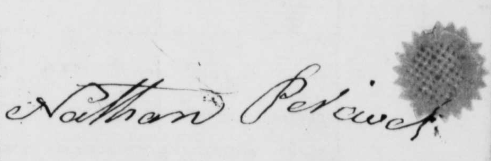
Nathan died on 3 May 1824 at the age of 58 and he was buried three days later. I find this naming the occupation of the person on the gravestone in such a prominent place as a little unusual, but it’s quite handy for giving a little more information. Unfortunately, reading Nathan’s will, he didn’t have any surviving children and his money went to his nephew, his wife’s son. I like that I can see Nathan’s signature on his will, in a life where not much survives in terms of the documentary record, this brings him to life just a little. He doesn’t appear on any family trees, although that’s not entirely surprising if he didn’t have any descendants.
-

Stockport : Stockport Library
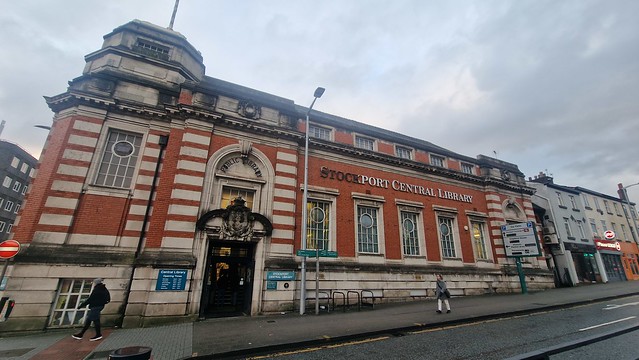
The exterior of Stockport Central Library, located near to the railway station, which is sadly going to be closed soon.
The first library was opened in 1875, a rather unassuming little collection in a room on the upper floor of the produce market.
The great Andrew Carnegie, from a time when wealthy tycoons did good things for the community, put £15,000 towards the construction of the new library building which opened in 1913. The design for the building was put out to competition, with the firm of Bradshaw, Gass & Hope winning with their Edwardian Baroque style.
The building is beautiful, although the local heritage collection has already been entirely stripped out in preparation for a move to a new location. The book selection isn’t huge, but it felt well curated and I got the impression that a trained librarian had actually had something to do with the whole arrangement.
I can already see the tragedy that the Stockroom, that is planned to replace this beautiful Carnegie building, is going to be. There’s a level of arrogance to some of the documentation that has been released already, which I suspect has not actually been run past a librarian, as it talks about the exciting coffee options with no mention of the local history section. It’s hard not to laugh at the “stunning” (their word) images they’re using to show off their new building, it looks like Stockport will be a laughing stock. These two are the only ones of the adult library and local history sections. The council want this to be a performance venue to up access numbers entering the building, a desire to have an on-trend coffee shop.
What do they need with all that shrubbery?
Well that looks peaceful and calm. They haven’t burdened themselves with images of where people will actually sit and haven’t bothered at all with images of the local history section. Even hotel chains make a vague stab at having spaces for people to work in their imagery.
The council has also decided it won’t linger on the results of their consultation which showed that 55% of people didn’t want the library to move. They claimed that the problem with these results was that they were skewed to people who used the library. Well, who knew….. Incidentally, the council have just announced more cuts to their library service, but who needs books when you can have a lovely new coffee shop and performance venue?
-

Stockport : Stockport St. Mary’s Church (Grave of William Davenport)

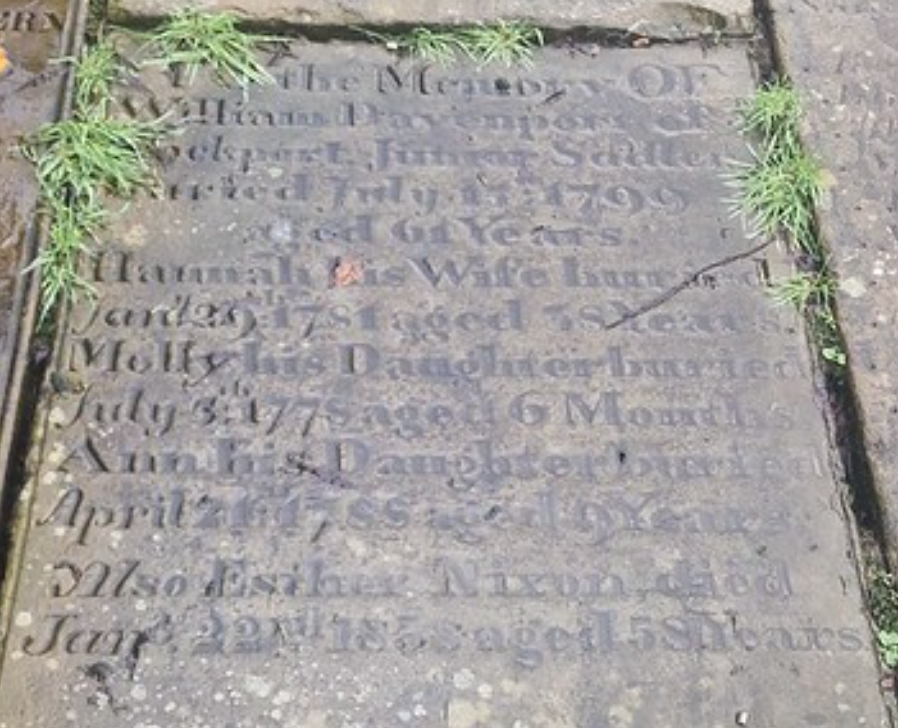
Located at St. Mary’s Church in Stockport, this is the grave of William Davenport, who died on 15 July 1799 at the age of 61.
William had been born in 1738 in Northenden, with his father also being William Davenport and his mother Mary, being baptised on 31 August 1738.
He married Hannah Hardey, who was around five years younger, in Stockport on 19 January 1776. More on her in a later post. At least I think this is the correct marriage, it’s the only one of a William Davenport in Stockport and the name of his wife matches, so that’s a decent start. The gravestone also notes that he lost his daughters Molly and Ann, both at a young age.
I can’t find out anything else, but that’s not entirely surprising as the archives aren’t packed with on-line records from this period. I can’t find any evidence of him having children who survived him, but I suspect that his wife died as a result of child birth, as she was just 38 years old. He had married aged nearly 40, later than usual for the time. I like that his marriage record survives though, to be able to see his signature on the document.
This is a good example of my limited knowledge as there are a couple of elements that I don’t understand here. I don’t understand the reference to the junior sadler on the grave and I don’t understand who Esther Nixon is. Maybe one day I’ll come back to this and try again to work it out….