
After a rather pleasant few days in Reading, it was time to return to the railway station and to try and leave. In the centre is the Three Guineas pub which was designed by Isambard Kingdom Brunel, although as a station building rather than a hospitality outlet. On either side is Reading railway station, much developed over recent years following the arrival of Crossrail. I was conscious in advance that this journey would be at least slightly challenging, as GWR had cancelled trains and issued a “do not travel if you can avoid it” notice, although I couldn’t much avoid it.

My rail ticket was for Farnborough North, which is a short direct journey operated by GWR, but the rail network was faced with a large number of cancellations and delays given the weather situation. GWR told me online that I could use any route to get to Farnborough, which adds some excitement to proceedings to work out what is possible. It transpired that the direct line to Farnborough North didn’t re-open for 24 hours, so waiting for that service would have been a mistake, I’d need to loop around into the main station in Farnborough.
I went and asked a staff member how I could get to Farnborough and he said that it was best to go via Basingstoke. I mentioned that the line from Basingstoke to Farnborough was seemingly closed, so after a little conference and debate with a number of other staff, the friendly staff member said that it was indeed currently closed but they were very optimistic that it would reopen soon. He agreed that although it was possible to go into London and back out, that was a much longer route, involved crossing the city and was on the same line as Basingstoke to Farnborough anyway, so it’d be open or shut whatever way I went.

So, I thought that I’d go to Basingstoke. There’s not a huge amount of jeopardy here really, in a worst case scenario I could have got a taxi (although I’d have recalled the cost for some years no doubt) and wouldn’t have been entirely stranded. I’m not sure that I’ve ever been to Basingstoke, but it seemed the best plan that was available. As an aside, one of the many unfortunate outcomes of the destruction of the rail network in the 1960s was that many lines were removed that would allow passengers to divert around any issues. Fortunately, the situation in this part of the country still allows that flexibility, otherwise my journey would have been impossible by public transport. It seems as fast as Network Rail staff were removing trees and branches from lines that more were falling elsewhere, so it was a challenging day and a reminder as to why they pro-actively cut down trees near to railway lines (even if that does annoy the locals sometimes).

It wasn’t an overly busy train from Reading to Basingstoke and it was running nearly enough to schedule. A guard was checking tickets, although he seemed to be just making very cursory checks.

It seemed a shame to be in Basingstoke and not go and pop into the town for a little bit. I went and asked the member of staff at the gateline if I could pop into Basingstoke and she seemed surprised that anyone would really want to do that, but she willingly let me through and thanked me for asking.

And there’s the station, a modern frontage constructed in 2012 hiding the older building behind it, which I’m not entirely sure is that aesthetically pleasing.

A slightly blurry photo unfortunately, but these the bushes outside of Basingstoke railway station. This will mean little to anyone unless they have heard the story told by the comedian James Acaster about his time there, but it’s a tale that is worth listening to. It felt quite an honour to be in the same location, or at least in the same area, I didn’t climb into the bushes.

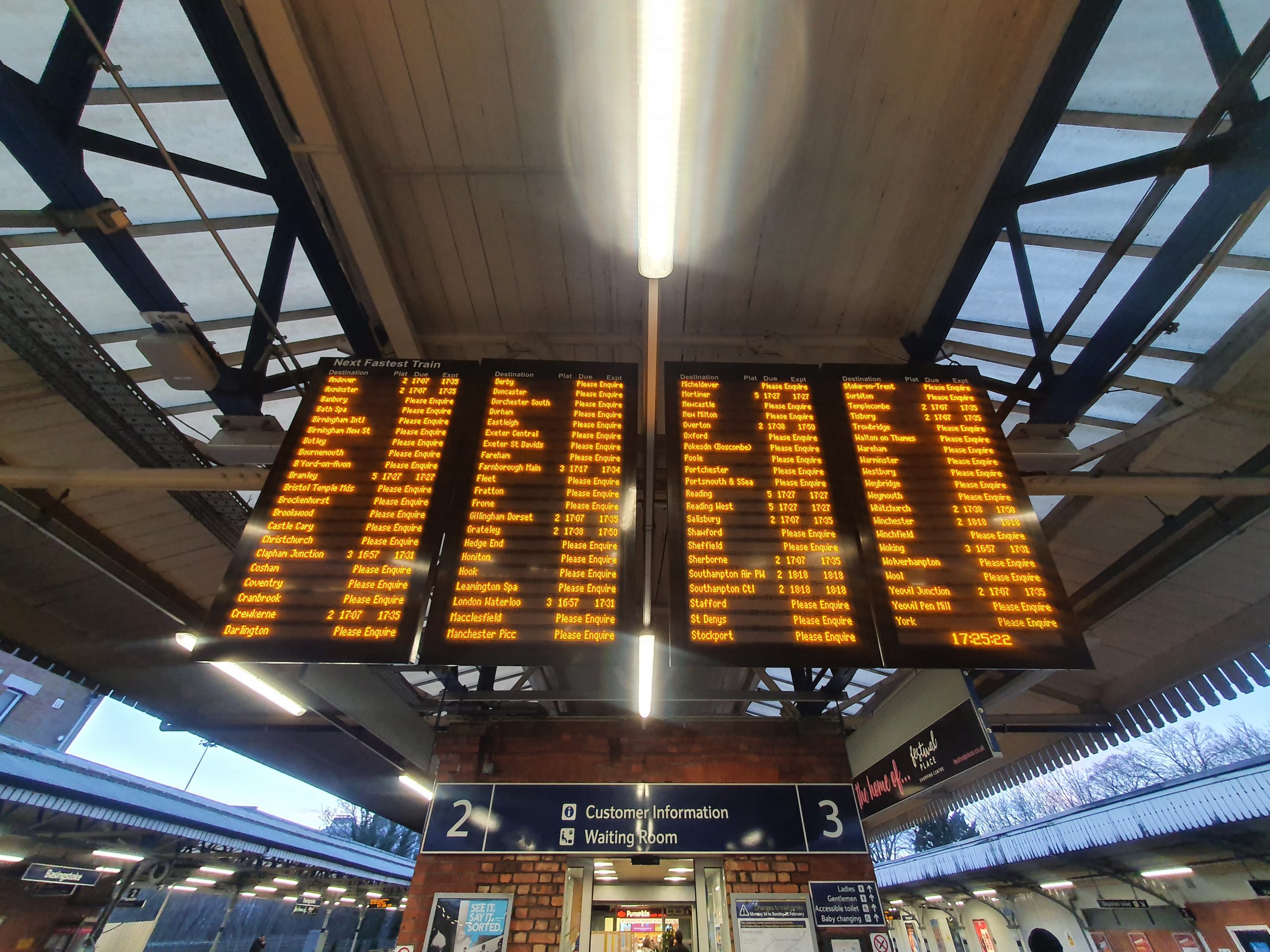
The same staff member at the gate line let me in after my sojourn around Basingstoke and it transpired that the information provided by Network Rail was complete nonsense. I thought I’d better just ask a staff member and he said that they had abandoned trying to get Network Rail data to match up, so the screens were mostly wrong, but they’d make clear announcements to assist passengers. He told me where to wait as the service I had hoped to catch wasn’t running, and it transpired the information that he gave was correct. There were plenty of customer service staff about, I thought that they were dealing with the problems with trains with some confidence and accuracy.

This screen was vaguely up-to-date, but nearly every “please enquire” was for a destination where the trains had been cancelled.

I was faced with the potentially confusing situation that I needed a train to London Waterloo, but only the 17.34 stopped at Farnborough, so I had to avoid the one at 17.31.This was made easy as they shifted my train to another platform and there were frequent announcements.

It’s always a relief to see any form of public transport which is the one that goes to my final destination and here’s the South Western Railway thunderbolt coming into London.

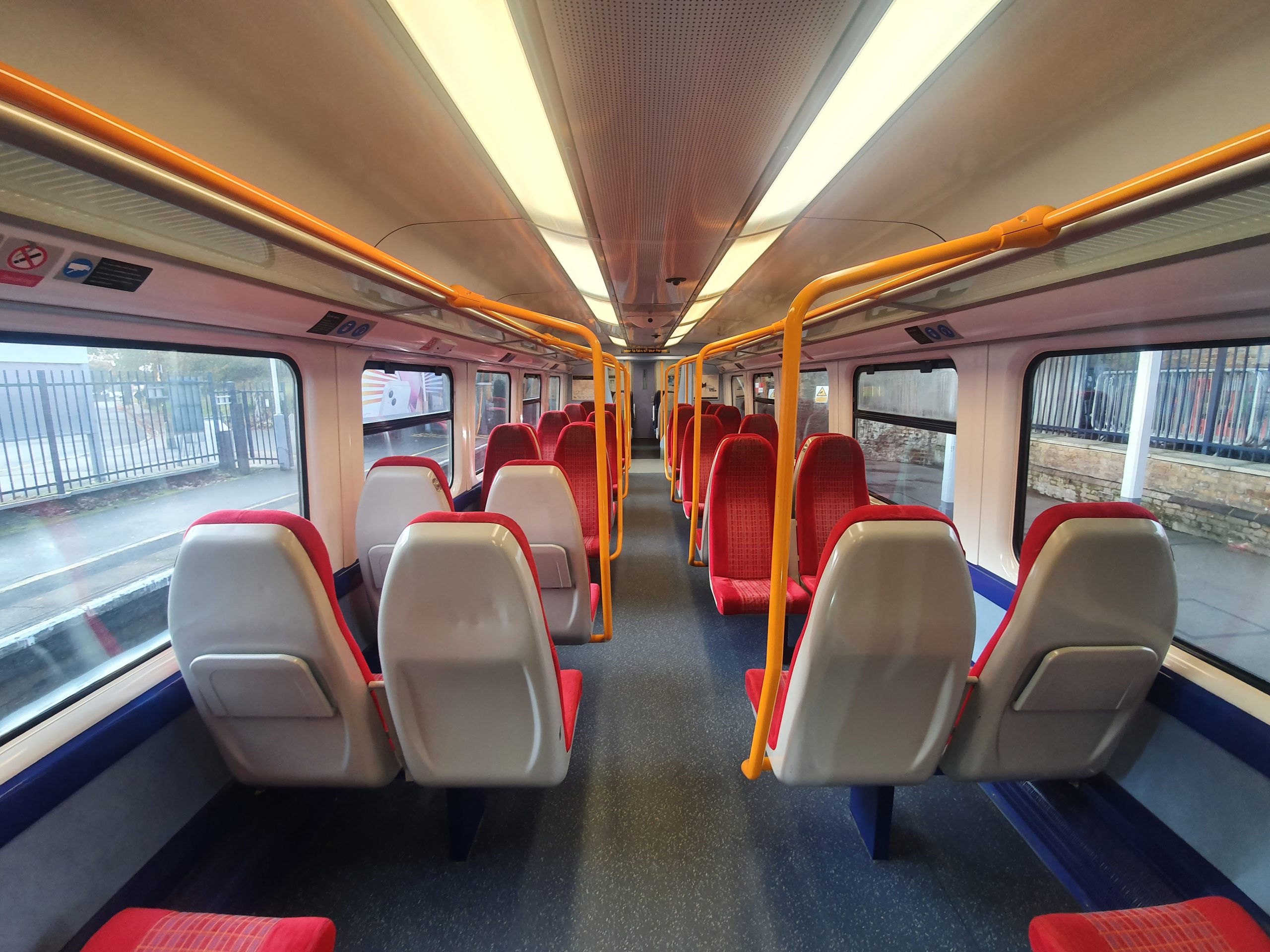
It wasn’t very busy and passengers could have an entire carriage to themselves if they wanted.

I’ve often wondered what people have tried to plug into these power points in the past to warrant stickers saying laptops only. I remember an edited sign on a train several years ago which said “no microwaves”, so I can only imagine that someone tried that once.

A fair bit after I was meant to arrive, here we are. As a station, it’s a little quirky as there was once a central platform island, but this has now been removed, and more about that in another post.

The exterior of the station building at Farnborough.

And welcome to Farnborough, late, but safely there. Given the mess that the railways were in because of the storms, I thought that the whole situation was handled well by the rail companies and it all added a little adventure to my day.