
[This is one of a series of posts about a group trip in 2018, which was rather designed for a specific audience at the time. However, I’ve reposted it to fix the broken image links and to ensure that the trip is preserved for posterity….]

Seville Cathedral is the largest cathedral in the world and is also one of the most visited attractions in Spain. We avoided the queues by buying a joint ticket with the Church of El Salvador, as this allowed us to jump the queues at the cathedral. Above is the Door of Assumption, or the Main Door, although this isn’t in general use for visitors.
The building was constructed for use as a mosque in the late twelfth century. When Seville became a Christian city in the thirteenth century the mosque was transformed into a cathedral, although some traces of its original use are still visible, primarily what is now the bell tower.

There has been an on-going effort to clean the stonework, which is visible at the gate which is located near to the exit. Anyone wanting to visit the cathedral who hadn’t bought a joint ticket, or some other form of advance ticket, had to wait in a queue and that would have taken perhaps half an hour or more.

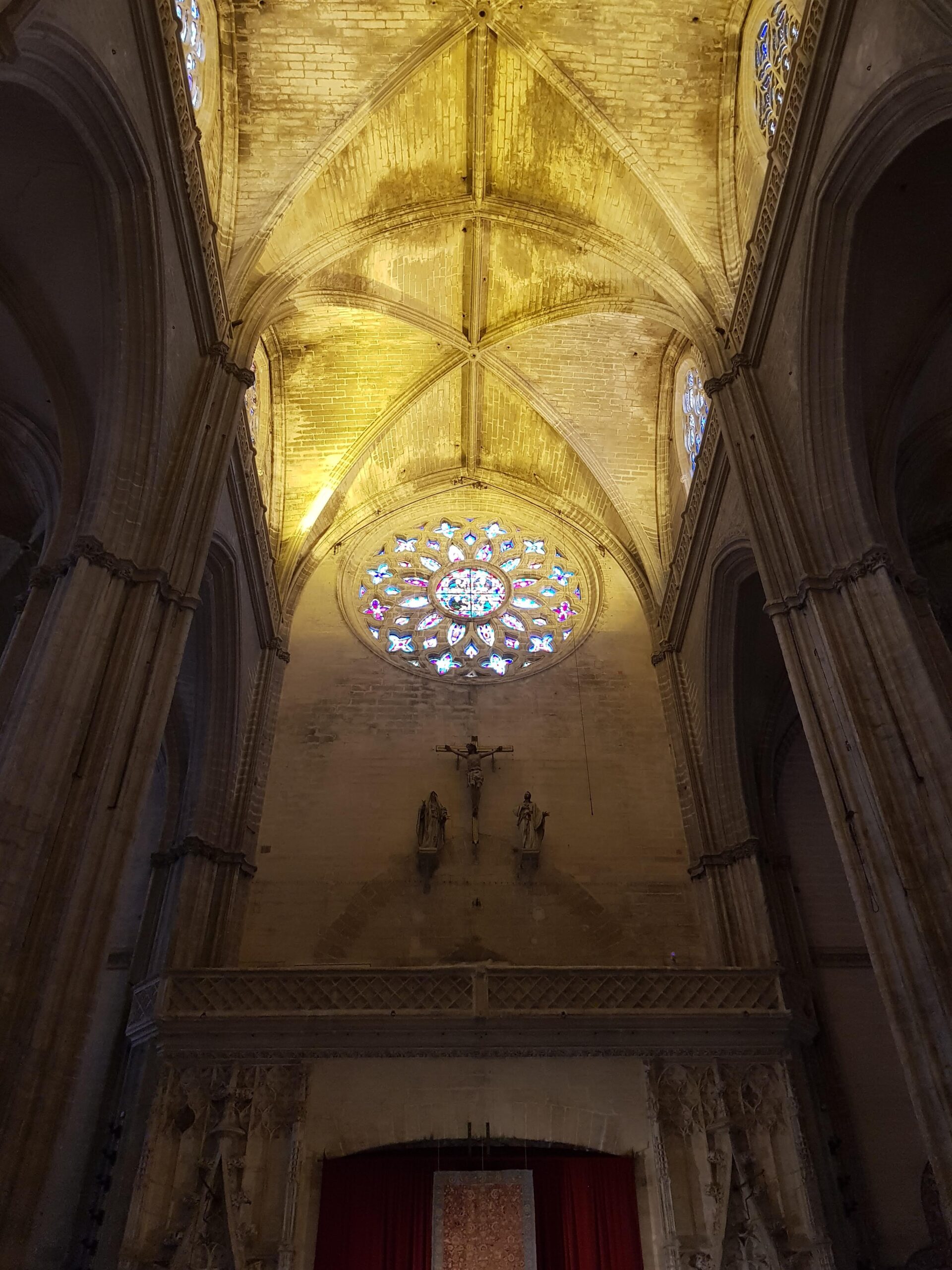
The nave is 42 metres high and light floods into the cathedral, making it feel open and spacious. There are eighty chapels located within the building and a proper investigation of the cathedral would take many hours.


The roof of the nave is beautifully decorated.

The interior of the chapter house which was completed in the late sixteenth century.

The tomb of Christopher Columbus, who although was an Italian was also an explorer paid by the Spanish Monarchy. The Spanish wanted to take a lead on trade with the Indies and after Portugal had turned down Columbus’s idea, their Monarchy agreed to fund his expeditions.
When Columbus died he was buried in Valladolid, a Spanish town, and then were moved on numerous occasions, including by the French who moved his remains to Havana, in Cuba. It was decided in 1898 to bring his remains back to Seville, although there is still some uncertainty about whether the remains are those of Columbus.

The side of Christopher Columbus’s tomb.

The rear of Christopher Columbus’s tomb.

There are many items of historic interest on display throughout the cathedral, including books, vestments, furniture and other pieces of religious history.

One of the cathedral’s courtyards.

The Giralda, or the Cathedral’s Bell Tower, which I wrote more about here.

Outside is the Orange Tree Courtyard, which was once an ablutions courtyard when the building was used as a mosque.