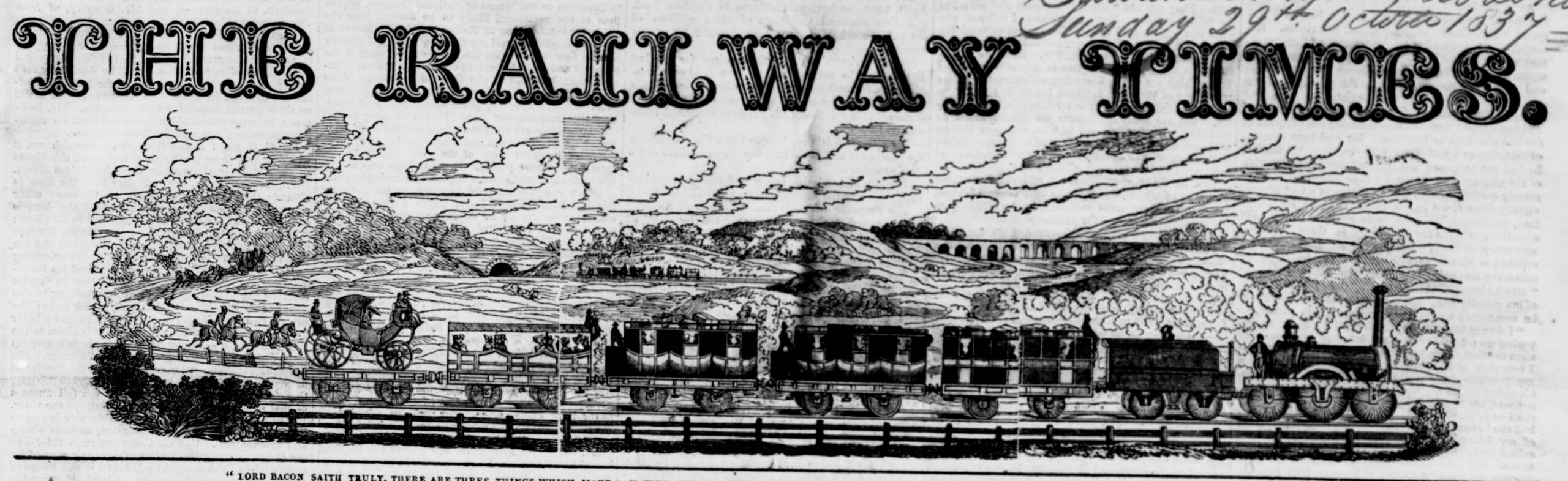
Back to my explorations of the Railway Times, now into 1838. This really does feel like a sub-optimal way of carrying gunpowder about the place….
“On Thursday se’nnight a serious accident happened on the works of the Great Western Railroad, near this city [Bristol], owing to excessive carelessness in the use of gunpowder. It appears that one of the men had just brought a fresh supply of gunpowder for blasting the rock, and had deposited a considerable quantity in his cap, which he placed near to the candle used in the blasting. One of the men in passing accidentally kicked down the candle, which communicated with the powder, an explosion took place, and five persons were more or less severely burnt. The unfortunate sufferers were conveyed to the infirmary.”
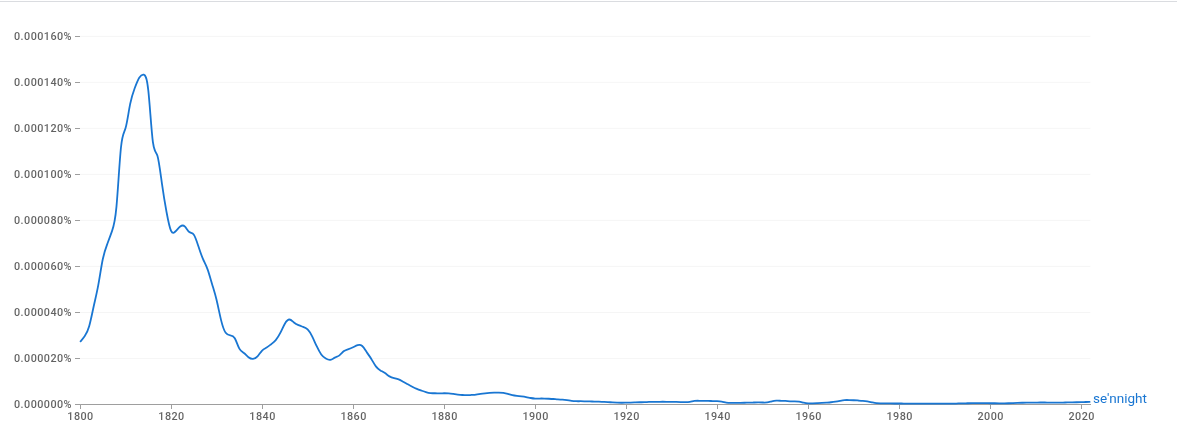
As an aside, which I think I’ve referred to before, the falling out of usage of the word “se’nnight” feels unfortunate. Meaning one week, in the same way as fortnight means two weeks, it’s a useful way of describing a period. Let’s break out Google’s Ngram that monitors word usage, I haven’t used this in a while.
It’s those pesky Victorians who forgot to use it….
One running theme of the 1830s was the sheer excitement of so many people about the possibilities of the rail network and the amount of time it could save them.
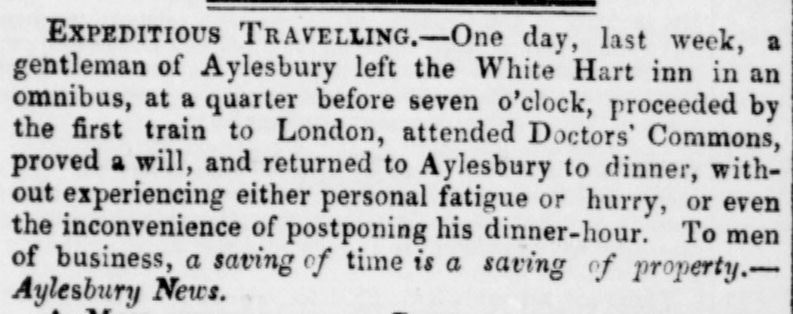
The Railway Times reprinted a news story that had been published in Aylesbury News in November 1837, although they must have got the omnibus to another nearby station (perhaps Tring railway station which had opened in October 1837) as the railway was another eighteen months from opening in Aylesbury.
“One day, last week, a gentleman of Aylesbury left the White Hart inn in an omnibus, at a quarter before seven o’clock, proceeded by the first train to London, attended Doctors’ Commons, proved a will, and returned to Aylesbury to dinner, without experiencing either personal fatigue or hurry, or even the inconvenience of postponing his dinner-hour. To men of business, a saving of time is a saving of property.”
This feels like a perfect example of the sort of thing that would have excited me, to be able to get a lunch in London without any “personal fatigue or hurry” and without having my evening meal late…
As another random aside, back to my reading through old back issues of the Railway Times…. There was an article in December 1837 which gave progress on the line between Birmingham and Gloucester.
“We have much pleasure in being able to inform our readers that considerable activity is displayed on this line. Fourteen contractors are at work—four in the Birmingham division, and ten in the Gloucester—five are engaged in earth-work, one brick-work and masonry, four fencing, and the remainder stone suppliers. Four miles of earth-work, and twenty miles of fencing are in progress.”
What amuses me is reading that the route of the line had been planned by Captain William Scarth Moorsom (1804-1863) who had worked with Robert Stephenson. He delivered a route which was economical, efficient and well planned, but unfortunately, it was economic as he had missed out nearly all the towns en route to save money. This displeased residents of numerous towns, including Cheltenham. The compromise was that Pearson Thompson (1794-1872), a member of a key committee of the railway and resident of Cheltenham, paid for much of it so that was a handy arrangement for the railway.
The whole project was successful, it was decided not to build a new railway station in Birmingham and instead they decided to share Curzon station. This building is interesting, it opened in 1838 but ceased to be used for rail purposes in 1966. It is very visible now amid all the civil engineer works when arriving into Birmingham as it is being integrated into the new Curzon HS2 railway station which should be open in around three to four years.
As for the towns that they missed, the railway network decided to build a series of branch lines, including to locations such as Tewkesbury and Worcester. That seemed to be a very reasonable compromise although Tewkesbury lost its rail connection following the Beeching cuts. Eventually the whole arrangement became part of the Midland Railway which then in turn became the London, Midland and Scottish Railway in 1923.
This has nothing whatsoever to do with the railways, but the Railway Times of 1837 certainly found itself with quite a lot to say about the world around them.
It’s some stretch to suggest that Germans speaking German in the United States, at a period of substantial migration, was “evil”, but it clearly concerned those speaking English. It’s also an interesting sign of the times that there was an opinion that it would be English and Spanish that would be the two major global languages.
“The Germans in America.—The German newspapers inform us, that according to the most recent intelligence, “German life and civilization,” develop themselves more and more at Saint Louis in the United States, and apparently will in time predominate in this part of the Union. A German Library is established there, a German Annual published, &c. In two of the German newspapers printed in America, a proposal has recently been made to found a German University in the States, and is said to be likely to meet with support. We hope that the friends of progressive civilization in America will not allow this evil to advance too far before they oppose a check. It has always been considered a cheering point in the future prospects of the world, that, in all probability but two languages, the English and Spanish, would prevail over the vast continent of America, among a population of hundreds of millions, whose influence would be of such weight as to spread those languages pretty generally among the whole human race, every person of education knowing both, and almost every individual knowing one or the other.
The common languages of Europe would then be eclipsed by the superior importance of these two, in the same manner as Welsh or Wallachian now by French or German. All this vast improvement in the condition of mankind will be prevented or obstructed, if another language is suffered to gain ground in America. The Portuguese is there already in Brazil, but that may be considered as hardly more than a dialect of the Spanish; the French is there already in Canada, but on the decline before the advancing influence of the English. Dutch, Russian, &c., are spoken at a few points, but have never attained sufficient importance to excite any apprehension that they will offer resistance to the gradually overpowering march of Spanish and English. But if the practice gain ground for natives of the different nations of Europe to emigrate in bodies, and carry their language and habits with them, we shall have an America as much cut up into small divisions as Europe, and the difference will be a fruitful source of dissensions and wars.
While the future mischief to be apprehended is so gigantic, the present inconvenience is by no means small. Lieber, the editor of the Encyclopædia Americana, himself a German, but who, since his emigration to America, not only speaks but writes in English, complains that the little knots of Germans scattered over the States, are full of ignorance and prejudice; not knowing the language of the country, they are shut out from intercourse with their neighbours.“
As a brief interlude between my posts about Italy and other assorted European countries, back to the Railway Times of 1837.
Firstly, the word superabound is a loss from the English language, no longer in use it meant something in abundance. The newspaper was at this time annoyed at Charles Poulett Thomson, 1st Baron Sydenham, the President of the Board of Trade, who also happened to become the First Governor General of Canada.
I think I’m with Thomson here, as although in 1837 the number of Acts of Parliament to build railways was low, the number soon increased to ridiculous levels. In 1846, there were 263 Acts of Parliament, so more pledges to build railways than could possibly be met.
The result was known as the Panic of 1847 and what became called railway mania, as large sums of money were lost. This is what Thomson had warned about and had prevented whilst he was President of the Board of Trade in the 1830s.
Here’s the long article from the Railway Times.
“We take the earliest opportunity, upon the re-assembling of Parliament, of adverting to the Standing Orders which were passed by the House of Commons in the recent Session, and very shortly before its close, with respect to future Railway Bills. Foremost among those enactments, and the most to be condemned, is that most unjustifiable and oppressive one, by which it is required, not only that “ten per cent. of the estimated capital shall be subscribed and paid,” before the parties promoting any Railway Bill shall be at liberty to proceed with it,—that is, long before it is required for the actual execution of the work,—but that the money so paid shall be lodged in the Bank of England, where it is well-known no interest is allowed on deposits. A greater impediment to the progress of the Railway System could not by possibility have been invented. Indeed, the author of the measure did not hesitate to avow, that it had for its express object “to check speculation” in Railways. The Premier had set the fashion to his colleagues of giving “heavy blows” and “serious discouragements”; and this was the President of the Board of Trade’s heavy blow and serious discouragement to a class of undertakings fraught with greater benefit to those interests, which it is his special duty to protect and promote, than any dozen other improvements or discoveries of modern times.
Now, without entering into the question of the merits or the demerits of many of the lines of Railways which have been projected within the last two or three years, we purpose to dwell in preference upon the right of individuals to judge for themselves as to the propriety of employing their money in any speculation which to themselves may appear good, and upon the fitness of the people of England being no longer treated as children, who have not the capacity to understand their own interests, without the interference of Mr. Poulett Thomson, whom we have never understood to be in any great degree wiser in such matters than other folks. True, it may be, that very grave errors have been committed in some of the projects which have been set on foot; but then it is to be borne in mind, that the Railway system was new in England but a few years back, and that a great deal of experience has since been acquired, which must go far to prevent the repetition of such errors—experience arising undoubtedly from some memorable failures, but from many more instances of the most triumphant success.
Why, moreover, should excess in Railway speculations alone be checked? Why not in other speculations as well? Is it simply because the House of Commons is possessed of no power over other fields of enterprise? And if so, what are we to think of the wisdom of a system of restriction which is necessarily partial in its operation, and has might alone (not right) for its basis! It is clear there is a great mass of superabundant capital in England; that the possessors of this money find it useless, unless invested in some commodity or public work or funds, which will yield an annual return. Although, therefore, Mr. Poulett Thomson be determined that the people shall not speculate in Railways, it is certain that he cannot prevent them from speculating in cotton, corn, wool, tea, silk, indigo, and a thousand other articles, all of which are forced up in consequence, and rendered dearer and less accessible to the great mass of the people. To allow Railways to be constructed, is to allow the agricultural labouring population to be employed; to allow the iron manufacture to flourish; to allow a thousand varieties of artificers to earn a good livelihood, in woodwork, brickwork, steam locomotive-engine building, and the like; whereas, to turn aside the current of capital from these works, is to force it into other and less beneficial, if not decidedly injurious channels of speculation; to raise the prices of cotton, silk, wool, hemp, and other raw materials of manufactures; by which rise the price of the finished article is raised, consumption diminished, and the manufacturing population, in a corresponding degree, left unemployed. This is precisely the present position of affairs. Money superabounds, because the employment of it in public works has been “checked;” and hence the many millions which would otherwise have been giving employment to the population in raising embankments, building bridges, and hammering out rails, is employed in forcing up the Cotton Market of Liverpool, and the Wool Market of Yorkshire, to prices which render the extremest caution necessary on the part of the manufacturer, to protect himself against the chances of a re-action—should spurs instead of checks happen once more to come into vogue.
Again, if Mr. Poulett Thomson be so bent upon checking speculation in Railways in England, how will he check the speculations in similar undertakings in various countries abroad? As he has not the power to prevent the English capitalist from sending over his money for investment in Railroads from Paris to Havre, Brussels, or Rouen,—or in Railways from New York to Philadelphia, Baltimore, or Boston,—it is clear that those places will attract the capital that is denied the opportunity of investment at home; that Railways will, therefore, be constructed with British capital in foreign countries, whilst no more Railways will be constructed in Britain itself; so that, in fact, by “checking speculation” in this country, we are preventing our own population from obtaining employment in preference to foreigners, and are assisting foreigners with our own money to gain the start of us in that which is the greatest of all auxiliaries to commercial and manufacturing industry—cheap and quick communication.
So far from “checking speculation” in Railways, there is no branch of enterprise from which the checks already existing should be so sedulously removed. As it is, they have quite enough to contend against in the high price of land in England, and the exclusive and stand-still spirit of its aristocracy; whereas, in the United States, the comparatively small value of land, and the absence of privileged castes, of legislative difficulties, and of artificial restraints, give that rising Republic advantages of so important a kind, that money alone is there wanted—that capital which Mr. Poulett Thomson is kindly doing his best to drive thither—to enable it to go immensely a-head of this and all other countries in the race of national improvement.
On referring to the Parliamentary Notices, we observe that there is scarcely one new Railway line to come before the House of Commons during the present session of Parliament; and on conversing on the subject with those most intimate with this branch of Parliamentary practice, we find they are unanimously of opinion that the compulsory payment of a large part of the capital—for no purpose whatsoever, save that it may lie dormant in the coffers of the Bank of England—is the principal reason why the progress of the system has been so deadened at the present time. Let us hope, therefore, that this most absurd and impolitic provision may be forthwith rescinded. There is room for the employment of many millions of capital upon new lines of Railway, of the success of which there can exist no reasonable doubt, and only Mr. Poulett Thomson, with his nonsensical checks and crotchets, stands in the way.”
I’ve now reached November 1837 with my reading of the Railway Times, as that’s just how interesting I am…. It’s a little bit like a soap opera already with some lines struggling, some land owners moaning and some railways charging ahead.
An article in the newspaper read:
“CHELTENHAM and GREAT WESTERN UNION RAILWAY.
The second half-yearly Meeting of this Company was held at the Masonic Hall, Cheltenham, on the 3rd instant, William Henry Hyett, Esq., in the Chair.
The report of the Directors stated that, as many of the Proprietors desired the operations of the Company should be limited in the first instance to the completion of some portion of the line which would yield an adequate and certain return for the capital expended on it, during the progress of the remainder, they recommended the construction of that part between Swindon and Cirencester, on the following grounds—The main object of the undertaking was to effect a Railway communication between Gloucester, South Wales, and London; that on the opening of the Great Western to Swindon, and this line being completed to Cirencester, 95 contiguous miles of that communication would be established; that as Cirencester is easily accessible by excellent turnpike-roads from Stroud, Gloucester, and Cheltenham, the portion of the line between Cirencester and the Great Western would carry all the London traffic, while the remainder of the line was in progress; and that though this part of the line would yield a much less income than any other, when the whole should be completed, it would, nevertheless, in the meantime, yield a greater profit than any other portion which was not contiguous with the Great Western.
That Mr. Brunel having been desired to revise his estimates, and report the cost of the line between Cirencester and Swindon, had reported that the cost with all improvements suggested by further experience adopted on the Great Western Railway, and which he strongly recommends as productive of future economy, would be £249,500.
That the Directors had also caused the traffic to be ascertained on the same portion of the line, and that this would yield a net annual income of £25,000, after deducting the costs of maintenance.
That an arrangement had been under consideration with the Great Western Directors, which had led to an offer, sanctioned by their Proprietors at a special General Meeting, to rent the line when completed from Swindon to Cirencester, at £17,000 per annum, the lessees maintaining the way for a term not exceeding ten years.
That the Directors of this Company considered that rent would involve a serious sacrifice of income, but had secured the option to this Company of accepting or rejecting the offer till within six months of the opening of the line, as it might be satisfactory to distant Proprietors, who might not be so well acquainted with the details of the probable traffic, to know that they may rely at the least on 7 per cent. for their money.
That calls to the extent of something more than 30 per share would be required for the completion of this part of the Railway, the whole of which would not be required under two years and a-half, and would be called for by easy instalments, and that no further call would be necessary for some months.
The Meeting was numerously attended by a highly respectable class of Shareholders, who testified their unanimous approbation and adoption of the report.”
The Cheltenham and Great Western Union Railway (C&GWUR) was a railway company, authorised in 1836, which was intended to create a broad gauge link between Cheltenham, Gloucester and Swindon, connecting to Isambard Kingdom Brunel’s Great Western Railway (GWR). And it was Brunel himself that was engaged with this railway setup as well.
However, the company faced significant financial difficulties and was unable to complete its ambitious plan. It only managed to open a short initial section of its line between Swindon and Cirencester in 1841, which is what was suggested in the 1837 meeting. Despite some attempts to operate as a partnership, the vital section between Cheltenham and Gloucester was actually built and opened by the competing narrow gauge Birmingham and Gloucester Railway company after the C&GWUR defaulted on its obligations.
GWR eventually bought the ailing railway up as apparently the directors were exhausted by trying to operate this line. They managed to open the stations of Purton, Minety and Cirencester in 1841 and the line is still partly still in place, but all of these stations were closed in 1964. The rather lovely Brunel designed railway station at Cirencester is standing empty, now miles away from the nearest track at Kemble. British Rail had the great idea of cutting the double track from single track at the same time in 1968, but this was returned to double track again in 2014.
There is vague talk about putting some sort of rail line into Cirencester, but it doesn’t look likely. Anyone wanting to go from Swindon to Cirencester today by public transport has to use the number 51 bus which takes around an hour, instead of a lovely shiny train which I imagine would today by operated by GWR. I’m not sure Brunel would have been pleased at his efforts being reduced to a bus service….
Back to the Railway Times (I like to mix things up on this ‘riveting’ blog….) and this is an article that they’ve republished from the Wilts and Gloucestershire Standard of November 1837.
I rather like that it summarises the debate of this exciting new form of transport which was still not winning everyone over. The article title was “The Importance of the Railways” and they still referred to the rail project as a “great experiment” which isn’t an unreasonable summary of the arrangement at the time.
As an aside, I like the use of the word “ebriety”, which I rarely see used now, it just means drunk although the word sobriety has continued in use. And there’s another interesting use of the word “characterizing” with a ‘z’ which was the frequently used spelling of the time before we’ve diverged off to prioritise our ‘s’ usage….
Most of all, it captures a snapshot of British life at the time, changing quickly and just as the population is getting used to the industrial revolution. It’s not just us today who live in interesting times.
“We beg to direct the attention of our readers to the subject of Railroads, as one destined, ere long, to produce a considerable revolution in the internal economy of this country. Some months ago the public mind was in such a ferment on this subject, and John Bull was so running riot, as he is wont to do on any matter affording scope for speculation, that the attempt to get at any sound notions, or information that could be depended upon, seemed hopeless. Now that this ebriety seems to have produced a complete lethargy, there is a chance of obtaining facts that may be relied on, and of arriving at just deductions from them.
This has become a subject of great national importance, as regards the commercial and manufacturing interests of the country. We have, hitherto, maintained a preference in the foreign markets by the comparative excellence and cheapness of our manufactures. It must be borne in mind that carriage, both of the raw material, and of the manufactured article, is, in many cases, a very important item in the cost of the latter, and that if we allow foreign countries to get the start of us, in modes of conveyance which very materially diminish expense, we shall give them a very serious advantage. It is not perhaps generally known what is going on in this way on the continents of Europe and America. In France, the following lines have been undertaken, some by the government and others by public companies: From Paris to Havre, by Rouen, 55 leagues; from Paris to Calais, 53 leagues; from Paris to Lisle, 53 leagues; from Paris to Lyons and Marseilles, 219 leagues; from Paris to Strasburg, 116 leagues; and from Paris to Bordeaux, 154 leagues. These communications are again carrying on from the Belgian frontier, as appears by the report of M. Nothcomb, the minister of public works, wherein it is stated that the Government has taken in hand an extent of 115 leagues; that the works were commenced in March, 1834, and have continued in progress, and that three sections are already open to the public. These traverse the country from the borders of France to those of Prussia. The Prussian government has fixed a line with various branches from the Belgian Railways by Aix-la-Chapelle to Cologne. In America there are upwards of 1500 miles of Railways completed, and 3000 miles reported to be in various stages of progress.
It is difficult to foresee the effect these wondrous means of communication will produce upon the value of property within their influence, upon the conveyance of commodities in different districts; on the localities of markets, and the modes of dealing, and even on the habits and manners of the people, by the great extension of intercourse which will necessarily result.
Though we are at present hardly justified in characterizing this bold and novel mode of conveyance, otherwise than as a great experiment, sufficient has been practically achieved, in particular cases, to render it morally certain that Railways will very soon entirely supersede the existing means of travelling, on all the great thoroughfares of the kingdom. It has been clearly established in practice, that, on a well-appointed Railroad, passengers can be conveyed in one-third of the time at two-thirds of the cost, with greater punctuality, with infinitely greater safety, and with much less fatigue than by the best appointed coaches now in use, excellent as they have become.
The general establishment of Railways, therefore, throughout the kingdom, is as certain as the return of the seasons. In this great commercial and manufacturing country, in which 9-10ths of the population are busily occupied a great proportion of the 24 hours, economy of time is of more consequence than economy of money; and the public will never submit to any system of transit, while another can be devised at once saving of time and money. Experience has shown us, that if coaches between two places, say 100 miles distant, have performed the journey in 12 hours, and a new coach starts and performs the same journey in eleven hours, the former must quicken their speed, or they will be driven off the road. The same result happens, if one coach conveys passengers for a few shillings less fare than those previously established. It having been demonstrated that the means exist of conveying passengers the 100 miles in four hours, at two-thirds of the cost, and with much less bodily fatigue, no man can doubt that the public will yield them.
Railways are so expensive in their construction, that they cannot be multiplied like ordinary roads. Their course and position, therefore, become a matter of the deepest interest to all persons of property, or who are engaged in trade, commerce, or manufacture, as there can be no question, but that the districts traversed by these lines, or in close communication with them, will derive advantages which will greatly enhance the value of property, as compared with that which is more remote. We entertain no doubt that, ere long, in advertisements for the sale of property, the advantage most prominently put forth will be, that it is within a certain distance of this or that Railway. It behoves, therefore, all those interested in any particular district, to bear an eye in time to this subject, and not allow their more foresighted neighbours to steal a march upon them.”
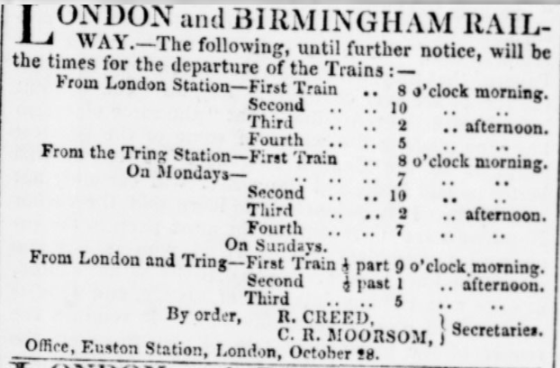
As I’m still reading through the Railway Times (I’ve reached the second issue now), this is from November 1837 and the London & Birmingham Railway has now managed to reach Tring. Although the railway station wasn’t built that near to Tring, the excited local population funded part of a new road to make it more accessible to residents.
They reached Tring on 16 October 1837 and it would be on 17 September 1838 that the full line between London Euston and Birmingham was opened. The glorious station and the Euston Arch were constructed in 1837, but the disaster that was the nationalised British Rail pulled it all down in the 1960s. But, that’s a different story.
Reading the Railway Times it’s evident just how exciting the advent of the new rail era actually was, the country was opening up and there were all manner of opportunities ahead. I was going to note that I’ve never been to Tring, but I’ve remembered that we walked through it when walking the Ridgeway a few years ago.
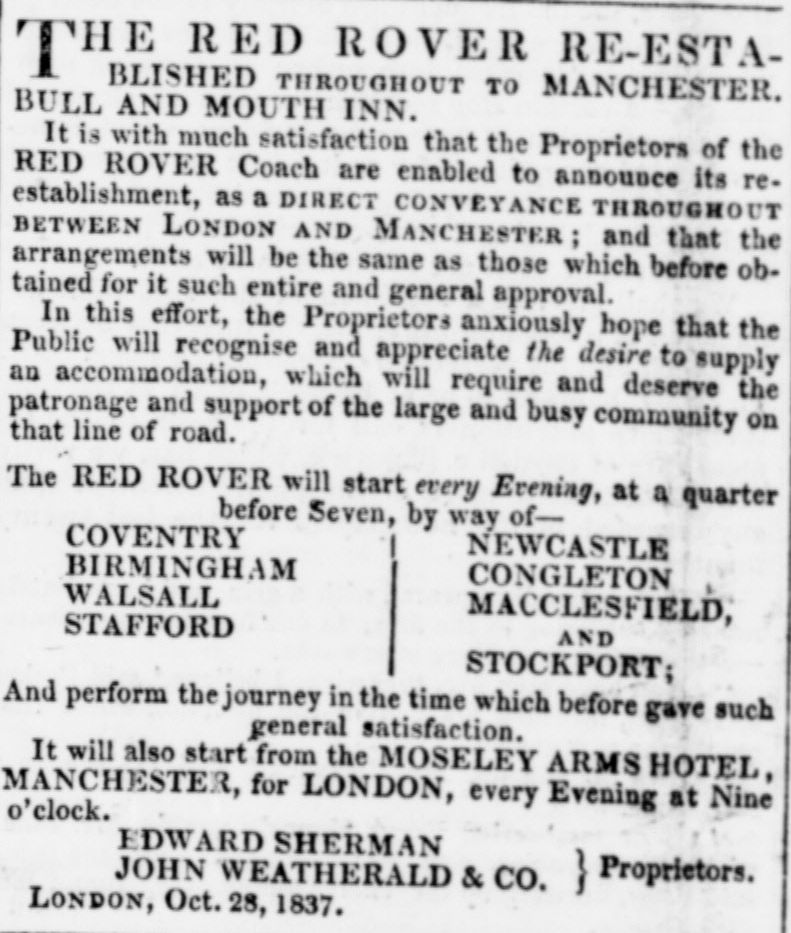
This advert in the Railway Times in 1837 is the turning point for long-distance transportation in the country. The Red Rover stagecoach route from London to Manchester was being re-established, but the sands of time weren’t in the favour of the service. The Red Rover service had been quite decadent, the drivers were well-paid and wore smart red hats and they were fined if their service was delayed (making them slightly less well-paid).
“LONDON – MANCHESTER. ‘THE RED ROVER’ London (Bull & Mouth, St Martins-le-Grand), Barnet, St Albans, Dunstable, Fenny Stratford, Stony Stratford, Towcester, Daventry, Coventry, Birmingham, Lichfield, Rugeley, Stafford, Stone, Newcastle-under- Lyme, Congleton, Wilmslow, Manchester – Distance 187 miles. Journey time 20 hours – Depart London at 8.30amManchester at 8.00am – 4 seats inside, 8 outside – Operator E Sherman & Co Numbers 3448, 3493″
On 17 September 1838, the rail service between London and Birmingham opened and the service between Manchester and Birmingham had already opened in 1837. The stagecoach services didn’t last much after this, most of the London services had ceased by the early 1840s.
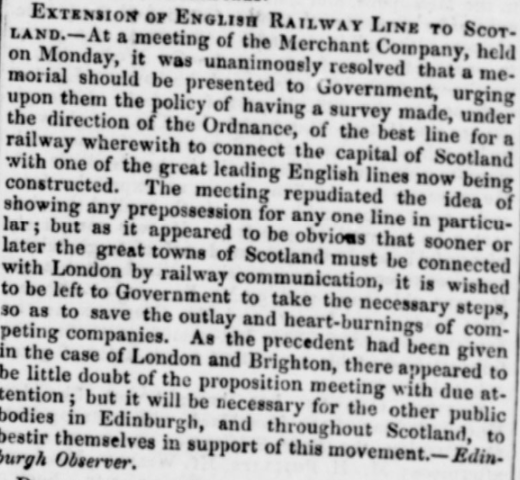
Since I’m now obsessed with this new archive, something that I hadn’t given much thought about is how in 1837 they were starting to wonder how they were going to connect England and Scotland by rail.
The businesses in Scotland were quite exercised by this, the opportunity for new trading opportunities started to become available and the initial thought was that this was all so complex and expensive that there would only be one line needed.
The very first comprehensive rail link between the English and Scottish networks wasn’t created until 1846 by the North British Railway, which opened its line from Edinburgh down to Berwick-upon-Tweed. This route connected the Scottish capital to the burgeoning English railway system, although it was not a continuous track journey into London initially, as it involved two “water breaks” which were crossings of the River Tweed at Berwick and the River Tyne at Newcastle, which necessitated road or ferry transfers. Only later, when bridges were built, did passengers finally get to stay comfortably aboard without the indignity of a ferry detour. It also transpired that the North British Railway made more of their money from transporting minerals around the place than they did from their passenger services.
A fully continuous, uninterrupted railway line between the two capitals for the first time came shortly after with the opening of the Caledonian Railway’s (and they were the big rivals of North British Railway with absolutely no love lost there at all) main line between Glasgow and Carlisle on 15 February 1848, which then linked to the English London and North Western Railway, finally establishing a complete, high-speed rail route between Glasgow and London.