
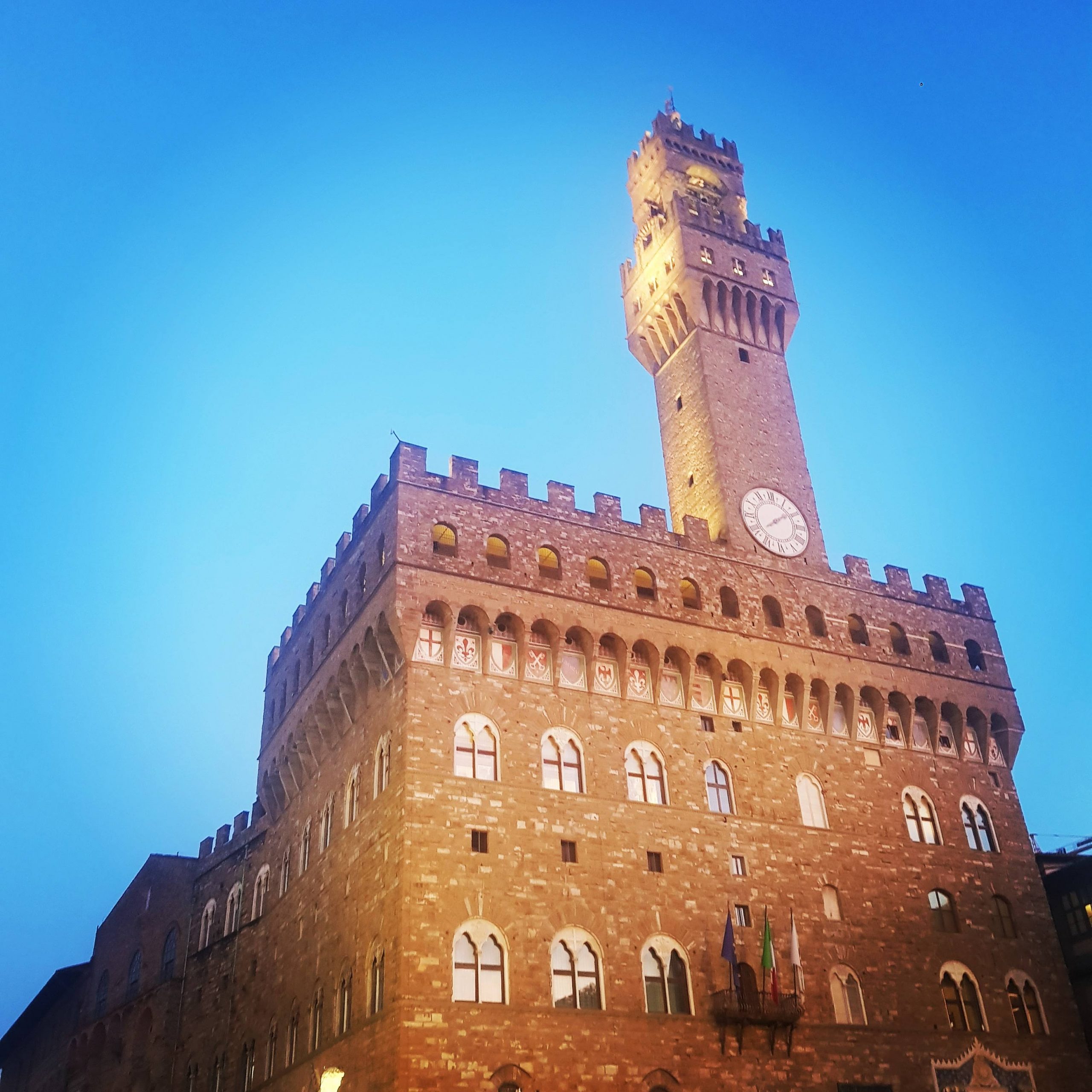
Tag: Palazzo Vecchio

  • Florence – Palazzo Vecchio (Tower)

    Florence – Palazzo Vecchio (Tower)

    The tower of the Palazzo Vecchio is 95 metres in height and was built in the thirteenth century, making it one of the oldest parts of the palace complex. The tower isn’t centred at the heart of the building, solely because the rest of the palace was later built around it. The tower is sometimes called Torre d’Arnolfo after its designer, Arnolfo di Cambio, who was also responsible for the construction of Florence Cathedral.

    A view of the tower from the lower platform.

    The walk to the top is easy in terms of the steps being wide and there’s space for people to pass. The system for entering the tower was also well managed, there are a limited number of people who are allowed to climb the steps to the top of the tower at any one time. When we got our tickets on the ground floor to see the palace, a helpful staff member suggested that we go to the tower first as it wouldn’t be as busy. That advice seemed useful, as the queues got much longer throughout the day (even in February) and we only had to wait around five minutes for our turn.

    There were views of the Uffizi Gallery, which takes up both sides of this neighbouring building.

    There were some excellent views of the city, but I’ve placed those in a separate post.

    Structural supports were evident as we ascended the tower.

    Unfortunately, visitors can’t climb to the very top as this section is closed off.

    This was under one of the wooden beams at the top of the tower, dated to 1690.

    I had a little look on TripAdvisor and most people enjoyed their experience. I did note this review, entirely bizarre….

    “For the person top of the tower your english is not up to standards , you should be fired if you can handle being polite or professional to people that come to visit and spend money in your country, thats why you have a job ( without visitors , no job!!). The only things Italian should stick with it are being in the field with food, harsh but sincere !!!!”

    It’s almost as though Florence is in England with the expectation that security staff should speak English. Most do, but I don’t see why they should have to….

    We used the Firenze Card to get entrance to all of the various areas of the Palazzo Vecchio, but for anyone who just wanted to climb the tower it’s €6.50. Children can climb the tower if they’re with a responsible adult (that’s me out then) unless they’re under the age of six, then they can’t. The museum warns that people with vertigo shouldn’t climb the tower, although personally, I didn’t find it at all bad as there weren’t really any sheer drops that had to be encountered. I think we were done in around half an hour, including the queueing, ascent, viewing and descent times and the views are just as good as other locations such as from the Cathedral.

  • Florence – Palazzo Vecchio (Views from the Tower)

    Florence – Palazzo Vecchio (Views from the Tower)

    Just photos in this post, these are views of the city taken from the top of the tower at the Palazzo Vecchio.

  • Florence – Palazzo Vecchio (Hall of Geographical Maps – Cornwall)

    Florence – Palazzo Vecchio (Hall of Geographical Maps – Cornwall)

    This is a photo of the sixteenth century UK map of Cornwall in the Hall of Geographical Maps.

    Not the clearest of photos, my camera zoom struggled a little when taking these images. Anyway, there are some geographical errors in the coastline of Cornwall, but it’s near enough there. Tintagel and Padstow are visible on the northern tip of the county, up to Bideford a little further north. Okehampton and Launceston are in the centre of the map, with St. Germans on the southern coast. Further to the west, there’s Bodmin and St. Columb, with Truro below them. I can’t make out some of the other locations, primarily as the photograph quality isn’t perfect, but again, it’s an interesting overview of what an Italian thought was here many centuries ago.

  • Florence – Palazzo Vecchio (Hall of Geographical Maps – UK)

    Florence – Palazzo Vecchio (Hall of Geographical Maps – UK)

    This is a photo of the sixteenth century UK map in the Hall of Geographical Maps.

    Following on from my last post about Norfolk, this is why it’s hard to work out exactly what is going on, as the mapping isn’t what I would call perfect. Understandable though since I struggle to map anything without Google Maps.

  • Florence – Palazzo Vecchio (Hall of Geographical Maps – Norfolk)

    Florence – Palazzo Vecchio (Hall of Geographical Maps – Norfolk)

    This is a photo from the sixteenth century UK map in the Hall of Geographical Maps.

    It’s interesting to see the names that the Italians at the time thought were the main places in Norfolk, we have Lyn (King’s Lynn), Cromer (I assume that’s Cromer, even though it’s in the wrong place) and Brandonferi (which I’m assuming is Brandon). Ah, since writing this, I’ve realised that the old name for Brandon is Brandon Ferry, so that’s what that is….

    I don’t know what Pienan is, maybe Dereham, but there’s no Norwich on the map. There is a Norduico to the right-hand side and that appears a few times in medieval texts, but it doesn’t seem to be Norwich.

  • Florence – Palazzo Vecchio (Hall of Geographical Maps – Poland 1)

    Florence – Palazzo Vecchio (Hall of Geographical Maps – Poland 1)

    This is a photo from the sixteenth century Polish map in the Hall of Geographical Maps.

    I was struggling to place this part of the map, until I saw Thorn, which is the old Germanic name for one of my favourite cities which is Torun. Then like a puzzle, things started to fit together, there’s Bromberg to the left of that, which is now the wonderful city of Bydgoszcz. Then to the north of Torun is Graudenz, which is the glorious city of Grudziądz.

    The rest is quite hard to place even with modern maps, Rosenburg is Susz, which is somewhere that I haven’t been. I don’t know where Deutschenland is, and I think that’s a place name and not a region, perhaps it’s what is now Iława and was once Deutsch Eylau. Chojnice is the new name for what on the map is for what the Germans call Konitz, or the Pomeranians called Chònice. Which is confusing as there’s a Conitz on the map, just to the north of Bydgoszcz.

    Anyway, of limited interest I know, but for anyone who knows the layout of modern-day Poland, it’s an interesting historic map, although the river placements don’t seem entirely accurate.

  • Florence – Palazzo Vecchio (Hall of Geographical Maps)

    Florence – Palazzo Vecchio (Hall of Geographical Maps)

    This was my favourite room in the Palazzo Vecchio, it’s the Hall of Geographic Maps, which is located on the second floor of the building.

    Work on the room started in 1563 in what was previously a courtyard, with the external arches of the windows which once faced outwards still being visible at the rear.

    The globe was designed for the room and there were originally meant to be two, with the other being hung from the ceiling and which would have been a celestial globe. Unfortunately, this globe is no longer in particularly good condition due to a decision made long ago to place it in an exposed position at the Uffizi.

    The aim of the room’s design was to show everything that was known in the universe at that time and there were also meant to be 300 paintings of individuals around the top of the room. 200 of these were painted, but they’re now at the nearby Uffizi. There was also a planetary clock designed by Lorenzo della Volpaia located in the room and although this was destroyed during the seventeenth century, there’s a copy at the Galileo Museum.

    There’s a marvellous artist’s recreation of how the room was designed to look at https://wtfarthistory.com/post/57615356623/sala-del-mappamondo-florence.

    These are the maps on the wall, much more on these in later posts….. There were 57 of them, all hand-painted, with 53 of them surviving today. Behind the frontage there was cabinet space and they would have included items from the geographical location that was painted on the front.