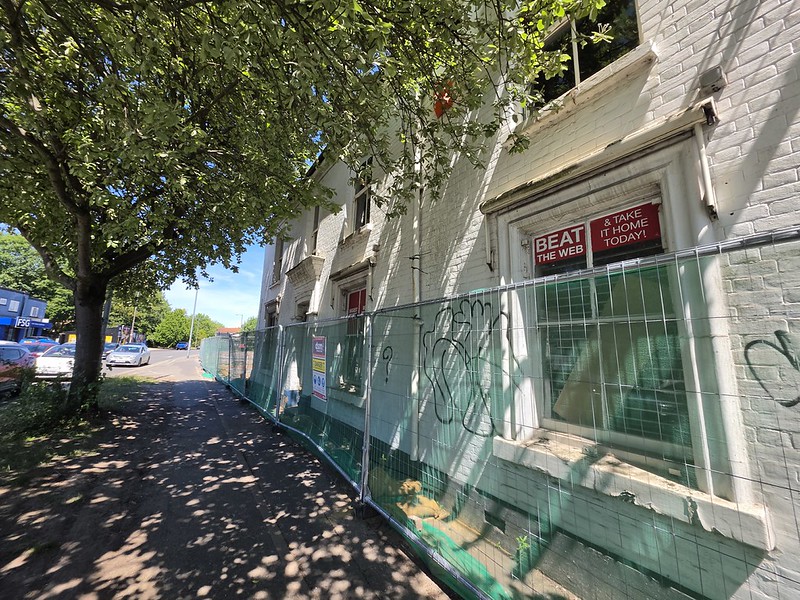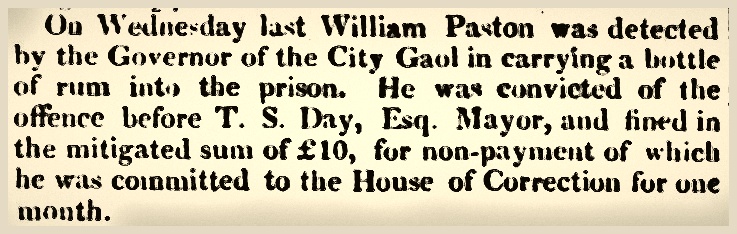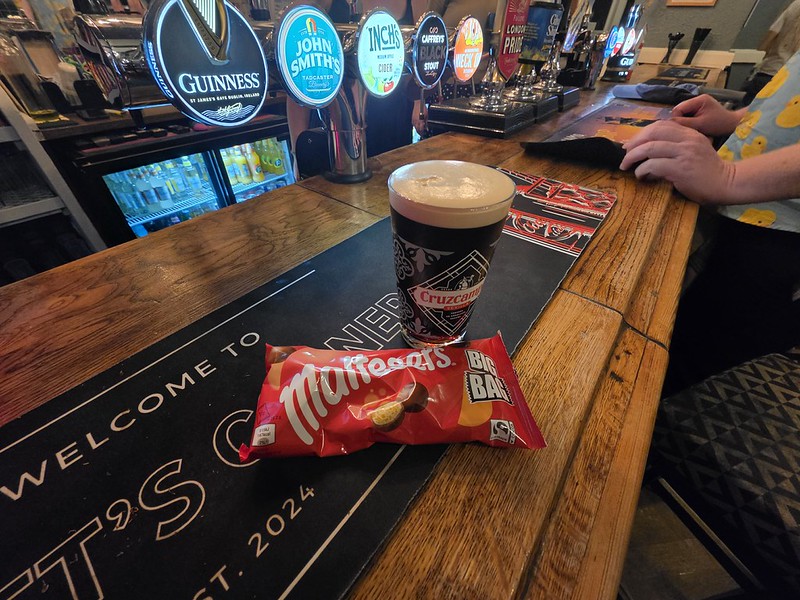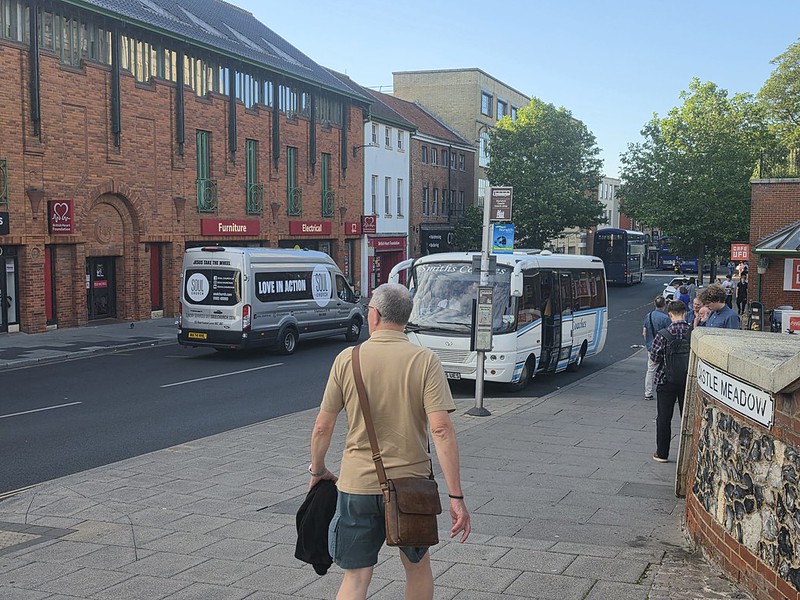
As I was on a double decker bus yesterday going past Anglia Square, that gave me an opportunity to take the below photos. A couple of hours after this they started to break into the cinema, so the demolition of that part has now begun. I’ll go down and take some photos of that tomorrow (2 April).
Whilst looking into the history of the Goat at Strumpshaw, I found this list of pubs that were being sold when St. George’s Brewery closed in 1864 and its assets were auctioned off. It’s an interesting little snapshot of what the brewery owned at the time.
And here’s a text transcription of the above:
“NORWICH AND NORFOLK. THE ST. GEORGE’S BREWERY,
With Dwelling-houses, Stabling, Malt-houses, and 40 PUBLIC-HOUSES, With Accommodation Lands, in the City of Norwich and County of Norfolk.
MESSRS. Spelman are favored with instructions from the Executors of Charles Weston, Esq., deceased, to Sell by Auction, on Thursday, August 18th, 1864, at Eleven for Twelve o’clock, at the Norfolk Hotel, Norwich.
The above Old-Established BREWERY and PUBLIC-HOUSES, which will be offered in One Lot, but should no acceptable bidding be made for the entirety, the whole of the Property will be immediately put up in the following lots:—
IN THE CITY OF NORWICH.
LOT 1 { The Brewery ………. } St. George’s { Crown …………… }
2 Jolly Butchers ………. St. John’s Sepulchre 3 Windmill …………… St. Michael at Thorn 4 Lion and Castle …….. St. John’s Timberhill 5 Peacock …………… St. Stephen’s 6 Prince of Orange …… St. Julian’s 7 Crown …………….. St. Benedict’s
8 Queen of Hungary …… St. Margaret’s 9 Builder’s Arms …….. St. Lawrence 10 Three Turks ………. Ditto 11 Blue Bell ………… St. Gregory 12 Boy and Cup (late) … St. John’s Maddermarket 13 Fleece …………… St. Andrew’s 14 Crown ……………. St. Peter Hungate 15 Jolly Hatters …….. St. James’ 16 Duke of Marlboro’ …. St. Edmund’s 17 Catherine Wheel …… St. Augustine’s 18 Angel ……………. St. Martin’s at Oak 19 Bess of Bedlam ……. Ditto 20 Cherry Tree ………. St. George’s Colegate 21 Hen and Chickens ….. St. Mary’s 22 Red Lion …………. St. Michael’s Coslany 23 Moon and Stars ……. Ditto 24 Royal Oak ………… Heigham 25 Half Moon ………… Ditto 26 Duke of York ……… Thorpe Hamlet
IN THE COUNTY OF NORFOLK.
27 Buck …………….. Thorpe Village 28 Ram ……………… Brundall 29 Goat …………….. Strumpshaw 30 King’s Head ………. St. Faith’s 31 Crown ……………. Ditto 32 Chequers …………. Hainford 33 Bird in Hand ……… Tasburgh 34 White Horse ………. Ashwellthorpe 35 Leather Bottle ……. Wymondham 36 Goat …………….. Ditto 37 Cross Keys ……….. Ditto 38 Cherry Tree ………. Seething 39 Folly ……………. Claxton 40 Cross Keys ……….. Mattishall”
Back to my series of articles from the Norwich Mercury 200 years ago, with this being the report of the sentence of death recorded against Clark Horn. Clark had been born in 1802, the son of John Horn and Mary Horn of Methwold.
There’s something of a brutality about all of this. However, views were changing in 1826 and the death sentence was clearly not working as a deterrent. It was reported in the Norfolk Chronicle of 6 May 1826 that Clark Horn had been removed from Norwich Castle and sent to the Leviathan prison ship.
Then on 7 October 1826, Clark was put on a ship, the Midas, to New South Wales and he arrived there on 15 February 1827. There were 148 prisoners on that ship and 61 of them had life sentences, although Clark’s punishment had by then been reduced to 16 years imprisonment.
He didn’t turn up again in the records until 1843 when it appears that he died in the area of Bathurst, New South Wales. His father, John Horn, missed all of this as he had died in 1808, but his mother, Mary Horn, would have known of the transportation as she died in 1830. It must have been a strange world for Clark Horn and I wonder if he lived an isolated life in one of the work camps. I can’t see that he had any descendants and that makes me wonder about just how many people might have thought about the life of Clark Horn since his crime….
There’s good news about the missing parish boundary marker which was located on Princes House and it seems that the building, and indeed the marker, is now in very good hands. Further information about this parish is at https://www.julianwhite.uk/norwich-history-by-parish-st-george-tombland/.
Andy from Princes House messaged me to say:
“The original design for Princes House from the early seventies was not the moribund architecture which you see now. The hard economic times saw the design diluted and we have played our part to add some interest and curiosity to our side of Princes Street.
You will be pleased to know that we are creating some art which will feature the Hungate St. Peter parish boundary marker which we have had professionally cleaned to remove the paint and cement splatter from it, while retaining its patina. We will describe the relevance of 1834 and the Poor Law Amendment Act and the historical boundaries referenced by the parish boundary marker. Along with this we plan on celebrating pictorially the local churches, those that are still with us and those that are not. It is our intention to have this up and displayed this spring.”
I think I might lead another walk when the work is completed.
In a move that serves as a definitive warning against leaving the room during a committee meeting, I have somehow managed to get myself appointed as the captain of the Artichoke Hearts bar billiards team. I am still not entirely sure how the transition from “vaguely reliable middle-order player” to “fearless leader” occurred, but yet here we are.
It is quite a step for someone who honestly thought they had successfully navigated their way into a quiet retirement from the competitive green baize of bar billiards, indeed, I’ve written about that before. But it seems that the league has a way of pulling you back in just when you think you have escaped the pressure of a tricky final shot.
The fixtures have just landed with some promptness and the grace of a lead balloon, and they have not exactly eased me into the role. Our opening gambit is against one of the absolute titans of the division, the Black Stars, and, to add a layer of personal drama to the proceedings, our subsequent match is against the quite wonderful Serengeti led by Roy, who is perhaps the most gentlemanly person I’ve ever met. Having spent a couple of seasons playing for them, I now find myself in the awkward position of trying to outmanoeuvre my old teammates while pretending I don’t know all their tactical weaknesses. Although they know my many weaknesses, so all of this might not be useful.
Despite my own questionable leadership credentials, the Artichoke Hearts are actually really quite good by all accounts. I won’t go overboard here as we’re likely to come last in the league, so no point being overly optimistic. There is a genuine sense of fun that (generally) permeates this league, which is probably why I couldn’t stay away. The social side is of course inevitably compelling, especially with the news that the Red Lion in Coltishall has joined the league this year and we’re playing there in May. I am genuinely excited about the prospect of heading out there, but I don’t get out much.
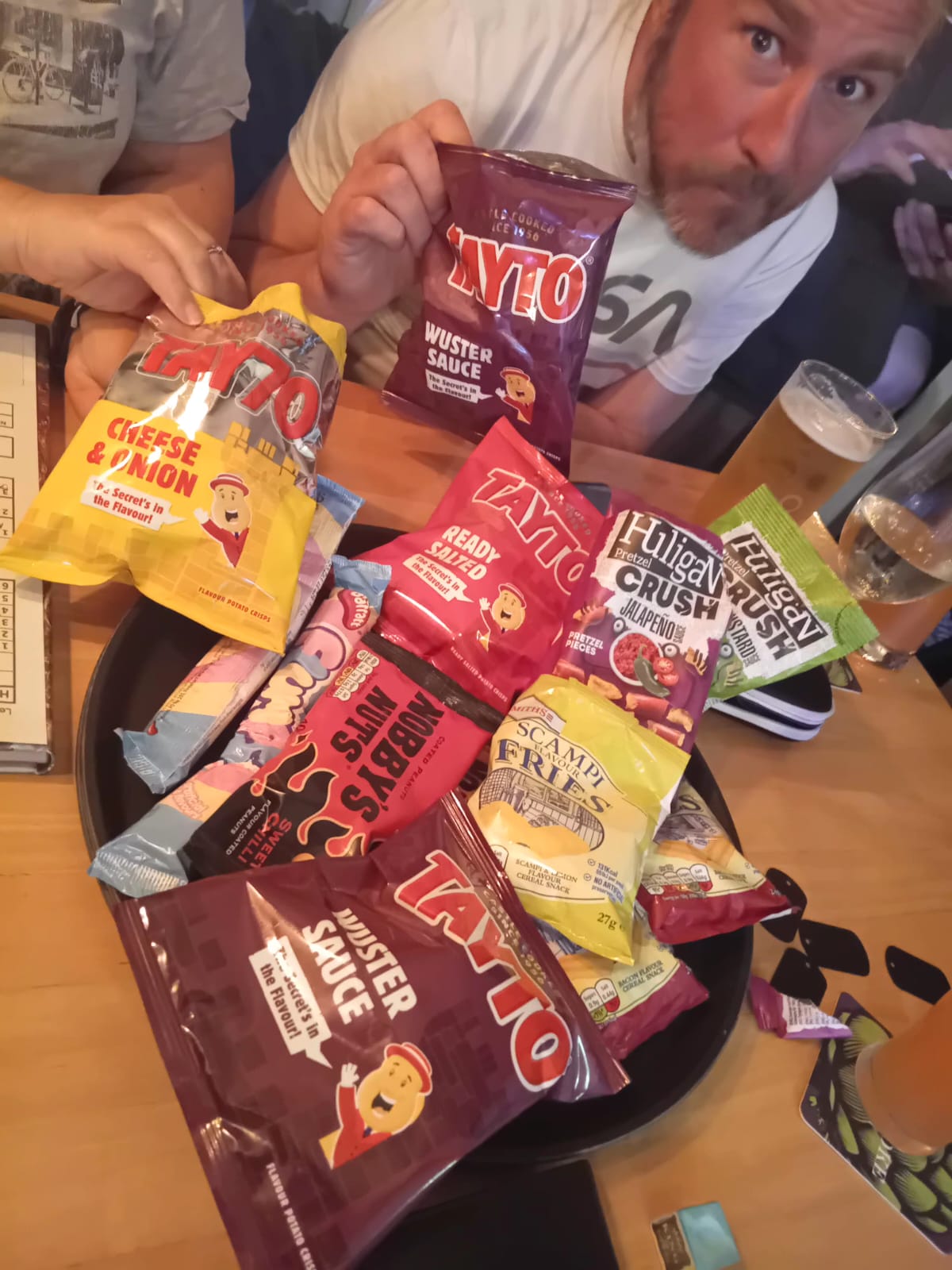
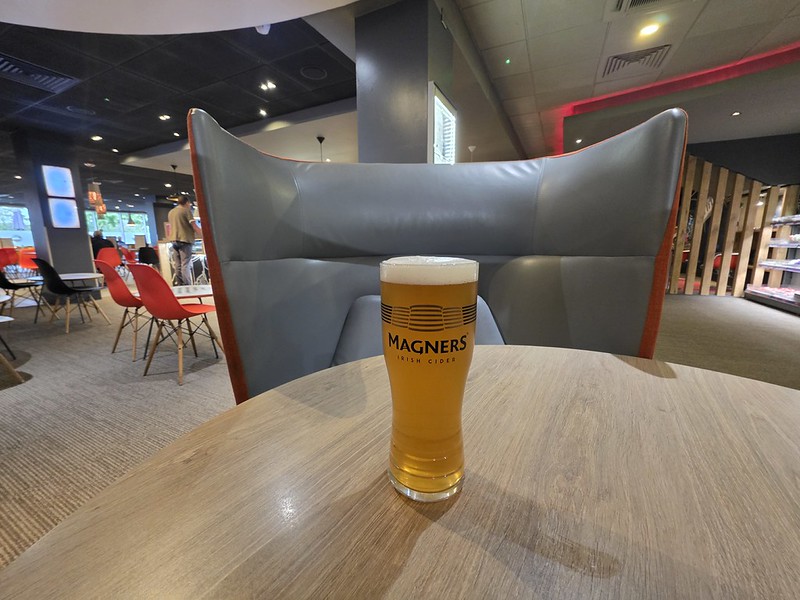
Home games at the Artichoke are fairly straightforward affairs involving decent beer and a steady supply of Tayto crisps, which remain the undisputed king of the bar snack hierarchy I’ve recently decided, although I can be fickle with these things. It is going to be a long, unpredictable season, but at least the crisps and beer are likely to be good. What could possibly go wrong?
And we’re off in Richard’s rickety old car, but I was very positive about it by talking about my friend Liam’s decadent car which does massages for the passenger seat…. I think Richard feels better when he hears about positive things.
Safely at the car park at Stratford with none of Richard’s eggs being broken on the journey. Richard reassured me that all the cars sounding their horns at him was just typical London behaviour.
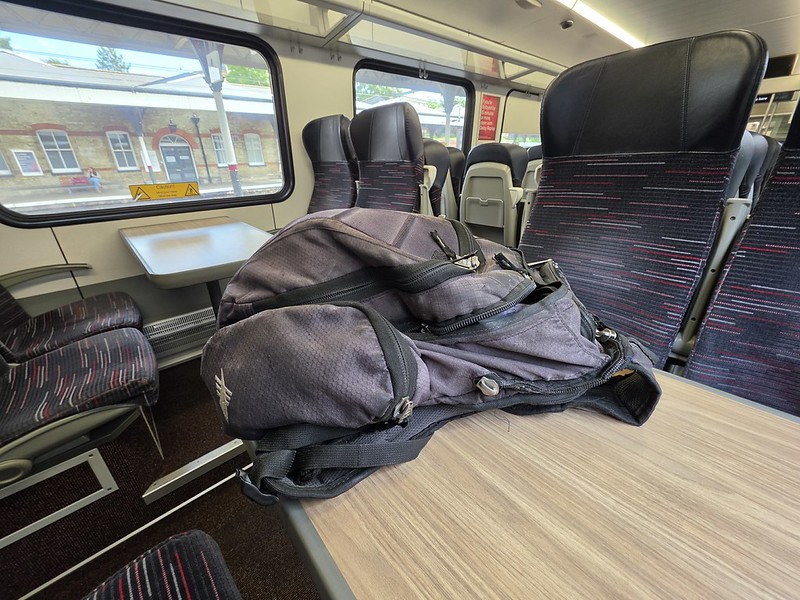
There were some cancellations on the Elizabeth Line, but we had a wait of just a few minutes. Most of the delays were because Richard has bought a suitcase bigger than me that he’s trailing behind him, whereas I have my backpack to allow for efficient travel. I didn’t say anything though.
Top travel tip, don’t use the Elizabeth Line to go to Heathrow Airport if you can avoid it, it’s around four times more than going to Hayes and Harlington on the Elizabeth Line.
And safely into Hayes and Harlington where I had found a little restaurant for us to eat our evening meal in. But more of that in the next post….
And just some more photos to remind myself of what was demolished and when at Anglia Square…. They’re making good progress, although it’ll be interesting to see the cinema when the side is taken off of that.
Back to my series of posts from 200 years ago, I think it might be useful to touch upon the brewery arrangement run by Thomas Massey. He advertised in the Norwich Mercury in March 1825 with this text:
“Thomas Massey, Ale and Table Beer Brewer and Maltster, St. Stephen’s Gates, Norwich. Most deeply impressed with a sense of gratitude for the support which he has received & which he continues daily to receive from his many Friends in the city of Norwich and county of Norfolk, begs thus publicly most respectfully to offer them his sincere and heartfelt thanks, at the same time assuring them his constant endeavours shall be to vend a beverage genuine in quality and pleasing to the palate. Families supplied with Malt and Hops.”
This was the St. Stephen’s Brewery which Massey operated and it was trading from the 1820s. He was still going into the early 1840s and by then he was brewing from the newly opened Champion pub (which is still there and I visited last year), which he appeared to own. In 1844, he decided that he would sell his entire operation off and that included the brewery, malting house, surrounding buildings and some land as well.
In 1899, following the death of Charles Crawshay, there was an interesting article in the local press which touched upon this brewery.
“It is with deep regret that we record the death of Mr Charles Crawshay, of Hingham, who passed away on Wednesday evening, after a very brief illness. The deceased was in his usual health on Tuesday, and enjoyed a long drive in his carriage in the forenoon, but shortly after his return he was suddenly seized with paralysis, which terminated fatally. Mr Crawshay was in his 85th year. Born at Rowfant, Surrey, the deceased gentleman, at the age of 18, went to the London firm of Messrs Charrington, Head, and Co., to undergo a three years training in all that pertains to a brewer’s business. In 1845 he took charge of his father’s St Stephen’s Brewery, Norwich, and in 1850 entered into partnership with Mr John Youngs (Youngs, Crawshay, and Youngs).
In 1876 by a maiden bid of £30,000 at auction he secured the Diss Brewery, which has since proved a valuable adjunct to the Norwich Crown Brewery, which latter has been recently converted in a limited liability company. For the greater part of the century Mr Crawshay has been a familiar figure in the county, and the older inhabitants of Norwich well remember his style and dash. He was one of the best “whips” in the neighbourhood, and the manner in which he handled his four-in-hand team was indeed a sight to witness. He subsequently turned his attention to yachting, and in 1852 his boat, the Kestral, won prizes at Cantley and Coldham Hall regattas and at Yarmouth water frolics. In 1856 he married Miss Cubitt, a relative of Sir William Cubitt, who constructed Lowestoft Harbour. The following year he served the office of Sheriff of Norwich, and received the thanks of the city for his services and hospitality.
On removing to Hingham in 1858 Mr Crawshay went in for farming, and gained considerable fame as a breeder of Southdown and cross-bred sheep. A keen sportsman, he was a big preserver of game. His love of sport is inherited by members of his family. His connection with politics was but slight, but he held that a parson should under no circumstances take part in magisterial affairs. By his death the poor of the district have lost a generous friend.”
In the early 1820s, the British public was gripped by a peculiar form of gambling fever orchestrated by Thomas Bish, someone who seemed quite a character to say the least. The advert above was in the Norwich Mercury from 200 years ago, although the lottery arrangement was a national one.
Bish was the most prominent lottery contractor of his day and he turned the sale of state lottery tickets into a massive marketing spectacle. Operating out of offices at 4 Cornhill and 9 Charing Cross in London he managed to get his whole lottery system sanctioned by the state. He put bold ads in newspapers, such as the Norwich Mercury, he created eye-catching handbills and used humour in his adverts. He was ahead of his time.
The era of these grand lotteries came to a close in 1826 when the Government finally abolished the state lottery as it didn’t suit their needs. Bish did not go quietly as he campaigned vigorously against the ban and even managed to get himself elected as an MP for Leominster twice although his first win was unseated because of his Government lottery contracts. Bish advertised that it would be the last ever lottery conducted in the Kingdom, but then in the 1990s, John Major came along and introduced the National Lottery once again.