Tag: Norwich Castle

  • Norwich – Norwich Castle Museum (Cromer by James Stark)

    Norwich – Norwich Castle Museum (Cromer by James Stark)

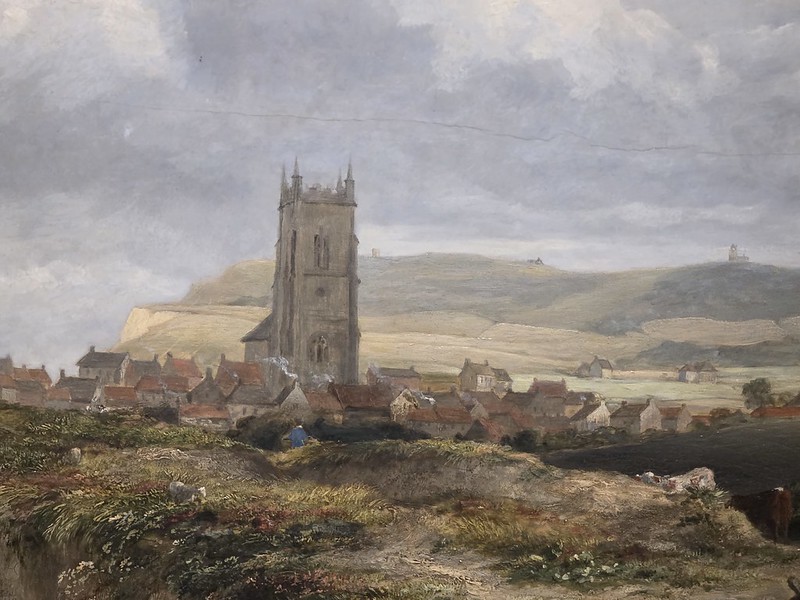
    This is an artwork by James Stark (1794-1859) which is in the collections of Norwich Castle Museum. It was purchased for the museum in 1975 with grants from the Art Fund, Watney Mann (I don’t specifically know why the brewery contributed to this) and the Victoria & Albert Museum.

    Stark was a Norwich School landscape painter, best known for his big and usually windswept skies along with his slightly melancholy countryside scenes. He trained in Norwich, showed at the Royal Academy, and later taught drawing, including a spell as a master at Queen’s College, Cambridge.

    In terms of this rather serene artwork, in the bottom-left of his painting there are some fishermen going about their business in what would have been a very different town. With no bus or train services at this point, this would have likely felt a rather remote destination.

    Stark painted this in the mid-1830s, at a time when Cromer was starting to evolve as something of a summer tourist destination for those in Norwich and environs. The railways didn’t arrive here until the 1870s, so the town would remain relatively unchanged for some decades.

    Of course, I feel the need for AI to join the party and this is what it believes the scene would look like today if painted in a similar style. I rather like this. The addition of Cromer pier, constructed in 1901, is an accurate one even if some other elements aren’t exactly perfect here.
  • Norwich – Norwich Castle Museum (Fuller’s House by Henry Ninham)

    Norwich – Norwich Castle Museum (Fuller’s House by Henry Ninham)

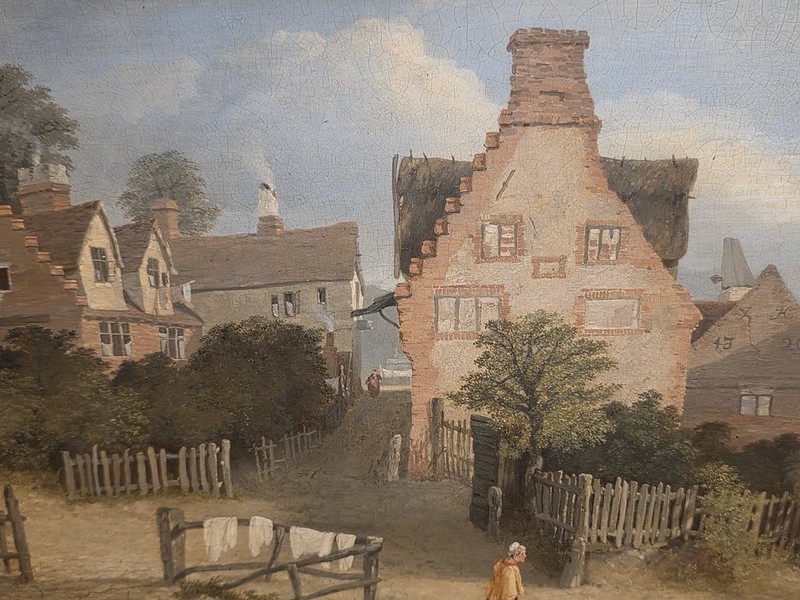
    This artwork is in the collections of Norwich Castle museum and was painted by Henry Ninham (1796-1874). The artwork was painted in the 1840s and was donated to the museum as part of the 1946 Russell James Colman bequest. Ninham nearly exclusively painted Norwich scenes and was enormously useful at recording the history of the city in the period just before photography.

    The building in the painting is Fuller’s House, also known as Fuller’s Hole, which was a residential property owned by Alderman Fuller, who it is frequently mentioned was the Mayor of Norwich, but I can’t find any evidence of that in the lists.

    Unfortunately, this building was pulled down amongst nearly everything else in the area as part of slum clearance in the 1930s. I’m not sure that the area is much better today in terms of architectural merit, it’s the St. Martin’s Close area of the city. If this would have somehow survived, as Elm Hill only just managed to do, it would have been full of character although the splitting of Oak Street in two by the flyover has rather broken this part of the city away.

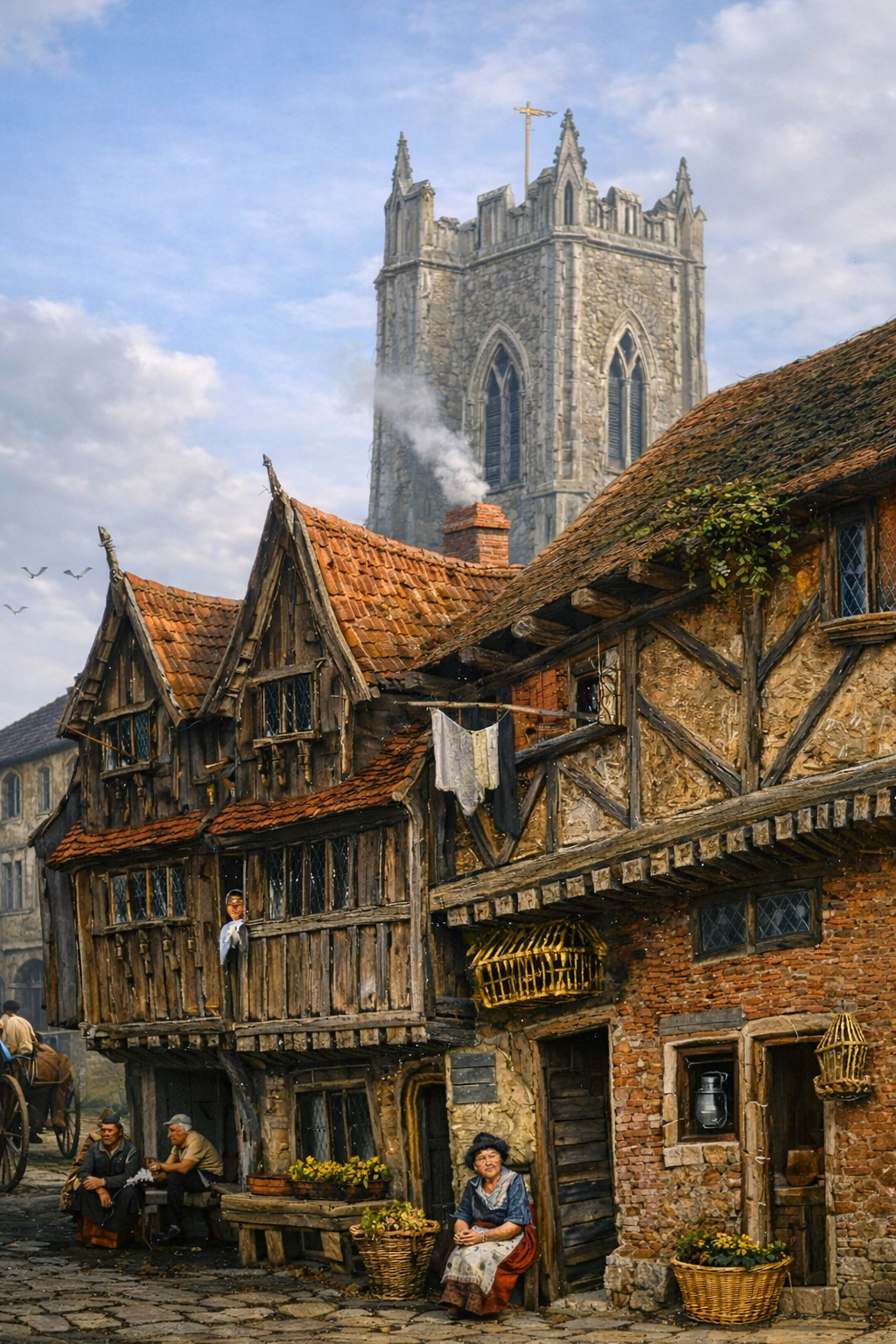
    I’ve felt the need to get AI to bring it to life a little, I think it adds a slightly interesting perspective to matters.

  • Norwich – Norwich Castle Museum (Lots of Old Keys)

    Norwich – Norwich Castle Museum (Lots of Old Keys)

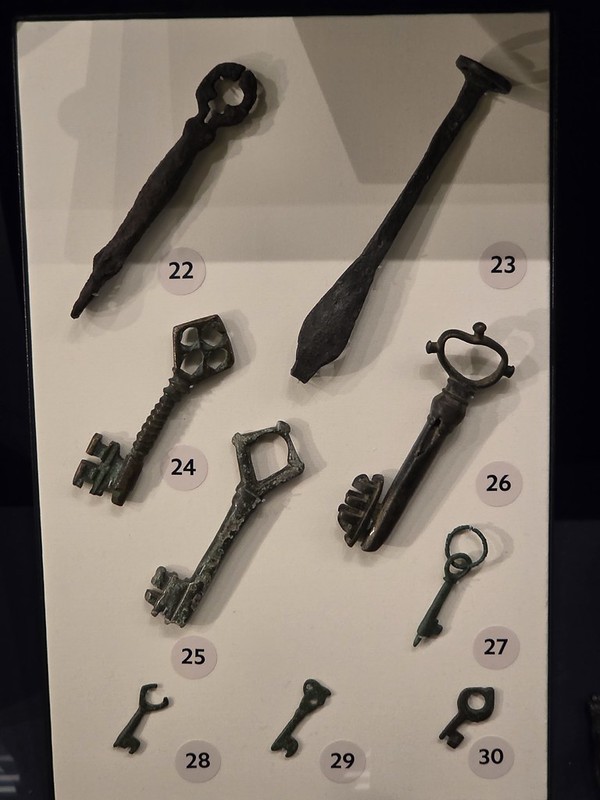
    Maybe a heap of old medieval keys in a museum isn’t at first sight very interesting, but there are certainly some stories hidden away here, even if it’s not clear exactly what they are. As a summary of the keys:

    22 : From St. Martin at Palace in Norwich (dated between 1000 and 1200)

    23 : Found at Castle Acre Castle (dated between 1100 and 1500). This is an iron barrel padlock key that entered the museum collections in 1984.

    24 : Found at Snettisham (dated between 1200 and 1300). This is a copper alloy key that entered the museum collections in 1907.

    25 : Found at Hardingham (dated between 1200 and 1500). This is a copper alloy key that entered the museum collections in 1999.

    26 : Found in Old Buckenham (dated between 1200 and 1500). This is a copper alloy key that entered the museum collections in 1966.

    27 : Found on Botolph Street (dated between 1200 and 1400). It is perhaps a little sub-optimal that this street has gone, I moan periodically that the street line of this could be restored with a little thought with the new Anglia Square replacement development.

    28 – 30 : Found in Caistor St Edmund (dated between 1200 and 1500)

    The museum appears to have put nearly all of their medieval keys on display, so perhaps it’s a little random, but at some point in history these keys would have guarded treasures and resources. There’s a fair amount of engineering that has gone on with some of these and some of them have a fair amount of styling to them.

    I’m not sure that much more is known about any of them, but I rather like the snapshot of history they provide even if their stories have been lost to time. And every treasure once had a keeper….

  • Norwich – Norwich Castle Museum (Severed Head of St. John the Baptist)

    Norwich – Norwich Castle Museum (Severed Head of St. John the Baptist)

    This is the severed head of John the Baptist, I mean what a lovely thing to pop in your living room. This was a popular image in the medieval period and it’s made of terracotta, dating from around 1380 to 1420.

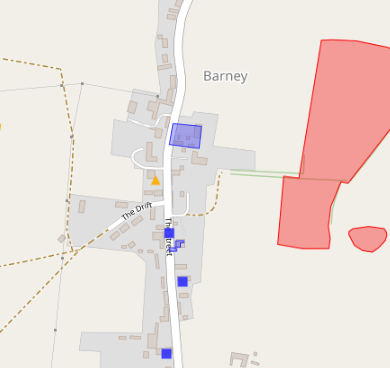
    It was probably once in a church at the top of an arch, but it ended up embedded in a cottage wall in the village of Barney, near to Thursford and was found in 1958 when the wall was demolished. I suppose that it’s quite inspirational in its own way.

    Thanks to Norfolk Heritage Explorer (which is a really wonderful website) the exact location where it was found is marked accurately on the map (the little yellow triangle in the middle of the image), although they only got confirmation of the location in 1984 because a local man remembered where it was found.

  • Norwich – Norwich Castle Museum (St Laurence’s Church by David Hodgson)

    Norwich – Norwich Castle Museum (St Laurence’s Church by David Hodgson)

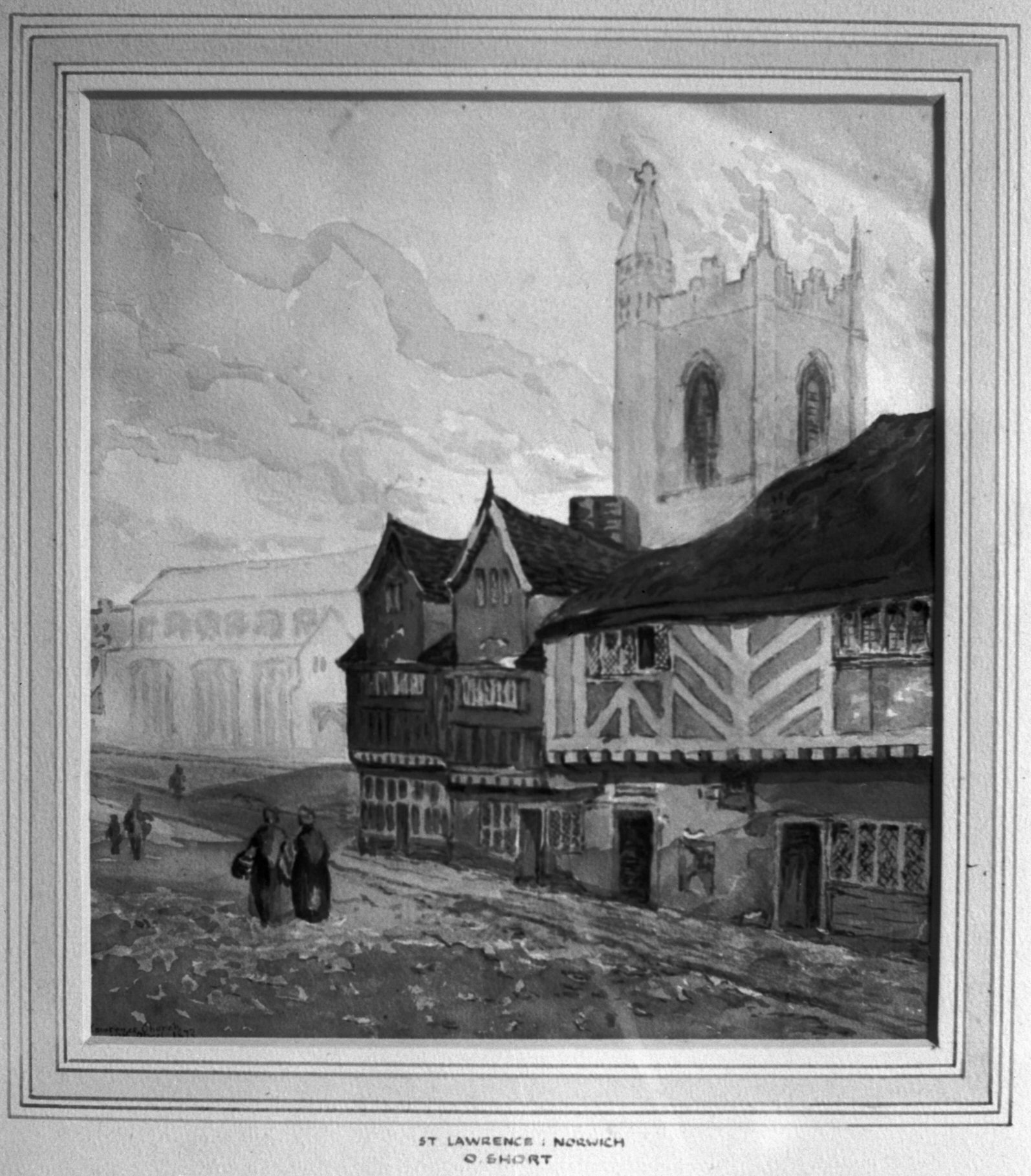
    This artwork is of St. Laurence’s Church in Norwich and was painted by David Hodgson (1798-1864) in 1863. This is one of the churches that was nearly demolished in the 1960s and I made reference to that when wittering on about a defaced statue found there. This artwork would have been painted from Westwick Street, but that area has changed too much to be able to put up a before and after photo. George Plunkett does though link to a watercolour which was painted in a similar place.

    As usual, I’ve had AI try and bring back some of the original colours to the painting. Quaint as the building might look, it’s not entirely clear to me that it was actually structurally sound and pleasant inside.

  • Norwich – Norwich Castle Museum (1400s Book – John Wycliffe)

    Norwich – Norwich Castle Museum (1400s Book – John Wycliffe)

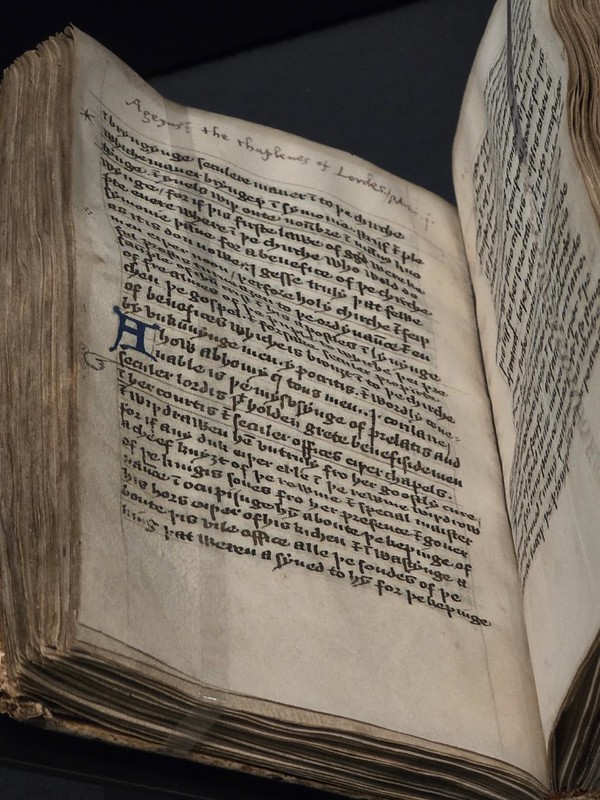
    Friends of mine know that I like books, especially when they come in their thousands at a time, but this is a rather special one published at some stage in the 1400s. I say published, but perhaps more written laboriously out might be more appropriate.

    I let ChatGPT have a go at transcribing this and it didn’t cope with it. However, Google Gemini had a lovely time with it, describing it as text by John Wycliffe (c.1328-1384) that was likely published in the fifteenth century. I know this is correct as the museum stated that it is a book of tracts by John Wycliffe and was published between 1400 and 1500.

    Google Gemini goes further and notes that the general thrust of this is that “it critiques those who hold great benefices and use their positions for worldly gain rather than spiritual care” and this does feel like the sort of text Wycliffe would have written. It’s yet another experiment in the incredible power of AI and I’ve established that it can read Middle English.

    Wycliffe wanted a bit of modernisation in the Catholic Church, ending the abuses and bringing the message of the Bible closer to the people. Pope Gregory XI, who was broadly incompetent for various reasons, condemned that arrangement straight away. There’s a relevance to Norfolk with all of this, as Wycliffe stirred up the Peasant’s Revolt, a national uprising which gained traction in the area. And the Lollards were sort of led by Wycliffe and they had a strong presence in East Anglia.

  • Norwich – Norwich Castle Museum (Mould for Walsingham Shrine Pilgrim Badges)

    Norwich – Norwich Castle Museum (Mould for Walsingham Shrine Pilgrim Badges)

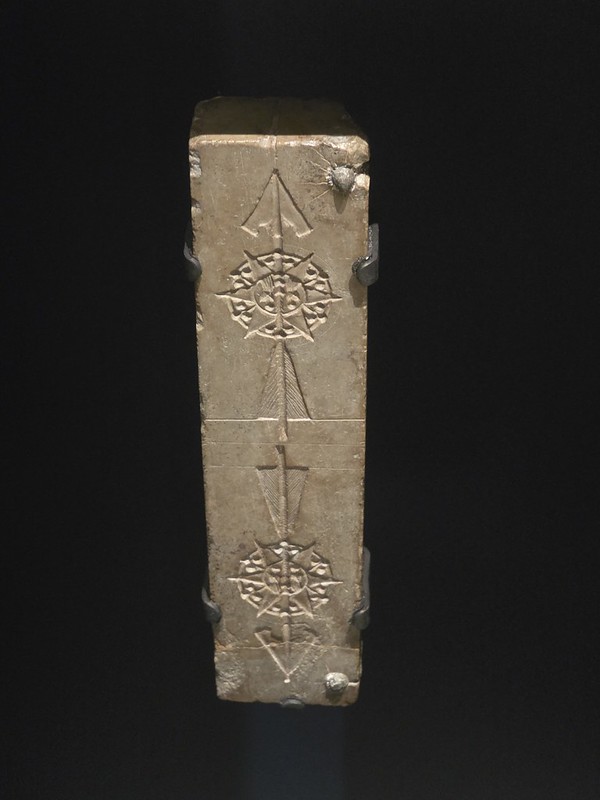
    There’s something a little tacky about this fascinating item in the collections of Norwich Castle Museum. It’s a special piece, it’s the pre-cut mould for pilgrim badges that were sold at Walsingham’s shrine before the Reformation.

    This is obviously how they were made, but perhaps the pilgrims who went there didn’t realise just how mass produced this whole arrangement was. Or, maybe they did, but even the museum notes that this method was designed to be “quick and cheap” rather than something produced to a high standard. And maybe there was a choice of pilgrim badges, from rather more decadent ones to cheap and cheerful. It seems though that some pilgrimage sites were selling over 100,000 badges a year, this truly was the Great Yarmouth of its day.

    King Henry III made a pilgrimage to Walsingham and the shrine of the Virgin Mary in the thirteenth century and then King Edward I, King Edward II, King Henry IV, King Henry VII and King Henry VIII all went afterwards during their reigns. That’s some destination and it’s clear why it also became desirable to pilgrims. King Henry VIII couldn’t have been entirely surprised and delighted by his visit as he later approved it being pulled down during the Reformation.

    I haven’t been able to find any badges in museums or for sale that look similar to this, I had hoped to see what one would have looked like.

  • Norwich – Norwich Castle Museum (Incised Stones in Castle Chapel Over Time)

    Norwich – Norwich Castle Museum (Incised Stones in Castle Chapel Over Time)

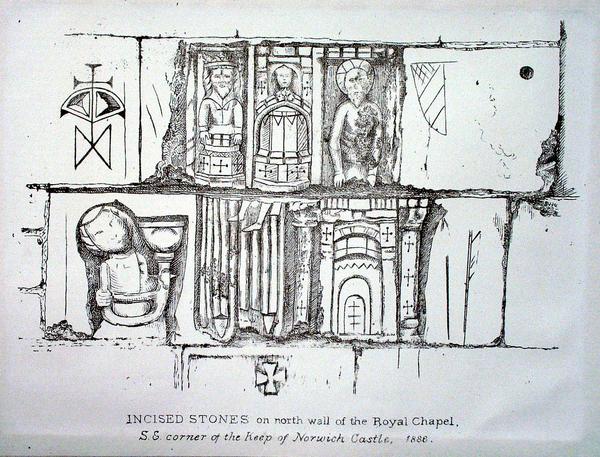
    I’m getting a bit niche now, so this is my last post about the Castle for a few days….. I posted about these stone inscriptions a few days ago.

    I’ve just found this image drawn by Cornelius Jansson Walter Winter (1817-1891) in 1888. The castle ceased to be the city’s prison in 1887 and this image would have been done as part of the work for the new castle museum.

    What I’m impressed by is that nearly 150 years later, the stonework is still in nearly the same condition as it was then. Although, there’s one exception and that’s in the top photo there’s a chunk of ironwork on the right hand side of the image and part of the stone above appears to have been removed. I should probably not be too worried about the removal of a piece of stone, but I’m intrigued.

  • Norwich – Norwich Castle Museum (1990 Information Leaflet)

    Norwich – Norwich Castle Museum (1990 Information Leaflet)

    This feels rather useful, it’s the information leaflet that was given out in 1990 and it’s tucked away on the Norfolk Museums site.

    The layout of the Castle Keep now, with the floor added back in, is pretty much exactly as they had it in this leaflet. This leaflet is slightly less useful as it was as lots has changed, but I think it’s a useful reminder of seeing it as it was.

  • Norwich – Norwich Castle Museum (Tomb Memorial Brass to John Stalon)

    Norwich – Norwich Castle Museum (Tomb Memorial Brass to John Stalon)

    This is a memorial brass which was on the tomb to John Stalon, a tanner in Norwich, who died on 10 October 1463.

    “Orate p aia johis stalon quoda civis norwici barkere qui obiit x die mens october A dm m cccc lxiii ciu Aie ppicient dei”

    The museum notes reads the above, which they translate as:

    “Pray for the soul of John Stalon, formerly a citizen of Norwich, a tanner, who died on the tenth day of the month of October in the year of our Lord 1463, on whose soul may God look with favour.”

    It was formerly in St. Swithin’s Church, which is now redundant. I haven’t written much about this church before, but it’s one of many on St. Benedict’s Street and it was already falling into disrepair in the Victorian period, so its future was never very secure although it did have a new and brief lease of life in the early twentieth century as a church. The Victorians took the tower down before it collapsed of its own accord and here’s what it looked like in the 1880s.

    The church is now used by Norwich Arts Centre who mention on their website:

    “Happily secure in its new 14th century flint building the venue went from strength to strength pulling in the best new music, comedy and performance names on the scene. Amongst those who have appeared are Nirvana, Oasis, Muse, Coldplay, Kasabian and The Manic Street Preachers during the 80’s and 90’s.”

    That’s quite a collection of artists as even I’ve heard of them…. Back to the memorial brass, which came into the collections of Norfolk Museums Service in 1963, handily exactly 500 years after John Stalon’s death. Quite where this memorial brass was over the centuries I don’t know, although it was quite possibly at the church where it avoided being pinched.