Tag: Munich

  • Munich – Führerbau

    Munich – Führerbau

    20250821_150646

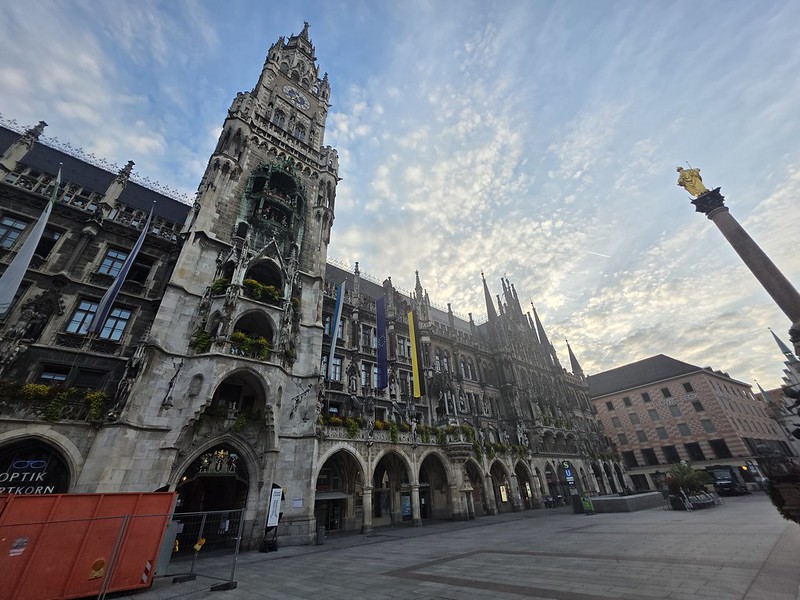
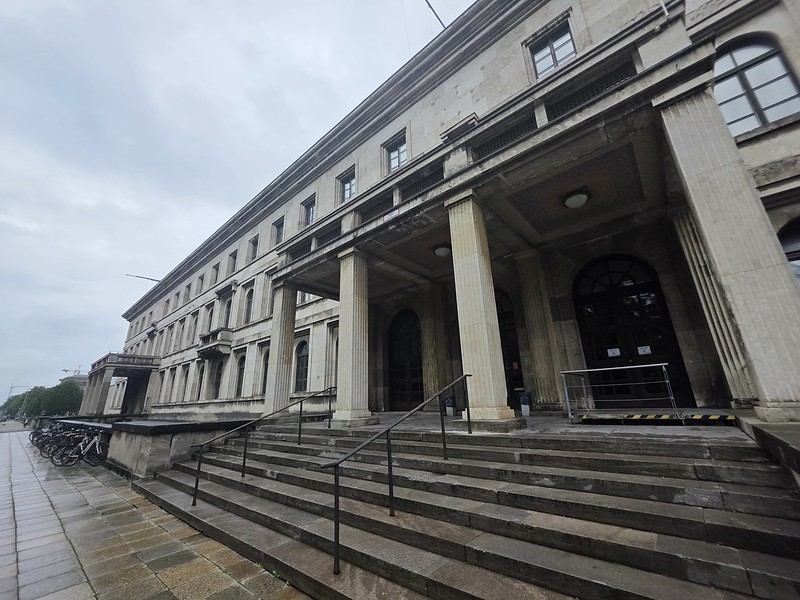
    This is the former Führerbau, which is where the Munich Agreement was signed on 30 September 1938. This deal was agreed by Nazi Germany, Britain, France and Italy, handing the Sudetenland, which was Czechoslovakia’s fortified and industrial border region, to Hitler. Czechoslovakia weren’t at the table to discuss the matter and the British Neville Chamberlain and French Édouard Daladier accepted the transfer to avoid immediate conflict. Germany occupied the Sudetenland in October 1938, stripping Czechoslovakia of key defences and heavy industry and leaving it strategically crippled. Chamberlain also signed a brief Anglo-German declaration with Hitler expressing the wish for peaceful relations, hence the famous “peace for our time” line on his return to London.

    20250821_150257

    The peace agreement didn’t hold, but Chamberlain perhaps didn’t really have much choice here. There was a chance in his mind that the peace agreement might work, but with hindsight it was inevitable that it would fail given Hitler’s evil intent. The document was signed in Hitler’s office, which is still there and used by the University of Music and Performing Arts Munich who now occupy the building. The building had been constructed between 1933 and 1937, part of the Königsplatz project that was part of Hitler’s architectural vision for the city.

    20250821_150641

    The city authorities would have ideally liked to have demolished all of the Nazi era buildings, but they already had a shortage of usable structures post-war and there was nothing wrong with this one other than its association with evil. But, for me to see this building was sobering, it’s not that long ago that Chamberlain turned up here in the hope that he could avert a war. There’s no obvious connection with the past other than for this subtle sign which is in German, Czech and Slovak, a gesture towards the attack on their nations that was agreed here.

    20250821_151057

    And the side of the building which was used by the US after the war as the central point to return artwork and cultural items stolen by Nazis back to their owners. It was given to the University of Music to give it a more positive use and to try and free it from its past. The more modern building to the right of the photo is the NS-Dokumentationszentrum, which during Hitler’s time was known as the Brown House.
  • Munich – BMW Welt

    Munich – BMW Welt

    20250821_124151

    As we were driving by, we thought that we’d pop into BMW Welt to see what the hype seemed to be about given the very positive on-line reviews. This is effectively a decadent car showroom which is free of admission, located opposite to the BMW Museum. This is the heart of Bayerische Motoren Werke and their global HQ, despite huge efforts being made by Dereham Town Council to get them to relocate to the centre of Norfolk.

    20250821_124338

    Some BMW cars.

    20250821_124333

    I was surprised just how busy this whole arrangement was.

    20250821_124426

    An old BMW car. I don’t think I’ll start a blog about cars if I’m being honest.

    20250821_124615

    The Rolls Royce Spectre, which apparently retails in the UK for a third of a million pounds. That’s a lot of Greggs.

    20250821_124634

    You can personalise your Rolls Royce should you wish.

    20250821_124543

    Richard didn’t like it as it wasn’t British enough.

    20250821_124747

    The Rolls Royce Cullinan, which is a little cheaper, but it still seems a lot of money for a car to me. Not that I’m in the market to buy a car, but I wouldn’t dare leave it anywhere in case it was scratched, vandalised or just stolen.

    20250821_124918

    This was Richard’s favourite car.

    20250821_125234

    Looking over the ground floor of the building.

    20250821_125212

    A BMW motorbike.

    20250821_125941

    We didn’t have time to go in, but this is the BMW Head Office on the left and the museum building on the right, both of which are located opposite to BMW Welt.

    BMW Welt is an impressive building insomuch as it’s clearly a popular place to visit. They had a few cafes, but they had rather forgotten to provide sufficient seating, but I’m sure anyone actually wanting to buy a car would be given a free hot drink. I did wonder whether if Richard bought a Rolls Royce whether they’d buy us lunch, but then he declared he didn’t like the designs and so that plan went out of the window. I suspect that I would be more engaged with this if I knew anything about cars of motorbikes, but it was an interesting place to see and especially as it was free.

  • Munich – Munich Documentation Center for the History of National Socialism (Knife and Fork from the Brown House)

    Munich – Munich Documentation Center for the History of National Socialism (Knife and Fork from the Brown House)

    20250820_102347

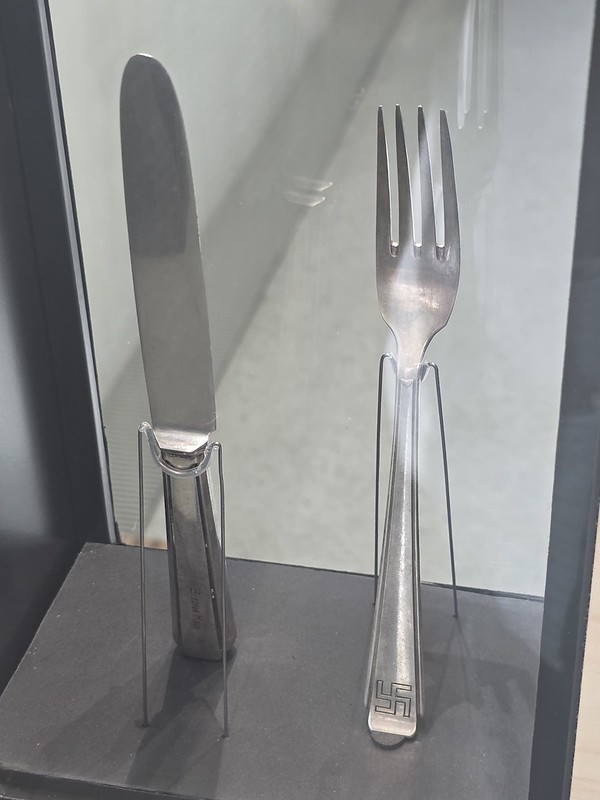
    This is one of the exhibits at the museum which questions what the visitor thinks about them being present, noting “what kind of feelings do these traces of the past trigger in us?” as they’re cutlery from the Brown House which was formerly on this site. The Brown House (Braunes Haus) was the Nazi Party’s headquarters in Munich, set on Brienner Straße between Karolinenplatz and Königsplatz. The building began life in 1828 as a neoclassical city palace, later known as Palais Barlow, designed by Jean-Baptiste Métivier. In May 1930 the NSDAP bought it, financed in part by donations and loans from industrialists such as Fritz Thyssen and Friedrich Flick and they then had architect Paul Ludwig Troost refit the villa into a suitably imposing party HQ. It opened for business in early 1931 and served as the movement’s nerve-centre until the end of the regime. The house was badly damaged in wartime bombing, effectively destroyed, and its ruins were cleared in 1947. For decades the plot remained an empty scar in a quarter that had also included the Führerbau and other party buildings framing Königsplatz, a showpiece space the Nazis had reworked for rallies and ceremony.

    The Munich Documentation Center for the History of National Socialism (NS-Dokumentationszentrum) opened here in 2015, bringing a more positive use to the previous empty space. This seems the ideal place for exhibits such as this to be displayed, they’ve survived for nearly a century now and they may as well be on display in locations which explain the war and the reasons for it. It’s an intriguing survival and the Brown House is where the Blutfahne, or Blood Flag, was stored and Hitler had offices, the centre of where the Nazi movement grew in the early 1930s. If forks from the Brown House can trouble us, it is because they expose how the regime embedded itself in rooms that felt safe and respectable.

  • Munich at 6am

    Munich at 6am

    Just some random photos from Munich at 6am today…. I was still tired from the overnight coach journey, so they might be a little bit wonky.

    20250820_063634

    20250820_063657

    20250820_064005

    20250820_063848

    20250820_065502

    20250820_065708

    20250820_065619

    20250820_065505

  • Munich – Munich Documentation Center for the History of National Socialism (Karl Vossler)

    Munich – Munich Documentation Center for the History of National Socialism (Karl Vossler)

    20250820_102852

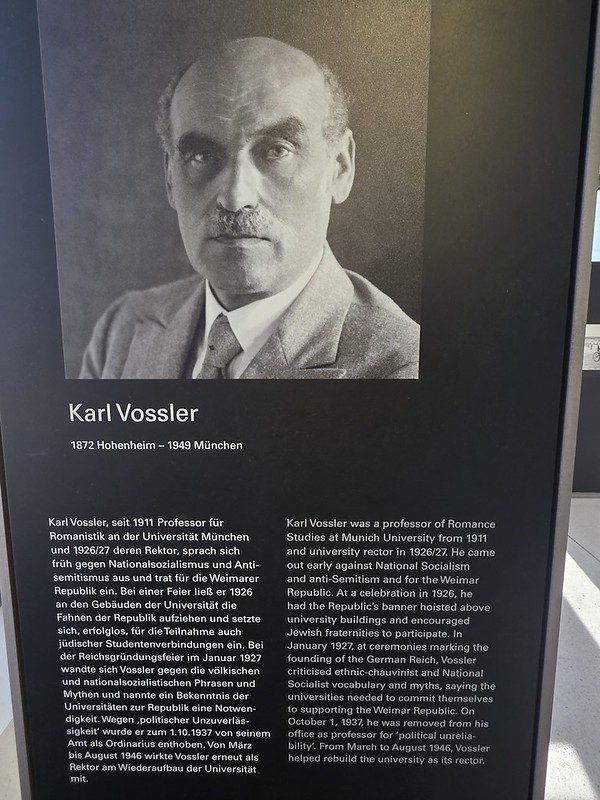
    Karl Vossler (6 September 1872 – 18 May 1949) was a German Romanist and linguist who became one of the leading European scholars of Romance literature before 1933, then a conspicuous academic opponent of Nazism in Munich. It’s for that opposition to the Nazis that has led this museum to feature him and his bravery in opposing the regime. He was born in Hohenheim near Stuttgart and Vossler studied German and Romance philology in Tübingen, Geneva, Strasbourg, Rome and Heidelberg, taking his doctorate in 1897 and his habilitation in 1900. He held the chair at Würzburg from 1909 and moved to the University of Munich in 1911, where he taught for the rest of his life. His standing brought election to the Bavarian Academy of Sciences and, in 1926, the Pour le Mérite for the arts and sciences.

    Politically he was no revolutionary in 1914, signing the wartime ‘Manifesto of the Ninety-Three’ (an interesting document in its own right), yet by the 1920s he was speaking publicly against rising antisemitism and the völkisch right. In a 15 December 1922 lecture to students he likened the swastika to barbed wire and during his 1926–27 term as rector he insisted on including Jewish student fraternities in university ceremonies while ordering the republican black-red-gold flag to be flown on campus. After Hitler’s takeover Vossler tried to shield colleagues, notably defending the philosopher Richard Hönigswald’s position in 1933. The regime soon branded him “politically unreliable” and on 1 October 1937 he was forced into early retirement and barred from teaching, a measure the Nazi lecturers’ association justified by casting him as an ideological opponent.

    When the war ended he returned to public academic life, serving as rector of the University of Munich from March to August 1946 to rebuild the institution and he delivered the memorial address that November for the university’s victims of National Socialism, including the White Rose. Vossler died in Munich on 18 May 1949 and was given an honorary grave in the city’s Waldfriedhof. At least he got to see the Nazi regime that he so hated coming to an end and he is now one of the city’s heroes.
  • Munich – Munich Documentation Center for the History of National Socialism (Ladies Hat from Kristallnacht in 1938)

    Munich – Munich Documentation Center for the History of National Socialism (Ladies Hat from Kristallnacht in 1938)

    20250820_110915

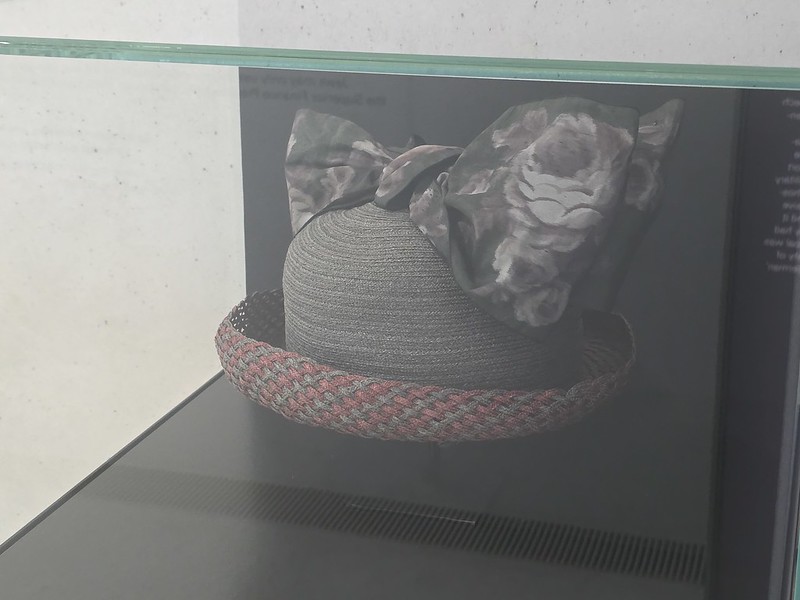
    This is another exhibit at the museum which is from their special exhibition “Memory Is” which is running until May 2026. I’ve visited a lot of museums which have exhibits about the Second World War and the advance of the Nazis, but I can’t recall ever seeing an item which was in a shop during Kristallnacht on 9 and 10 November 1938. This hat was located at the Heinrich Rothschild Hat and Accessories Stall in Sendlinger Strasse (the site is now the Tretter shoe store) and it was badly damaged during the pogrom and then forcibly liquidated soon after.

    The above photo was taken after the pogrom and shows the shop boarded up following the attacks. The Munich City Museum’s director, Konrad Schießl, purchased 92 of the shop’s hats at a heavily discounted price, something which I think showed some considerable foresight. It wasn’t clear that anyone knew what to do with the though and they languished in the museum’s stores and their provenance was left unquestioned. In 2016, the museum wanted to put them on display and they made efforts to find the descendants of the owners and the family allowed the museum to keep the items so that they can remain as exhibits.

    Katrina Recker, the great-granddaughter of the former shop owner Heinrich Rothschild, noted:

    “In the name of my family, I am deeply grateful that this hat, a very personal and moving contemporary witness, now stands as an eternal reminder of the fate of millions of Jewish families during that time. Never forget and never again.”

    And it’s an intriguing thought that this hat was inside the shop when the pogrom took place, it’s another very powerful exhibit that the museum has chosen to put on display.

  • Munich – Munich Documentation Center for the History of National Socialism (No Jews in Libraries)

    Munich – Munich Documentation Center for the History of National Socialism (No Jews in Libraries)

    20250820_104310

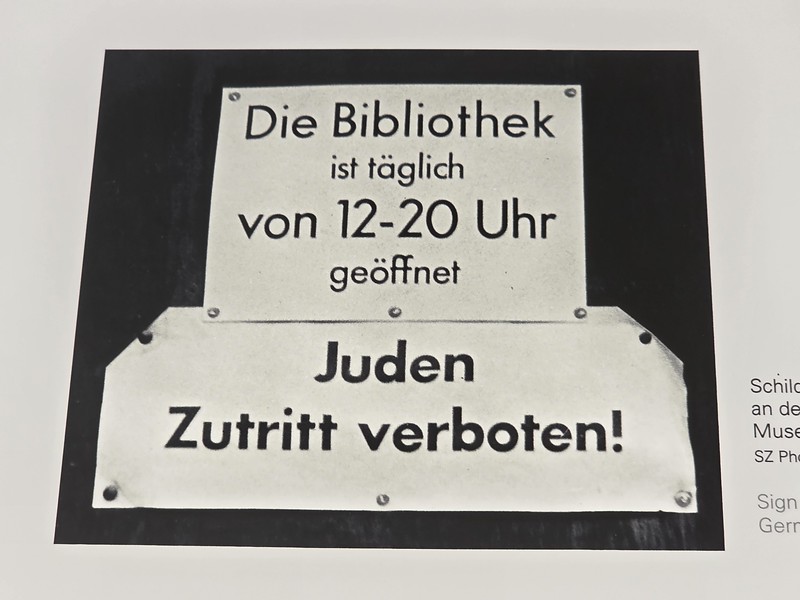
    I wasn’t surprised to read in the museum about how Jews were banned from libraries in Munich in the 1930s as their rights were so comprehensively stripped away from them, but I’m not sure that I’ve actually seen a sign being so clear that they were banned from accessing education in this way. The particular location referenced here was the Deutsches Museum library which is the largest of its type in the country and by 1932, it was known internationally for how it led the way in promoting reading, learning and understanding.

    The library doesn’t directly mention on its website about this ban on Jews being able to access the books, but they do note:

    “During the Nazi regime, the Deutsches Museum could only maintain its independence by making numerous concessions: Nazi functionaries were elected to the museum’s committees, a “Hall for Motor Vehicles” sponsored by Reich Chancellor Adolf Hitler opened in 1938, but above all the library building was used for several propaganda exhibitions, including the inflammatory show “The Eternal Jew”.”

    There are some regimes around the world which still attack libraries, hoping that denying education to those they seek to oppress will someone strengthen their own case and position. For anyone who loved books, learning and education it must have been traumatic to see that denied to them.

  • Munich – Munich Documentation Center for the History of National Socialism (Painting of Maria and Georg Pöltl)

    Munich – Munich Documentation Center for the History of National Socialism (Painting of Maria and Georg Pöltl)

    20250820_105403

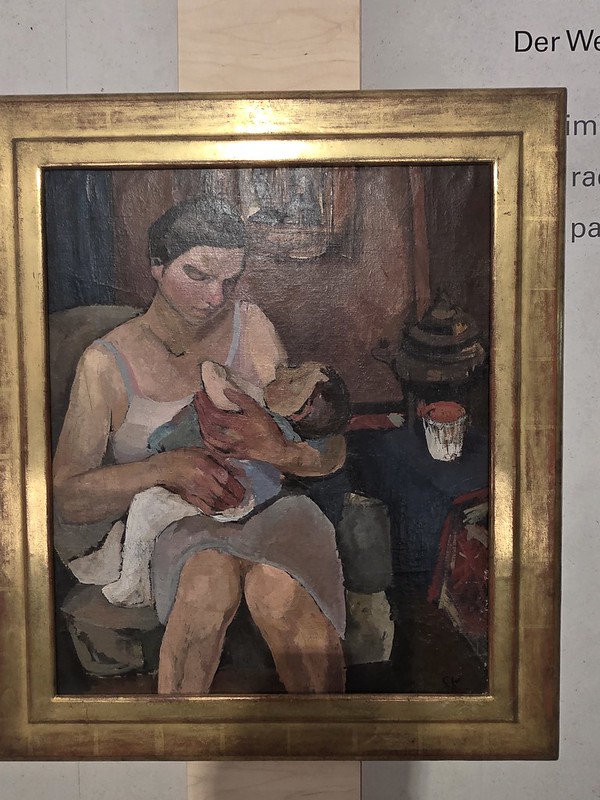
    This painting is one of the items in the “Memory Is” collection which is on display at the museum until May 2026. The painting, by Karoline Wittmann, shows her sister Maria and her sister’s son, Georg. Georg had been born in 1928 and opposed the regime and was sympathetic to the suffering that he saw the Jews were enduring, secretly wearing a Star of David on his undershirt. The museum describes him as a “rebellious spirit” and it’s evident that he wasn’t what the Germans considered to be a well-behaved young man. However, Georg’s father had been killed in Ukraine in 1943 and his mother was required to do wartime labour.

    In February 1945, he and a friend entered a bombed out villa in Bogenhausen and got drunk on bottles that they found in the wine cellar. The police arrested them but as there was no space in Munich’s prisons by that time, he was sent to Dachau concentration camp and thrown into Barrack 27. His bereft mother took him food parcels in the attempt to help and protect him, but it’s not thought that they ever got through to him. She and Karoline went to Dachau on 10 April 1945 and the authorities admitted that Georg had died on 3 April 1945 and they claimed he had died of blood poisoning and that he had been cremated, giving his mother some of his ashes. The camp was overrun by typhus and famine at the time, it was likely that this combination is what made Georg unwell.

    The friend arrested with Georg survived the war and he later explained that he was actually thrown alive onto a pile of corpses and left to die. There were no crematoria in operation at the time, he was buried in a mass grave and the ashes given to his mother weren’t his. Georg was her only child and his mother suffered terribly until her death in 1984, never allowing any mention of her son. Georg was nicknamed Schorschi by his friends and his death at the age of 16 was just another unnecessary casualty of war, being killed shortly before Dachau was liberated by the Americans on 27 April 1945. What looked liked just a typical painting from the period transpired to have a story behind it which the museum has done well to uncover and to explain to visitors.

  • Munich – Munich Documentation Center for the History of National Socialism (Franz Stenzer)

    Munich – Munich Documentation Center for the History of National Socialism (Franz Stenzer)

    20250820_103149

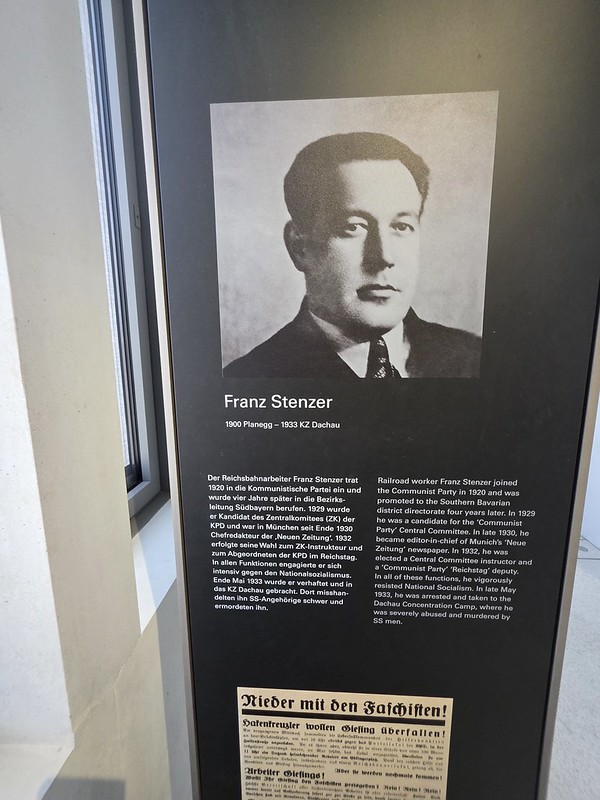
    Franz Stenzer (9 June 1900 – 22 August 1933) was someone that I hadn’t heard of before visiting this museum and he was featured in a section of individuals who opposed the Nazi regime. He was born in Planegg near Munich, he moved to the city as a teenager, served briefly in the navy at the end of the First World War, then found steady work at the Bahnbetriebswerk in Pasing. Colleagues repeatedly elected him to the works council, and in 1919 he joined the local KPD group, cutting his political teeth in workplace and union battles during the turbulent early Weimar years.

    By the mid-1920s Stenzer had risen into the leadership of the KPD’s South Bavarian district. From autumn 1928 to spring 1929 he attended the International Lenin School in Moscow, returned to Munich as a full-time organiser, and was elected to the Pasing city council in 1929. He later edited the party paper Neue Zeitung in Munich and, at the November 1932 election, won a Reichstag seat for the KPD and in 1932 he also joined the party’s Central Committee.

    After Hitler came to power Stenzer stayed in Bavaria, working underground to coordinate the KPD’s illegal network and this displeased the new regime. The police could not find him at first and on 19 April 1933 they took his wife Emma (who lived until 1998) hostage, leaving their three young daughters at home. He was seized in Munich on 30 May 1933, taken the next day to the newly established Dachau concentration camp, and singled out as a prominent opponent of the regime. On 22 August 1933 SS men removed him from his cell and murdered him with Nazi newspapers claiming he was shot while trying to escape, a story later disproved by an investigation that established he had been killed with a close-range shot to the back of the head.

    Emma Stenzer was released for the funeral, then fled with the children via the Saar and Paris into Soviet exile before returning to Germany after the war. Franz is commemorated among the murdered members of the Reichstag in Berlin, and in Munich in 2023 a memorial sign was installed at his former home on the 90th anniversary of his killing in 2023. In the GDR his name was also given to the substantial ‘RAW Franz Stenzer’ railway works in Berlin-Friedrichshain. The news of his death wasn’t secret and was reported in the British media of the time and it must have been something which caused some concern to a few readers who could foresee what was going to happen. He is significant for many reasons, but not least as the first member of the Reichstag to be murdered by the Nazis.

  • Flixbus – Wrocław to Munich

    Flixbus – Wrocław to Munich

    20250819_182057

    As I’m meeting up with Richard in Munich later today, I needed to get from Wrocław last night and the most efficient way of doing that was the direct Flixbus between the two cities. I’ve had mixed experiences with Flixbus, but I thought that it would be worth the risk as the timings worked out well to save me getting a hotel for the evening. Here’s the rather glamorous bus station in Wrocław, although it’s more a shopping centre than a bus station. It’s relatively new and it apparently replaced a ramshackle and disorganised bus station that was previously on the site.

    20250819_184249

    And here’s the grand central area of the shopping centre element, which was rather nicer than the bus station. Ridiculously, the bus station toilets are chargeable and the shopping malls ones are free, so I walked the extra 50 metres to go to the latter.

    20250819_182302

    The coach stops are in the downstairs of the building, but everything was clearly signed. I was pleased that it seemed logical, it’s not always the case.

    20250819_191821

    There we go, stand 7 and I discovered something that I didn’t know, which is that Monachium is the Polish name for Munich.

    20250819_193246

    The coach comes sweeping into stand 6, but that’s near enough. There were two drivers (well, one driver and one helping) and they were friendly and personable.

    20250819_193421

    On board and I had a compulsory free seat reservation which I sometimes think are more hassle than they’re worth. Some people were put next to others despite the coach being nearly empty, but I was fortunate to have no-one next to me for the entire journey so there was plenty of space. There were only two stops which were Dresden and Nuremberg (well, and to fill the thing up with diesel and for the police check).

    20250819_194449

    It was clean on board, but the tray was sticky.

    20250819_194027

    The charging point being down there was a bit of a hassle as neither of my cables were long enough to even tuck my phone into the seat pocket. Instead, I charged my power bank and then charged my phone from the power bank.

    20250819_195528

    Leaving Wrocław I tried to take a photo of the sunset, but, having thought about it, the foreground doesn’t look very decadent.

    20250819_220625

    The police board at the German border, which I’m not sure is entirely commonplace, but it’s why Flixbus has to check passports and ID documents before anyone boards a cross-border route. The policeman was particularly interested in my passport with all its stamps, but not concerned enough to hold the coach up. There was a stop for diesel just before we crossed the Polish/German border and there must have been some sort of issue as there was lots of shouting about and moving the coach about the place. Someone wanted to get off for a cigarette, but this was refused in the middle of a petrol station.

    20250820_061118

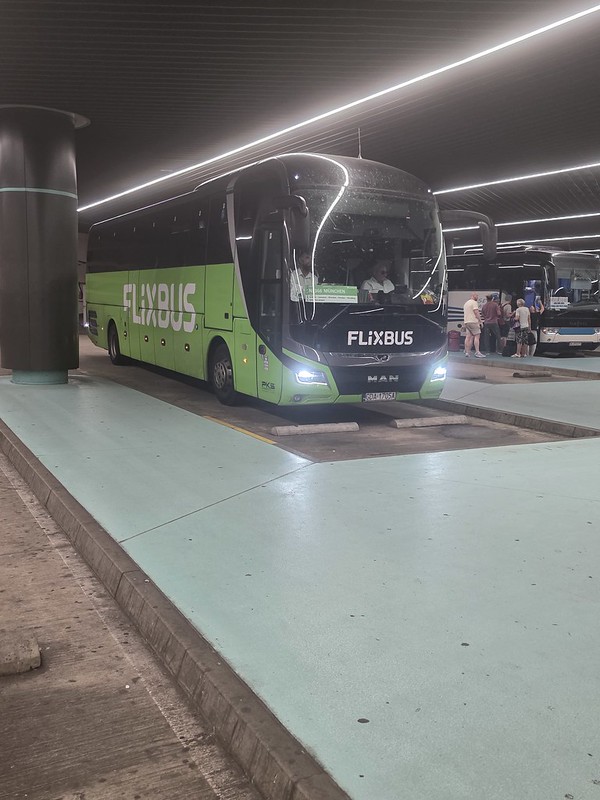
    And safely in Munich after the stops at Dresden and Nuremberg. The coach was always on time, or within a couple of minutes, and it was clean and comfortable. The free wi-fi was a bit limited in terms of the amount of data, but I had free roaming so it didn’t matter. The drivers were friendly, there was plenty of space and it was a reasonable experience for the £45 I paid. This was I accept a little bit expensive for a coach trip, but it saved a hotel and didn’t seem unreasonable. I got a sufficient amount of sleep on board and it was a generally very quiet coach which made that easier. Based on this experience, I’m becoming a little more confident to use Flixbus a little more often rather than just as an operator of last resort. Oh, and the coach station at Munich wasn’t as new and shiny as the one in Wrocław and it did look a bit like it might fall down soon.