Tag: Ickworth

  • Ickworth House – Below Stairs

    Ickworth House – Below Stairs

    20250413_133559

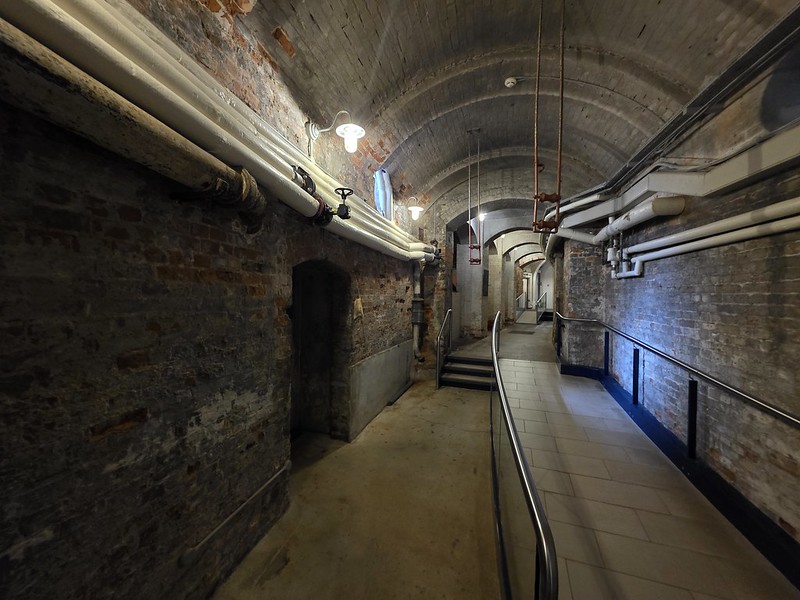
    One of the volunteer guides at Ickworth House told me that this favourite area of the property was the below stairs tunnels and rooms. These comments transpired to be very understandable having seen the whole building, there’s an element of rawness down here.

    20250413_133658

    Located on the lower floor under the Rotunda, the opportunity to explore this hidden world is largely thanks to a significant initiative by the National Trust: the “Ickworth Lives” project. Launched in 2011, this project meticulously researched and restored the basement quarters to reflect their appearance and function during the 1930s.

    20250413_133609

    The wine and craft beer storage area. I accept it was mostly the former.

    20250413_133633

    Keeping track of who was staying in the rooms.

    20250413_134059

    A lovely view of a brick wall, although at least there was some sun shining in. Anyway, I think it’s time for a table:

    Role Key Responsibilities Mentioned/Implied at Ickworth References
    Butler Supervise male staff, manage wine cellar, oversee dining service, potentially valet duties Yes (Mr. Dunning)
    Housekeeper Supervise female staff, manage linens & stores, oversee house cleaning Yes (Mrs. Seddons)
    Cook/Head Cook Plan menus, order food, manage kitchen staff, prepare meals Yes
    Valet Gentleman’s personal servant: dressing, clothes care, shaving, boot polishing Implied/General
    Lady’s Maid Lady’s personal servant: dressing, hair, cosmetics, clothes care Implied/General
    Footman Assist butler, serve meals, answer door, run errands, polish silver Yes (Laurence)
    Housemaid Clean rooms, make beds, clean fires, dust, general household duties Yes (Rose, Lily, Florence)
    Parlour Maid Serve meals (often breakfast/lunch), clean reception rooms, answer door Yes (Mary Brunning)
    Kitchen Maid Assist cook with food preparation, kitchen cleaning Yes (Ruth Mizen, Maggie)
    Scullery Maid Wash dishes/pots/pans, heavy cleaning in kitchen/scullery, prepare vegetables, light fires Yes (Arianna, Harriet Flack)
    Hall Boy General errands, heavy lifting (coal/wood), cleaning boots, assisting footmen/butler Yes (John Mayhew)

    That’s quite a selection of staff who were working in the warren of rooms downstairs. The job wasn’t the worst going, but it would require an early rise and shifts tended to be up to 16 hours a day, with minimal days off. Lady Theodora Hervey, the 4th Marchioness, had at least improved matters somewhat in her 1910 investment in the facilities which reduced the need to walk so far to serve food and it also introduced electric lighting and hot water boilers.

    20250413_134104

    It seems that rather than the servants being housed in the attic of the building,some of their sleeping quarters were located in the maze of downstairs rooms.

    20250413_134155

    I’ve seen far worse in terms of accommodation.

    20250413_134129

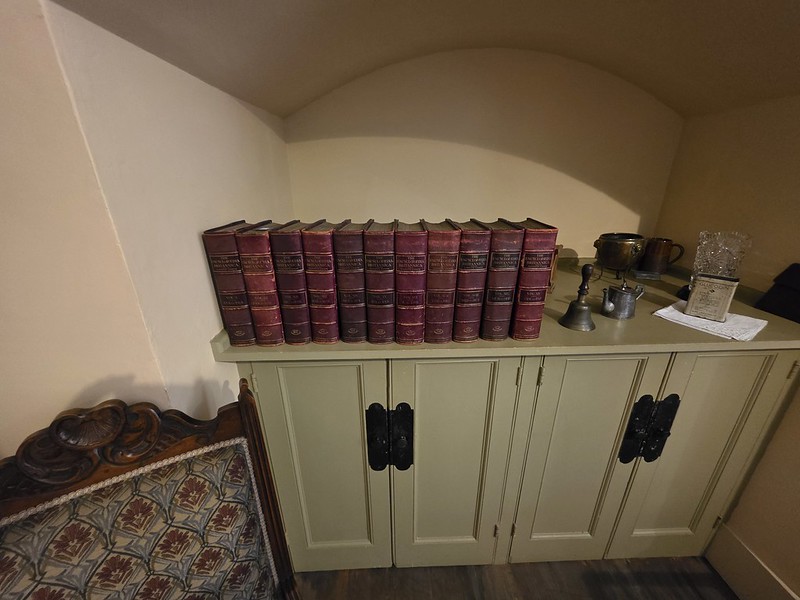
    I can only imagine this was one of the rooms for a butler or valet, it’s quite decadent. It also has half a set of encyclopaedias.

    20250413_134230

    Some of the industrial equipment in the cellars. Liam was more excited about all this engineering than I was. How someone can get excited by a piling rig is beyond me, but I don’t judge.

    20250413_134400

    The finishing kitchen and this was installed after the dining room debacle meant the food was getting cold by the time it arrived.

    20250413_134414

    I did note that the kitchen was bigger than my entire flat….

    20250413_134639

    More engineering.

    20250413_134647

    Liam understood this.

    20250413_134707

    The pipes continue.

    20250413_134722

    One of the toilets that the servants could use.

    20250413_134754

    And, for the sake of completeness, the other one.

    There’s been an increase in interest in this whole sort of thing since Downton Abbey, although I’ve personally always been more engaged with You Rang, M’Lord?, although I must admit to having never watched Downton Abbey…. It’s definitely an intriguing area of the house and they’ve restored this really to quite a high standard of authenticity which has humanised the rooms.
  • Ickworth House – William Hogarth’s ‘The Hervey Conversation Piece’

    Ickworth House – William Hogarth’s ‘The Hervey Conversation Piece’

    20250413_131837

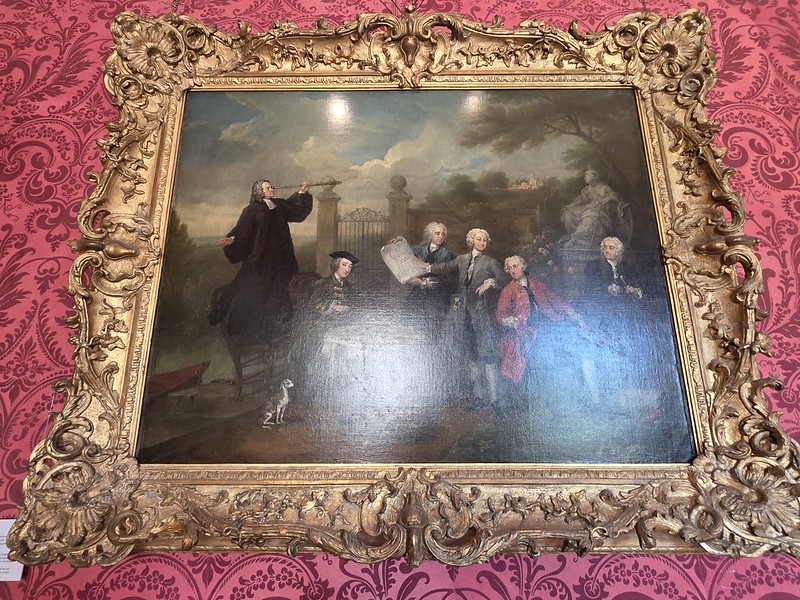
    As I’m not observant, I hadn’t realised at the time that this painting at Ickworth House was by William Hogarth (1697-1764) who must rank as one of the most influential British artists. The work was commissioned by John, Lord Hervey, and also has the title of ‘The Holland House Group’ which seems to me to be a more grown-up sounding name than ‘the Hervey Conversation Piece’. This secondary title points towards the significant presence of Henry and Stephen Fox, whose family later held the title Baron Holland and resided at Holland House. I had to look it up, but the ‘conversation piece’ style of artwork was a thing in the eighteenth century, a way of the middle classes to show off their status.

    It was painted between 1738 and 1740, with this being time for another table…

    Sitter Key Title/Role Depicted Action/Pose Relationship to Hervey/Group
    John Hervey, 2nd Baron Hervey (1696–1743) Vice-Chamberlain to Royal Household Standing centrally, wearing gold key, gesturing at plan Commissioner; Central figure; Political leader/Courtier
    Henry Fox, 1st Baron Holland (1705–1774) Surveyor-General of the King’s Works Standing, holding up architectural plan Political ally (Whig); Colleague (related interests in architecture/works)
    Stephen Fox, 1st Earl of Ilchester (1704–1776) Later Joint Secretary to the Treasury Seated at table with wine/fruit, dog at feet; stick upsets Desaguliers’ chair Brother of Henry Fox; Political ally (Whig); Social connection
    Charles Spencer, 3rd Duke of Marlborough (1706–1758) Gentleman of the King’s Bedchamber (from 1738) Seated left of Hervey, leaning in, gesturing Colleague in Royal Household; Political ally (Whig); Social connection
    Thomas Winnington (1696–1746) Whig Politician Standing beside Marlborough, foot on garden roller Political ally (Whig); Social connection
    Rev. John Theophilus Desaguliers (1683–1744) Natural Philosopher, Clergyman, Engineer, Freemason Peering through telescope, teetering on upset chair near river Intellectual figure; Represents scientific/Enlightenment interests within Hervey’s circle

    I love a political artwork (I don’t get out much) as they’re statements of intent and political alliances rather than anything else. Hervey had reached the giddy heights of Vice-Chamberlain to Royal Household which was a rather more powerful role than it is today. I note that because I would bet that the majority of people don’t know that Samantha Dixon currently holds the role, although I sometimes fear that the majority of people don’t know who the Home Secretary is.

    There is some background information here, which is that John Hervey and Stephen Fox were in a relationship, although initially John has pursued Henry Fox until he rejected the advances and he went for his older brother instead. For extra excitement, Winnington had an affair, likely more than one, and managed to get himself involved in a duel.

    The artwork has never left the property and was owned by the Hervey family until 1956 when it was accepted by HM Treasury in lieu of death duties and then given to the National Trust. There’s also a copy of the artwork at Redlynch Park in Wiltshire, which was the country seat of the Fox family.

  • Ickworth House – Painting of Constantine Phipps Greeting Augustus Hervey

    Ickworth House – Painting of Constantine Phipps Greeting Augustus Hervey

    20250413_131925

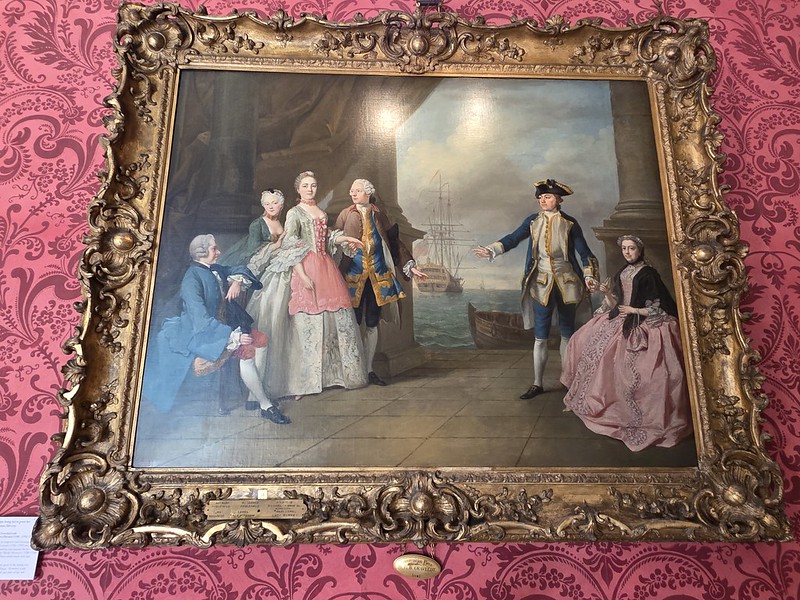
    This painting at Ickworth House shows the meeting of the Hon. Mrs Constantine Phipps being led to greet her brother, Captain the Hon Augustus Hervey, later 3rd Earl of Bristol. The artwork was commissioned in 1750 by the matriarch Mary, Lady Hervey, but it was a rather more complex affair than she might have first intended. The six individuals posed, or whatever it is people do when sitting for a painting, in Paris in October 1750 and much of the whole thing was a show of her social status. Anyway, there’s more about Mary at https://en.wikipedia.org/wiki/Mary_Hervey and more about Augustus at https://en.wikipedia.org/wiki/Augustus_Hervey,_3rd_Earl_of_Bristol.

    The artist was Hubert-François Bourguignon (1699-1773), known as Gravelot, who was something of an active participant in London’s burgeoning art scene, frequenting Slaughter’s Coffee House and teaching at the St. Martin’s Lane Academy, an important precursor to the Royal Academy, alongside figures like William Hogarth and Francis Hayman. His pupils included the young Thomas Gainsborough, who reportedly even painted backgrounds for Gravelot in the mid-1740s. In the Ickworth painting, commissioned five years after his return to Paris, Gravelot appears to have been the primary architect and instigator of the whole arrangement. He is credited with painting the bodies of the figures and, significantly, the heads of Mary, Lady Hervey, and the Fitzgerald couple.

    But then we move onto Jean-Étienne Liotard (1702–1789), a portrait painter born in Geneva to French Huguenot parents. For the Ickworth commission, Liotard was specifically engaged to paint the heads of the Honourable Mrs Constantine Phipps and her husband. But then it seems that Lady Hervey became a bit impatient with the speed of everything and she commissioned Francis Hayman (1708-1776) to finish everything off, although his exact contribution is unclear so there are some figures that have likely been painted by three different people.

    Which gives us (as everyone loves a handy table):

    Figure Name & Title (at time of painting / later) Dates Relationship to Commissioner (Mary, Lady Hervey) Depicted Attire Artist of Head
    Woman being led Hon. Lepell Phipps (née Hervey) / later Lady Mulgrave 1723–1780 Daughter Pink and white dress Liotard
    Man being greeted Captain the Hon. Augustus Hervey / later 3rd Earl of Bristol 1724–1779 Son Blue naval uniform, gold braid Gravelot
    Woman seated (right) Mary ‘Molly’ Lepel, Lady Hervey c. 1700–1768 Commissioner (Self) Pink dress, black shawl Gravelot
    Man leading woman Constantine Phipps / later 1st Baron Mulgrave 1722–1775 Son-in-law Blue attire Liotard
    Second woman standing Lady Mary Fitzgerald (née Hervey) 1726–1815 Daughter Green dress Gravelot
    Second man standing George Fitzgerald, MP (dates N/A) Son-in-law Murrey-brown coat, blue waistcoat Gravelot

    What a faff. This painting was one of the relatively few at Ickworth House that just stayed at the property, perhaps because no-one else would want it, rather than being one that the National Trust had to work out how to reacquire later on. The whole thing feels like the eighteenth century equivalent of a modern-day photo of a family on a first class flight somewhere cultural, showing happy families, a slight air of superiority and a hint of cultural aspirations. Well, something rather more than a hint. The painting is all very country house aristocracy, although to be fair, that’s exactly what it is and I’m rather pleased (as much as anyone can be in the circumstances) that the painting has continued to be kept at the house.

  • Ickworth House – Encyclopædia Britannica Eleventh Edition

    Ickworth House – Encyclopædia Britannica Eleventh Edition

    20250413_134138

    I am that dull that I not only have a favourite encyclopaedia, I have a favourite edition….. So, I’m always surprised and delighted to see them in the wild so to speak. Although the National Trust has split this collection at Ickworth House between two rooms which I managed not to be too traumatised about, although I had a strong urge for Liam to put them all together in one place. I don’t have a physical copy of the book at the moment, but there is a free version on-line and here’s just one random section from the complete set of books that Project Gutenburg has transcribed. I can’t remember if I’ve mentioned, but I had some e-mail conversations with Michael Hart, the founder of Project Gutenberg, in what must have been around 1995. Unfortunately, my e-mail archive doesn’t go back that far to read what riveting things I asked him about….. Anyway, I appear to have digressed once again.

  • Ickworth House – Library

    Ickworth House – Library

    20250413_130928

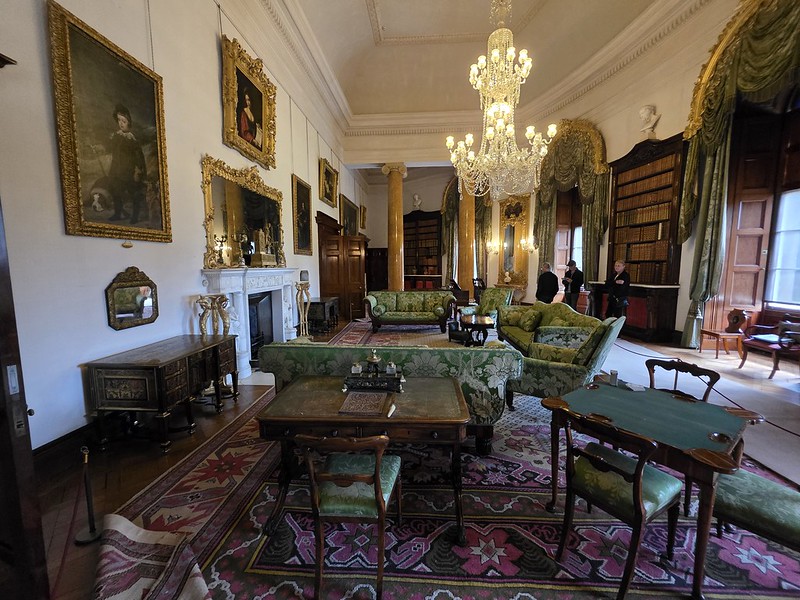
    The library at Ickworth House, the largest of the property’s grand rooms and it is located adjoining the dining room. The name feels slightly misleading, as there are books all over the house and this room doesn’t have that many of them. It’s located at the heart of the Rotunda and is a large and expansive space that was also used as a ballroom. The fireplace was brought from Italy and installed by John Field, all part of the Grand Tour influence.

    20250413_131017

    A lot of the books were rebound by Theodora, Lady Bristol, which has rather hidden their true beauty. I don’t like this uniformity, it’s a shame that the original bindings were lost. That’s what happens when books are seen as aesthetic things rather than beautiful in their own damaged right.

    20250413_131020

    These great pillars are giant scagliola columns which cost £332 back when the room was laid out in the 1820s. It’s fair to say, that was a lot of money, somewhere around £35,000 in today’s money. At the same time, the bookshelves were installed, designed by the royal furniture makers Banting, France & Co who also supplied some of the other furniture in the room.

    Anyway, onto one of my judgemental comments…. This room was significant in 2015 when the National Trust, under the leadership of Helen Ghosh, made a decision that they wanted people to linger in the room longer and to do that they would take the furniture out and put in bean bags. The mind process is just ridiculous, it’s easy to get people to linger in a room but it’s just as illogical to turn it into a waiting room as it is to fill it with clutter and force visitors to spend longer there as they can’t get around. At the time, the former head curator at the National Trust called the whole thing “misguided” and he seems right to me. After much hilarity from some observers, the National Trust scrapped the new vision after realising it was a bloody stupid one.

    A lot of the blame appears to have been dumped by the National Trust onto Sue Borges, and there’s a photo of the bean bag project at Art History News. Borges claimed none of the 9,500 visitors who had gone through that weekend had criticised the arrangement, but the room guides apparently had a different take according to that article and it’s odd that out of such a large audience no-one had a differing view. Normally the Daily Telegraph have an entirely different view on the National Trust to me, as I’ve apparently gone a bit woke, but I’m pleased that wiser heads prevailed. Right, that’s that complaint out of the way and I very much like that they’re taken the historic items they bought back out of storage and restored them to the room.

  • Ickworth House – Dining Room

    Ickworth House – Dining Room

    20250413_131036

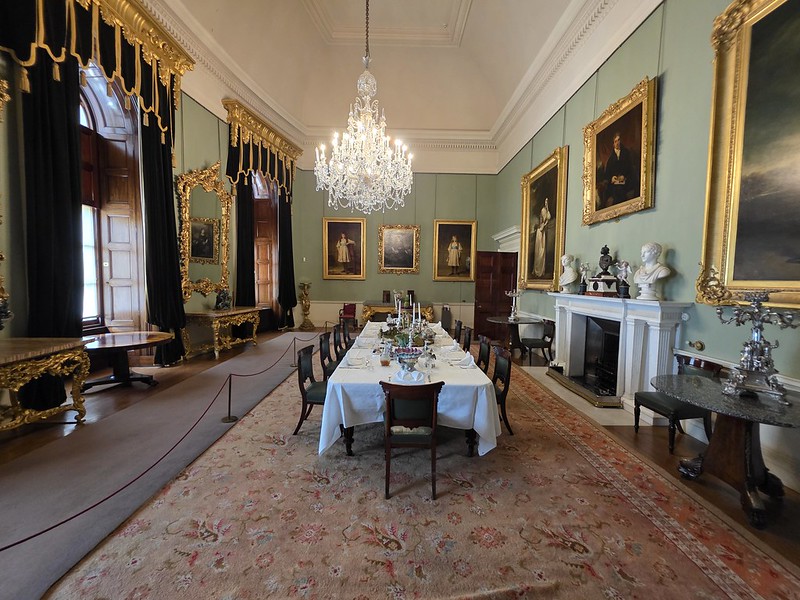
    This is the decadent dining room at Ickworth House, one of the major state rooms in the property which was used for grand dining and located next to the library.

    The room is located on the ground floor of the imposing Rotunda and occupies a central position in the property. The whole Rotunda arrangement was initially conceived by its progenitor, Frederick Hervey, the Earl Bishop, as a magnificent gallery, a ‘kunsthaus’ designed primarily to showcase the vast collection of art and antiquities he amassed during his extensive European travels. However, much of this collection was confiscated by Napoleonic troops which was a bit sub-optimal for the whole arrangement. His son, Frederick William, the 5th Earl and later 1st Marquess, inherited the unfinished project and he decided to mostly live in the East Wing, turning this room into one used only for formal entertaining to surprise and delight visitors.

    Until 1910, the food was brought up from the East Wing kitchens which were located around 300 feet away, so meals turned up on trolleys rather colder than ideal, so a new kitchen was built underneath this room when the property was reworked and a dumb waiter installed to link them. The family were still living in the East Wing, so these kitchens remained the day to day ones, meaning the new one was designed to just be a Finishing Kitchen used occasionally when these big formal entertaining dinners were needed.

  • Ickworth House – West Corridor and William Pitt the Younger

    Ickworth House – West Corridor and William Pitt the Younger

    20250413_130530

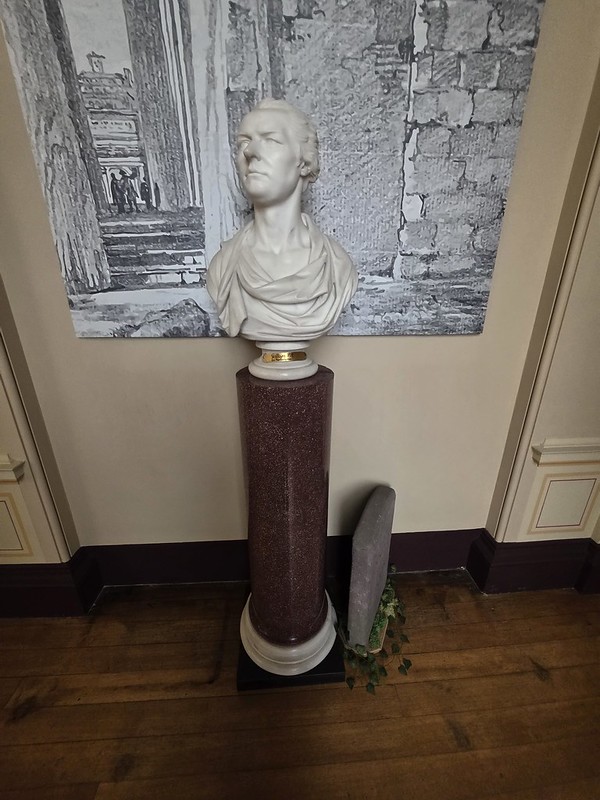
    This sculpture of William Pitt the Younger is located in the West Corridor at Ickworth House, standing next to the sculpture of the 2nd Earl of Liverpool. And, for anyone who remembers (or cares) from that blog post, this sculpture is on a red porphyry scagliola column with a white marble base. Very technical of me…. I don’t much need to write about William Pitt the Younger as he’s hardly an anonymous person.

    Joseph Nollekens (1737-1823) was one of the best known British sculptors during the late eighteenth and early nineteenth centuries. He was born in London to Flemish immigrant parents (his father was a painter) and he trained under the sculptor Peter Scheemakers the Younger and later spent several years in Rome, where he studied classical sculpture and worked for the renowned antiquarian Gavin Hamilton.

    Incidentally, the West Corridor was only completed in 1879 and the Pompeian Room lies at the end of the corridor. The Edwardians painted out all the Victorian artwork on the walls, but much was put back again in 1995.

  • Ickworth House – West Corridor and the Earl of Liverpool

    Ickworth House – West Corridor and the Earl of Liverpool

    20250413_130549

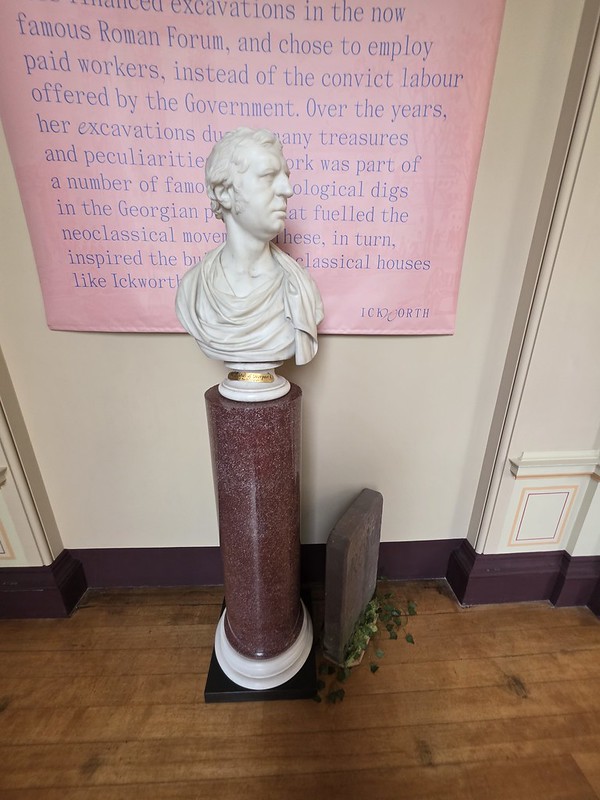
    This sculpture of the 2nd Earl of Liverpool is located in the West Corridor of Ickworth House and it was created by the sculptor B.F. Hardenburg in 1816 who had a studio was located near that of the Rome-trained sculptor Sir Richard Westmacott. I’m not an expert in rock, but apparently:

    “The bust is mounted on a white marble socle (a low pedestal) which then sits on a more substantial porphyry scagliola column. Scagliola is a technique for producing imitation marble, and porphyry is a type of hard, purplish-red rock often associated with royalty and antiquity, suggesting the Earl’s high status”

    I’m not sure I’ll remember some of the more complex words in that sentence, something akin to how I struggle to remember the Polish words I try to learn, but there we go.

    Robert Banks Jenkinson, 2nd Earl of Liverpool (1770-1828), has the connection to the property that he was the brother-in-law of the 1st Marquess as he married Louisa Jenkinson, Countess of Liverpool (nee Hervey). And he was also quite good at politics as he became Prime Minister between 1812 and 1827 which is a lengthy spell surpassed only by Sir Robert Walpole and William Pitt the Younger meaning no-one following him has lasted longer in the role. Incidentally, he was the first Prime Minister to wear trousers rather than breeches, so there’s a fun fact. OK, I accept ‘fun fact’ is a bit relative here…. Incidentally, there’s some irony to me that he is known for this fashion statement, but in the sculpture at Ickworth they’ve dressed him up as a Roman wearing a toga.

  • Ickworth House – Pompeian Room

    Ickworth House – Pompeian Room

    20250413_130722

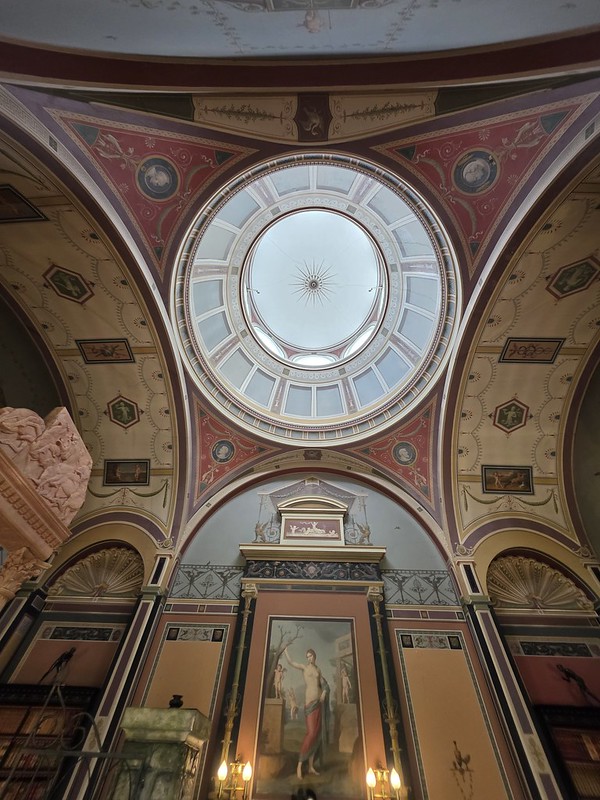
    The Pompeian Room at Ickworth House was completed in 1879 and this wasn’t in the original design conceived by the Earl-Bishop, even though he was inspired by Italian elements during his Grand Tour. Instead, it was the concept of Frederick William John Hervey, the 3rd Marquess of Bristol (1834-1907), who inherited the estate and title long after the initial Neoclassical vision had been established. In 1879, the 3rd Marquess engaged the architect Francis Cranmer Penrose (F.C. Penrose) to undertake works aimed at improving the internal layout of Ickworth. Penrose, a notable and quite decadent figure who held the prestigious position of Surveyor of St Paul’s Cathedral, was specifically tasked with creating both the Pompeian Room and its counterpart, the Smoking Room, within the projecting bays of the linking corridors to the main house.

    While Penrose handled the architectural modifications, the room’s defining characteristic – its elaborate decoration – was entrusted to John Diblee Crace (J.D. Crace) of the renowned Crace decorating firm. J.D. Crace was a leading figure in 19th-century interior decoration, particularly skilled in historical revival styles, making him something of an apt choice for realising a Pompeian scheme. Despite the name of the room, they copied the design from Roman wall paintings found at the Villa Negroni in Rome, rather than using anything that had been found in Pompeii.

    20250413_130719

    Much of the Earl-Bishop’s collections of Italian archaeological treasures were seized by Napoleon, which rather limited his initial intention to create a substantial art gallery and museum at the house. That meant that when Hervey came along decades later, he had to use imitation designs when he built this room. The Victorians, or at least the Victorians who owned large houses, liked to have rooms for specific reasons, such as the smoking room that was built at the same time. This room was used for rather advanced leisure gatherings, it must have all been quite sophisticated and intellectual in here…..

  • Ickworth House – Nothing but Feed, Feed, Feed

    Ickworth House – Nothing but Feed, Feed, Feed

    20250413_135000

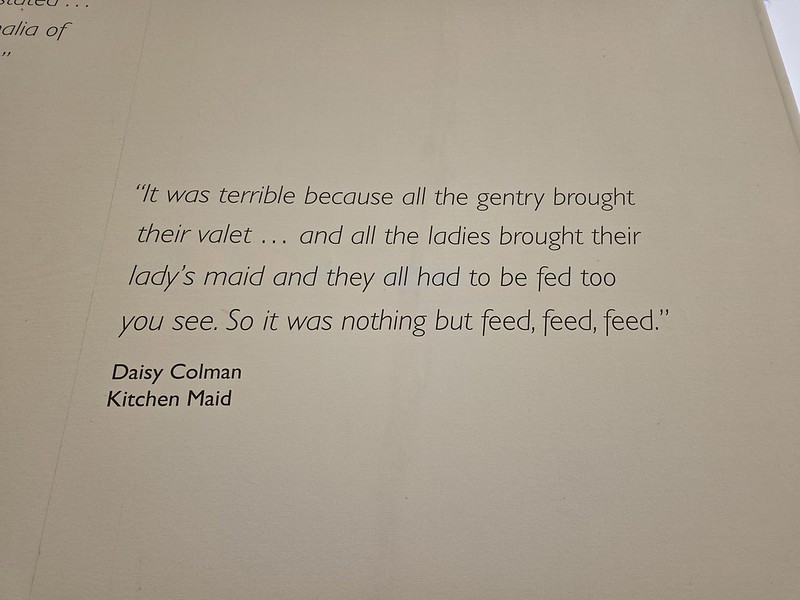
    Liam noticed this when we were at Ickworth House and I rather liked it. It sounds like some of the challenge events I go to when I mention that I’m hungry….