Tag: Great Bealings

  • Great Bealings – St. Mary’s Church

    Great Bealings – St. Mary’s Church

    20250504_174421

    St. Mary’s Church in Great Bealings was mentioned in the 1086 Domesday Book, with reference made to Anund, the first priest, but there’s evidence that there might have been a pagan burial site here before that. I’m a little confused about the age of the church, the listed record dates it to the sixteenth century with substantial alterations in the nineteenth century, but parts of the nave seem older than that to me. But, I’m not a church historian, so there we go….

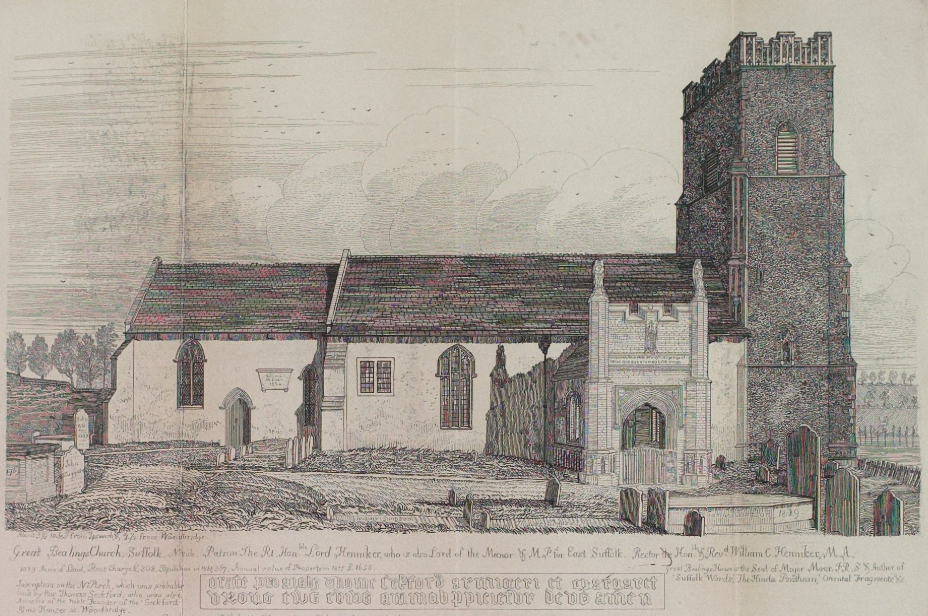
    The church in the early 1840s, before the Victorians faffed around with it. Comparing it with my photo above, it’s an excellent way of seeing just how much of this church was rebuilt in the subsequent renovations and the Victorian obsession with fiddling with these historic buildings.

    20250504_175355

    From the other side of the building, the tower of the church is later, likely from around the 1450s, although this date again isn’t tying into the listed building record. When we parked, which took Richard some time although I obviously didn’t comment, we parked on Lower Street where it meets Boot Street.

    This felt an odd piece of land and it transpires (and is evident from the above map) that this is where the Manor House was located until it was demolished in 1775 and relocated nearby.

    20250504_174510

    This is mentioned to be an original Tudor wooden door and portal into the nave, although it’s in notably decent condition.

    20250504_174541

    The interior is bright with the large windows and gives something of a Georgian vibe at first look.

    20250504_174550

    Bench end carvings and that black and white floor dates from the late eighteenth century when it was relaid in the Georgian period.

    20250504_174606

    The pulpit is Jacobean, from the early seventeenth century and is made from oak, although it was faffed about with the in the Victorian period to add more decoration.

    20250504_174626

    The Seckford Memorial was erected in 1583 to commemorate the life of Thomas Seckford, who died in 1575. It’s notable that there are no effigies, although since they’d only recently gone through the Reformation when a lot of them had been destroyed, perhaps they thought that was wise.

    20250504_175113

    The Seckford Porch, made from brick and added here in the 1520s, which was really when the church was arguably at its greatest power and influence following the reconstruction and patronage.

    20250504_174743

    This is the Clench Monument, which was erected in 1628 for John Clench and his wife, a notable piece of Jacobean art. There was an attempt to depict the Puritan piety and the emphasis on religious commitment.

    20250504_174658

    The chancel which has a strong nineteenth century feel to it.

    20250504_174759

    The stained glass windows are mostly from the Victorian refurbishment.

    20250504_174816

    Looking back down the nave, designed in the early English Gothic style.

    20250504_175018

    I’ve already written about the church’s font (which is one of the earliest items still in the church as it dates from the thirteenth century), the link with the Mayflower Pilgrims and the grave of John Julian Ganzoni.

    20250504_175657

    The village war memorial in the churchyard and I’ve also written separately about the only casualty from the village in the Second World War, Edward Charles Porter.
  • Great Bealings – St. Mary’s Church (John Carver and the Mayflower Pilgrims)

    Great Bealings – St. Mary’s Church (John Carver and the Mayflower Pilgrims)

    20250504_175031

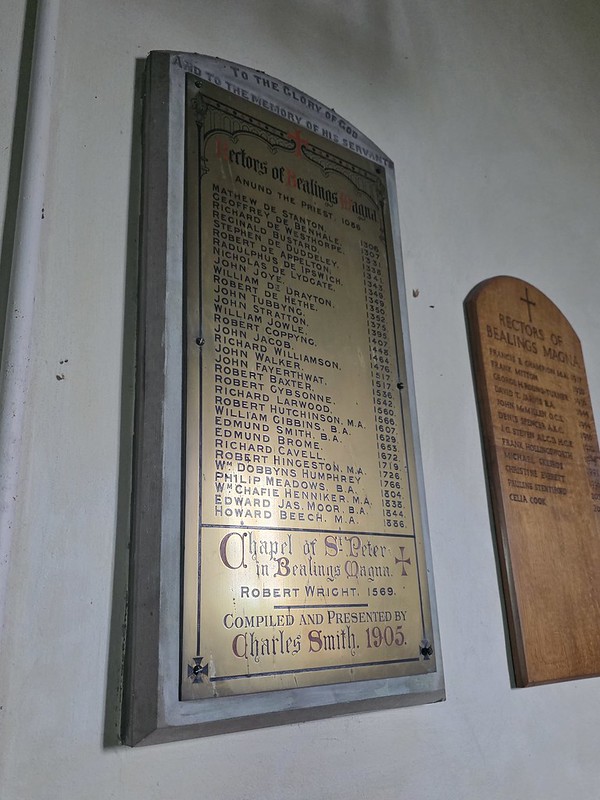
    This is the list of rectors at St. Mary’s Church in Great Bealings and there’s something interesting that took place during the period that Richard Larwood was the rector here and at this font. This is the baptism of John Carver in the church on 12 March 1580/1581 and there’s more information about this at https://mayflowerhistory.com/carver-john and some of this might be recent discoveries as older documents don’t mention it. He appeared in the records of the local Seckford Hall but he sold off all of his holdings there in 1605 and then disappeared from the record before reappearing in Leiden.

    Carver was a member of the Leiden congregation of Separatists who fled religious persecution under the Church of England. Deeply involved in organising the Mayflower voyage, Carver played a critical role in securing funding and negotiating the charter that allowed the Pilgrims to settle in the New World. Carver was elected governor of the colony shortly after the Mayflower arrived in November 1620 and was a key figure in drafting the Mayflower Compact, the first governing document of the colony. Known for his leadership and diplomacy, particularly in maintaining peaceful relations with local Wampanoag peoples, Carver’s tenure was tragically brief and rather sub-optimal. He died in April 1621, likely from illness brought on by the harsh conditions of the first winter, and was succeeded by William Bradford. His legacy remains as one of the founding leaders of early colonial America.

  • Great Bealings – St. Mary’s Church (Memorial to Edward Charles Porter)

    Great Bealings – St. Mary’s Church (Memorial to Edward Charles Porter)

    20250504_174616

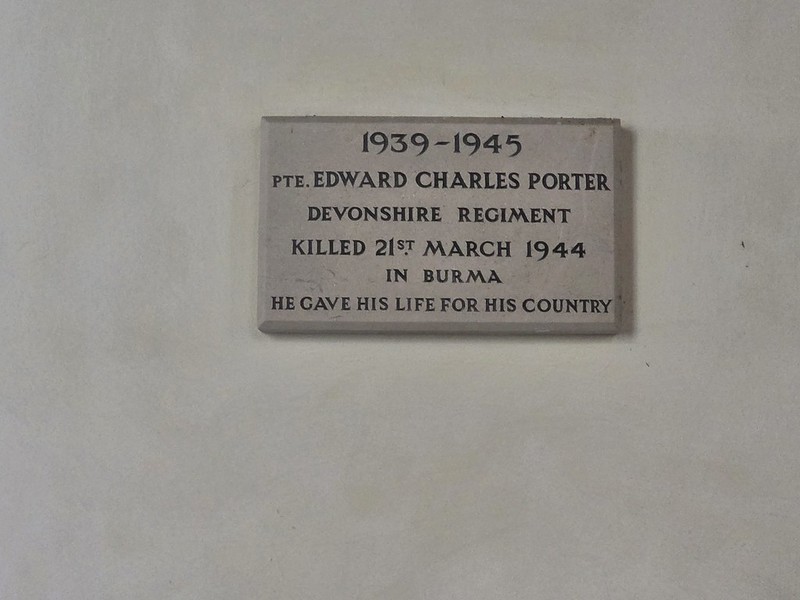
    This memorial to Private Edward Charles Porter is located in St. Mary’s Church in Great Bealings and he was the one villager to lose his life in the Second World War. Edward was born on 18 June 1924 and he was the son of Ernest Albert and Florrie Annie Porter from the village. At the 1939 Register, he’s listed as living at ‘Homeby’ on Boot Street and was working as a market gardener labourer.

    Edward served in the 1st Battalion of the Devonshire Regiment and his service number was 14371165. By October 1943, the 1st Battalion of the Devonshire Regiment was actively engaged in operations near Tamu, a strategically important area in Burma close to the Indian border. Their duties involved extensive patrolling in the Kabaw Valley and along the line of the River Chindwin. This period of patrolling and reconnaissance placed them directly in the path of the impending Japanese offensive.

    The anticipated Japanese offensive, codenamed “U-Go” was launched in March 1944 with the ambitious aim of invading India and capturing the key Allied bases of Imphal and Kohima. As this major offensive began to unfold, the 1st Devons found themselves playing a critical role in the defensive battles. They were heavily involved in defending the series of hills that ran along the vital Tamu Road as this road was a crucial artery for communication and supply, and its control was paramount for both the advancing Japanese and the defending Allied forces.

    The War Diary of the 1st Battalion, Devonshire Regiment, provides specific details about the action in which Private Porter lost his life. On 21 March 1944, the battalion launched an attack against a small, enemy-held hill. This assault was initiated from a feature known as “Devon Hill”. The designation of this starting point as “Devon Hill” suggests it may have been a position recently captured by, or significantly associated with, the Devonshire Regiment, a common practice for naming features in a rapidly evolving battlefield. The attack involved A and B Companies of the 1st Devons and during the assault, B Company, along with the Battalion Headquarters element, came under heavy machine gun fire from well-sited Japanese positions. Two men from the battalion were killed in this specific attack and one of these was Private Edward Charles Porter, dead aged just 19.

    His body wasn’t recovered and he is commemorated on the Rangoon Memorial in Myanmar, a very long way from home. Edward, whose nickname was Jack, gave his life for his country, as the memorial states. His father, Ernest Albert Porter died at the age of 1983 at the age of 95, that’s a long time where he was likely grieving for his lost son, and his mother Florrie Annie Porter died in 1967.

  • Great Bealings – St. Mary’s Church (John Julian Ganzoni, 2nd Baron Belstead)

    Great Bealings – St. Mary’s Church (John Julian Ganzoni, 2nd Baron Belstead)

    20250504_175315

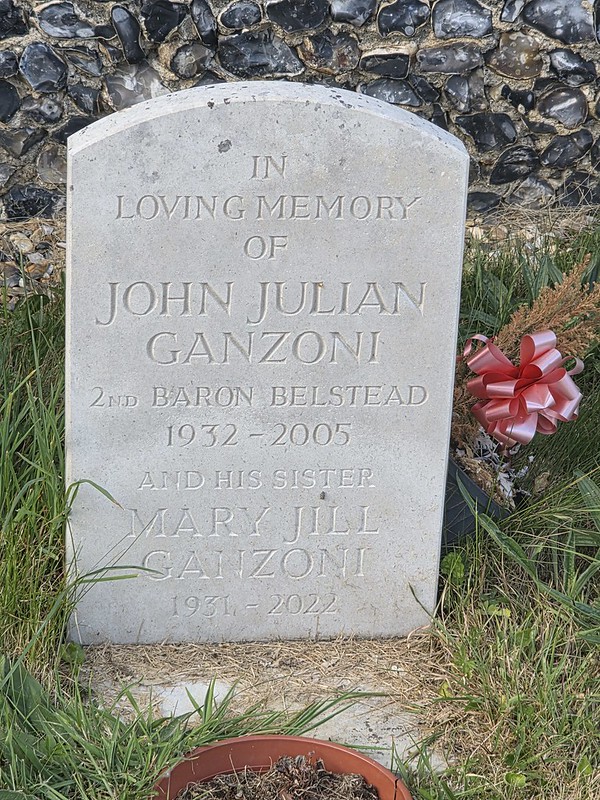
    Whilst meandering around St. Mary’s Church in Great Bealings, this grave caught my eye, commemorating the life of John Julian Ganzoni, 2nd Baron Belstead (1932-2005). John Julian Ganzoni was born on 30 September 1932, the only son of Sir (Francis) John Childs Ganzoni and Gwendolen Gertrude Turner. His father was a distinguished figure in his own right who was a barrister by profession and a long-serving Conservative Member of Parliament for Ipswich, who was elevated to the peerage as the 1st Baron Belstead in 1938. The first Lord Belstead had also served his country during the First World War as an officer in the Suffolk Regiment and his mother, Gwendolen, was the daughter of Arthur Turner, also of Ipswich.

    John Julian grew up with an elder sister, The Honourable Jill Ganzoni, who would later become known for her philanthropic endeavours, notably her significant contributions to the Belstead Centre at Woodbridge School, a lasting tribute to the family name in Suffolk. An early, perhaps formative, brush with the world of high politics occurred in his childhood when he and his sister Jill were presented to the then Prime Minister, Stanley Baldwin, at their parents’ Ipswich home which must have been really rather exciting. Such an environment, where political discourse and public service were familiar concepts, likely instilled in the young Ganzoni a nascent understanding of duty, even if his own political ambitions were not to surface for some years.

    When his father died in 1958, it meant that he joined the House of Lords, but it took him several years to make his maiden speech. Matters changed somewhat though over the next few decades as he was given appointments by numerous Prime Ministers. I think we need a table here….

    Role Department/Body Dates Prime Minister(s) Served Under
    Parliamentary Under-Secretary of State Department of Education and Science 1970–1973 Edward Heath
    Parliamentary Under-Secretary of State Northern Ireland Office 1973–1974 Edward Heath
    Chairman Association of Governing Bodies of Public Schools 1974–1979 N/A
    Parliamentary Under-Secretary of State Home Office 1979–1982 Margaret Thatcher
    Minister of State Foreign and Commonwealth Office 1982–1983 Margaret Thatcher
    Minister of State Ministry of Agriculture, Fisheries and Food 1983–1987 Margaret Thatcher
    Deputy Leader of the House of Lords House of Lords 1983–1987 Margaret Thatcher
    Minister of State Department of the Environment 1987–1988 Margaret Thatcher
    Leader of the House of Lords and Lord Privy Seal House of Lords / Privy Council Office 1988–1990 Margaret Thatcher
    Paymaster General HM Treasury 1990–1992 John Major
    Minister of State Northern Ireland Office 1990–1992 John Major

    After retiring from Government, in 1992 he took over as Chairman of the Parole Board for five years and was known throughout his career as a compassionate Conservative. He died in 2005 without children and when his sister, Honourable Jill Ganzoni, died in 2022 her ashes were scattered next to his which all seems really rather lovely.

  • Great Bealings – St. Mary’s Church (Font)

    Great Bealings – St. Mary’s Church (Font)

    20250504_175018

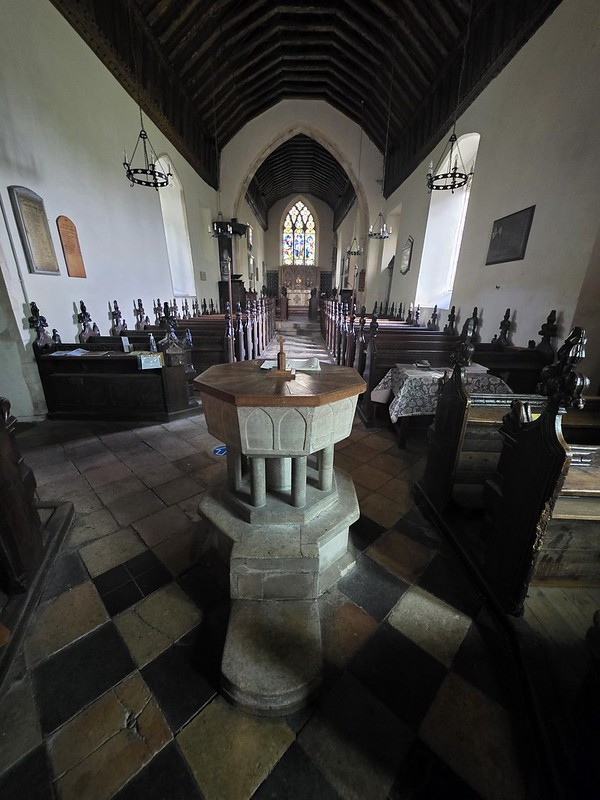
    As I don’t get out much, I’m always intrigued to see an old font in a church, just because of the considerable heritage that they so often have. This one is likely to date from the thirteenth century, a relatively simple octagonal bowl with recessed arches on the sides and made from Purbeck marble.

    20250504_174849

    The circular shaft, with its eight supporting columns, is likely to have been added later. I accept that getting excited about a bit of old stone in a church might seem excessive, but it’s where children were being baptised 800 years ago and that continuity of history does seem remarkable. I like things that are enduring and this has survived through centuries of societal change, conflict and renewal. And that’s not to mention that this font was initially designed for a Catholic Church, but here we are generations later with the font being used for Protestant services. It’s also likely the font where John Carver was baptised.