
Tag: Foxley

  • Foxley – Church of St. Thomas the Apostle (Mabel Annie Purdy – 1883-1913)

    Foxley – Church of St. Thomas the Apostle (Mabel Annie Purdy – 1883-1913)

    20250511_150708

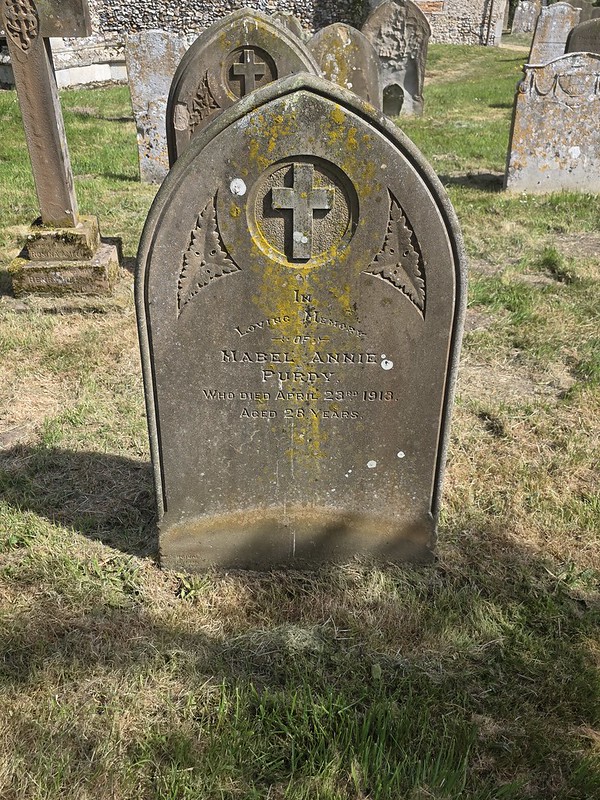
    This grave at the Church of St. Thomas the Apostle caught my eye as it commemorated the life of Mabel Annie Purdy who died according to the gravestone at the young age of just 28. I was initially confused as the church’s birth register notes that a Mabel Annie Purdy was born on 25 November 1882 and baptised on 15 February 1883. However, I then noticed a birth of Mabel Annie Purdy on 7 August 1883 and baptism on 26 October 1884, so I assume the first little girl died and they wanted to give their next child the same name. Both girls were the daughters of Henry Purdy, a publican, and Rosina Purdy (nee Connell). The pub that they ran was the Chequers in the village, which closed in 1968, but apparently the pub sign remains in place so the building on Stocks Hill remains. Henry was a farmer and he was the licensee of the pub between 1863 and very early in 1913, when he died, which is quite a tenure.

    Mabel was mentioned in the Eastern Evening News on 14 April 1902 when her beautiful singing in a concert in Bawdeswell to raise money for the Foxley church bells was mentioned. These church bells have had a substantial amount of fund raising over the years…. The Downham Market Gazette also mentioned on 29 December 1900 that Mabel was excellent at needlework and the Eastern Daily Press on 24 October 1901 mentioned that Mabel and her sister Ada were bridesmaids at the wedding of Albert Green and Edith Purdy. At least those newspaper mentions add a little colour to the detail of her life, I always find it a little sad when it seems nearly nothing is known.

    Mabel died on 23 April 1913, not long after her father died. Unfortunately, I can’t find any mention in the local newspapers as to why she died, so that remains a mystery for the moment at least…
  • Foxley – Church of St. Thomas the Apostle

    Foxley – Church of St. Thomas the Apostle

    20250511_150230

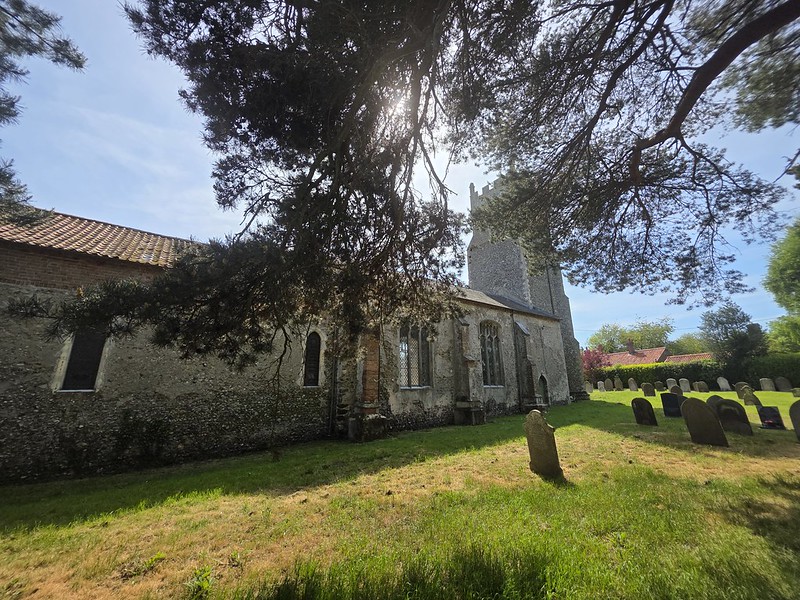
    Next on the tour of Norfolk churches that Richard and I were embarking on was the Church of St. Thomas the Apostle in Foxley. Unfortunately, the church was locked, so I’ll have to limit myself to just the exterior of the building. There has been a church here since Saxon times, although it was rebuilt in stone in the Norman period and most of the nave is from the early fourteenth century and the chancel a little earlier.

    20250511_150532

    I’m assuming these trees mark an extension to the churchyard.

    20250511_145915

    The tower with its not very subtle built-in staircase. The bells in the tower were restored and rededicated in January 2014 by the then Bishop of Norwich, the Rt. Reverend Graham Jones. The bell ringers here have had some challenges over the years, as the Downham Market Gazette reported in November 1879 that £5 was needed to restore the bells as they had been out of use for some time. There was then another fund raiser in 1901 as the bells needs work again, and indeed, nearly every newspaper article mentioning the church over the last 300 years has been about these bells.

    20250511_145934

    The porch was added in the middle of the fifteenth century.

    20250511_145945

    The porch arrangement, now missing its niche statue which was likely removed during the Reformation, was funded by the local Grey family.

    20250511_145953

    The wall painting is from the nineteenth century when the Victorians tidied the building up.

    20250511_145958

    The porch door which is around 700 years old and it does look like it has some heritage to it. I make my usual comment that it still feels special to be able to see a door that has been used by generations by the local congregation and it’s so old that it was originally a door to the pre-reformation Catholic church.

    20250511_150157

    The end of the chancel and this part of the building dates from the late thirteenth century.

    20250511_150127

    The chancel which looks like it was rendered at one point, but that has at some stage mostly fallen off. The render does make quite a lot of sense in terms of protecting the building, and it’s likely the church was rendered for quite a chunk of its history, but it’s nice to see the raw stone underneath.

    20250511_150250

    The side of the chancel, which appears to have been increased at some point given that odd brickwork at the top.

    There are apparently some interesting elements inside, including the fourteenth century font, the old pulpit and the repaired rood screen, but they’ll have to wait until we visit again when the church is open.