
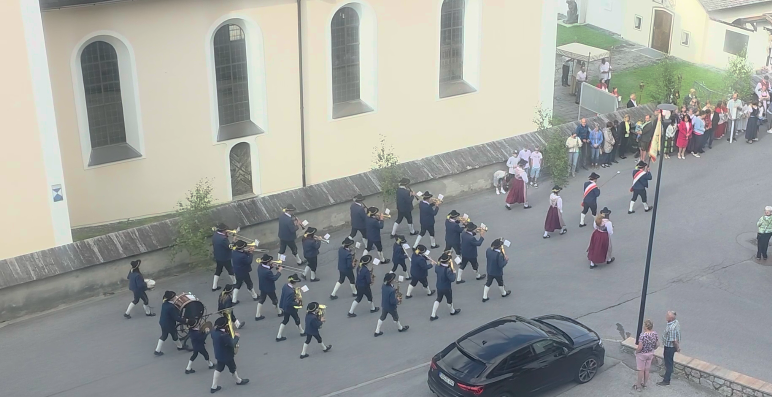
And the second video filmed from my hotel balcony of the parish fair which was held in Richard’s honour. I was surprised that I didn’t see him being carried on the shoulders of the local residents, but he doesn’t like to be showy.
Tag: Flirsch
-
Flirsch – Parish Fair (Video 1)
This was nice, the locals were so excited by Richard’s arrival in their town that they held a parish fair in his honour.
-
Flirsch – St. Bartholomew Church

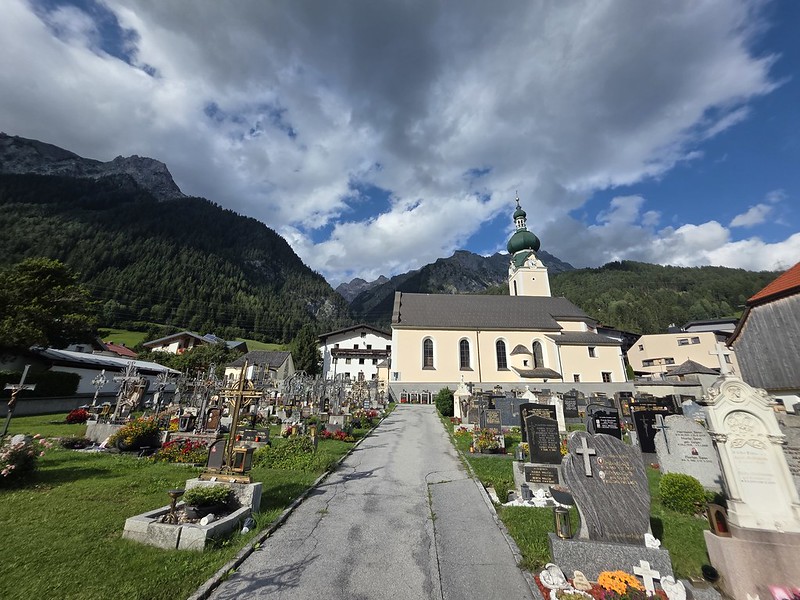
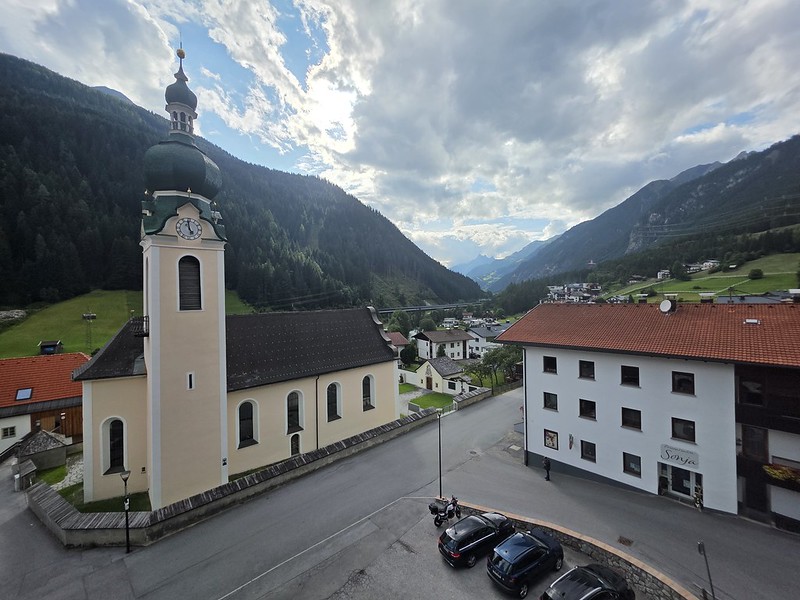
As this was my view from the hotel balcony, I thought it would be sensible to actually visit this beautiful church.

This is certainly a rather photogenic church. The present building dates to 1820, but the parish is older and there was an earlier church on this site. Documentary evidence shows that there was a priest in Flirsch as early as 1385, so there’s a long religious tradition here.

The interior of church looking towards the altar.

And looking back along the nave.

The pulpit and it was slightly puzzling to see how exactly this worked in terms of the priest having to somehow climb up from one side. Until 1975 there was more stained glass here, but they’ve removed a fair amount of it to ensure that the interior looked brighter.

Things became a little clearer when we went to see what was on the other side of the wall. It’s a beautiful church and I’m puzzled that I didn’t take a few more photos, but I think I was distracted at how the pulpit worked….
-
Flirsch – St. Bartholomew Church (War Memorial – World War Two)

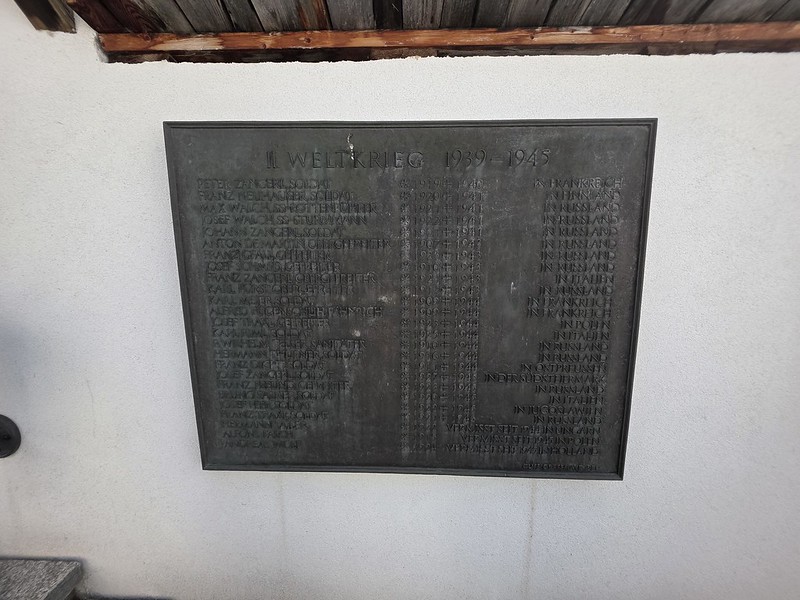
I’ve already written about the war memorial here relating to the First World War, but a second panel was needed following the deaths during the Second World War.

And here’s a list of all those from the local area who died during the Second World War.
Peter Zangerl, Soldier
Born 8 September 1916 – Died 13 May 1940 in FranceFranz Helmuth, Corporal
Born 9 July 1920 – Died 10 April 1941 in ItalyMax Walch, Senior Corporal
Born 29 May 1918 – Died 13 September 1941 in RussiaJosef Walch, Corporal
Born 1 February 1914 – Died 16 November 1941 in RussiaJohann Zangerl, Soldier
Born 18 March 1921 – Died 10 December 1941 in RussiaAnton Kathrein, Senior Corporal
Born 16 June 1919 – Died 13 December 1941 in RussiaGeorg Zangerl, Corporal
Born 2 September 1918 – Died 15 December 1941 in RussiaFranz Zangerl, Corporal
Born 20 June 1914 – Died 28 December 1941 in RussiaPaul Mang, Soldier
Born 10 September 1917 – Died 25 January 1942 in RussiaAlfons Zangerl, Corporal
Born 11 January 1913 – Died 10 February 1942 in RussiaKarl Heim, Senior Corporal
Born 8 March 1912 – Died 18 March 1942 in RussiaAlbert Walser, Corporal
Born 30 March 1912 – Died 10 July 1942 in RussiaFranz Ladner, Corporal
Born 6 October 1908 – Died 17 December 1942 in RussiaJosef Mang, Corporal
Born 8 March 1915 – Died 2 January 1943 in RussiaLamprecht Hellrigl, Corporal
Born 24 February 1914 – Died 21 February 1943 in RussiaKarl Zangerl, Soldier
Born 7 May 1924 – Died 28 August 1943 in RussiaAdolf Ladner, Corporal
Born 2 December 1914 – Died 21 February 1944 in RussiaWilhelm Ladner, Soldier
Born 4 February 1919 – Died 26 July 1944 in FranceKurt Kathrein, Senior Corporal
Born 1 April 1922 – Died 8 August 1944 in NormandyJohann Ladner, Corporal
Born 26 September 1911 – Died 20 September 1944 in the NetherlandsVincenz Kathrein, Corporal
Born 5 January 1909 – Died 18 October 1944 in RussiaJosef Walch, Corporal
Born 22 September 1919 – Died 19 January 1945 in HungaryWilhelm Kathrein, Corporal
Born 24 January 1916 – Died 24 February 1945 in HungaryHermann Ladner, Soldier
Born 28 June 1925 – Died 4 March 1945 in RussiaMissing since 1944 in Russia:
Johann Zangerl, Soldier
Vincenz Zangerl, Soldier
Franz Ladner, SoldierIt had inevitably been challenging for families of the dead during the First World War to come to terms with their loss, but this time, not only was there defeat but very many Austrians had welcomed the Anschluss with Germany in 1938.
It’s an intriguing concept to wonder what would have happened if Winston Churchill had got his way to create a new republic including Austria, Bavaria and perhaps Hungary, a nation designed to be strong enough to stand up to Germany and Russia. Stalin didn’t like this idea, precisely for the reasons that Churchill wanted it, but I can see the appeal of uniting Bavaria and Austria. But probably not now, the moment has rather passed….
-
Flirsch – St. Bartholomew Church (War Memorial – World War One)

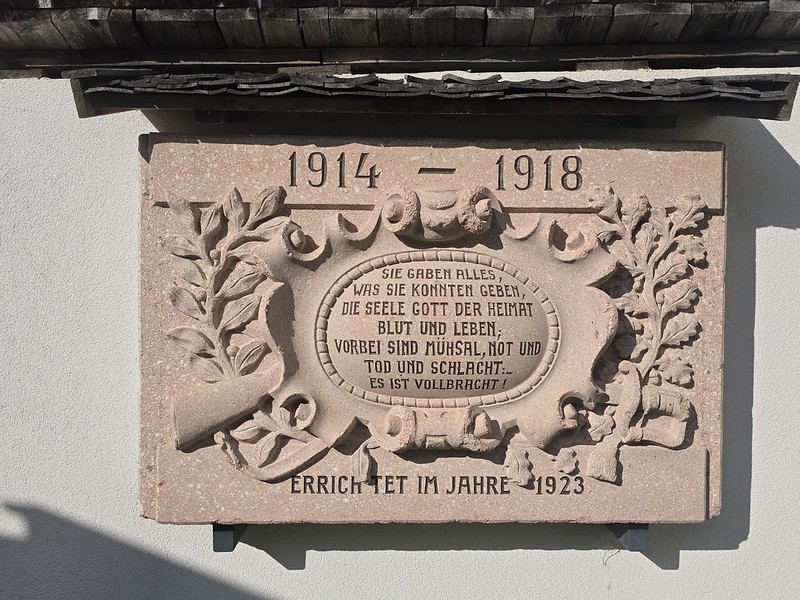
I’m used to seeing war memorials in the UK commemorating the lives of those who died during the First World War, but it feels different looking at the Austrian equivalent. The difference is ultimately because Austria lost the war, so families of the dead had no consolation that at least their loved ones hadn’t died in vain.
The translation of the text reads:
“They gave everything
they could give,
their soul to God, their homeland
their blood and life.
Past are toil, hardship,
death and battle…
It is accomplished!”I’m not actually sure how cheery that messaging is, it would have been hard to explain to families in Austria what exactly had been accomplished given that the Austro-Hungarian Empire had collapsed in 1918.

WORLD WAR 1914–1918
Anton Ehart, Territorial Rifleman
Born 8 December 1891 – Died 4 September 1914 in GaliciaRudolf Geiger, Imperial Rifleman
Born 8 December 1894 – Died 7 September 1914 in GaliciaFranz Grobner, Imperial Rifleman
Born 8 January 1895 – Died 6 September 1914 in GaliciaRudolf Schwenk, Senior Rifleman
Born 8 January 1895 – Died 6 September 1914 in GaliciaAlfons Lins, Imperial Rifleman
Born 18 February 1897 – Died 7 June 1915 in BudapestEngelbert Schaltner, Imperial Engineer
Born 3 December 1887 – Died 14 July 1915 in GaliciaAdolf Wald, Imperial Rifleman
Born 2 April 1891 – Died 16 July 1915 in RussiaJosef Trawa, Imperial Rifleman
Born 13 December 1890 – Died 28 July 1915 in ItalyJosef Alois Tragl, Imperial Rifleman
Born 13 June 1892 – Died 14 May 1916 in ItalyAlbert Martl, Imperial Rifleman
Born 26 March 1895 – Died 10 June 1916 in RussiaSiegfried Tschofen, Territorial Rifleman
Born 6 February 1896 – Died 21 May 1917 in ItalyFranz Ladner, Imperial Rifleman
Born 23 December 1894 – Died 7 October 1917 in ItalyMartin Thalhammer, Territorial Rifleman
Born 4 September 1883 – Died 15 October 1918 in Montkuk (likely Montcuq or another wartime location)Josef Schmid, Territorial Rifleman
Born 7 March 1890 – Died 26 October 1918 in South TyrolJosef Zangerl, Imperial Rifleman
Born 15 February 1892 – Died 13 October 1918 in InnsbruckHermann Walch, Imperial Rifleman
Missing since 1918 in GaliciaJohann Zangerl, Territorial Rifleman
Missing since 1918 in GaliciaI’m sure that it exists, but I can’t find any Austrian list of war dead to find out more about any of these individuals. Around 1.2 to 1.5 million members of the Austrian military lost their lives in the conflict, compared to around 880,000 members of the armed forces from the UK and colonies.
The country of Austria found itself no longer part of an empire, with Vienna now being an oversized capital with considerably less power than it had. The population had to decide whether to throw their hats in with Germany or try and go for it independently, all whilst dealing with a badly damaged economy and infrastructure.
-
Flirsch – Hotel Basur

Richard and I were booking hotels just a day or so in advance a few weeks ago, so going to this location in Austria was a little random. Flirsch is a small, picturesque village in Tyrol which is nestled in the Stanzer Valley between Landeck and St. Anton am Arlberg. It has a lot of alpine charm and traditional wooden houses, a very peaceful little place (well, other than the church bells, but I’ll come onto those in another post).

I’ve never been to a hotel like this, a full on wooden Austrian guesthouse and it was something of a delight. There was a friendly welcome at reception and a cosy atmosphere to the whole arrangement. The online reviews we’d looked at in advance were quite mixed, but it transpired to be a positive experience for us.

Richard had booked a deluxe room with a balcony and I had booked a cupboard, as I like a thrifty option. However, I got to the room and immediately thought that they’d given us the wrong room keys. Much as I liked my room, even I thought that I’d do the decent thing and message Richard telling him he might want to come to the room he had booked.
I was confused as I had booked a room which didn’t have a balcony, yet here I was standing on a balcony with this view. I was surprised and very delighted when Richard replied by message that his room was correct, which meant that I’d been upgraded.

Given Richard had done all the driving that day (and indeed every day) I thought it was only fair that we had a meal on his balcony.

Healthy eh?

The view from my balcony in the evening. This really was so much better than I had anticipated, the room had only cost £60 including breakfast.

A little reading area near reception.

I thought it was a little confusing where to go for breakfast so I waited for Richard as he’s more responsible than I am and he went to go and ask. It’s handy having an adult around.

The meats selection.

The highlight of the breakfast for me was the tomatoes, they were absolutely lovely. I had a lot of them alongside the fresh rolls. This was a perfectly agreeable breakfast and a solid start for the day for Richard and I as we prepared to visit four countries in one day. The juices are from a machine, something Richard wasn’t keen on, but the coffees had a bit of a depth of taste.
As a hotel, this surprised and delighted, although I thought I’d be on my best behaviour all day as Richard questioned privately why they’d given me similar to him when he had paid more. But he was very understanding as he’s better natured than I am with these matters. But the views from my room really were idyllic, I’d very much like to come back here.