
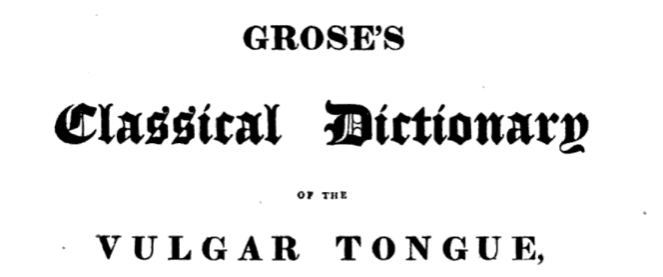
Tag: Dictionary of the Vulgar Tongue

  • Dictionary of the Vulgar Tongue – Day 196

    Dictionary of the Vulgar Tongue – Day 196

    The Dictionary of the Vulgar Tongue was first published at the end of the eighteenth century, and given that the current health crisis is giving too much time to read books, I thought I’d pick a daily word from it until I got bored….

    Loophole

    Grose defined this in the same way that the word is used today, “an opening, or means of escape. To find a loophole in an act of parliament, ie, a method of evading it”. A loophole is another word for an arrowslit, the narrow windows which archers could fire arrows from with minimal chance of being hit back. The meaning of evasion comes from around the seventeenth century, with the word loop coming from the Dutch ‘lûpen’, meaning ‘to watch’.

    The word came into more common usage in the late nineteenth century and has remained in use since then.

  • Dictionary of the Vulgar Tongue – Day 195

    Dictionary of the Vulgar Tongue – Day 195

    The Dictionary of the Vulgar Tongue was first published at the end of the eighteenth century, and given that the current health crisis is giving too much time to read books, I thought I’d pick a daily word from it until I got bored….

    Long Stomach

    A nice definition from Grose which is short and self-explanatory, “a voracious appetite”. Unfortunately, there’s not much to add to this as it doesn’t appear to have been a phrase that was much used. But it should be….

  • Dictionary of the Vulgar Tongue – Day 194

    Dictionary of the Vulgar Tongue – Day 194

    The Dictionary of the Vulgar Tongue was first published at the end of the eighteenth century, and given that the current health crisis is giving too much time to read books, I thought I’d pick a daily word from it until I got bored….

    Lollipop

    Grose excelled himself with this definition, as it’s the earliest that is known for the word (although the OED might be in with a shout here, although they had a different spelling), noting the word meant “sweet lozenges purchased by children”. As Grose noted elsewhere in his dictionary, the word ‘loll’ relates to the tongue, and ‘pop’ is probably just from the sound that eating such a sweet would make.

    Until around the Second World War, the words lollypop and lollipop were usually about the same amount, with lollipop only becoming the preferred spelling in the last few decades.

  • Dictionary of the Vulgar Tongue – Day 193

    Dictionary of the Vulgar Tongue – Day 193

    The Dictionary of the Vulgar Tongue was first published at the end of the eighteenth century, and given that the current health crisis is giving too much time to read books, I thought I’d pick a daily word from it until I got bored….

    Loll

    This is a more upbeat (he often talks about all manner of negative and offensive terms) definition from Grose which is “mother’s loll; a favourite child, the mother’s darling”. I have no idea why the word would come to mean this, it’s from the word ‘lollen’, or to act in a lazy manner. I would have said that this has fallen out of usage, but I have heard children being referred to in this manner, so somehow this word has lingered on….

  • Dictionary of the Vulgar Tongue – Day 192

    Dictionary of the Vulgar Tongue – Day 192

    The Dictionary of the Vulgar Tongue was first published at the end of the eighteenth century, and given that the current health crisis is giving too much time to read books, I thought I’d pick a daily word from it until I got bored….

    Lobscouse

    This word is defined by Grose as “a dish much eaten at sea, composed of salt beef, biscuit and onion, well peppered, and stewed together”. It has a greater importance though in etymological terms because it became a word used to describe those who ate this lamb or beef stew, who were mainly sailors. The shortened version of the word, which is ‘scouse’ became used to describe the workers at the docks in Liverpool and later became used as a nickname for all Liverpudlians.

    And the evolution of the two words over time.

  • Dictionary of the Vulgar Tongue – Day 191

    Dictionary of the Vulgar Tongue – Day 191

    The Dictionary of the Vulgar Tongue was first published at the end of the eighteenth century, and given that the current health crisis is giving too much time to read books, I thought I’d pick a daily word from it until I got bored….

    Little Ease

    Grose defines this as “a small dark cell in Guildhall, London, where disorderly apprentices are confined by the city chamberlain. It is called Little Ease from its being so low that a lad cannot stand upright in it”. Today, the phrase is perhaps better known for a similar room located underneath the White Tower in the Tower of London, although there’s not a great deal of evidence to show that it was used to hold prisoners.

    Walter Thornbury wrote in 1878 about the cells at the Guildhall:

    “On brackets to the right and left of the balcony were the gigantic figures of Gog and Magog, as before-mentioned, giving, by their vast size and singular costume, an unique character to the whole. At the sides of the steps, under the hall-keeper’s office, were two dark cells, or cages, in which unruly apprentices were occasionally confined, by order of the City Chamberlain; these were called ‘Little Ease,’ from not being of sufficient height for a big boy to stand upright in them.”

    It doesn’t sound ideal….


  • Dictionary of the Vulgar Tongue – Day 190

    Dictionary of the Vulgar Tongue – Day 190

    The Dictionary of the Vulgar Tongue was first published at the end of the eighteenth century, and given that the current health crisis is giving too much time to read books, I thought I’d pick a daily word from it until I got bored….

    Lingo

    I had thought (and this is another thing that I haven’t really given much thought to) that this was a newer word than it is, with Grose defining it as “language, an outlandish lingo; a foreign tongue. The parlezvous lingo; the French language”. The word actually seems to date from around 1700, probably from the Portuguese word ‘lingoa’ or the French ‘lingua’.

    The word has remained in relatively constant usage over the last two centuries, with an upturn over the last few decades.

  • Dictionary of the Vulgar Tongue – Day 189

    Dictionary of the Vulgar Tongue – Day 189

    The Dictionary of the Vulgar Tongue was first published at the end of the eighteenth century, and given that the current health crisis is giving too much time to read books, I thought I’d pick a daily word from it until I got bored….

    Light House

    This is another one of Grose’s definitions that I don’t feel the need to add to, but I’ve included it here as I like it. His definition is simply “a man with a red fiery nose”.

  • Dictionary of the Vulgar Tongue – Day 188

    Dictionary of the Vulgar Tongue – Day 188

    The Dictionary of the Vulgar Tongue was first published at the end of the eighteenth century, and given that the current health crisis is giving too much time to read books, I thought I’d pick a daily word from it until I got bored….

    Letch

    This is a word that Grose was one of the first to define and he noted it to be “a whim of the amorous kind, out of the common way”. The origins of the word are unknown, but it might be a slight corruption of the word ‘latch’, which is from the Old English ‘læccan’, which is to grasp or take hold of.

  • Dictionary of the Vulgar Tongue – Day 187

    Dictionary of the Vulgar Tongue – Day 187

    The Dictionary of the Vulgar Tongue was first published at the end of the eighteenth century, and given that the current health crisis is giving too much time to read books, I thought I’d pick a daily word from it until I got bored….

    Lazybones

    I’m not quite sure where Grose got this definition from, as it differs from other accounts on how lazybones evolved, which remains a commonly used word today to describe someone as lazy. He defined it as “an instrument like a pair of tongs, for old or very fat people to take any thing from the ground without stooping”. I prefer his definition though, ‘tongs for very fat people’ to that presented in etymological dictionaries, which just says that it evolved from the word ‘lazy’ being added to ‘bones’, to represent a person.

    It’s one of the few words in the dictionary which is much more in use today than it was when Grose published his book.