
Tag: Dictionary of the Vulgar Tongue

  • Dictionary of the Vulgar Tongue – Day Six

    Dictionary of the Vulgar Tongue – Day Six

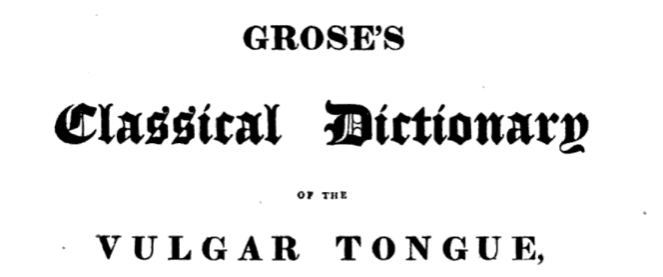
    The Dictionary of the Vulgar Tongue was first published at the end of the eighteenth century, and given that the Coronavirus crisis is giving too much time to read books, I thought I’d pick a daily word from it until I got bored…..

    Arsy Yarsey

    This rather lovely little term used in the seventeenth and eighteenth centuries simply means to fall head over heels, deriving from arsy-versy used from as early as the sixteenth century which had a wider meaning of topsy turvy or back to front. I’m not sure that this term ever appeared much in print, I’m guessing that it was used more in the vernacular.

  • Dictionary of the Vulgar Tongue – Day Five

    Dictionary of the Vulgar Tongue – Day Five

    The Dictionary of the Vulgar Tongue was first published at the end of the eighteenth century, and given that the Coronavirus crisis is giving too much time to read books, I thought I’d pick a daily word from it until I got bored…..

    Ark Ruffians

    The dictionary defines this as “rogues who, in conjunction with watermen, robbed, and sometimes murdered, on the water, by picking a quarrel with the passengers in a boat, boarding it, plundering, stripping, and throwing them overboard.”

    I’m unsure whether the author simply made this up, as there is no mention of this in any UK or US newspaper that I can find. Nearly every Internet search of the term just brings up the dictionary itself, so if this was a phrase then it wasn’t very widespread. It would be interesting though if this practice did take place, something akin to highwaymen on the rivers.

  • Dictionary of the Vulgar Tongue – Day Four

    Dictionary of the Vulgar Tongue – Day Four

    The Dictionary of the Vulgar Tongue was first published at the end of the eighteenth century, and given that the Coronavirus crisis is giving too much time to read books, I thought I’d pick a daily word from it until I got bored…..

    Apple-Pye Bed

    This is of course an expression still in use today, the practice of doubling up sheets so that someone can’t get into bed. The dictionary notes that “it’s a common trick played by frolicsome country lasses on their sweethearts, male relations or visitors”.

    I was also intrigued at the spelling of the word pye, I thought that had gone out of use earlier than it had, it was still persisting in the nineteenth century given the above graph. For those fascinated by the evolution of language, there are two distinct possibilities of how this term came about. Some thing that it’s from an apple pie turnover, where the pastry is folded over. Others say it’s from the French nappe pliee, which is a folded sheet.

  • Dictionary of the Vulgar Tongue – Day Three

    Dictionary of the Vulgar Tongue – Day Three

    The Dictionary of the Vulgar Tongue was first published at the end of the eighteenth century, and given that the Coronavirus crisis is giving too much time to read books, I thought I’d pick a daily word from it until I got bored…..

    Anabaptist

    The traditional meaning of this word is to describe the religious movement that believes baptism is only relevant and meaningful if it’s done by free choice. So being baptised as a baby wouldn’t count, as it wouldn’t be a conscious decision of behalf of the child.

    Anyway, that’s not the slang meaning, which is “a pickpocket caught in the fact, and punished with the discipline of the pump or horse-pond” according to the dictionary. This ‘caught in the fact’ is interesting, not a phrase I’ve heard before, but it seems to be a common nineteenth century alternative to ‘caught in the act’. The link is that if a criminal is ducked into water for his crime that this is like a new baptism, hence the use of the word anabaptist.

    I’m not sure how common the usage of this word was, nearly every mention on-line is from the dictionary itself, with no obvious usage in earlier newspapers. Given that we don’t tend to punish criminals by chucking them in water any more, I can’t see this being a word brought back into usage.

  • Dictionary of the Vulgar Tongue – Day Two

    Dictionary of the Vulgar Tongue – Day Two

    The Dictionary of the Vulgar Tongue was first published at the end of the eighteenth century, and given that the Coronavirus crisis is giving too much time to read books, I thought I’d pick a daily word from it until I got bored…..

    Alderman

    An alderman is an elected, or indeed unelected, member of a county or borough council, but that isn’t what this dictionary defines. Instead, in the seventeenth to nineteenth centuries, an alderman was also a roasted turkey which was garnished with sausages, with these representing the gold chain worn by the council member.

    As an example (thanks to Greens Dictionary of Slang), in the book ‘The Life and Trial of James Mackcoull’, the line “Mackcoull suggested, that they should, in place of an alderman, have a goose and green pease for supper” appears. The word alderman in its original meaning has fallen out of favour in recent decades, now they’re referred to nearly entirely as mayors or councillors. That has also meant that this alternative name for a roasted turkey has fallen out of favour and has been rarely used since the nineteenth century. Which is perhaps a shame as I like the word…..

  • Dictionary of the Vulgar Tongue – Day One

    Dictionary of the Vulgar Tongue – Day One

    The Dictionary of the Vulgar Tongue was first published at the end of the eighteenth century, and given that the Coronavirus crisis is giving too much time to read books, I thought I’d pick a daily word from it until I got bored…..

    Affidavit Men

    Not so much vulgar, but a piece of history that is new to me. These were men who used to hang around courts and places such as Westminster Hall in the eighteenth century and they’d be willing to lie and swear on oath, for a fee of course. Incidentally, trials did once take place in Westminster Hall, including the ridiculous trial of Warren Hastings, which lasted for 7 years and he was eventually found not guilty.

    There was a tongue in cheek newspaper article in July 1776 which advertised for affidavit men, saying:

    “They must be none of your squeamish men, but swear in the face of conviction, for which the following rewards will be given.

    A direct lie – 2 pounds 2 shillings 0 pence

    An indirect lie – 1 pound 1 shilling 0 pence

    An oblique lie – 0 pound 10 shillings 6 pence

    The naked truth – 0 pound 0 shillings 0 pence

    Polling twice – 21 pounds 0 shillings 0 pence”