
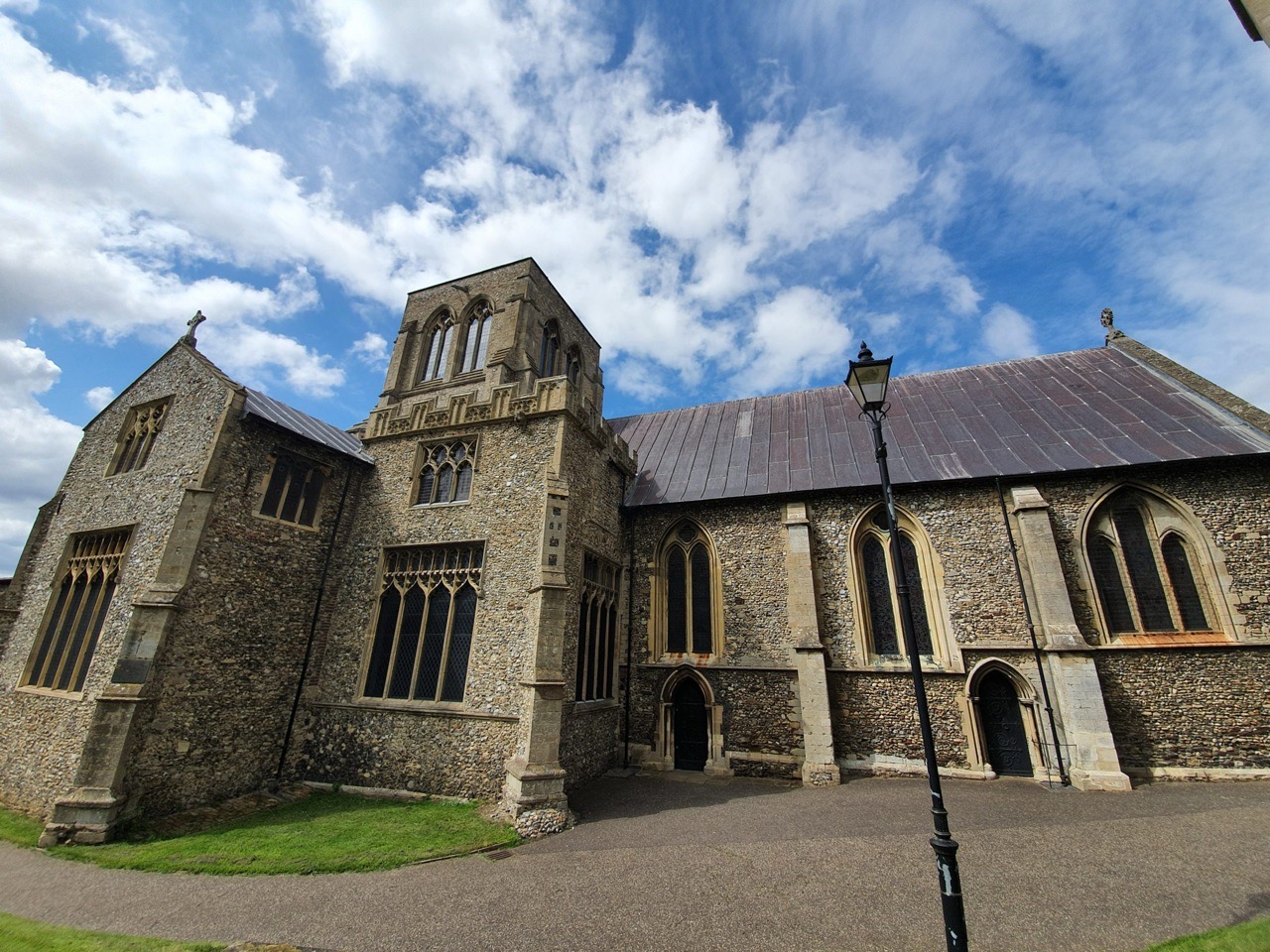
Tag: Church of St. Nicholas

  • Dereham – Church of St. Nicholas (George Dunn)

    Dereham – Church of St. Nicholas (George Dunn)

    There was no particular reason that I photographed this gravestone at the Church of St. Nicholas in Dereham, but it’s of George Dunn, who died on 12 December 1861 at the age of 50.

    The probate record remains for George, which noted:

    “Effects worth under £450. The will of George Dunn, late of East Dereham, in the County of Norfolk. Shoemaker, deceased who died on 12 December 1861 at East Dereham, aforesaid was proved at Norwich by the oath of George Jackson of East Dereham, aforesaid carpenter and sole executor”.

    The effects value were in bands, of which £450 wasn’t the lowest, and very roughly (and relying on the National Archives currency calculator), it was probably around £25,000 in today’s money. George wasn’t likely a poor man, although that’s relative in this period, during his life as he was a registered elector due to being a freeholder property owner.

    George was born in April 1811, the son of John Dunn, and he was baptised at the Church of St. Nicholas. He married Susan Clarke on 30 October 1844, again at the same church. The 1851 census gives a picture of what life was like for George, when he was living on Norwich Road in Dereham. He was aged 40, working as a shoemaker, married to Susan Dunn (born in Thetford), who was aged 37, as well as living with his children William R (aged 5) and Anna J (aged 4). He was also living with his father, John Dunn, who had been born in 1782 and worked as a tailor, by this time aged 69 and widowed.

    By the 1861 census, they lived in the same property as in 1851, with John and Susan still living with William and Anna. William was by this time working as a watchmaker and Anna was still at school. Still teenagers, it must have been a difficult life for the family when George died a few months after the census was taken.

    It was evident just how common theft was in Victorian Britain, with George being a victim of crime when in July 1855 a pair of wellington boots was stolen from his shop. Maria Barlow, an eighteen-year old bootmaker, was found guilty of the crime and sent to prison for six months.

    The church in Dereham clearly played a great part in George’s life. From when he was baptised with his family present, excited about the future, to when he got married to what I assume was more excitement and then to his funeral service and burial.

  • Dereham – Church of St. Nicholas (Richard Peacock)

    Dereham – Church of St. Nicholas (Richard Peacock)

    This is another in my series of wanting to find out whatever stories are possible from gravestones, for no real reason other than being intrigued about how much information still remains about a person.

    This is the grave of Richard Peacock, who died on 28 April 1856, at the age of 36. The burial record remains and gives his full name, Richard Henry Peacock, buried on Sunday 4 May 1856.

    That gives us sufficient information to find Richard on the 1851 census, where he was listed as living with his wife Mary Ann and his 1-year old son, Henry William Peacock. Richard was working as a machine maker and he had been born in Warham (a village in North Norfolk), whilst his wife who was also born in 1820 came from London. At this census, Richard and family were living on Theatre Road, which I assume is the same as Theatre Street in the town today.

    Going back to the 1841 census, Richard was living in Binham with his parents, Henry and Ann, as well as numerous siblings. Richard and Mary Ann (nee Roper) married in the church in Dereham in 1848.

    The Norwich Mercury reported in January 1856 that Jeremiah Oakley, a machine maker, had been arrested and charged with the theft of two match planes, three chisels and one gouge that belonged to Richard Peacock of Dereham. Given that these were tools used by machine makers, this is likely the same Richard Peacock. In March 1856, the trial took place and more information came to light, which was that Oakley worked with Peacock, who had been ill in late 1855 and noticed the missing items. The court wasn’t convinced and Oakley was found not guilty, although this does now give some background to the illness that may have caused Richard’s death in the April of 1856.

    Richard’s grave also notes “also two of his children”, suggesting that they died young. Henry William Peacock, Richard’s son, did survive and was married in 1873, living in Dereham with his family until his death in the first few years of the twentieth century. So, that’s as much as I can find, it’s a life which sounds like it was challenging and led to a relatively early death. It is also sad that the last few months of Richard’s life were mired in part with the court case of some of his items being stolen.