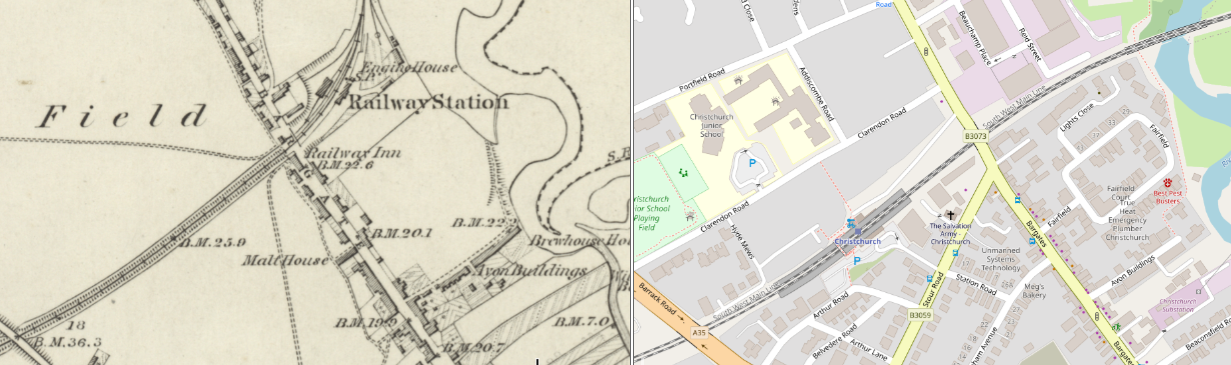
The current railway station in Christchurch was opened on 30 May 1886, replacing one a little further down the line which had opened on 13 November 1862.
This dual map shows how the railway station has switched to the other side of the main road, with the railway line looking like it has been rerouted. It hasn’t, the bit shooting off to the right is the South West Main Line which was extended in the 1870s and 1880s to allow for an extension to Bournemouth that allowed tourists from London to access it. The line which goes up to the north on the old map was the branch line to Ringwood which was closed in 1935 as rail traffic had fallen away since the construction of the South West Main Line.
There’s our South Western Railways (SWR) train from Bournemouth departing the station.
The current station is functional and near to the town centre, with all services operated by SWR.
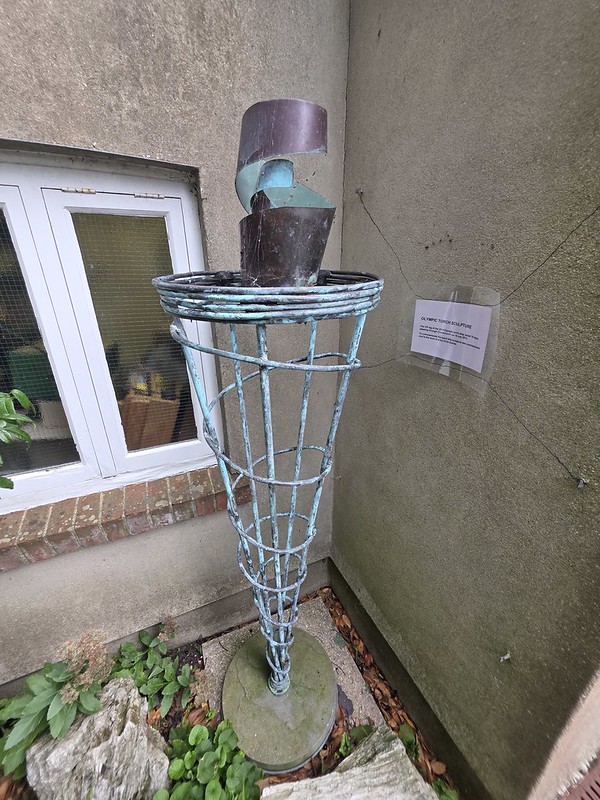
Located at the Red House Museum and Gardens in Christchurch is this Olympic Torch sculpture. A sign by the sculpture notes that this was designed by local artist Chris Davies and it was sculpted to mark the 70 day Olympic torch relay which took place in 2012 and which reached Christchurch on 14 July 2012.
It’s easy to forget how important events like this would have been for the community, even if it was just for one day. Judging from this video, the turnout on the main street in the town was sizeable.
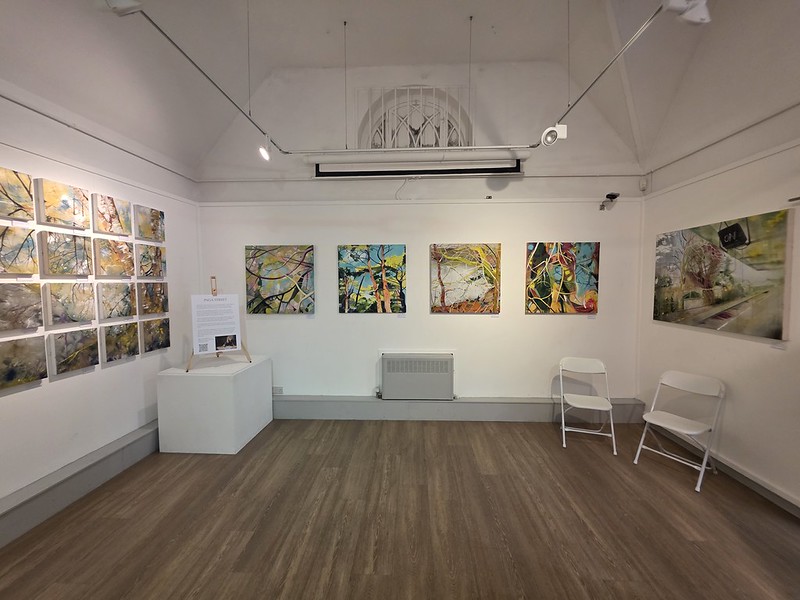
Attached on a building to the side of Red House Museum, there’s a regularly changing gallery section. At the time of our visit, it was featuring the works of local artist Inga Street.
The artwork is varied and it seems to be an opportunity to both display the pieces and also put them up for sale at the same time. This seems a sensible way of the museum having something to offer in its gallery, whilst still being something very useful for the artist.
I’m not sure that I’m the target market here, and Ross (who is a well-known art critic) declared that he thought he could have painted some of them. But, variety is important and the artist is popular locally, so this feels like another reason for the venue staying open. I mention that as the volunteer suggested when we left that we left a positive review for the museum to ensure that its survival was assured given the challenging finances in local Government at the moment.
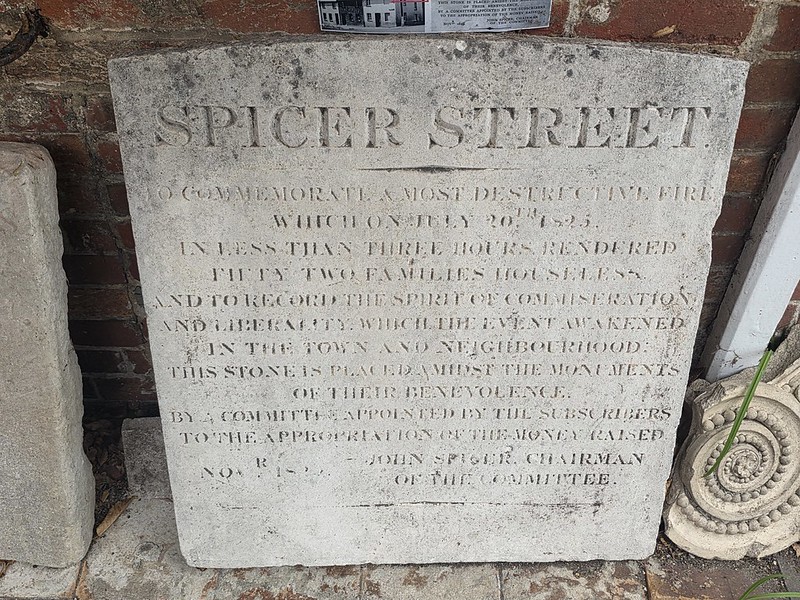
This stone memorial is located in the garden of the Red House Museum in Christchurch and it reads:
“SPICER STREET
To commemorate a most destructive fire which on July 20th 1825 in less than three hours rendered fifty two families houseless, and to record the spirit of compassion and liberality which the event awakened in the town and neighbourhood this stone is placed amidst the monuments of their benevolence.
By a committee appointed by the subscribers to the appropriation of the money raised.
Novr. 1825 John Spicer, Chairman of the Committee.”
The house that this memorial was attached to was demolished in the late 1930s, so it has made its way here. The day after the tragedy, a national newspaper published a letter written by a local:
“As you will hear of the distressing fire which happened this morning in this town, I think it best, to prevent your uneasiness on my account, to state the case as far as it has at present proceeded. The fire broke out at about eleven o’clock, in the New Town, a little above Mr. Aldridge’s, and had the wind continued as it then was, the destruction of the whole town it appears would have been inevitable; but very providentially the wind took the direction of the fields, and thereby is is hoped many houses will be saved. Some time since I heard there were at least 50 houses burnt down, and the fire, though much subdued, is still burning in various parts. You can scarcely think with what rapidity it spread, the houses being chiefly thatched, and many of mud walls—the intense heat of the weather, and the dryness of the buildings, no doubt contributed to the work of desolation.—What renders it very afflicting is, that the sufferers are chiefly poor people, who, although it is hoped they have saved many of their things, will still be great losers. The bellman has just been through the town, calling a meeting of the inhabitants this day, at four o’clock, to take into consideration what will be the best mode of providing for their present relief. They will, I should think, have to sleep to-night in the fields, which are strewed with beds, &c. that are saved. It is on this account a happy circumstance that the nights are so hot. I hope something will be done to reinstate them in their dwellings, and that the destructive element will be shortly subdued. Some person in each house will no doubt sit up all night, for there is a general alarm.”
The museum has a photo of where the commemorative stone was once placed, seemingly blocking up the view from Mrs Preston’s window. Anyway, it’s marvellous that the stone has been kept so that at least the memory of what happened 200 years ago isn’t forgotten.
Red House Museum and Gardens is located near to Christchurch Priory and is a volunteer led venue which doesn’t have an admission charge.
As the signage notes, the building was constructed to be a workhouse. The museum itself adds about the history:
“The building dates from 1764 and was the parish workhouse for Christchurch and Bournemouth. In 1886, as a result of the increasing population, a new union workhouse was built in Fairmile and the old house was sold to the vicar of Christchurch Priory, the Reverend T. H. Bush. Reverend Bush named the building ‘The Red House’ after the colour of the bricks and he demolished the women’s wards in 1887 to construct the stables, now the temporary exhibition gallery. Later, the building became the private museum of Herbert Druitt, an avid local collector. It was his passion for textile and fashion, bygones and archaeological material that created the Red House Museum collections. In 1951, the Red House Museum became a charitable trust and our doors have been open to the public ever since.”
There was a friendly welcome from the volunteer at the front desk who explained about the museum, with this being the ground floor that was once the living and dining area of the workhouse.
The displays are a little eclectic, but this is a provincial museum and it is trying to cover a lot of ground. It’s more quirky than formal, but there’s a place for museums like this.
A display on fusee chain making and this was part of the clock and watch making process. It’s explained here that someone living in the workhouse might be required to complete this task for over seventy hours a week. They wouldn’t have been paid directly for their efforts, but they would have living accommodation and meals provided, so they were at least safe if hardly living in great comfort. Although the Victorians often decided that there were benefit fraudsters and so conditions in workhouses often declined towards the end of the nineteenth century.
A display about architectural finds in the local region.
An old menu board from the workhouse.
And an example of the culinary delights that were served up.
A plan of the workhouse from an old Ordnance Survey map.
The rear of the museum.
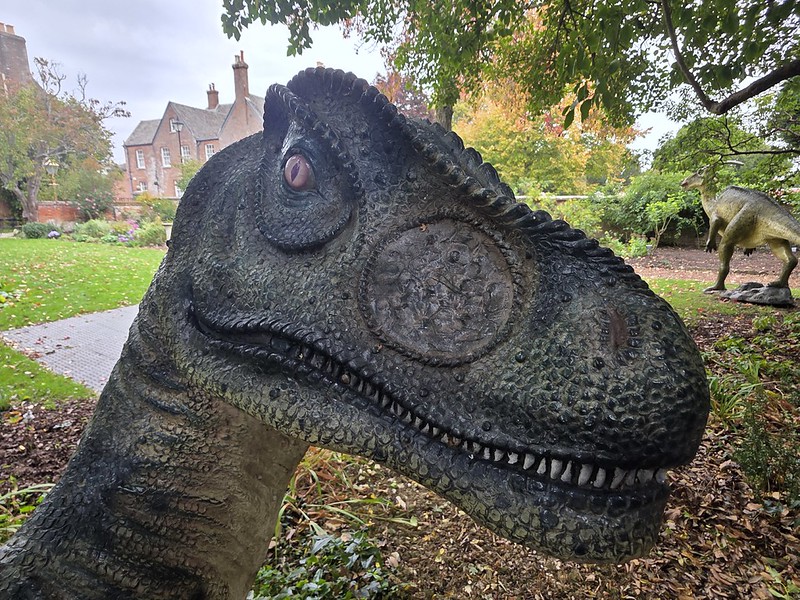
There’s a small dinosaur garden to the rear of the museum and a path which winds around so that visitors can see them all.
To be fair, this is a great idea for kids to want to come to the museum. Well, and Ross liked them. The plan seemed to work, there were numerous families looking around the museum and although a visit isn’t likely to take more than an hour or so, it’s definitely worth a little pop in.
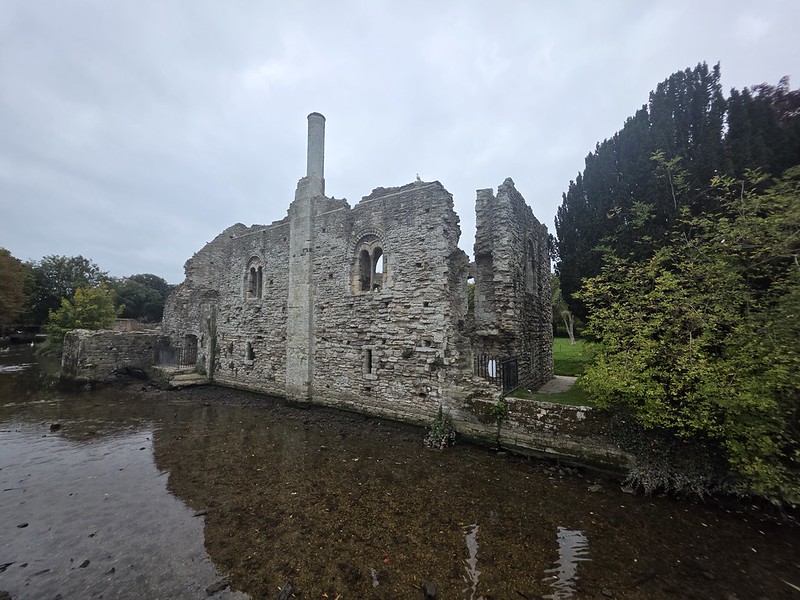
This is Norman House, a rather nicely located residence situated by the river in Christchurch. It still looks rather decadent even though half of it has fallen down.
Looking from the other side of the building, which is located near Christchurch Castle. The history of the two is interlinked, the castle was defensive and a place of safety, but the property was where the Lord lived when people weren’t attacking him. Built in around 1160, it was a luxurious property for the Lord and it was later used by the Constable of the Castle.
Inside the building which fell into disrepair after the medieval period. I’m surprised that it survived after this, as it would have been easy to cart the stone away to use elsewhere which is what happened to most of the castle.
The sockets where the first floor slotted in are clearly visible around the structure.
And the remains of the steps with a sign warning of deep water, although it didn’t look very deep to me.
The remains of a former fireplace, with the rare Norman chimney, and the whole arrangement is notable as it’s one of the few surviving Norman residential properties in the UK, although there’s one in Norwich hidden under the magistrates’ courts.
English Heritage has this plan of the property and I’m slightly amused by the little bit of modern there and I’ve stared at photos and I have no idea what they’re referring to, unless it’s the closing up of a door. Some sources say that demolition started in the eighteenth century, but the local vicar was able to intervene to stop the total destruction of the property. This would explain why it has sort of survived, it became recognised quite early on as a building that needed to be retained for future generations.
Anyway, the monument is accessible for free at any time for anyone who wants to see the modern section of the building, or indeed, the Norman bit.
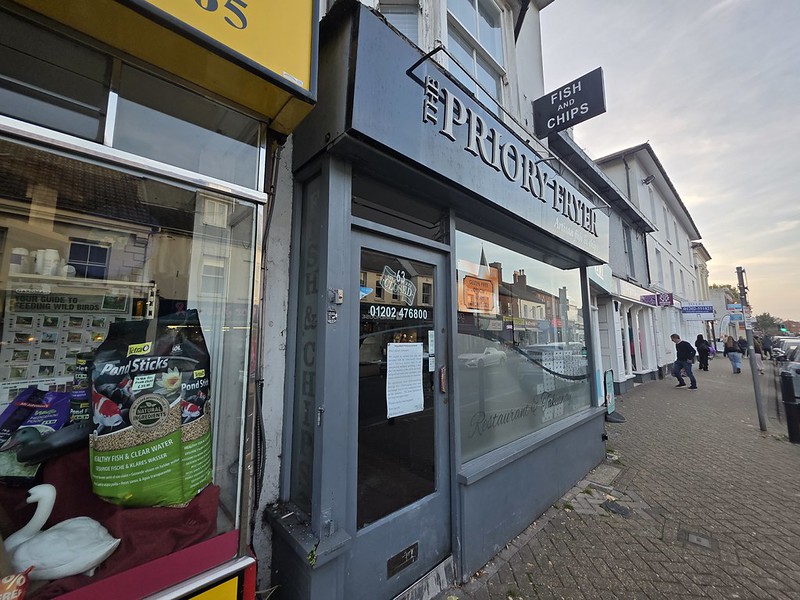
We did think of popping in here, but we were a little bit limited by the fact that it was shut.
It’s this that I liked, the phrasing that they were closed “due to an unexpected incident involving a fire” sounds like something I’d write. I hope everyone is well and if I’m back in Christchurch I’ll pop in here as I like their style.
One of the more curious, and frankly slightly odd, tales connected with Christchurch Priory is that of the so-called miraculous beam. When the Priory was being built in the early twelfth century, the craftsmen encountered a bit of a structural hiccup that was considered to be rather sub-optimal. A large timber beam, essential for the roof not to fall down, turned out to be too short for its intended place. This is a civil engineering blunder and I’m sure my friend Liam would have been appalled at such incompetence.
But then, so the story goes, a mysterious carpenter appeared and he was a man that no-one had seen before, who quietly went about his work without complaint. Overnight, the too-short beam was miraculously found to be the perfect length, fitting flawlessly where before it had failed. The stranger, naturally, had vanished. So the rest of the builders decided that it must have been Jesus himself who fixed the beam. Hence the name Christ’s Church, the Priory’s supposed moment of celestial rebranding. I imagine that this whole thing was the talk of the pubs for that evening and indeed several nights to come.
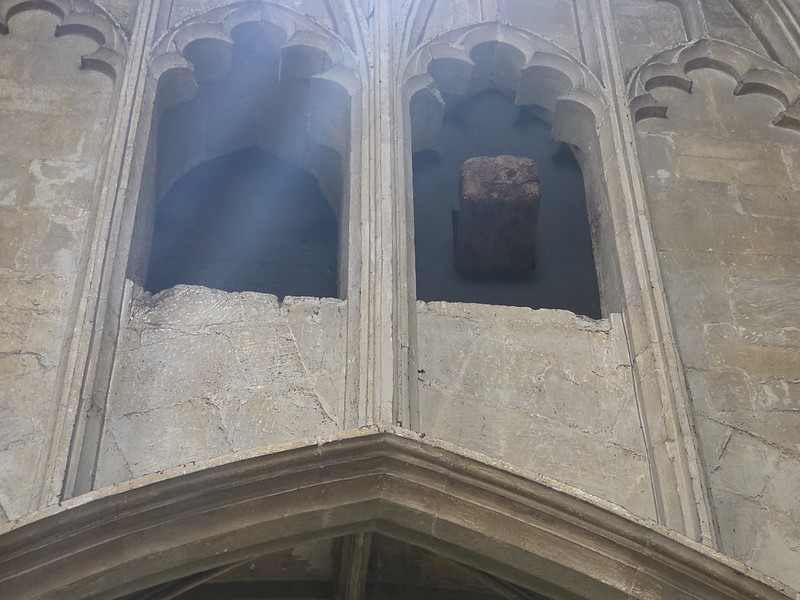
The beam itself is still there today, high up in the Priory’s roof and my photo isn’t really very clear. It’s a reminder though of the construction process, although I rather suspect that they just did some medieval joining of a beam rather than Jesus himself popping across, but who knows? I mean, it’s good for publicity if nothing else?
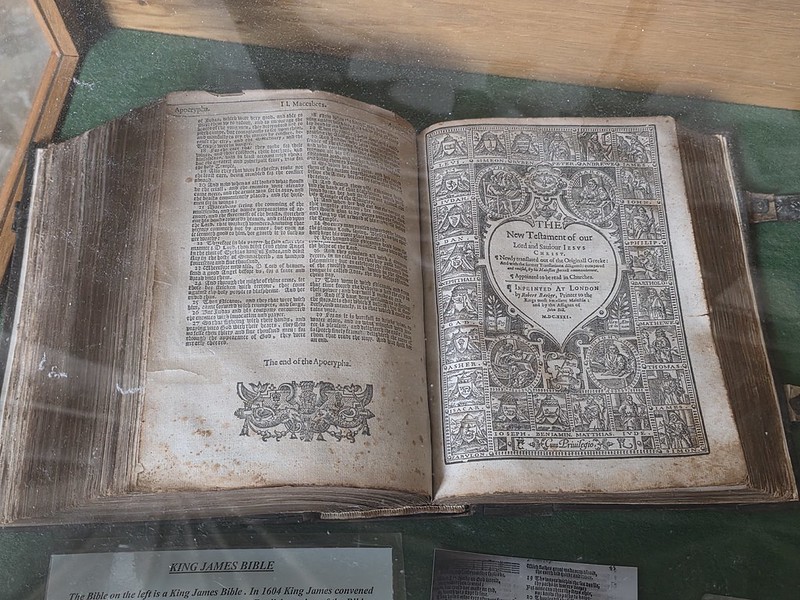
It’s not a secret that I love old books and this is a King James Bible that dates from around 1633, which the priory has been able to date due to the inclusion of metrical psalms that weren’t in earlier editions. The Bible was important, it was the third translation into English that had been approved by the Church of England, with the first being the Great Bible in 1535 and the second being the Bishops’ Bible in 1568.
Unfortunately, the priory doesn’t know much about the heritage of this Bible, other than knowing it has been rebound. But, it’s likely that the Bible was used extensively in the church and it’s not in bad condition today. As a side issue, I’m not sure why the building is still known as Christchurch Priory (as its days as a priory have long since come to an end), I suspect it’s the reality that Christchurch Church doesn’t exactly roll off the tongue (although its formal name is the Priory Church of the Holy Trinity).
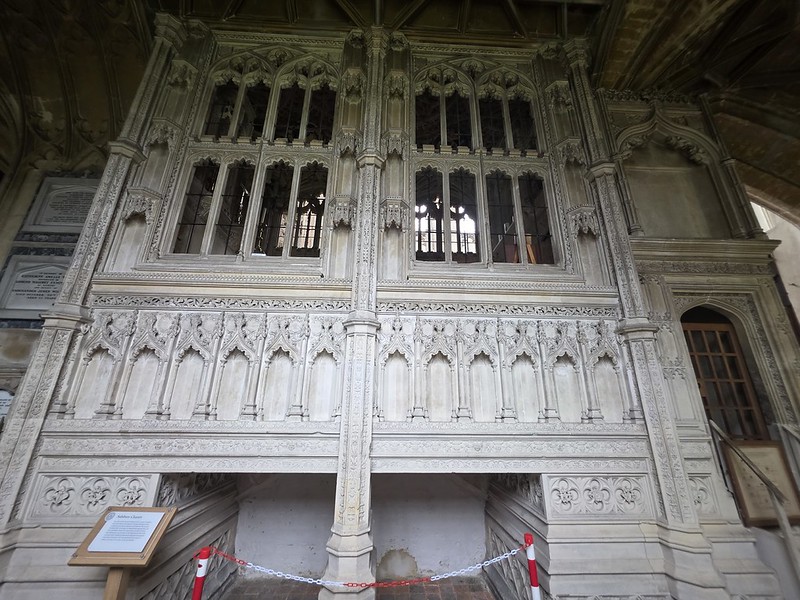
The Salisbury Chantry at Christchurch Priory is grand, decadent and rather ornate. It was founded by Margaret Pole, Countess of Salisbury, a woman whose life seemed quite dramatic. She was the niece of both Edward IV and Richard III, but unfortunately for her, she was a Plantagenet and this didn’t entirely fit with the Tudor way of thinking. So, Henry VIII eventually had her executed on 27 May 1541 (and at 07:00 so she had to get up early) and her chantry at Christchurch has survived, but remains unused. There’s a lot more about Margaret Pole at the Historic Royal Palaces website, she was a powerful figure until she was killed…..
Architecturally, the chantry is beautiful in a rich and late Gothic way with its delicate stone tracery and niches that likely held figures long since lost. There are some traces of medieval paint remaining and I imagine in its day it would have rather more glowed with candles and felt a little warmer.
This is the other side of it, by the altar. The fact it survived the Reformation at all is rather miraculous, since most chantries were dissolved and removed with their endowments seized by the Crown. And this is the sort of thing that actually brought down the Catholic Church, it was ridiculous that this wealth brought such privilege in the priory that someone could be buried in a construction such as this right by the altar.
The corruption, nepotism and greed of the Catholic Church at this point is what ultimately led to the Reformation across Europe. The church willingly took wealth from those who didn’t really have any, so fearful were they that they or their loved ones wouldn’t go to heaven. Any money brought privilege and access, a fast track to heaven.
Margaret Pole is now buried at the Chapel Royal of St Peter ad Vincula located in the Tower of London, so that’s not a bad final resting place. It wasn’t the one she wanted and her death meant that she became something of a martyr, which is perhaps why this chantry survived and remains today.