Tag: Berlin Tempelhof Airport

  • Berlin Trip : Berlin Tempelhof Airport Tour (Part 6)

    Berlin Trip : Berlin Tempelhof Airport Tour (Part 6)

    20241121_151431

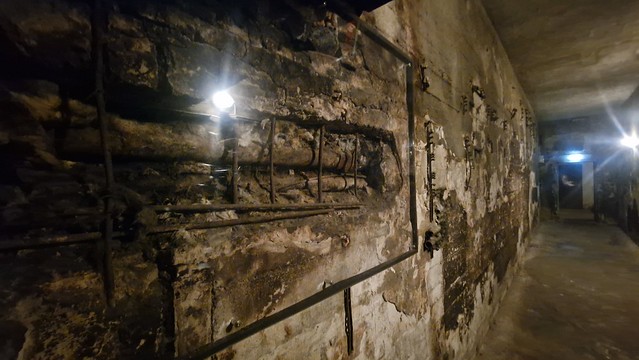
    This was the final part of the tour, which are the two floors of rooms which are known as the ‘film bunker’ where film and photographs were stored during the Nazi regime.

    20241121_151711

    It’s not known quite what happened here other than there was a substantial fire which destroyed everything left in them. Looking at the damage done, this was a fire of some considerable size to damage the reinforced walls and ceilings like this. Some accounts say that the Germans did this to destroy evidence and others say that the Russians did it by mistake when trying to open the locked rooms, although I don’t know either way, but the former seems most likely to me. Either way, the Russians decided that they wouldn’t do anything with these rooms after the Second World War and that’s why they’re the same now as in 1945. The joys of a building that’s so large that they could just leave bits of it untouched.

    20241121_151720

    The graffiti is mostly recent, from urban explorers.

    20241121_151927

    It feels sub-optimal, although in about fifty years this more modern graffiti will become part of the historical story.

    20241121_151746

    There are two identical floors with a number of rooms which look like prison cells.

    20241121_152105

    The rooms are located downstairs in one of the lowest levels of the entire airport complex.

    That was the end of the tour and I mentioned earlier that it was one of the best that I’ve ever been on. The Dutch guide was humorous and knowledgeable, with plenty of different things to see and I was delighted that politics, history and travel were all intertwined here. The guide mentioned that parts of the building was rented out, but there are some structural issues that need expensive fixes and it will be a long time until more of the complex is rented out and used. He also mentioned that the electricity bill here is substantial and I admired the guide’s attention to detail in ensuring that the lights were always turned off after we left a room. I hope that they leave the sections alone that I visited on the tour, it’s a wonderful time capsule of some many parts of twentieth century Berlin. As for the tour, definitely recommended and it only cost around £14.
  • Berlin Trip : Berlin Tempelhof Airport Tour (Part 5)

    Berlin Trip : Berlin Tempelhof Airport Tour (Part 5)

    20241121_144934

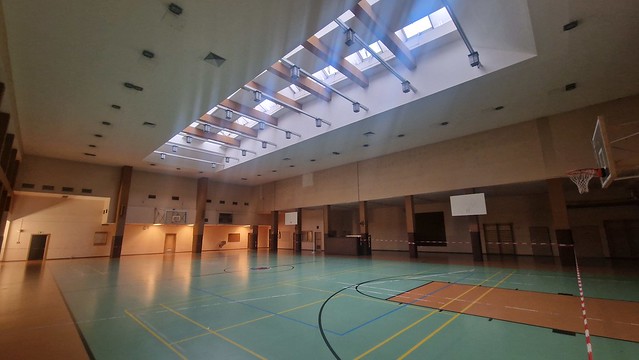
    Templehof Airport was used by the US military between 1945 and 1994 and it’s fair to say that they’ve left quite a legacy in the little things that they added, not least a baseball court.

    20241121_145018

    I wonder what the Nazi building designers would have thought about this little arrangement.

    20241121_145100

    There are plenty of empty spaces, they use areas such as this part of the tour now.

    20241121_145213

    Now mostly removed, but this is where the bowling lanes were located. There were numerous other games played in these rooms, along with a gym, showers, squash courts and all manner of other bits and pieces.

    20241121_145222

    A building plan, but I’m not sure from which year.

    20241121_150640

    We were shown some of the former offices used by the army. This one had a copper roof, although it’s not visible in my photo as the ceiling tiles are in the way. It’s a sprawling complex, it was hard during the tour to really understand how it all fit together as the building was just so large. The US military left the airport in August 1994 after having been in the city for 49 years and as with much of the rest of the building, it’s pretty much the same 30 years on.

  • Berlin Trip : Berlin Tempelhof Airport Tour (Part 4)

    Berlin Trip : Berlin Tempelhof Airport Tour (Part 4)

    20241121_143848

    I ended my last post with this photo, which is the former entrance area of the airport for passengers. The building wasn’t designed like this by the Nazis, it was meant to be a more impressive and imposing entrance for passengers with higher ceilings and an attempt to make it fill people with awe as they entered.

    20241121_144043

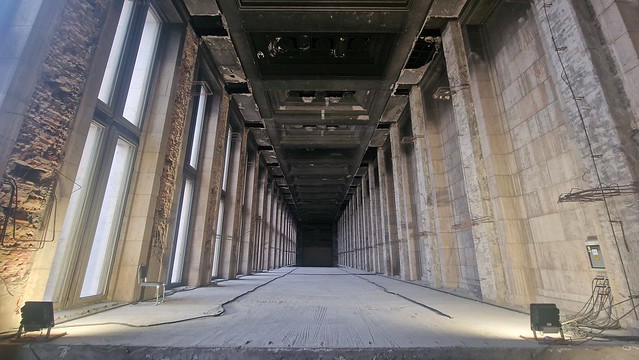
    The entrance area was once much higher and this is the Nazi design which was once visible to passengers entering the airport. The floor was that added during the process of ‘denazification’ after the Second World War.

    20241121_144236

    It’s badly damaged, but it’s still there.

    20241121_144605

    The hole punched in the wall to allow modern day access.

    20241121_144139

    Even to my untrained architect’s eye, I can see there’s some damage here.

    I hadn’t realised that the Nazi designed building was constructed with what is known as monumentalism architecture, something more common in the early twentieth century. This was the plan for the exterior of the building, although the interior was designed with a more modernist design style plan.

  • Berlin Trip : Berlin Tempelhof Airport Tour (Part 3)

    Berlin Trip : Berlin Tempelhof Airport Tour (Part 3)

    20241121_141839

    The next part of the tour around Tempelhof took us to what I considered to be the heart of the building, the old check-in area. It’s preserved pretty much as it was when it closed to passengers on 30 October 2008.

    20241121_141929

    Absolutely no imagination is needed to picture this as as working airport as it still looks ready for action.

    20241121_142500

    The signage to the restaurant which was located on the first floor.

    20241121_142134

    Inside the restaurant.

    20241121_142357

    The airport’s bar.

    20241121_142522

    The arrivals board.

    20241121_143713

    The baggage belt.

    20241121_143723

    Empty retail units.

    20241121_143740

    Check-in desks.

    20241121_143748

    The display showing how much bags weighed.

    20241121_143806

    I’m not sure I understand this as Air Bourbon did’t last long, it had one plane and it didn’t routinely fly from Berlin.

    20241121_143831

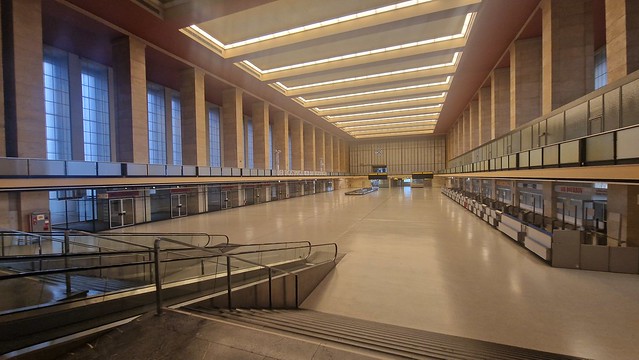
    The empty terminal. I very much enjoyed this part of the tour as it’s rare for an airport to be mothballed like this, stuff is usually just ripped out and buildings demolished.

    20241121_143848

    The guide mentioned that the floor was designed with a stone floor, but for cleaning purposes a lino type flooring was put in after the building was ‘denazified’, although more on that in a later post. The stone floor has remained in the entrance area.

  • Berlin Trip : Berlin Tempelhof Airport Tour (Part 2)

    Berlin Trip : Berlin Tempelhof Airport Tour (Part 2)

    20241121_140313

    The next part of the tour (previous part here) went to the more hidden areas of the airport past this pump thing. I have no idea what it is. I asked AI and I was pleased to see that it didn’t much differ, noting that it was a “grey metal device: This could be a pump, ventilation system, or some other kind of machinery.” That’ll do.

    20241121_140358

    The airport was built at a time when the Germans secretly knew that buildings needed to have safe areas in case of attack, with this room being one fitted out with calming imagery for children. The Dutch guide did explain the wording, which went across the room, and he said that it was typical German humour which no-one else found funny. AI tells me that this reads:

    “Hey! – he thinks – that’s great!
    and loosens the lid a bit.”

    20241121_140524

    Never used during the war, but this was an emergency exit. The floor levels are confusing, I felt low down in the building at this point as we had entered a bunker area, but because the airport was built on numerous levels, it was still higher than the runway.

    20241121_141002

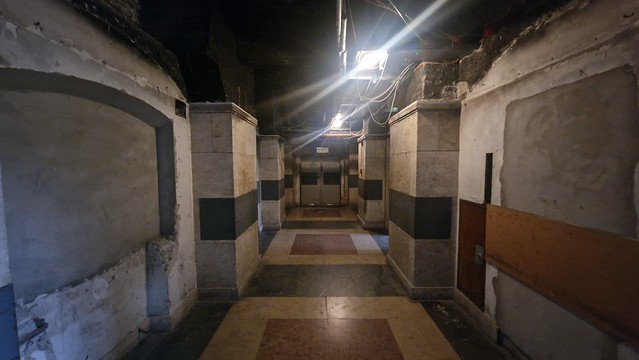
    Some old corridors.

    20241121_141009

    It wasn’t quite clear what rooms like this were built for, but this area of the airport was attacked and damaged by the RAF during the Second World War.

    20241121_141502

    The guide mentioned that the red marks on the stone were fires caused by bombings. It’s some grand architecture, but more on that in a later post.

    20241121_141618

    Soviet graffiti from when their soldiers took over the building. Back to AI (yes, I ask it a lot of questions), which says it means “sore throat”, although I’m not entirely sure what relevance that has here. The Soviets wanted to capture Tempelhof Airport to stop senior Nazis trying to flee the country, seizing it on 26 April 1945 after some fierce fighting. They didn’t have it long, it was put under the United States Army sector on 2 July 1945.

    20241121_141750

    Then we headed back towards what was the public area of the terminal.

  • Berlin Trip : Berlin Tempelhof Airport Tour (Part 1)

    Berlin Trip : Berlin Tempelhof Airport Tour (Part 1)

    20241121_123110

    This transpired to be one of the most interesting tours that I’ve been on, a two-hour guided tour around the former Templehof Airport. It’s a complex site and the tour consisted of seeing the old airport terminal, the airside area, some of the remaining Nazi architectural elements, the US military base and the location of the Nazi secret storage. Hence why it might take me a while to plough through all the photos that I took, so there might be a few posts for my two loyal blog readers.

    20241121_123144

    But we’ll start at the entrance as that seems sensible. The site is used for numerous purposes now, although the airport terminal building itself is still as it was left when it closed in 2008. I arrived a little early for the tour, although friends won’t be surprised at that, but there’s a little museum to look at whilst waiting.

    20241121_124051

    This photo shows the scale of the site.

    20241121_130512

    A photo of the terminal on 1 September 1975 and the tour took in this hall.

    20241121_134828

    The Dutch guide was excellent and full of enthusiasm. Whilst walking to the next stage on the tour, he mentioned that Hitler had a private entrance to the airport and that’s in the centre of this photo.

    20241121_135005

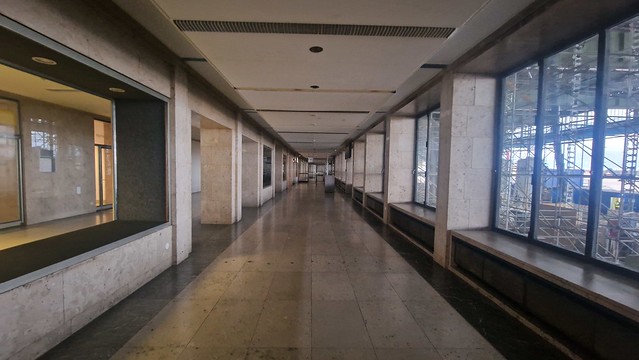
    One of the airside corridors. It doesn’t take much imagination to picture how this would have looked full of travellers.

    20241121_135114

    Out on the tarmac and my friend Liam would like this, he used to specialise in concrete pours of runways (or whatever the technical term is).

    20241121_135128

    The structure is ridiculously large and was at the time of its construction one of the world’s top twenty largest buildings. It’s one of the few airports that was designed to support massive growth in airline travel, although the Nazis had many grand plans. It was built to be symmetrical, but that didn’t quite come to pass. It was designed by the architect Ernst Sagebiel (1892-1970) and construction took place between 1936 and 1941, but some elements weren’t finished and some of the plans were changed. Norman Foster, who led the design for the reopened Reichstag, referred to it as “the mother of all airports”.

    20241121_140006

    The airport wasn’t built with long runways, as they weren’t much needed at the time, and this limitation is one of the reasons that its growth was limited later on.

    It wasn’t the only airport used during the Berlin Airlift after the Second World War, but it was perhaps the most important.

    20241121_140031

    The old passport control signage.

    20241121_140152

    20241121_140202

    20241121_140214

    The baggage system is all still there as part of the attempts to preserve the past. It wasn’t entirely clear to me what the long-term plan is for all of this, but I hope that they keep it.