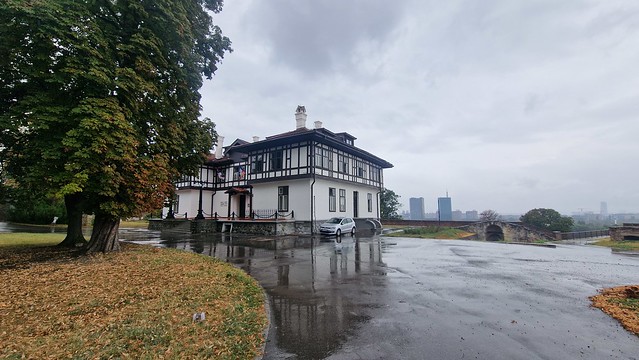
I liked a repurposed building, this was initially built between 1902 and 1904 for the General Staff of the Serbian Army. It was heavily damaged during the First World War bombings, but was repaired and used as the History Department of the General Staff until 1928. As an aside, if I joined the military, that’s where I’d quite like to work. Brave as I am, I feel my archiving skills would be better than my fighting skills. Anyway, I digress. The building then became used as a home for the military museum in 1937, but they were moved out in 1961 and it was given to the Institute for the Protection of Cultural Monuments. I do wonder why such a lovely building that would make a fine museum has been given over to the organisation that likely hands out buildings that would make fine museums, but there we go.
Tag: Belgrade Fortress
-

Belgrade Trip – Belgrade Fortress (Views)
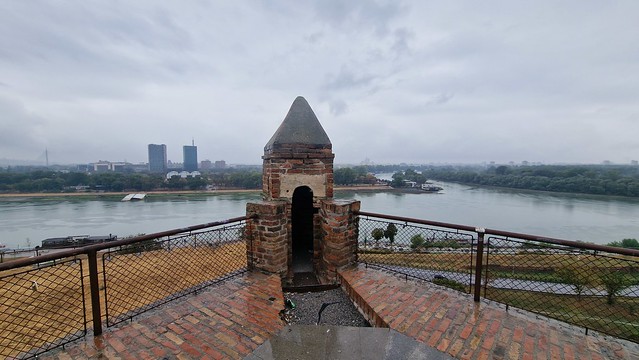
Just photos of the view from the Belgrade Fortress. It’s evident why they built the fortress on a high point where two rivers meet, but this always proved to be a defensive challenge for the occupiers. As an aside that I hadn’t realised, this is effectively where the First World War began on 28 July 1914 when the Austro-Hungarians attacked Serbia at this point.
-

Belgrade Trip – Stefan Lazarevic the Despot Statue
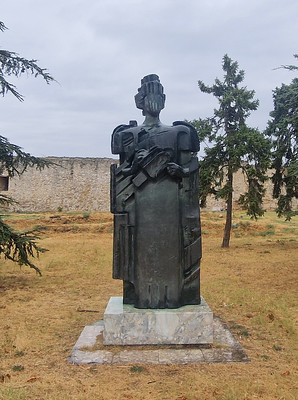
Many things in this world puzzle me, and one of these conundrums is why a man known as a despot is revered within the Serbian Orthodox Church and has a rather nice little statue of him within Belgrade Fortress. This mystery was solved when I discovered that in many parts of the Balkans, the word ‘despot’ used to be bestowed on the sons of reigning emperors. The word meaning has changed somewhat since the eighteenth century, but this has also happened with the words ‘dictator’ and ‘tyrant’ which now have negative connotations.
Back to Stefan (1377-1427), who we (well, I) now discover is something of a hero to many Serbians. To them, he used the periods of peace to help build Belgrade up militarily, economically, politically and socially, so he’s seen as something of a reformer. He was also something of a supporter of the arts and a writer himself, he sounds quite the modern man. Interestingly, on the Serbian Wikipedia, he’s known as Stefan the Despot, but on the English version he’s known as Stefan the Tall. I can see why I might have got the wrong first impression here.
Anyway, if either of my two loyal blog readers are interested, there’s lots more about him on Wikipedia.
-

Belgrade Trip – Belgrade Fortress (Zindan Gate)
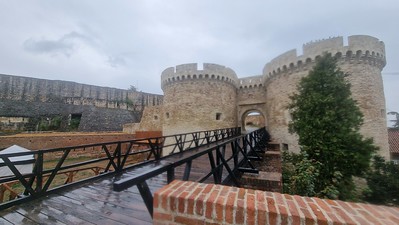
Once again, I won’t be winning any awards for photography with the blurry photos, but it was raining for the entire time that I was at the Belgrade Fortress which has led to some (well, quite a lot) sub-optimal imagery. Belgrade Fortress has one of the most challenging histories to unpick given how many times it has been raided, besieged, stormed, attacked and so on, but this is the Zindan Gate or the ‘dungeon gate’.
The gate was originally built by the Hungarians between 1440 and 1456 and was the first part of the fortress to be constructed with cannons in mind. It worked for a while, but then the Ottomans took the fortress in 1521, but they didn’t do much more with the gate because the frontline had moved on from Belgrade and they didn’t need to defend it. The Austrians decided to get a bit aggressive for a while, indeed hundreds of years, and it bounced between their occupation and the Ottomans who would take it back.
The rear of the gate. Reminding me of the rather aspirational modernisation of Carcassonne Castle, the current design of the gate is modern and dates back to the 1938 restoration which gave it an appearance which it had never had. It’s possible to walk all around the gate and it has a more elevated position than might be evident from these photos.
Views from the top of the gate over the River Danube. There’s a wooden bridge now in front of the gate, this is recent, but there was once a drawbridge designed to keep the ruffians out. Today, it’s one of the main entrances into the Belgrade Fortress, a large complex which is free of charge to enter and there are plenty of interpretation boards to help explain the history of the site.