
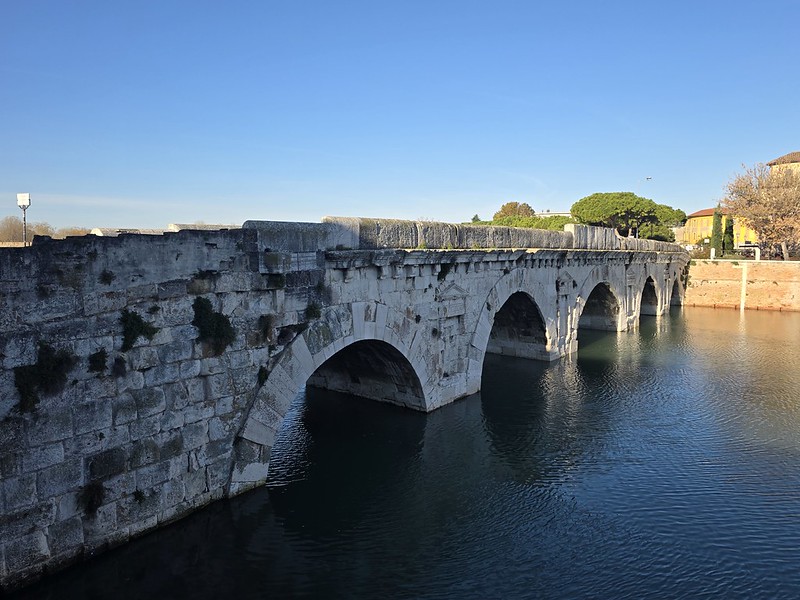

Now this is exciting, known as one of the more important Roman bridges still standing. It is known today as the Bridge of Tiberius, but it is also known as the Bridge of Augustus and the Bridge of St. Julian. I’ve decided that I like the latter one the best, so that’s what I’m calling it.

The construction of this bridge began in 14 AD under Emperor Augustus and it’s evident that he likes things that were built to last. Emperor Tiberius finished the job off and it’s his name that seems to be the most commonly used now which probably would have annoyed Augustus.
This was an important structure, it carried the Via Aemilia and the Via Popilia, which in Roman times were major roads connecting Rimini to the rest of the Roman Empire. Architecturally, I think that this is rather beautiful with its five arches constructed out of Istrian stone, that sturdy pale rock that the Romans adored for its durability. It was also properly built with foundations that goes right into the riverbed, with some clever load distribution systems going on which even my civil engineer friend Liam would have likely been surprised and delighted by.

The bridge has had some challenging times, although that’s not entirely surprising given that it’s 2,000 years old. In 552, the bridge was deliberately damaged by a Gothic military commander and it was damaged again in 1528 when Pandolfo (a name which sounds like a magician) retreated from Rimini. The Spanish knocked it about a bit during the War of the Austrian Succession and it was ordered to be demolished by the Germans in 1944. However, the local commander seemingly deliberately did a bad job of that, so, fortunately, it was saved and it was the only bridge along the River Marecchia that did survive.
In May 2020, after some considerable years of debate, argument and planning, the sensible decision was finally made to pedestrianise it. That has now helped protect it for future generations and has made it much easier for pedestrians and cyclists to actually use without the fear of cars hitting them.

I had a little walk along the bridge, which is one of the oldest surviving in the world, and it is hard not to be impressed by the heritage of this. The stonework glistened and it looked sturdy and robust, I’m very much impressed at the Roman engineers who managed to put this together. The Istrian stone that was used wasn’t local and it would have been a faff to get here, but the Romans wanted something that wouldn’t promptly fall down and I’d say that it was worth the effort.