
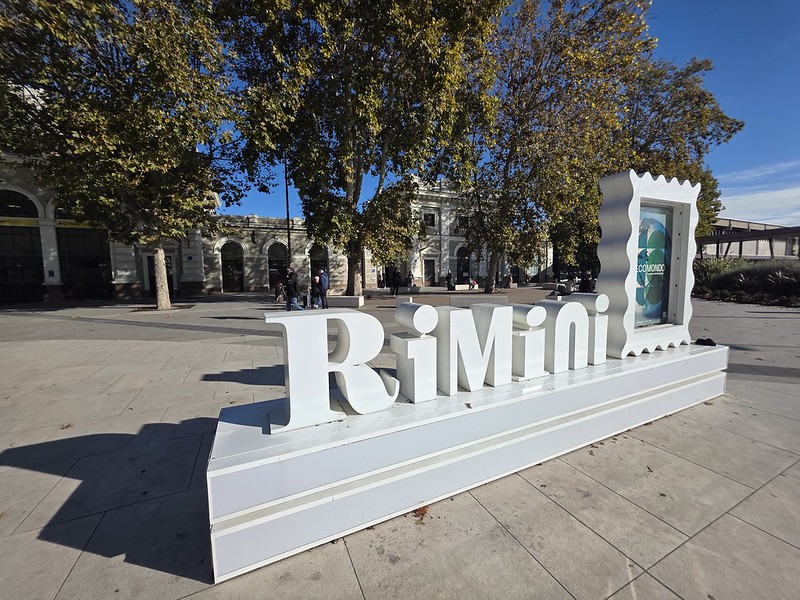

And some other photos that I took during my rather brief stay in Rimini.

Approaching the railway station.

As a general comment, the provision for cyclists seems to be ever improving across Italy.

I accept that this might not look like the most exciting of photos, but the significance is that this is where the first British bombing of Rimini took place. It occurred on All Saints’ Day, 1 November 1943, at 11:50 and 68 people died with 69 people injured.

I didn’t have time to go in, but this museum, Domus del Chirurgo, has one of the mosaic floors that has been discovered in the city.

A sculpture of Count Luigi Ferrari Banditi (1849-1895) who was a local politician from the noble Rasponi family of Ravenna.

A monument to Francisco Busignani (1913-1936), an Italian engineer and army officer who lost his life in the Second Italo-Ethiopian War. This was added to Piazza Ferrari in 1939, designed by Elio Morri.

The Torre dell’Orologio which is where the names of the fallen from the area are listed. This was constructed in 1547 and rebuilt in 1759, before being refocused as a war memorial in the twentieth century.

A bronze statue of the great Roman emperor, Julius Caesar. This dates to 1933 and was cast by the foundry Fonderia Laganà. The statue was removed during the Second World War for political reasons and to prevent it from being damaged, before then being put in a military store before being put back here.

This might look like a random hole, but this is Piazza Tre Martiri and those are the original Roman paving stones. There’s some archaeological work planned here with the intention of making more of this history open to the public.

Christmas is coming……

One of the harbours for those who can afford a yacht, located on the Marecchia River.