
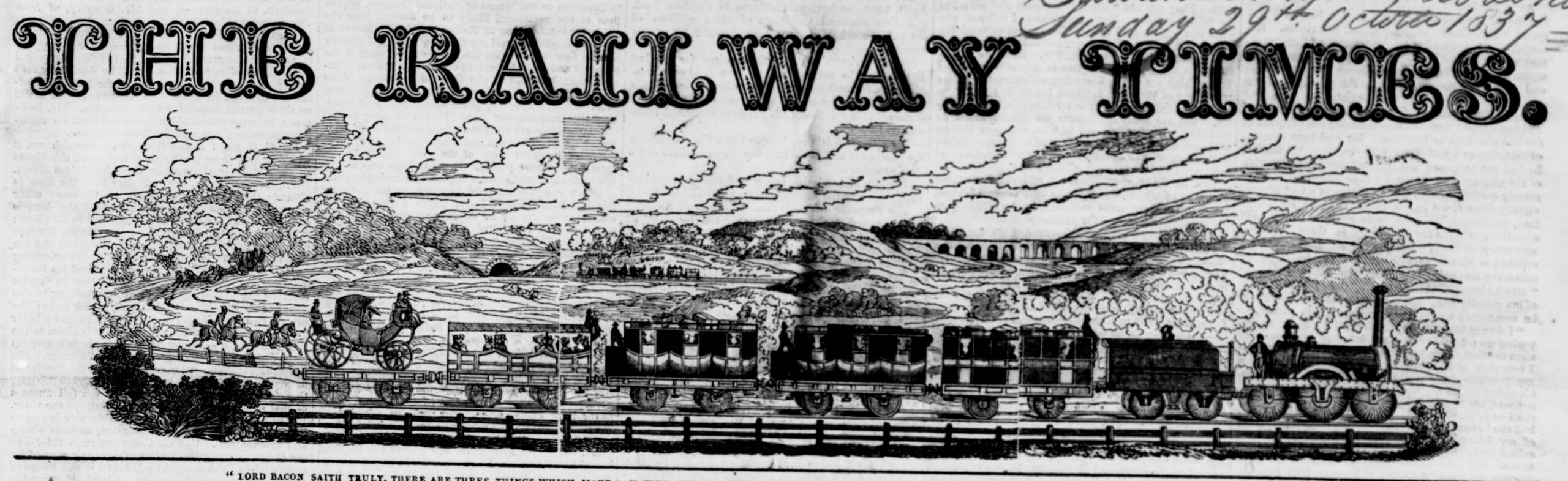

Back to the Railway Times (I like to mix things up on this ‘riveting’ blog….) and this is an article that they’ve republished from the Wilts and Gloucestershire Standard of November 1837.
I rather like that it summarises the debate of this exciting new form of transport which was still not winning everyone over. The article title was “The Importance of the Railways” and they still referred to the rail project as a “great experiment” which isn’t an unreasonable summary of the arrangement at the time.
As an aside, I like the use of the word “ebriety”, which I rarely see used now, it just means drunk although the word sobriety has continued in use. And there’s another interesting use of the word “characterizing” with a ‘z’ which was the frequently used spelling of the time before we’ve diverged off to prioritise our ‘s’ usage….
Most of all, it captures a snapshot of British life at the time, changing quickly and just as the population is getting used to the industrial revolution. It’s not just us today who live in interesting times.
“We beg to direct the attention of our readers to the subject of Railroads, as one destined, ere long, to produce a considerable revolution in the internal economy of this country. Some months ago the public mind was in such a ferment on this subject, and John Bull was so running riot, as he is wont to do on any matter affording scope for speculation, that the attempt to get at any sound notions, or information that could be depended upon, seemed hopeless. Now that this ebriety seems to have produced a complete lethargy, there is a chance of obtaining facts that may be relied on, and of arriving at just deductions from them.
This has become a subject of great national importance, as regards the commercial and manufacturing interests of the country. We have, hitherto, maintained a preference in the foreign markets by the comparative excellence and cheapness of our manufactures. It must be borne in mind that carriage, both of the raw material, and of the manufactured article, is, in many cases, a very important item in the cost of the latter, and that if we allow foreign countries to get the start of us, in modes of conveyance which very materially diminish expense, we shall give them a very serious advantage. It is not perhaps generally known what is going on in this way on the continents of Europe and America. In France, the following lines have been undertaken, some by the government and others by public companies: From Paris to Havre, by Rouen, 55 leagues; from Paris to Calais, 53 leagues; from Paris to Lisle, 53 leagues; from Paris to Lyons and Marseilles, 219 leagues; from Paris to Strasburg, 116 leagues; and from Paris to Bordeaux, 154 leagues. These communications are again carrying on from the Belgian frontier, as appears by the report of M. Nothcomb, the minister of public works, wherein it is stated that the Government has taken in hand an extent of 115 leagues; that the works were commenced in March, 1834, and have continued in progress, and that three sections are already open to the public. These traverse the country from the borders of France to those of Prussia. The Prussian government has fixed a line with various branches from the Belgian Railways by Aix-la-Chapelle to Cologne. In America there are upwards of 1500 miles of Railways completed, and 3000 miles reported to be in various stages of progress.
It is difficult to foresee the effect these wondrous means of communication will produce upon the value of property within their influence, upon the conveyance of commodities in different districts; on the localities of markets, and the modes of dealing, and even on the habits and manners of the people, by the great extension of intercourse which will necessarily result.
Though we are at present hardly justified in characterizing this bold and novel mode of conveyance, otherwise than as a great experiment, sufficient has been practically achieved, in particular cases, to render it morally certain that Railways will very soon entirely supersede the existing means of travelling, on all the great thoroughfares of the kingdom. It has been clearly established in practice, that, on a well-appointed Railroad, passengers can be conveyed in one-third of the time at two-thirds of the cost, with greater punctuality, with infinitely greater safety, and with much less fatigue than by the best appointed coaches now in use, excellent as they have become.
The general establishment of Railways, therefore, throughout the kingdom, is as certain as the return of the seasons. In this great commercial and manufacturing country, in which 9-10ths of the population are busily occupied a great proportion of the 24 hours, economy of time is of more consequence than economy of money; and the public will never submit to any system of transit, while another can be devised at once saving of time and money. Experience has shown us, that if coaches between two places, say 100 miles distant, have performed the journey in 12 hours, and a new coach starts and performs the same journey in eleven hours, the former must quicken their speed, or they will be driven off the road. The same result happens, if one coach conveys passengers for a few shillings less fare than those previously established. It having been demonstrated that the means exist of conveying passengers the 100 miles in four hours, at two-thirds of the cost, and with much less bodily fatigue, no man can doubt that the public will yield them.
Railways are so expensive in their construction, that they cannot be multiplied like ordinary roads. Their course and position, therefore, become a matter of the deepest interest to all persons of property, or who are engaged in trade, commerce, or manufacture, as there can be no question, but that the districts traversed by these lines, or in close communication with them, will derive advantages which will greatly enhance the value of property, as compared with that which is more remote. We entertain no doubt that, ere long, in advertisements for the sale of property, the advantage most prominently put forth will be, that it is within a certain distance of this or that Railway. It behoves, therefore, all those interested in any particular district, to bear an eye in time to this subject, and not allow their more foresighted neighbours to steal a march upon them.”