
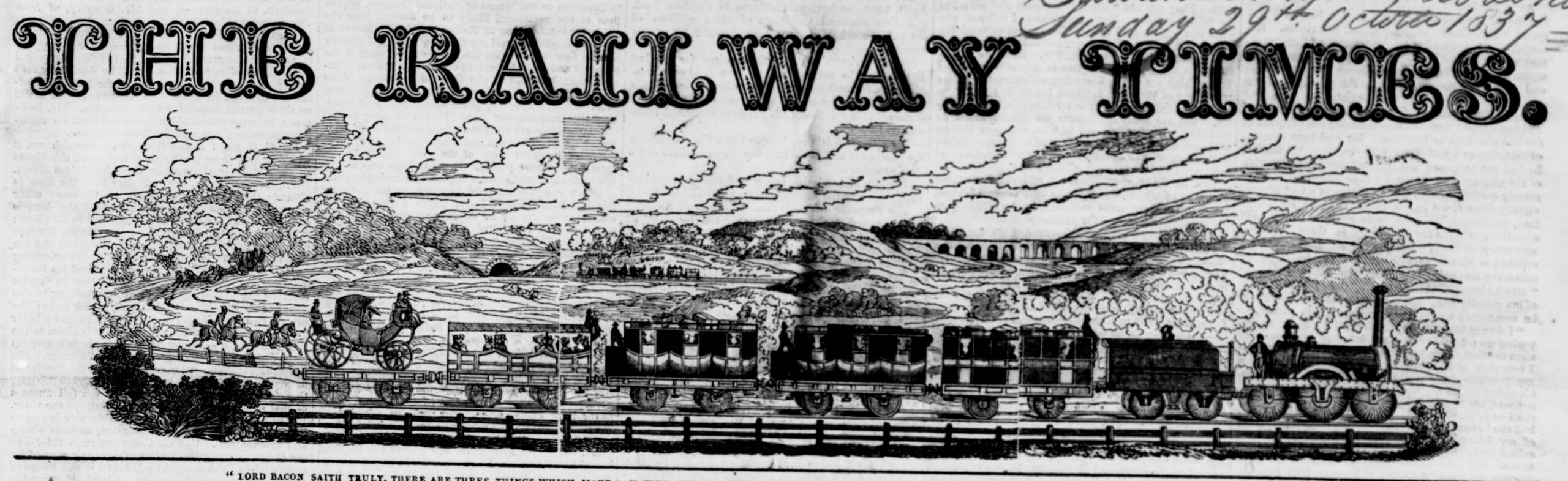

As a brief interlude between my posts about Italy and other assorted European countries, back to the Railway Times of 1837.
Firstly, the word superabound is a loss from the English language, no longer in use it meant something in abundance. The newspaper was at this time annoyed at Charles Poulett Thomson, 1st Baron Sydenham, the President of the Board of Trade, who also happened to become the First Governor General of Canada.
I think I’m with Thomson here, as although in 1837 the number of Acts of Parliament to build railways was low, the number soon increased to ridiculous levels. In 1846, there were 263 Acts of Parliament, so more pledges to build railways than could possibly be met.
The result was known as the Panic of 1847 and what became called railway mania, as large sums of money were lost. This is what Thomson had warned about and had prevented whilst he was President of the Board of Trade in the 1830s.
Here’s the long article from the Railway Times.
“We take the earliest opportunity, upon the re-assembling of Parliament, of adverting to the Standing Orders which were passed by the House of Commons in the recent Session, and very shortly before its close, with respect to future Railway Bills. Foremost among those enactments, and the most to be condemned, is that most unjustifiable and oppressive one, by which it is required, not only that “ten per cent. of the estimated capital shall be subscribed and paid,” before the parties promoting any Railway Bill shall be at liberty to proceed with it,—that is, long before it is required for the actual execution of the work,—but that the money so paid shall be lodged in the Bank of England, where it is well-known no interest is allowed on deposits. A greater impediment to the progress of the Railway System could not by possibility have been invented. Indeed, the author of the measure did not hesitate to avow, that it had for its express object “to check speculation” in Railways. The Premier had set the fashion to his colleagues of giving “heavy blows” and “serious discouragements”; and this was the President of the Board of Trade’s heavy blow and serious discouragement to a class of undertakings fraught with greater benefit to those interests, which it is his special duty to protect and promote, than any dozen other improvements or discoveries of modern times.
Now, without entering into the question of the merits or the demerits of many of the lines of Railways which have been projected within the last two or three years, we purpose to dwell in preference upon the right of individuals to judge for themselves as to the propriety of employing their money in any speculation which to themselves may appear good, and upon the fitness of the people of England being no longer treated as children, who have not the capacity to understand their own interests, without the interference of Mr. Poulett Thomson, whom we have never understood to be in any great degree wiser in such matters than other folks. True, it may be, that very grave errors have been committed in some of the projects which have been set on foot; but then it is to be borne in mind, that the Railway system was new in England but a few years back, and that a great deal of experience has since been acquired, which must go far to prevent the repetition of such errors—experience arising undoubtedly from some memorable failures, but from many more instances of the most triumphant success.
Why, moreover, should excess in Railway speculations alone be checked? Why not in other speculations as well? Is it simply because the House of Commons is possessed of no power over other fields of enterprise? And if so, what are we to think of the wisdom of a system of restriction which is necessarily partial in its operation, and has might alone (not right) for its basis! It is clear there is a great mass of superabundant capital in England; that the possessors of this money find it useless, unless invested in some commodity or public work or funds, which will yield an annual return. Although, therefore, Mr. Poulett Thomson be determined that the people shall not speculate in Railways, it is certain that he cannot prevent them from speculating in cotton, corn, wool, tea, silk, indigo, and a thousand other articles, all of which are forced up in consequence, and rendered dearer and less accessible to the great mass of the people. To allow Railways to be constructed, is to allow the agricultural labouring population to be employed; to allow the iron manufacture to flourish; to allow a thousand varieties of artificers to earn a good livelihood, in woodwork, brickwork, steam locomotive-engine building, and the like; whereas, to turn aside the current of capital from these works, is to force it into other and less beneficial, if not decidedly injurious channels of speculation; to raise the prices of cotton, silk, wool, hemp, and other raw materials of manufactures; by which rise the price of the finished article is raised, consumption diminished, and the manufacturing population, in a corresponding degree, left unemployed. This is precisely the present position of affairs. Money superabounds, because the employment of it in public works has been “checked;” and hence the many millions which would otherwise have been giving employment to the population in raising embankments, building bridges, and hammering out rails, is employed in forcing up the Cotton Market of Liverpool, and the Wool Market of Yorkshire, to prices which render the extremest caution necessary on the part of the manufacturer, to protect himself against the chances of a re-action—should spurs instead of checks happen once more to come into vogue.
Again, if Mr. Poulett Thomson be so bent upon checking speculation in Railways in England, how will he check the speculations in similar undertakings in various countries abroad? As he has not the power to prevent the English capitalist from sending over his money for investment in Railroads from Paris to Havre, Brussels, or Rouen,—or in Railways from New York to Philadelphia, Baltimore, or Boston,—it is clear that those places will attract the capital that is denied the opportunity of investment at home; that Railways will, therefore, be constructed with British capital in foreign countries, whilst no more Railways will be constructed in Britain itself; so that, in fact, by “checking speculation” in this country, we are preventing our own population from obtaining employment in preference to foreigners, and are assisting foreigners with our own money to gain the start of us in that which is the greatest of all auxiliaries to commercial and manufacturing industry—cheap and quick communication.
So far from “checking speculation” in Railways, there is no branch of enterprise from which the checks already existing should be so sedulously removed. As it is, they have quite enough to contend against in the high price of land in England, and the exclusive and stand-still spirit of its aristocracy; whereas, in the United States, the comparatively small value of land, and the absence of privileged castes, of legislative difficulties, and of artificial restraints, give that rising Republic advantages of so important a kind, that money alone is there wanted—that capital which Mr. Poulett Thomson is kindly doing his best to drive thither—to enable it to go immensely a-head of this and all other countries in the race of national improvement.
On referring to the Parliamentary Notices, we observe that there is scarcely one new Railway line to come before the House of Commons during the present session of Parliament; and on conversing on the subject with those most intimate with this branch of Parliamentary practice, we find they are unanimously of opinion that the compulsory payment of a large part of the capital—for no purpose whatsoever, save that it may lie dormant in the coffers of the Bank of England—is the principal reason why the progress of the system has been so deadened at the present time. Let us hope, therefore, that this most absurd and impolitic provision may be forthwith rescinded. There is room for the employment of many millions of capital upon new lines of Railway, of the success of which there can exist no reasonable doubt, and only Mr. Poulett Thomson, with his nonsensical checks and crotchets, stands in the way.”