
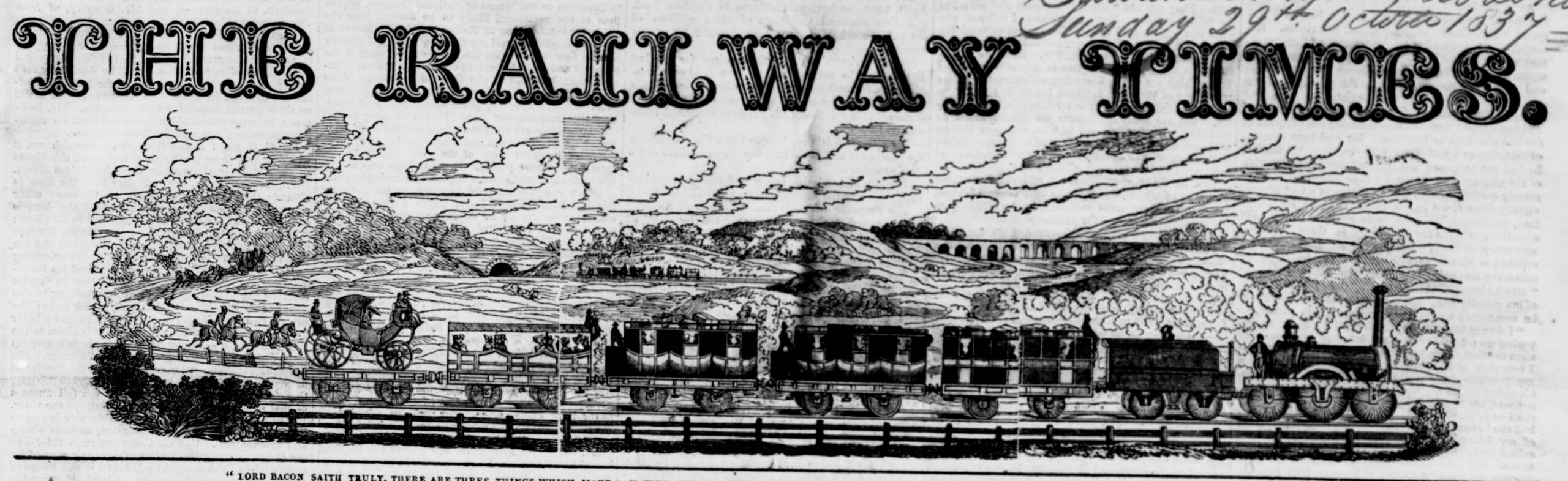

This has nothing whatsoever to do with the railways, but the Railway Times of 1837 certainly found itself with quite a lot to say about the world around them.
It’s some stretch to suggest that Germans speaking German in the United States, at a period of substantial migration, was “evil”, but it clearly concerned those speaking English. It’s also an interesting sign of the times that there was an opinion that it would be English and Spanish that would be the two major global languages.
“The Germans in America.—The German newspapers inform us, that according to the most recent intelligence, “German life and civilization,” develop themselves more and more at Saint Louis in the United States, and apparently will in time predominate in this part of the Union. A German Library is established there, a German Annual published, &c. In two of the German newspapers printed in America, a proposal has recently been made to found a German University in the States, and is said to be likely to meet with support. We hope that the friends of progressive civilization in America will not allow this evil to advance too far before they oppose a check. It has always been considered a cheering point in the future prospects of the world, that, in all probability but two languages, the English and Spanish, would prevail over the vast continent of America, among a population of hundreds of millions, whose influence would be of such weight as to spread those languages pretty generally among the whole human race, every person of education knowing both, and almost every individual knowing one or the other.
The common languages of Europe would then be eclipsed by the superior importance of these two, in the same manner as Welsh or Wallachian now by French or German. All this vast improvement in the condition of mankind will be prevented or obstructed, if another language is suffered to gain ground in America. The Portuguese is there already in Brazil, but that may be considered as hardly more than a dialect of the Spanish; the French is there already in Canada, but on the decline before the advancing influence of the English. Dutch, Russian, &c., are spoken at a few points, but have never attained sufficient importance to excite any apprehension that they will offer resistance to the gradually overpowering march of Spanish and English. But if the practice gain ground for natives of the different nations of Europe to emigrate in bodies, and carry their language and habits with them, we shall have an America as much cut up into small divisions as Europe, and the difference will be a fruitful source of dissensions and wars.
While the future mischief to be apprehended is so gigantic, the present inconvenience is by no means small. Lieber, the editor of the Encyclopædia Americana, himself a German, but who, since his emigration to America, not only speaks but writes in English, complains that the little knots of Germans scattered over the States, are full of ignorance and prejudice; not knowing the language of the country, they are shut out from intercourse with their neighbours.“